Taking Vitamin C Daily? Check These Four Things
Before making vitamin C a long-term habit, add up every source and match the amount to your reason, life stage, and health history.
For most adult women, the vitamin C recommended amount is 75 mg a day, or 85 mg during pregnancy and 120 mg while breastfeeding. The adult upper limit is 2,000 mg a day from all sources, but that’s a ceiling, not a target. Before taking a high dose every day, review the total, purpose, duration, and any kidney or iron-overload concerns. 1
Start with the total, not the bottle
Check the vitamin C amount in each product you use. Add up a multivitamin or prenatal, a separate vitamin C tablet, and any drink mix or other supplement that contains it. Check the serving size too: the amount listed may be for more than one tablet or scoop. Food and fortified foods also count toward your total, even though they can be harder to tally day to day. The upper limit applies to vitamin C from food and supplements combined. 1
For adults age 19 and older, the recommended daily amount is 75 mg for women, 85 mg during pregnancy, and 120 mg while breastfeeding. For ages 14-18, it’s 65 mg, 80 mg during pregnancy, and 115 mg while breastfeeding. People who smoke need 35 mg more per day than people who don’t. These are recommended total intakes, not amounts you need to take as a supplement if your diet already provides enough. 1
For adults, including during pregnancy and breastfeeding, the upper limit is 2,000 mg per day. For ages 14-18, it’s 1,800 mg. An upper limit is a maximum intake unlikely to cause harm for most people, not a goal or a guarantee that an amount below it is right for you. Long-term intake above the limit may raise the chance of adverse effects. 1
Match the amount to the reason
Vitamin C is needed for normal body functions, and a diagnosed deficiency or another medical indication can change what makes sense. People with limited food variety or some absorption problems may be more likely to have inadequate intake. If you’re taking vitamin C for a known deficiency or as part of treatment, follow the plan for that reason rather than treating the general adult upper limit as a substitute for medical guidance. The NIH fact sheet notes that the upper limits don’t apply to people receiving vitamin C as medical treatment, who should be under a physician’s care. 1
A separate clinical example shows why treatment context matters: a randomized prospective trial followed 180 young patients with vitamin C-deficient beta-thalassemia and iron overload who were receiving iron chelation. The trial tested vitamin C at 100 mg daily for one year and reported no adverse events. This specific supervised treatment setting does not establish safety for hereditary hemochromatosis or for unsupervised, long-term high-dose use. 2
If your reason is general “immune support,” keep expectations grounded. Regular vitamin C supplements don’t appear to prevent colds in the general population, though they may modestly shorten colds in adults. Taking vitamin C after cold symptoms start doesn’t appear to reduce their duration or severity. That’s a different tradeoff from treating a deficiency. 1
Write down why you started, how much you take, and whether there was an intended end or review point. If the reason has passed, don’t assume a high daily amount is still needed just because it’s become routine.
Give extra attention to kidney and iron history
High vitamin C intake may increase the amount of oxalate and uric acid in urine, which could contribute to kidney stones. Research on vitamin C and stones has had conflicting results, so this isn’t a reason to assume that everyone who takes a supplement will develop stones. Concern is greater for people with renal disorders, and the strongest evidence cited by the NIH is in people with pre-existing hyperoxaluria. If you’ve had kidney stones, have kidney disease, or have been told you have hyperoxaluria, mention that before continuing a high-dose daily supplement. 1
Vitamin C helps the body absorb nonheme iron, the type found in plant foods. High-dose, long-term use is a particular concern for people with hereditary hemochromatosis because it could worsen iron overload. The NIH fact sheet says this increase in iron absorption does not appear to be a concern for healthy people generally. If you have diagnosed hemochromatosis, review the supplement with the clinician managing it instead of assuming a standard multivitamin and a separate high-dose product are interchangeable. 1
Notice effects and treatment context
High doses can cause diarrhea, nausea, abdominal cramps, or other stomach and bowel upset. The NIH explains that unabsorbed vitamin C can draw water into the gut, which helps account for these symptoms. If you’re getting these effects, check your total across products rather than simply switching brands or forms. 1
If you’re receiving chemotherapy or radiation, ask your oncology team about vitamin C supplements before taking them, especially at high doses. Whether antioxidant supplements affect cancer treatment is uncertain, and some evidence suggests they could protect tumor cells while other evidence suggests possible protection of normal tissue. This is a specific treatment-context question, not a reason to avoid vitamin C in general. 1
A practical review is simple: total the amount, compare it with the recommended intake and upper limit for your age and life stage, write down why you take it and for how long, then flag any kidney-stone, kidney-disease, or iron-overload history. That gives you a clearer basis for deciding whether a daily supplement still fits your needs.
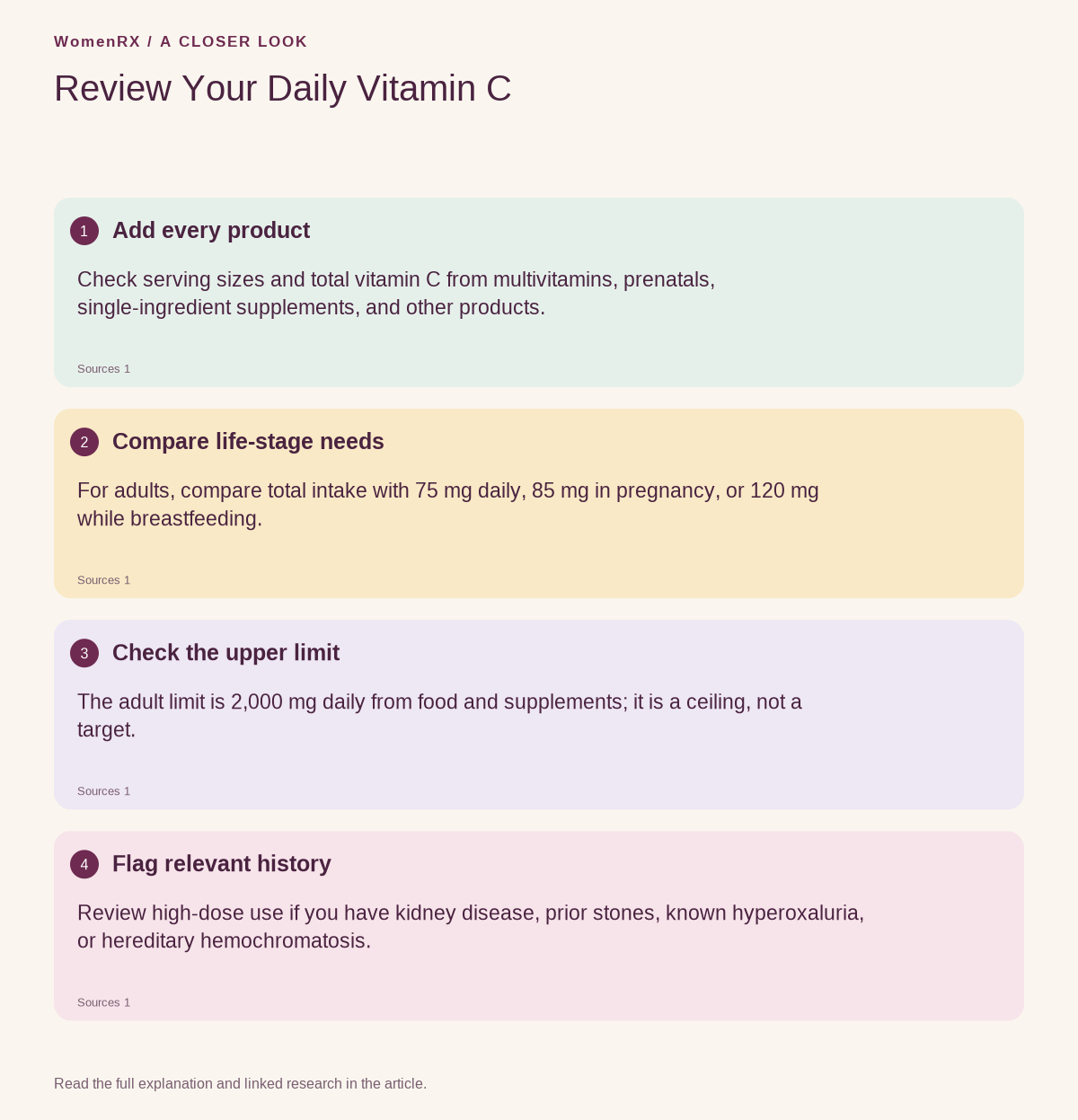
Review Your Daily Vitamin C
Add every product: Check serving sizes and total vitamin C from multivitamins, prenatals, single-ingredient supplements, and other products.1
Compare life-stage needs: For adults, compare total intake with 75 mg daily, 85 mg in pregnancy, or 120 mg while breastfeeding.1
Check the upper limit: The adult limit is 2,000 mg daily from food and supplements; it is a ceiling, not a target.1
Flag relevant history: Review high-dose use if you have kidney disease, prior stones, known hyperoxaluria, or hereditary hemochromatosis.1
Read the figure as text
Use these four checks to see what your daily routine adds up to and which circumstances may change the conversation.- Add every product: Check serving sizes and total vitamin C from multivitamins, prenatals, single-ingredient supplements, and other products.1
- Compare life-stage needs: For adults, compare total intake with 75 mg daily, 85 mg in pregnancy, or 120 mg while breastfeeding.1
- Check the upper limit: The adult limit is 2,000 mg daily from food and supplements; it is a ceiling, not a target.1
- Flag relevant history: Review high-dose use if you have kidney disease, prior stones, known hyperoxaluria, or hereditary hemochromatosis.1
More questions, answered
Does a prenatal vitamin count toward my daily total?
Yes. Include vitamin C from a prenatal, multivitamin, standalone supplement, and other products when adding up your intake. During pregnancy, the recommended total for adults age 19 and older is 85 mg per day; the upper limit is 2,000 mg per day from all sources. 1
Is the upper limit a safe daily target?
No. It’s a maximum intake unlikely to cause adverse effects for most people, not a recommended amount or a guarantee that a particular dose suits your health history. 1
Sources you can check
- Vitamin C - Health Professional Fact SheetAccessed 2026-09-25Return to first citation
- Role of vitamin C as an adjuvant therapy to different iron chelators in young β-thalassemia major patients: efficacy and safety in relation to tissue iron overload.Elalfy MS, Saber MM, Adly AA, Ismail EA, Tarif M, Ibrahim F, Elalfy OM. · European journal of haematology · 2016Return to first citation