Can You Take Vitamin C on an Empty Stomach?
You can get vitamin C with food. If a supplement leaves you queasy, its dose deserves a closer look.
An empty stomach is not a requirement for getting vitamin C: foods supply it too. If your supplement causes nausea, cramps or diarrhea, check the amount across all your products. High doses can cause digestive symptoms. Taking it with a meal is an option to try for comfort, but a large dose may still bother you. 111
The dose is the first thing to check
If your morning vitamin C leaves you queasy, the bottle may hold a more useful clue than the clock. Large amounts can cause stomach pain and diarrhea; NIH also lists nausea and abdominal cramps. Unabsorbed vitamin C draws water into the gut, helping explain those effects. 111
Read the amount per serving on every product you take, including a separate vitamin C tablet, multivitamin, prenatal or drink mix. Multiply by the servings you actually use. For example, a 1,000 mg tablet plus 250 mg in a drink is 1,250 mg from supplements, before food. That is label arithmetic, not a recommended daily amount.
For women 19 or older, the U.S. recommended daily amount is 75 mg, rising to 85 mg during pregnancy and 120 mg while breastfeeding. These are total daily amounts from food and supplements. The adult upper limit is 2,000 mg a day, including during pregnancy and breastfeeding. It is a ceiling, not a target or a promise that your stomach will tolerate that much. 1
What changes when you take it with food?
Vitamin C does not need a separate fasting ritual. You already absorb it from fruit and vegetables. NIH describes the ascorbic acid in supplements as having equivalent bioavailability to naturally occurring ascorbic acid in foods. 1
If you are using an ordinary supplement, trying it alongside a meal is a reasonable personal preference. Keep the dose in view: food does not turn a high intake into a lower one. If vitamin C was prescribed for a specific reason, use those instructions when deciding whether to change it.
You could also meet more of your needs through food. A medium orange supplies about 70 mg, half a cup of raw sweet red pepper 95 mg, and half a cup of sliced fresh strawberries 49 mg. These are reference amounts; choose the foods you enjoy and can use regularly. 1
Does a different form solve the problem?
Ascorbic acid is the usual supplement form. You may also see sodium ascorbate or calcium ascorbate. Those names describe different forms, but they do not tell you how much vitamin C is in the serving. Compare the amount as well as the ingredients. 1
An absorption comparison is also a different question from whether a product feels comfortable in your stomach. A more expensive label is not enough reason to expect better tolerance. Before buying another bottle, work out whether you need the separate supplement and whether several products are adding up to more than you intended.
If you are pregnant or breastfeeding, include your prenatal in that calculation. The daily requirement changes, but adding a high-dose vitamin C product on top is not how the requirement is defined. Start with your total intake and the reason for the supplement. 1
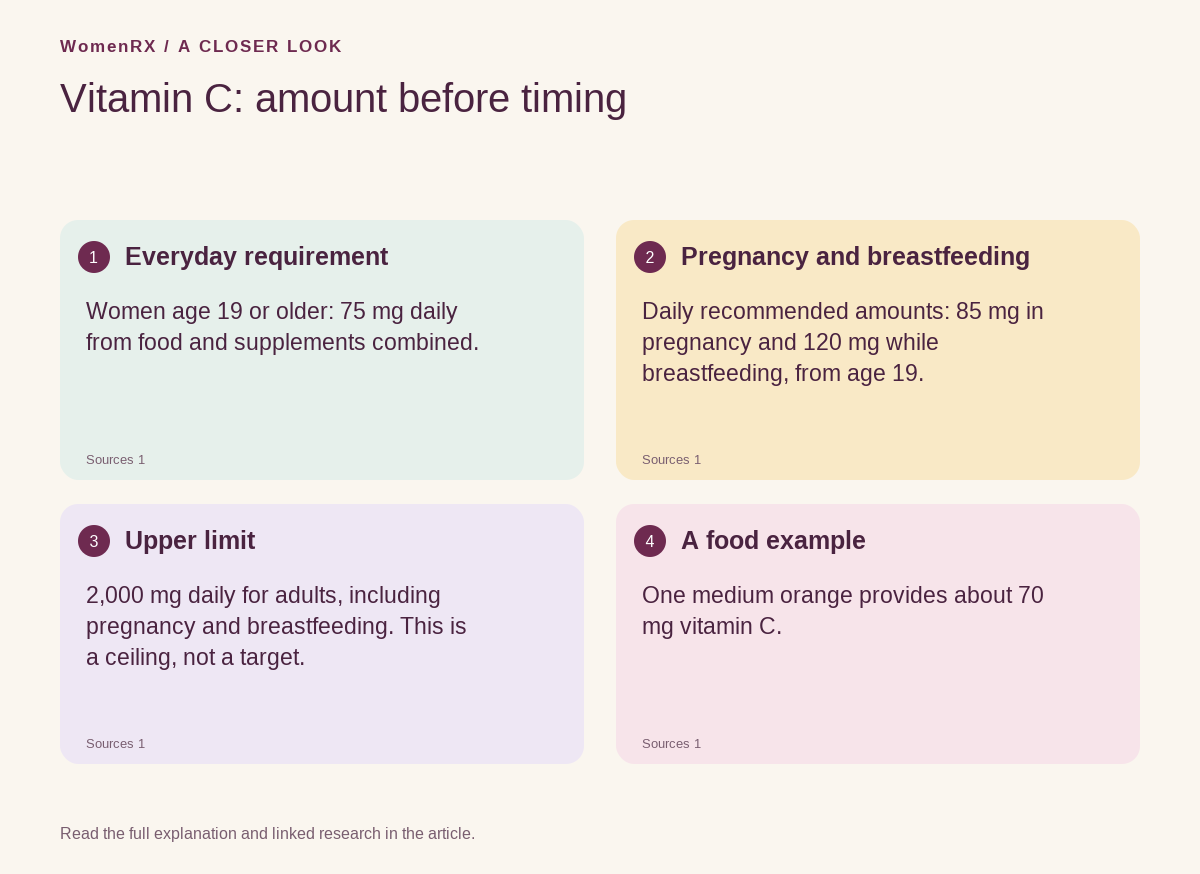
Vitamin C: amount before timing
Everyday requirement: Women age 19 or older: 75 mg daily from food and supplements combined.1
Pregnancy and breastfeeding: Daily recommended amounts: 85 mg in pregnancy and 120 mg while breastfeeding, from age 19.1
Upper limit: 2,000 mg daily for adults, including pregnancy and breastfeeding. This is a ceiling, not a target.1
A food example: One medium orange provides about 70 mg vitamin C.1
Read the figure as text
Use total daily intake when comparing products. Adult figures below apply from age 19.- Everyday requirement: Women age 19 or older: 75 mg daily from food and supplements combined.1
- Pregnancy and breastfeeding: Daily recommended amounts: 85 mg in pregnancy and 120 mg while breastfeeding, from age 19.1
- Upper limit: 2,000 mg daily for adults, including pregnancy and breastfeeding. This is a ceiling, not a target.1
- A food example: One medium orange provides about 70 mg vitamin C.1
Sources you can check
- Vitamin C - Health Professional Fact SheetAccessed 2026-09-25Return to first citation
- Vitamins and minerals - Vitamin C - NHSAccessed 2026-09-26Return to first citation