Vitamin C: Daily Needs, Upper Limits, and Label Tips
For most adult women, the daily target is 75 mg, while the 2,000 mg upper limit is a ceiling for all sources combined, not a supplement goal.
For women age 19 and older, the recommended daily amount is 75 mg of vitamin C; it rises to 85 mg during pregnancy and 120 mg while breastfeeding. Add vitamin C from food, fortified products, and every supplement when comparing your total with the adult upper limit of 2,000 mg per day. That limit is not a target. 1
Start with the target, not the biggest number on the label
For adult women, the recommended dietary allowance (RDA) for vitamin C is 75 mg a day. It’s 85 mg during pregnancy and 120 mg while breastfeeding. These are daily intake goals, not amounts you need to get from a pill. People who smoke need 35 mg more per day than people who don’t. 1
The RDA and the upper limit answer different questions. The RDA is an intake level expected to meet the needs of nearly all healthy people in that group. The adult upper limit, or UL, is 2,000 mg per day: the highest total daily intake unlikely to cause adverse effects for most people. It applies to adults age 19 and older, including during pregnancy and breastfeeding. It is not a recommended dose, and staying below it doesn’t mean a high-dose supplement is useful for you. 1
Count food, fortified products, and supplements together
When you check your intake, add up vitamin C from your whole day, not just from a bottle. The UL includes vitamin C from food and supplements. Check serving sizes and amounts in products you use more than once, such as a multivitamin and a separate vitamin C tablet. 1
Food can contribute a substantial amount. For example, half a cup of raw red pepper has 95 mg, a medium orange has 70 mg, and half a cup of cooked broccoli has 51 mg. Vitamin C is also found in strawberries, kiwifruit, Brussels sprouts, and some fortified cereals. 1
On a U.S. Supplement Facts label, the % Daily Value (%DV) gives another comparison point. The FDA’s adult %DV for vitamin C is 90 mg, so it is not the same as the 75 mg RDA for adult women. A product listing 100% DV provides 90 mg per serving. That can be more than the adult woman’s RDA before counting food, but it is still far below the UL. 1
A practical label check is to note the milligrams per serving, confirm how many tablets or gummies make up a serving, and look for vitamin C in other supplements you take. Then consider how much you regularly get from food. You don’t need to calculate every bite to make a useful comparison: the main point is that the label amount is only one part of your daily total.
When a separate supplement may not be needed
Fruits and vegetables are the best food sources, and a varied diet can provide enough vitamin C to meet the RDA. For example, the NIH fact sheet notes that five varied servings of fruits and vegetables can provide more than 200 mg. Supplemental ascorbic acid has bioavailability equivalent to naturally occurring ascorbic acid in foods. 1
That doesn’t mean a supplement is never appropriate. Intake can be harder to meet with a limited food variety, and some medical conditions can affect absorption or needs. But a high-dose product isn’t automatically a better match for your needs: the body absorbs a smaller proportion of vitamin C at very high intakes, and excess absorbed vitamin C is excreted in urine. 1
During pregnancy or breastfeeding, use the life-stage target when comparing labels. Prenatal products vary in what they contain, so check whether yours already includes vitamin C before adding a separate product. The higher breastfeeding target does not mean you should automatically take a high-dose supplement. 1 2
Cautions that can change your decision
Large doses can cause diarrhea, nausea, abdominal cramps, and other digestive upset. Kidney-stone risk is less clear for healthy people, but high intakes may be a concern if you have a kidney disorder or pre-existing hyperoxaluria. If either applies, get individualized guidance before taking a high-dose supplement. 1
Vitamin C increases absorption of iron from plant foods. That’s useful for many people, but chronic high-dose supplements may worsen iron overload in people with hereditary hemochromatosis. 1
If you’re receiving chemotherapy or radiation, ask your oncology team before starting vitamin C or other antioxidant supplements, especially at high doses. Whether antioxidants interfere with or support cancer treatment remains uncertain, and the possible effects depend on treatment context. 1
There is also a specific, limited medication concern: vitamin C taken with other antioxidants may blunt the rise in HDL cholesterol from combination niacin-simvastatin therapy. It’s not known whether this applies to other cholesterol-lowering regimens. If you take that combination, tell your care team about antioxidant supplements rather than assuming the issue applies to every statin. 1
For many women, the useful comparison is simple: use the RDA as the daily target, count food and supplements together, and treat the UL as a ceiling rather than a reason to take more.
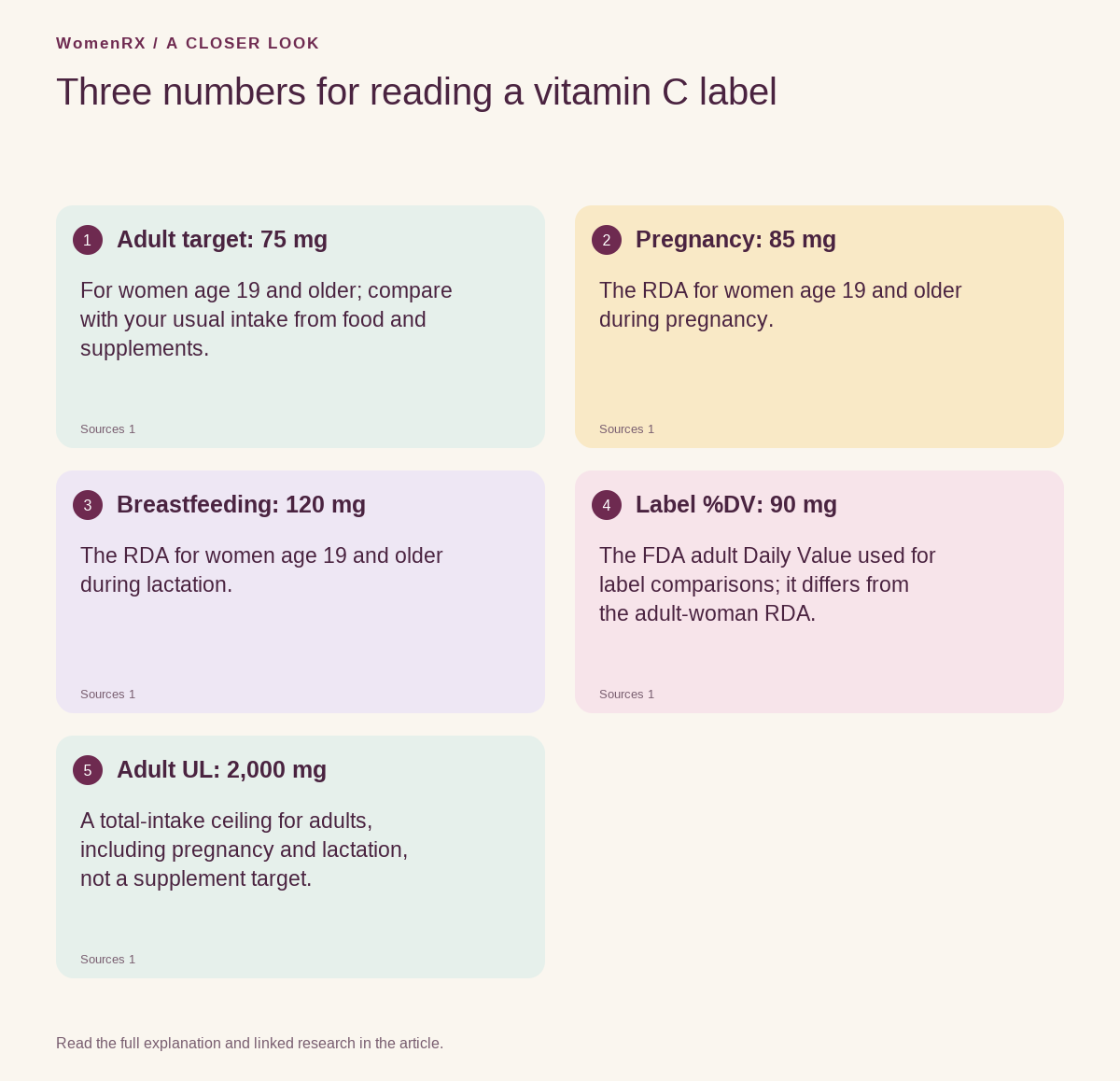
Three numbers for reading a vitamin C label
Adult target: 75 mg: For women age 19 and older; compare with your usual intake from food and supplements.1
Pregnancy: 85 mg: The RDA for women age 19 and older during pregnancy.1
Breastfeeding: 120 mg: The RDA for women age 19 and older during lactation.1
Label %DV: 90 mg: The FDA adult Daily Value used for label comparisons; it differs from the adult-woman RDA.1
Adult UL: 2,000 mg: A total-intake ceiling for adults, including pregnancy and lactation, not a supplement target.1
Read the figure as text
Compare the life-stage intake target with the label reference and the total daily upper limit. The UL includes vitamin C from food and supplements.- Adult target: 75 mg: For women age 19 and older; compare with your usual intake from food and supplements.1
- Pregnancy: 85 mg: The RDA for women age 19 and older during pregnancy.1
- Breastfeeding: 120 mg: The RDA for women age 19 and older during lactation.1
- Label %DV: 90 mg: The FDA adult Daily Value used for label comparisons; it differs from the adult-woman RDA.1
- Adult UL: 2,000 mg: A total-intake ceiling for adults, including pregnancy and lactation, not a supplement target.1
More questions, answered
Why does the label’s 90 mg Daily Value differ from my 75 mg target?
The FDA’s adult Daily Value is 90 mg, while the RDA for women age 19 and older is 75 mg. The %DV is a label-comparison tool, not a personalized target. 1
Does the 2,000 mg upper limit apply during pregnancy or breastfeeding?
For adults age 19 and older, the UL is 2,000 mg per day during pregnancy and lactation as well as at other times. Count food and supplement sources together; the UL is a ceiling, not a recommended intake. 1
Sources you can check
- Vitamin C - Health Professional Fact SheetAccessed 2026-09-25Return to first citation
- Estimation of Total Usual Dietary Intakes of Pregnant Women in the United States.Bailey RL, Pac SG, Fulgoni VL, Reidy KC, Catalano PM. · JAMA network open · 2019Return to first citation