Vaginal Estrogen or Systemic HRT: What Each Can Treat
Vaginal estrogen focuses on vaginal symptoms, while systemic hormone therapy can treat hot flashes and may also ease genitourinary symptoms.
If vaginal dryness, irritation, pain with sex, or related urinary symptoms are your main concern, ask about local vaginal estrogen. It does not treat hot flashes. Systemic hormone therapy can treat hot flashes and genitourinary symptoms, but its benefits and risks depend on your health history and treatment details. If you have both symptom groups, discuss which route, or combination, fits your goals. 1 3 5
Match the treatment to the symptoms
Vaginal symptoms can begin as estrogen levels fall during the menopause transition and may continue after menopause. They can include dryness and irritation; genitourinary syndrome of menopause can also involve pain with sex, urinary urgency, burning with urination, or recurrent urinary tract infections. The mix and intensity of symptoms vary from person to person. 1 2 5
Vaginal estrogen is a local treatment aimed at vaginal symptoms. It does not treat hot flashes or other menopause symptoms such as sleep problems. Systemic hormone therapy works beyond the vagina: it is the most effective treatment for hot flashes and can also help genitourinary symptoms. 1 3
For example, if vaginal dryness is the main issue and hot flashes aren't bothering you, local treatment may match your goal more directly. If you have both vaginal symptoms and hot flashes, ask how systemic treatment's broader symptom coverage fits your personal risks and whether a local treatment has a role too. The options aren't interchangeable, and one isn't automatically right for everyone.
What “local” means, and what it doesn't
Vaginal estrogen comes in different forms, including tablets, creams, and rings. With low-dose vaginal estrogen, little of the medicine reaches the rest of the body, but products and considerations aren't necessarily identical. Ask about the specific formulation being discussed. 1 5
A uterus can change the hormone discussion. With low-dose vaginal estrogen, a progestogen is usually not needed because exposure beyond the vagina is low. With systemic estrogen, someone who still has a uterus generally needs a progestogen to protect the uterine lining. If you've had a hysterectomy, say so; uterine status is part of choosing a systemic regimen. 1 6
Local treatment can take time: vaginal estrogen may take up to three months to work fully. Vaginal moisturizers and lubricants may also help with vaginal symptoms, though they don't address hot flashes. 2
When systemic treatment may be worth discussing
If hot flashes or night sweats are a major concern, vaginal estrogen alone won't treat them. Systemic hormone therapy is the most effective treatment for vasomotor symptoms, and may also help genitourinary symptoms. That wider coverage may matter when you're weighing treatment for more than one symptom group. 1 3
Systemic therapy's benefits and risks depend on factors such as the type of treatment, route, duration, timing, and whether a progestogen is used. The North American Menopause Society's 2022 position statement describes a more favorable benefit-risk balance for many healthy women younger than 60 or within 10 years of menopause onset who have no contraindications. It describes a less favorable balance when treatment starts later, in part because absolute risks of coronary heart disease, stroke, venous thromboembolism, and dementia are higher. These are considerations for an individual discussion, not a decision rule based on age alone. 3
Bring relevant history into the conversation
Mention whether you have a uterus and any history of breast cancer, another hormone-sensitive cancer, or cardiovascular disease. Such history can affect whether systemic therapy is appropriate. The North American Menopause Society's nonhormone therapy statement lists estrogen-dependent cancers and cardiovascular disease among examples of reasons someone may not be a good candidate for hormone therapy. 4
After breast cancer, systemic hormone therapy and low-dose vaginal estrogen are separate decisions. A 2026 consensus review says systemic menopausal hormone therapy is generally not recommended after breast cancer because of concern about recurrence. A separate review reports that low-dose vaginal estrogen has not been associated with higher recurrence or mortality in most survivors, while calling for shared decision-making for people taking aromatase inhibitors. These findings don't make local estrogen risk-free or suitable for everyone; they do mean the route and treatment goal matter in the discussion. 7 8
A useful question to take in is: “Which symptoms is this treatment meant to help, and how do my uterus status and medical history change the choice?” If you have both vaginal symptoms and hot flashes, name both, so the options can be compared against the full picture.
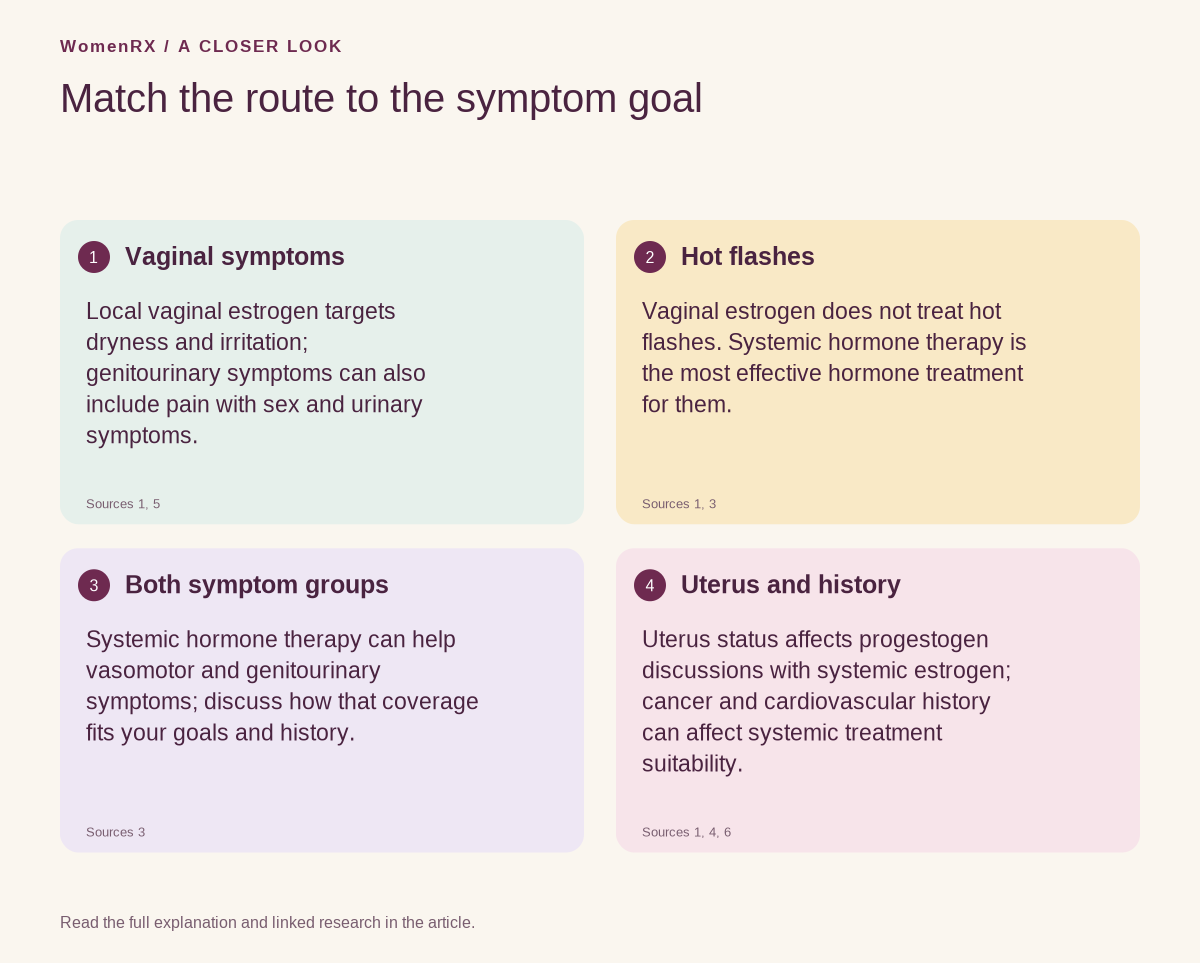
Match the route to the symptom goal
Vaginal symptoms: Local vaginal estrogen targets dryness and irritation; genitourinary symptoms can also include pain with sex and urinary symptoms.15
Hot flashes: Vaginal estrogen does not treat hot flashes. Systemic hormone therapy is the most effective hormone treatment for them.13
Both symptom groups: Systemic hormone therapy can help vasomotor and genitourinary symptoms; discuss how that coverage fits your goals and history.3
Uterus and history: Uterus status affects progestogen discussions with systemic estrogen; cancer and cardiovascular history can affect systemic treatment suitability.146
Read the figure as text
Compare what local vaginal estrogen and systemic hormone therapy can address, then factor in uterine status and personal history.- Vaginal symptoms: Local vaginal estrogen targets dryness and irritation; genitourinary symptoms can also include pain with sex and urinary symptoms.15
- Hot flashes: Vaginal estrogen does not treat hot flashes. Systemic hormone therapy is the most effective hormone treatment for them.13
- Both symptom groups: Systemic hormone therapy can help vasomotor and genitourinary symptoms; discuss how that coverage fits your goals and history.3
- Uterus and history: Uterus status affects progestogen discussions with systemic estrogen; cancer and cardiovascular history can affect systemic treatment suitability.146
More questions, answered
Can vaginal estrogen help hot flashes?
No. Vaginal estrogen is a local treatment for symptoms such as vaginal dryness and irritation; it does not treat hot flashes. Systemic hormone therapy is the most effective hormone treatment for hot flashes. 1 3
Can systemic hormone therapy help vaginal symptoms too?
Yes. Hormone therapy can treat both vasomotor symptoms, such as hot flashes, and genitourinary symptoms of menopause. Whether systemic treatment is a good fit depends on your health history and treatment goals. 3
Sources you can check
- About vaginal oestrogen - NHSAccessed 2026-09-25Return to first citation
- Common questions about vaginal oestrogen - NHSAccessed 2026-09-25Return to first citation
- The 2022 hormone therapy position statement of The North American Menopause Society.“The 2022 Hormone Therapy Position Statement of The North American Menopause Society” Advisory Panel. · Menopause (New York, N.Y.) · 2022Return to first citation
- The 2023 nonhormone therapy position statement of The North American Menopause Society.Menopause (New York, N.Y.) · 2023Return to first citation
- Vaginal Estrogen: Pearls for the Practitioner A Practical Review of Evidence, Guidelines, and Prescribing Strategies for Genitourinary Syndrome of Menopause.Perelmuter S, Srivastava M, Freedman KP, Hanfling S, Rubin RS. · Journal of women's health (2002) · 2026Return to first citation
- Menopausal hormone therapy and comprehensive postmenopausal care in gynecologic cancer survivors: A position paper from the FIGO Committee on Women at Menopausal Age.da Silva-Filho AL, Khadilkar S, Divakar H, Benedetto C, Genazzani AR, Ramos D, Argale E, Herrera E, Hickey M. · International journal of gynaecology and obstetrics: the official organ of the International Federation of Gynaecology and Obstetrics · 2026Return to first citation
- Menopausal hormone therapy for breast cancer patients: what is the current evidence?Glynne S, Simon J, Branson A, Payne S, Newson L, Manyonda I, Cleator S, Douek M, Usiskin S, Tobias JS, Vaidya JS. · Menopause (New York, N.Y.) · 2026Return to first citation
- Menopausal hormone therapy and breast cancer: risk and management.Sanserino K. · Current opinion in obstetrics & gynecology · 2026Return to first citation