Supplements After 40: What Changes, and What Depends on You?
Turning 40 or entering perimenopause doesn’t create a universal need for supplements; the useful question is whether a nutrient or product fits your diet, health needs, or life stage.
After 40, age alone isn’t a reason to start a supplement. Calcium guidance changes after age 50, and vitamin D recommendations vary by age, but those amounts refer to daily intake, not automatically to pills. For hot flashes, a menopause society’s evidence review does not recommend supplements or herbal remedies as treatment. Start with the goal, then consider your overall intake and circumstances. 2 4 6
A changing period or a new birthday can make a supplement seem like a sensible precaution. But “over 40” isn’t one nutritional category, and perimenopause by itself doesn’t establish that you need a multivitamin, calcium, magnesium, or a product marketed for hormones.
A more useful first step is to name what you want the product to do. Filling a dietary gap, supporting bone health, and easing hot flashes are different goals, with different evidence behind them.
Calcium: a changing reference amount isn’t a pill prescription
The recommended total calcium intake is 1,000 mg a day for women ages 19-50 and 1,200 mg a day for women older than 50. Those totals include food and supplements together; they aren’t recommended supplement doses. 2 3
That change makes it reasonable to revisit your overall calcium intake as you get older. It doesn’t mean everyone needs a calcium pill at 50. Food contributes to the total, and the evidence on whether calcium supplements prevent fractures in older adults is mixed. One meta-analysis of trials in adults older than 50 found lower fracture risk with calcium and vitamin D together; another review found no benefit. These findings don’t establish that every woman should supplement. 2
Menopause is relevant to bone health because lower estrogen can reduce calcium absorption and increase calcium loss in urine and resorption from bone. Average bone mineral density loss after menopause is about 1% per year, but that’s a population average, not a prediction of what will happen to you. 2
Vitamin D: intake and blood levels aren’t the same measure
Recommended vitamin D intake for adults is 15-20 mcg (600-800 IU) a day, depending on age. This is a general intake reference for bone health and normal calcium metabolism, not a menopause-specific supplement plan. 4
U.S. survey data indicate that many people consume less vitamin D than the recommended amount, while most have sufficient blood concentrations by the threshold used in the cited reference. Sun exposure helps explain why dietary intake alone doesn’t predict blood levels. So a low-looking food total doesn’t, by itself, tell you what your own vitamin D status is. 4
Magnesium: a nutrient need doesn’t prove a menopause benefit
Magnesium recommendations vary by age and sex. In one U.S. survey analysis, 48% of people of all ages consumed less magnesium from food and drinks than their estimated average requirement. That figure is not specific to women over 40, and it doesn’t show that an individual needs a supplement. 1
If magnesium is on your list because you hope it will help hot flashes, note the distinction: the North American Menopause Society’s 2023 review does not recommend supplements or herbal remedies for menopause-related vasomotor symptoms. The statement addresses supplements as a category; it doesn’t establish a specific magnesium effect. 6
If hot flashes are the goal, look beyond supplements
The 2023 position statement recommends some nonhormonal options for vasomotor symptoms, including cognitive behavioral therapy and clinical hypnosis, as well as certain prescription treatments. It also identifies hormone therapy as the most effective treatment for these symptoms. Which option fits depends on the person; a supplement marketed for menopause shouldn’t be treated as a proven substitute. 5 6
This is the key distinction: needing a nutrient and benefiting from extra of it for a menopause symptom are separate questions. A nutrient reference amount helps frame total intake. It doesn’t show that a supplement will ease hot flashes.
A practical way to assess a product
Before choosing a supplement, connect it to a specific reason:
- For a possible dietary gap: Consider the nutrient from food and supplements together, rather than assuming an age label identifies a need.
- For bone health: Use the calcium reference for your age as a guide to total intake, not as a supplement dose. Fracture-prevention findings for supplements are mixed. 2 3
- For hot flashes: Don’t count on supplements or herbal remedies as evidence-supported treatment; the menopause society review lists other options. 6
- For magnesium: Population-level intake figures don’t determine your individual need or show a menopause symptom benefit. 1 6
Perimenopause can be a useful moment to reconsider what you eat and what you want help with. It isn’t, on its own, a reason to buy a supplement.
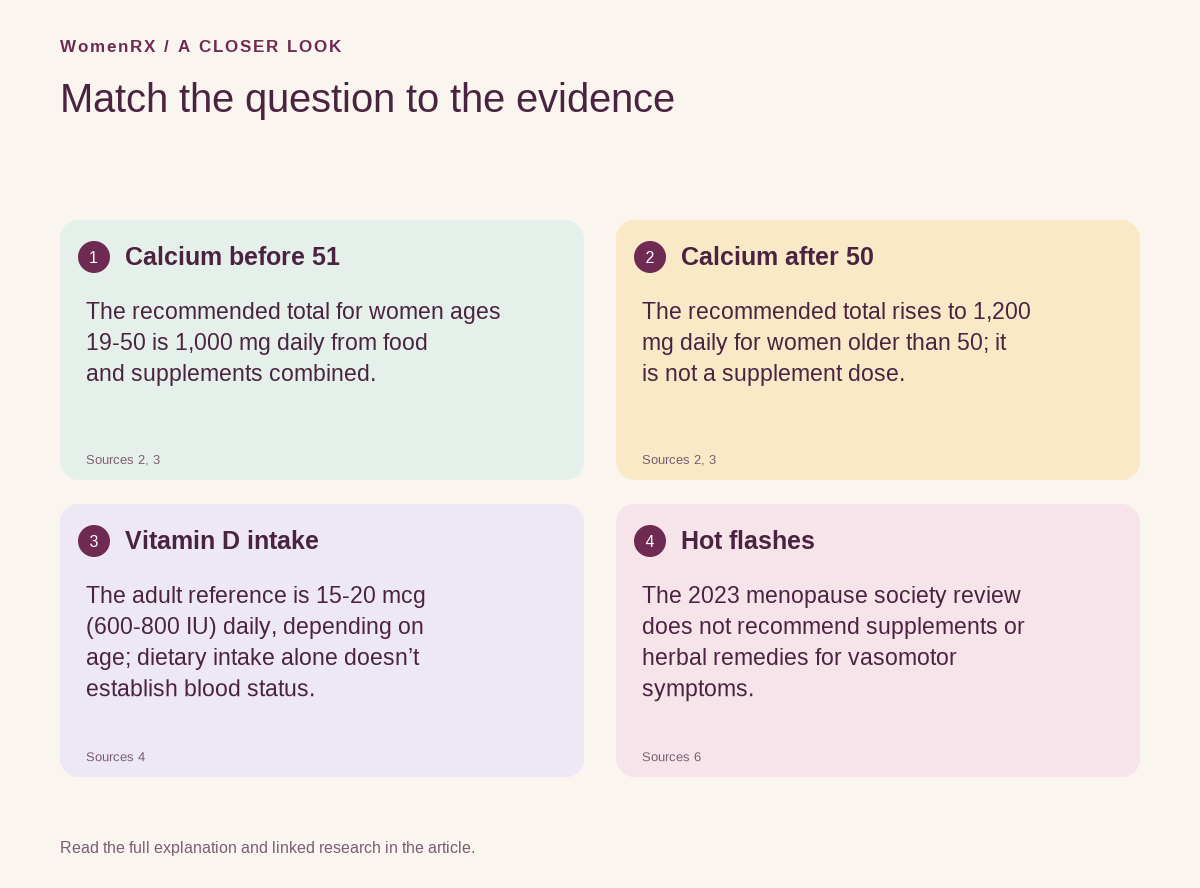
Match the question to the evidence
Calcium before 51: The recommended total for women ages 19-50 is 1,000 mg daily from food and supplements combined.23
Calcium after 50: The recommended total rises to 1,200 mg daily for women older than 50; it is not a supplement dose.23
Vitamin D intake: The adult reference is 15-20 mcg (600-800 IU) daily, depending on age; dietary intake alone doesn’t establish blood status.4
Hot flashes: The 2023 menopause society review does not recommend supplements or herbal remedies for vasomotor symptoms.6
Read the figure as text
These distinctions show why age, nutrient intake, and symptom treatment call for different supplement questions.- Calcium before 51: The recommended total for women ages 19-50 is 1,000 mg daily from food and supplements combined.23
- Calcium after 50: The recommended total rises to 1,200 mg daily for women older than 50; it is not a supplement dose.23
- Vitamin D intake: The adult reference is 15-20 mcg (600-800 IU) daily, depending on age; dietary intake alone doesn’t establish blood status.4
- Hot flashes: The 2023 menopause society review does not recommend supplements or herbal remedies for vasomotor symptoms.6
More questions, answered
Does the vitamin D amount tell me whether I need a supplement?
No. The adult reference amount describes intake, while blood concentrations reflect more than dietary intake alone. U.S. survey data found that many people consumed less than the recommended amount, yet most had sufficient blood concentrations by the cited threshold. 4
Does everyone need a calcium supplement after 50?
No. The recommended 1,200 mg daily for women older than 50 is a total from food and supplements combined. Whether a supplement is useful depends on how that total compares with your intake and circumstances; fracture-prevention findings are mixed. 2 3
Sources you can check
- Magnesium - Health Professional Fact SheetAccessed 2026-09-25Return to first citation
- Calcium - Health Professional Fact SheetAccessed 2026-09-25Return to first citation
- Calcium | MedlinePlusAccessed 2026-09-25Return to first citation
- Vitamin D - Health Professional Fact SheetAccessed 2026-09-25Return to first citation
- The 2022 hormone therapy position statement of The North American Menopause Society.“The 2022 Hormone Therapy Position Statement of The North American Menopause Society” Advisory Panel. · Menopause (New York, N.Y.) · 2022Return to first citation
- The 2023 nonhormone therapy position statement of The North American Menopause Society.Menopause (New York, N.Y.) · 2023Return to first citation