Eating for Stronger Bones at Every Life Stage
Calcium-rich foods, vitamin D, and enough protein support bone health, but your age and fracture risk change what diet can do for you.
Build meals that regularly include calcium-rich foods, look for vitamin D in fortified foods and a few naturally occurring sources, and eat enough protein as part of an overall healthy diet. No single food prevents osteoporosis. If you’ve been told you have low bone density or have other risk factors for bone loss, eating well belongs alongside a bone-health assessment, not in place of one. 1458
Start with foods you’ll actually eat
Calcium is a building material for bone, and vitamin D helps your body absorb it. Your bones are living tissue: old bone is continually broken down and replaced. Over time, if more is broken down than replaced, bone density falls. Eating well supports that process, but a calcium-rich meal cannot tell you how dense your bones are or whether you need treatment. 13
For calcium, you have more choices than a glass of milk. Milk, yogurt, and cheese are common sources in the US. If you don’t eat dairy, options include calcium-fortified foods and drinks, calcium-enriched tofu, canned sardines or salmon with edible soft bones, and vegetables such as kale and bok choy. Lactose-free dairy is another option if lactose, rather than dairy itself, is the issue. Check the label on a fortified food: its calcium content depends on the product. 34
Vitamin D takes a little more attention. Few foods contain it naturally; saltwater fish and egg yolks are examples. Fortified milk, some cereals, and some yogurts can contribute, but being fortified with calcium doesn’t necessarily tell you how much vitamin D a product contains. Read for both nutrients if you’re relying on a particular food or drink. Vitamin D also comes from sunlight and supplements, so a low dietary intake does not, by itself, mean your vitamin D level is low. 78
Give protein a place, without treating more as a cure
Protein is worth considering when you look at your overall eating pattern, especially if meals have become smaller or you routinely skip a main source of it. That might mean including foods such as beans, eggs, fish, or yogurt across the day. But evidence does not establish that pushing protein intake above recommended levels will prevent fractures in women. An umbrella review of trials and cohort studies found mostly low- or very-low-certainty evidence and could not determine whether higher amounts or animal versus plant protein improve bone health overall. 5
There is a reason you may see more upbeat claims: a review focused on adults 65 and older found an association between higher protein intake and fewer hip fractures in pooled cohort studies. An association is not proof that adding protein will prevent a fracture for an individual woman. The practical aim is an adequate, workable diet, not a high-protein promise. 56
Let your life stage change the question
During pregnancy, calcium and vitamin D still matter, but bone health isn’t the only reason a prenatal plan may address them. NIH guidance notes that prenatal supplements typically contain relatively little calcium, and that calcium supplements may be useful when food intake is inadequate, particularly for someone avoiding dairy. The recommended vitamin D intake during pregnancy is 15 micrograms daily. That does not mean every pregnant woman is deficient or needs an additional supplement. 2
If you’re breastfeeding, don’t assume that pregnancy advice, a menopause plan, or someone else’s supplement routine answers your question. Review what you eat and any supplements you already take when discussing your own needs. The pregnancy-specific recommendation above should not be treated as a breastfeeding recommendation. 2
Around and after menopause, paying attention to food remains worthwhile, but more calcium does not guarantee higher bone density. In one cross-sectional study of adults 60 and older, higher dietary calcium was associated with greater lumbar-spine bone density among women. An analysis of women older than 65 in an Australian trial found no association between dietary calcium intake and bone density at the sites measured. These findings make a useful distinction: getting enough calcium matters, while an individual’s bone density cannot be inferred from her diet alone. 3
At older ages, consider food and fracture risk together. Bone density tends to decline with age, and a family history of osteoporosis, prolonged inactivity, certain medicines, or a history of low bone mass can add reason to discuss assessment. A bone-density scan can identify low density or osteoporosis and help inform decisions about fracture risk and treatment. A healthy diet, regular activity, and, in some cases, medication all have roles. 1
When food is the starting point, not the whole plan
A useful next move is to look at an ordinary day of eating rather than searching for a single “best” bone food. Where does calcium show up? Are your usual vitamin D sources fortified, and what do their labels say? Is protein part of meals you can keep eating? If the answers reveal a gap, food choices may help close it. If you’ve been told you have low bone density or osteoporosis, or you have a relevant fracture-risk factor, bring that bigger picture into a bone-health conversation. Food can support bones; it cannot replace measuring bone density or deciding whether treatment is needed. 1458
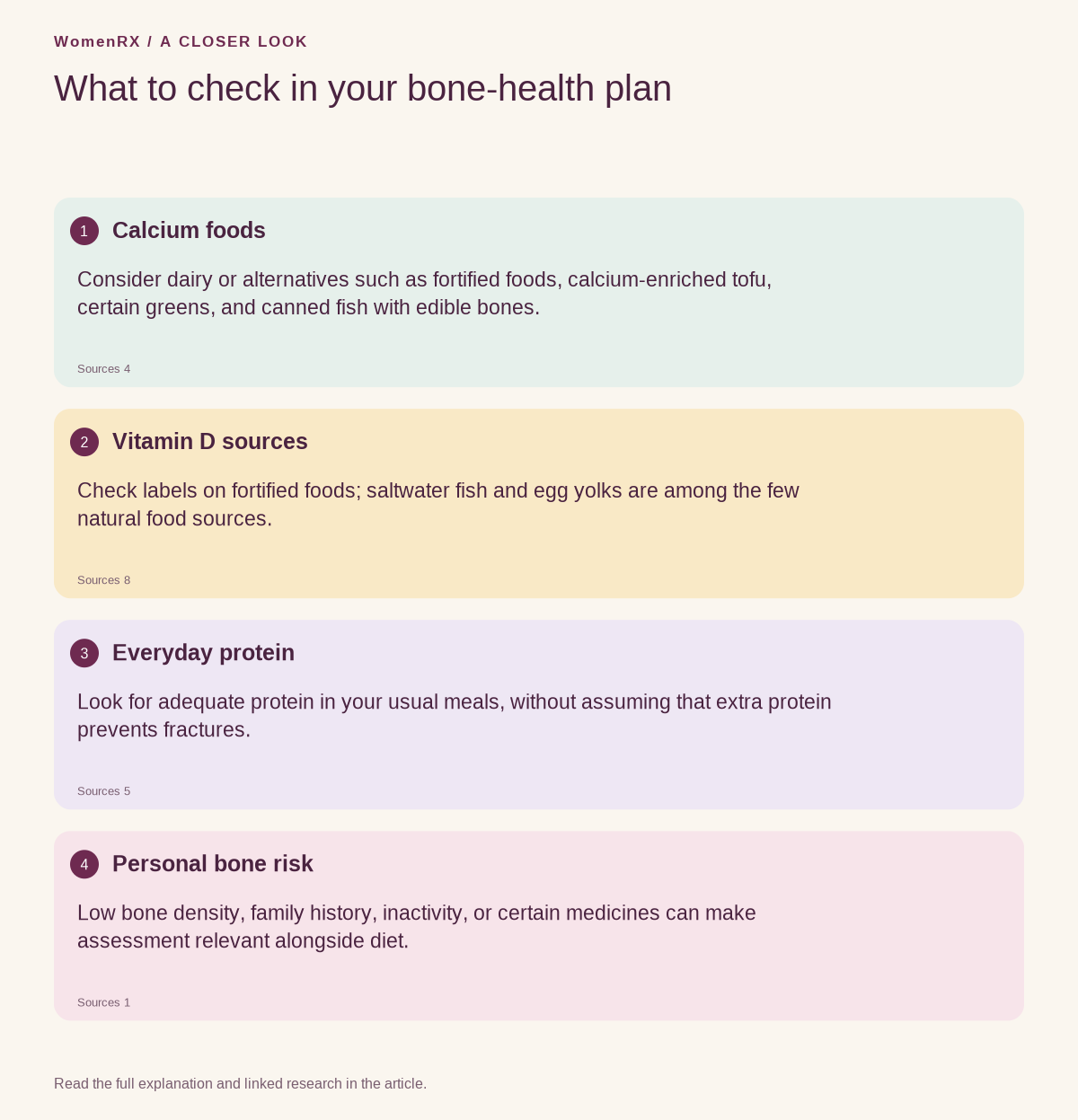
What to check in your bone-health plan
Calcium foods: Consider dairy or alternatives such as fortified foods, calcium-enriched tofu, certain greens, and canned fish with edible bones.4
Vitamin D sources: Check labels on fortified foods; saltwater fish and egg yolks are among the few natural food sources.8
Everyday protein: Look for adequate protein in your usual meals, without assuming that extra protein prevents fractures.5
Personal bone risk: Low bone density, family history, inactivity, or certain medicines can make assessment relevant alongside diet.1
Read the figure as text
Four different questions keep food choices and fracture-risk assessment from getting mixed up.- Calcium foods: Consider dairy or alternatives such as fortified foods, calcium-enriched tofu, certain greens, and canned fish with edible bones.4
- Vitamin D sources: Check labels on fortified foods; saltwater fish and egg yolks are among the few natural food sources.8
- Everyday protein: Look for adequate protein in your usual meals, without assuming that extra protein prevents fractures.5
- Personal bone risk: Low bone density, family history, inactivity, or certain medicines can make assessment relevant alongside diet.1
More questions, answered
Does a low vitamin D intake mean I’m deficient?
Not necessarily. Many people in the US consume less than the recommended amount from food, yet most have sufficient blood levels by the thresholds described by NIH. Dietary intake and vitamin D status are related, but they are not the same measurement. 7
Should I add a calcium and vitamin D supplement for my bones?
First consider what you already get from food and any supplements you take. Calcium and vitamin D supplements can help some people reach recommended intakes, but research in older adults has not consistently shown that taking them prevents fractures. Your existing intake and bone-health risk matter more than a blanket rule. 27
Sources you can check
- Bone Density | Bone Mineral Density | BMD | MedlinePlusAccessed 2026-09-25Return to first citation
- Dietary Supplements and Life Stages: Pregnancy - Health Professional Fact SheetAccessed 2026-09-25Return to first citation
- Calcium - Health Professional Fact SheetAccessed 2026-09-25Return to first citation
- Calcium | MedlinePlusAccessed 2026-09-25Return to first citation
- Protein intake and bone health: an umbrella review of systematic reviews for the evidence-based guideline of the German Nutrition Society.Zittermann A, Schmidt A, Haardt J, Kalotai N, Lehmann A, Egert S, Ellinger S, Kroke A, Lorkowski S, Louis S, Schulze MB, Schwingshackl L, Siener R, Stangl GI, Volkert D, Watzl B, B... · Osteoporosis international : a journal established as result of cooperation between the European Foundation for Osteoporosis and the National Osteoporosis Foundation of the USA · 2023Return to first citation
- High Versus low Dietary Protein Intake and Bone Health in Older Adults: a Systematic Review and Meta-Analysis.Groenendijk I, den Boeft L, van Loon LJC, de Groot LCPGM. · Computational and structural biotechnology journal · 2019Return to first citation
- Vitamin D - Health Professional Fact SheetAccessed 2026-09-25Return to first citation
- Vitamin D: MedlinePlusAccessed 2026-09-25Return to first citation