Menopause Is a Life Stage, Not a Treatment: What Can Help Symptoms?
Menopause itself doesn’t relieve symptoms on a schedule; care is chosen for the symptoms that are bothering you.
Menopause is a life transition, not a treatment that eventually starts working. Symptoms can range from mild to severe and last for shorter or longer periods, so there’s no single date when they must stop. Whether you’re in perimenopause or postmenopause, the practical question is which symptom you want help with and what options target it. 1

Menopause doesn’t switch symptoms off
If you’re waiting for menopause to start helping, the key distinction is that menopause is a life transition, not a therapy. Symptoms associated with it can range from minor to severe and last for short or long periods. That means there isn’t one point on the calendar when every symptom is expected to stop. 1
Perimenopause and postmenopause are useful names for different parts of the transition and life stage, but the labels alone don’t tell you when a particular symptom will ease. Guidance recommends tailoring care and adapting it if symptoms change over time. 1
A more useful starting point is to name what’s bothering you: hot flashes and night sweats, for example, or bothersome vaginal symptoms associated with menopause. Different symptoms can call for different care discussions.
Match the discussion to the symptom
Hot flashes and night sweats
Hot flashes and night sweats are called vasomotor symptoms. Menopausal hormone therapy is the most effective treatment for them, but it isn’t the only option. For people who don’t want hormone therapy or aren’t good candidates for it, a menopause society position statement lists evidence-supported nonhormone options, including cognitive behavioral therapy, clinical hypnosis, and certain prescription medicines. The evidence levels differ by option. 23
These choices aren’t interchangeable, and a list of options can’t determine what’s right for you. The potential benefits and risks of hormone therapy vary with factors such as the type, route, timing, and duration of treatment, and whether a progestogen is used. For women younger than 60 or within 10 years of menopause onset who have no contraindications, the 2022 position statement describes the benefit-risk balance as favorable for bothersome vasomotor symptoms. That’s guidance for a group, not a prediction of an individual outcome. 2
Vaginal symptoms associated with menopause
Bothersome genitourinary symptoms associated with menopause call for a different discussion from hot flashes. For these symptoms when over-the-counter therapies haven’t helped, the position statement describes low-dose vaginal estrogen, vaginal dehydroepiandrosterone, and oral ospemifene as options for people without an indication for systemic hormone therapy. These are options for the specified menopause-related symptoms, not for urinary discomfort in general. 2
The distinction is useful: treatments aimed at genitourinary symptoms are not the same as systemic hormone therapy discussed for symptoms such as hot flashes. If vaginal symptoms are what’s affecting you most, make that the focus of the conversation rather than assuming every menopause treatment addresses every symptom.
Symptoms and care can change over time
A final menstrual period doesn’t mean every symptom will stop immediately. Guidance recognizes that menopause-associated symptoms can last for shorter or longer periods, and the hormone therapy position statement identifies persistent vasomotor symptoms as one possible documented reason for longer treatment, with shared decision-making and periodic reassessment. 12
That doesn’t mean you need treatment or that a treatment must continue indefinitely. It means the question can be revisited: Is the symptom still affecting you? Is the approach aimed at that symptom? Have your preferences or circumstances changed? Those questions are more useful than waiting for menopause itself to start working.
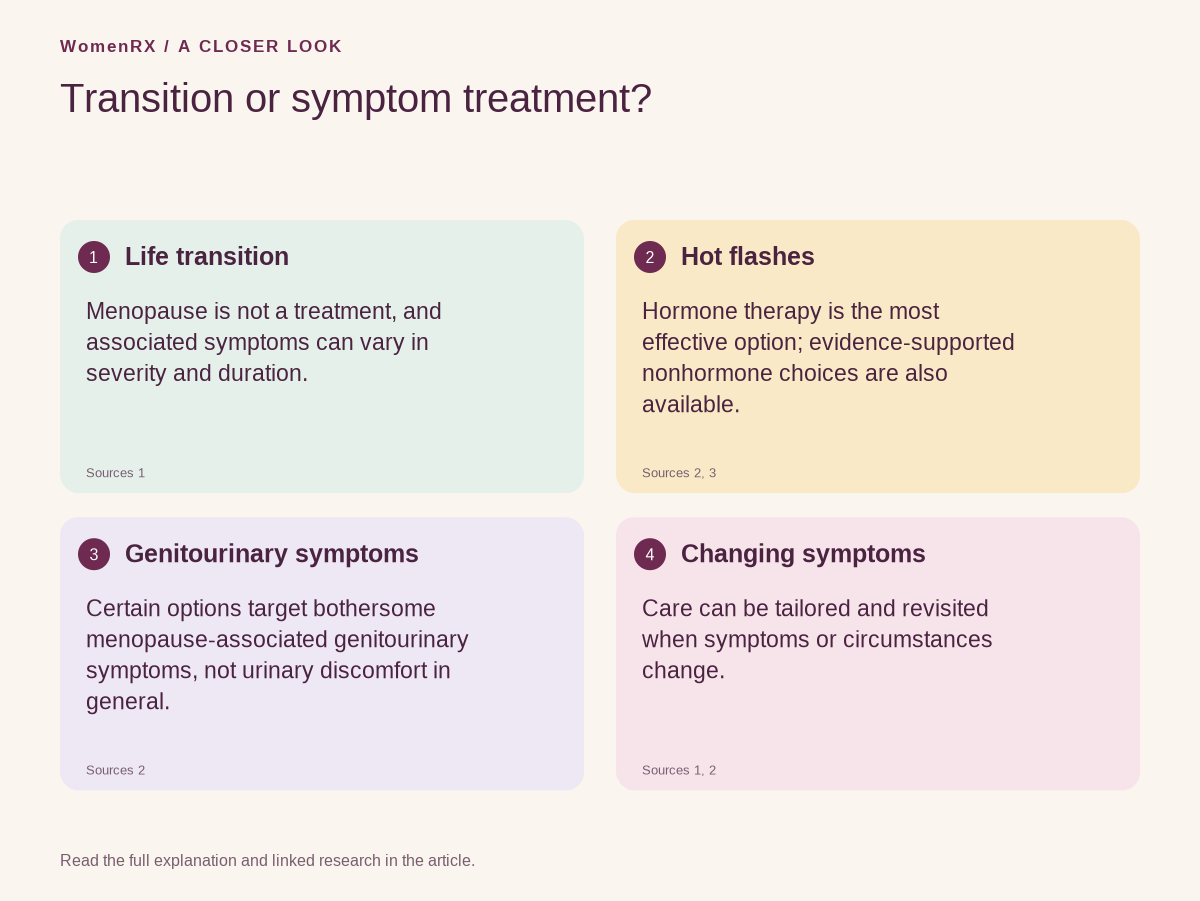
Transition or symptom treatment?
Life transition: Menopause is not a treatment, and associated symptoms can vary in severity and duration.1
Hot flashes: Hormone therapy is the most effective option; evidence-supported nonhormone choices are also available.23
Genitourinary symptoms: Certain options target bothersome menopause-associated genitourinary symptoms, not urinary discomfort in general.2
Changing symptoms: Care can be tailored and revisited when symptoms or circumstances change.12
Read the figure as text
Menopause is a life transition; treatment options are considered for particular symptoms rather than to make the transition work faster.- Life transition: Menopause is not a treatment, and associated symptoms can vary in severity and duration.1
- Hot flashes: Hormone therapy is the most effective option; evidence-supported nonhormone choices are also available.23
- Genitourinary symptoms: Certain options target bothersome menopause-associated genitourinary symptoms, not urinary discomfort in general.2
- Changing symptoms: Care can be tailored and revisited when symptoms or circumstances change.12
More questions, answered
Can hot flashes continue after my final menstrual period?
Yes. Menopause-associated symptoms may last for short or long periods, though that guidance can’t predict how long yours will last. There isn’t a single date by which every person’s hot flashes must stop. 1
Is there one treatment for every menopause symptom?
No. The options described for vasomotor symptoms differ from those discussed for bothersome genitourinary symptoms associated with menopause. The symptom you want to address helps shape the treatment conversation. 23
Sources you can check
- Recommendations | Menopause: identification and management | Guidance | NICEAccessed 2026-09-25Return to first citation
- The 2022 hormone therapy position statement of The North American Menopause Society.“The 2022 Hormone Therapy Position Statement of The North American Menopause Society” Advisory Panel. · Menopause (New York, N.Y.) · 2022Return to first citation
- The 2023 nonhormone therapy position statement of The North American Menopause Society.Menopause (New York, N.Y.) · 2023Return to first citation