Iron After 40: Let Your Bleeding and Life Stage Guide You
Age alone doesn’t establish a need for iron supplements, while menstrual loss, pregnancy, symptoms, and medical history can shape whether testing is useful.
Being over 40 isn’t, on its own, a reason to take iron. The NIH fact sheet describes iron risks and tests but doesn’t set a general testing schedule for asymptomatic, nonpregnant women. If you still have periods, heavy bleeding can raise the chance of iron loss. Pregnancy raises iron needs. After menopause, confirmed deficiency calls for looking for a cause, not assuming it’s age-related. 13
The useful question isn’t your age alone
Iron needs and iron loss change across life, but 40 isn’t a dividing line for supplements. The NIH fact sheet describes ways to assess iron status and groups at higher risk, but it doesn’t set a general testing schedule for asymptomatic, nonpregnant women. Iron is lost through bleeding, and menstruating women lose more iron on average than people who don’t menstruate. At the same time, iron deficiency can happen before hemoglobin falls enough to show anemia on a blood count. 1
That’s why symptoms and circumstances matter. Weakness, fatigue, and trouble concentrating can occur with iron-deficiency anemia, but they don’t establish that iron is the cause. 1 A blood count checks hemoglobin; ferritin gives information about iron stores and can fall earlier. Ferritin can also be raised by inflammation, so results may need to be interpreted alongside other information. 1
If you still have periods
Heavy menstrual bleeding makes iron deficiency more likely, including during the years when periods become less predictable. Heavy bleeding can occur as menopause approaches, and blood loss can add up over repeated cycles. 13
For example, bleeding that is much heavier or more disruptive than your usual pattern, or that comes with persistent tiredness or shortness of breath, is a reason to raise both the bleeding and iron questions with your clinician. Heavy bleeding can have causes beyond menopause, including conditions affecting the uterus or ovaries. Treating low iron without addressing ongoing blood loss may leave the reason for the deficiency unresolved. 13
If pregnancy is possible
Pregnancy increases iron needs as the body makes more red blood cells and supports the fetus and placenta. The recommended dietary allowance is 27 milligrams a day during pregnancy, compared with 18 milligrams a day for nonpregnant, nonlactating women ages 19-50. These are intake recommendations, not a dose for treating a deficiency. 1
Guidance on routine iron supplements for pregnant people who have no symptoms differs: the NIH fact sheet reports that ACOG recommends low-dose supplementation, while the USPSTF says evidence is insufficient to assess routine screening and supplementation in asymptomatic pregnant women. If you’re pregnant or might be, discuss your iron plan as part of pregnancy care rather than starting a high-dose supplement on your own. 1
After periods stop, look for another explanation
For women over 45, menopause is usually diagnosed after more than a year without a period. 2 If you’re postmenopausal and tests show iron deficiency, routine menstrual loss no longer explains it. Other possible contributors include blood loss, inadequate intake, or poor absorption; gastrointestinal conditions and some types of gastrointestinal surgery can interfere with iron absorption. Vaginal bleeding after menopause is not routine menstrual loss and should be evaluated as a possible source of blood loss. The useful next step is to ask what could be causing the deficiency, not to dismiss it as a normal effect of getting older. 12
Any vaginal bleeding after menopause should be checked, even if it happens once. It may have a noncancerous cause, but it can also signal a condition that needs attention. 2
What the age-based numbers do, and don’t, mean
The recommended dietary allowance for nonpregnant, nonlactating women is 18 milligrams a day from ages 19-50. For women in that age range who are lactating, it is 9 milligrams a day. From age 51 onward, the recommended allowance is 8 milligrams a day. Pregnancy has a separate recommendation. Those population-level intake values don’t show whether your iron stores are low, and the change at 51 isn’t a rule to start or stop supplements. 1
Iron supplements can cause stomach upset, nausea, or constipation, especially at higher amounts. Iron can also be harmful in excess for some people, including those with hereditary hemochromatosis, a condition that can lead to excess iron absorption. A result showing deficiency, the reason for it, and a suitable replacement plan are more useful guides than age alone. 1
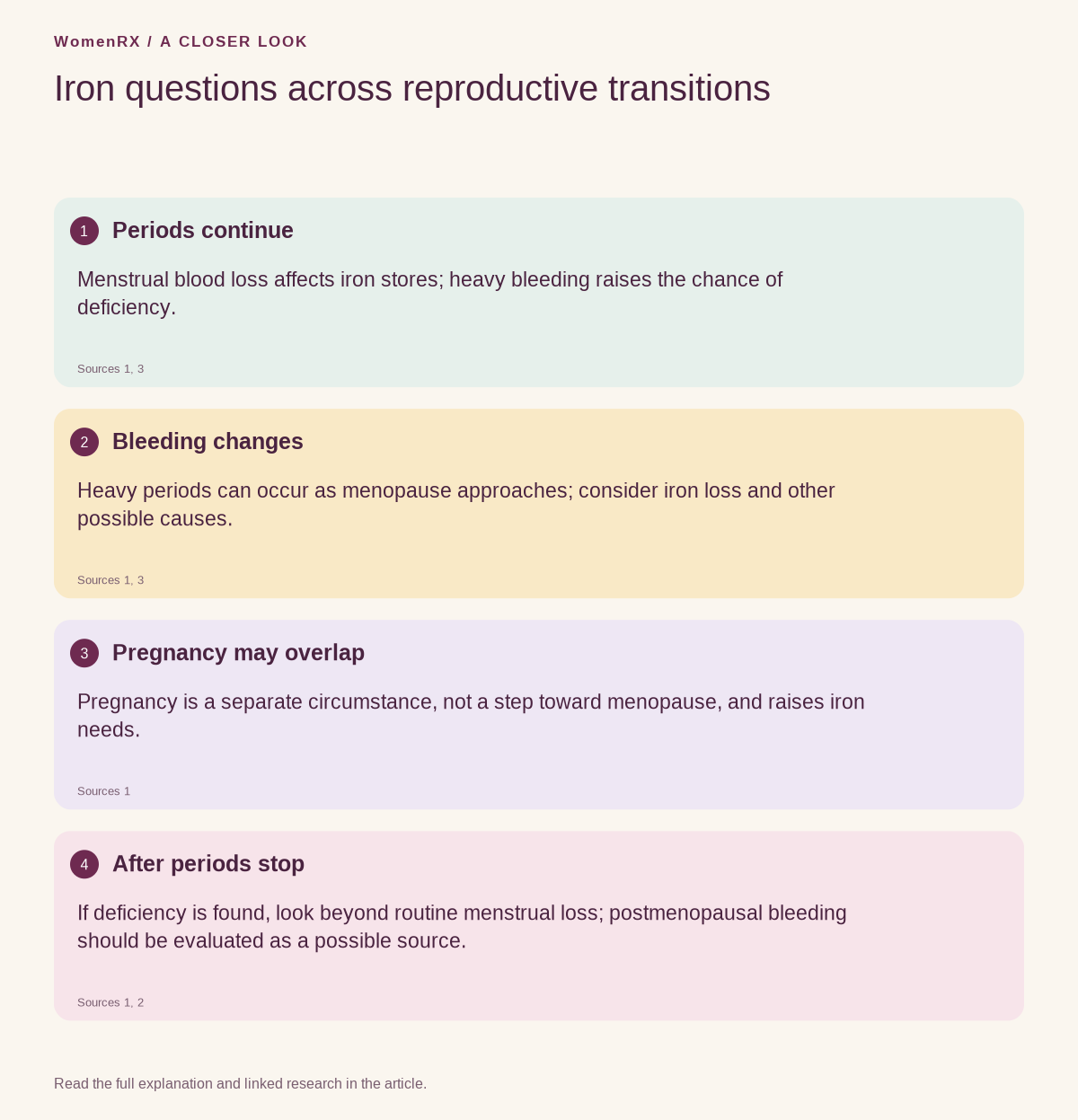
Iron questions across reproductive transitions
Periods continue: Menstrual blood loss affects iron stores; heavy bleeding raises the chance of deficiency.13
Bleeding changes: Heavy periods can occur as menopause approaches; consider iron loss and other possible causes.13
Pregnancy may overlap: Pregnancy is a separate circumstance, not a step toward menopause, and raises iron needs.1
After periods stop: If deficiency is found, look beyond routine menstrual loss; postmenopausal bleeding should be evaluated as a possible source.12
Read the figure as text
Periods and menopause form one transition; pregnancy is a separate circumstance that can overlap with reproductive years.- Periods continue: Menstrual blood loss affects iron stores; heavy bleeding raises the chance of deficiency.13
- Bleeding changes: Heavy periods can occur as menopause approaches; consider iron loss and other possible causes.13
- Pregnancy may overlap: Pregnancy is a separate circumstance, not a step toward menopause, and raises iron needs.1
- After periods stop: If deficiency is found, look beyond routine menstrual loss; postmenopausal bleeding should be evaluated as a possible source.12
More questions, answered
Can iron be low if my hemoglobin is normal?
Yes. Iron stores can become depleted before hemoglobin falls. Ferritin is used to assess iron stores, though inflammation can raise ferritin and affect how a result is interpreted. 1
Does turning 51 mean I should stop taking iron?
No. The recommended dietary allowance changes at 51, but that number isn’t a personal test result or a rule about supplements. Whether you need iron depends on your circumstances and, when relevant, test results. 1
Sources you can check
- Iron - Health Professional Fact SheetAccessed 2026-09-25Return to first citation
- Postmenopausal bleeding - NHSAccessed 2026-09-25Return to first citation
- Heavy periods - NHSAccessed 2026-09-25Return to first citation