Copper Deficiency: Symptoms, Risk Factors, and Testing
Copper deficiency is uncommon, and symptoms alone can’t confirm it, but certain nerve or blood changes alongside specific risk factors are worth assessing.
Possible signs include worsening balance, numbness or tingling, leg weakness, anemia, or a low white blood cell count. These symptoms have other causes, including vitamin B12 deficiency. A clinician can consider your health history and blood count alongside copper and ceruloplasmin tests. Stomach or intestinal surgery, malabsorption, and substantial zinc intake make the question more relevant. 1 3
Copper deficiency is uncommon, so a symptom by itself usually isn’t a reason to assume your copper is low. The more useful clue is a combination: changes in walking or sensation, certain blood-count problems, and a history that could interfere with copper absorption or balance. 1 3
The symptoms doctors may look for
The most concerning pattern described in reports is a gradual problem with the spinal cord or nerves. It can include unsteady walking, reduced sensation or tingling, weakness, and difficulty sensing the position or vibration of the feet. Some people develop increased muscle stiffness or reflexes. Copper-related nerve problems can resemble those caused by vitamin B12 deficiency, so symptoms don’t reliably distinguish between them. 1 3
Copper deficiency can also be associated with anemia and a low white blood cell count. These blood changes can occur with other conditions too; they are clues for evaluation, not proof of a copper problem. A small case series described both neurological symptoms and blood-count changes, but it cannot establish how often these occur in the wider population. 3
When your history raises the question
Copper is absorbed through the intestine, so a history of upper gastrointestinal surgery, chronic gastrointestinal problems, or malabsorption can make deficiency more plausible. Excessive zinc intake is another recognized risk: zinc can interfere with copper absorption. Mention zinc-containing supplements or other zinc products you use, especially if you take them regularly. 1 3
People being treated for Wilson disease need a different kind of monitoring. Wilson disease causes copper accumulation, and treatments that reduce copper can sometimes lead to deficiency if the balance shifts too far. In a systematic review of 20 reported cases, deficiency occurred most often in people with Wilson disease taking zinc salts as treatment. That situation calls for monitoring by the team managing Wilson disease, not self-adjusting treatment. 2
How assessment works
A clinician can put the symptoms and risk factors together with blood tests. Assessment may include a complete blood count and measurements of serum copper and ceruloplasmin, a protein that carries copper in the blood. Low copper-related results can support the diagnosis in the right clinical context, but they need to be interpreted alongside the person’s history and findings. 1 2
If you’re being treated for Wilson disease, assessment may also involve urine copper testing. The interpretation differs in that setting because the condition and its treatments are intended to change copper levels. Don’t stop or change Wilson disease treatment based on symptoms or one result without the treating team’s guidance. 2
Because B12 deficiency can produce a similar nerve pattern, clinicians may consider it and other explanations rather than treating a low-copper result, or a symptom, as the whole answer. One case report describes a person whose symptoms did not improve with B12 treatment and whose evaluation found low copper; a single case illustrates the overlap, not a diagnostic rule. 1
What this means for women
The clinical reports include women, but they don’t compare symptoms or risk by sex, and they don’t establish a separate copper-deficiency pattern during pregnancy or another life stage. The practical question remains whether symptoms, blood findings, and personal risk factors together make testing relevant. 3
If you notice progressive trouble with balance or walking, new weakness, or persistent numbness, particularly after gastrointestinal surgery or with a malabsorption condition, bring that combination to a clinician rather than trying copper supplements on your own. These symptoms can have several causes, and copper overload is also a real concern in Wilson disease. 1 4
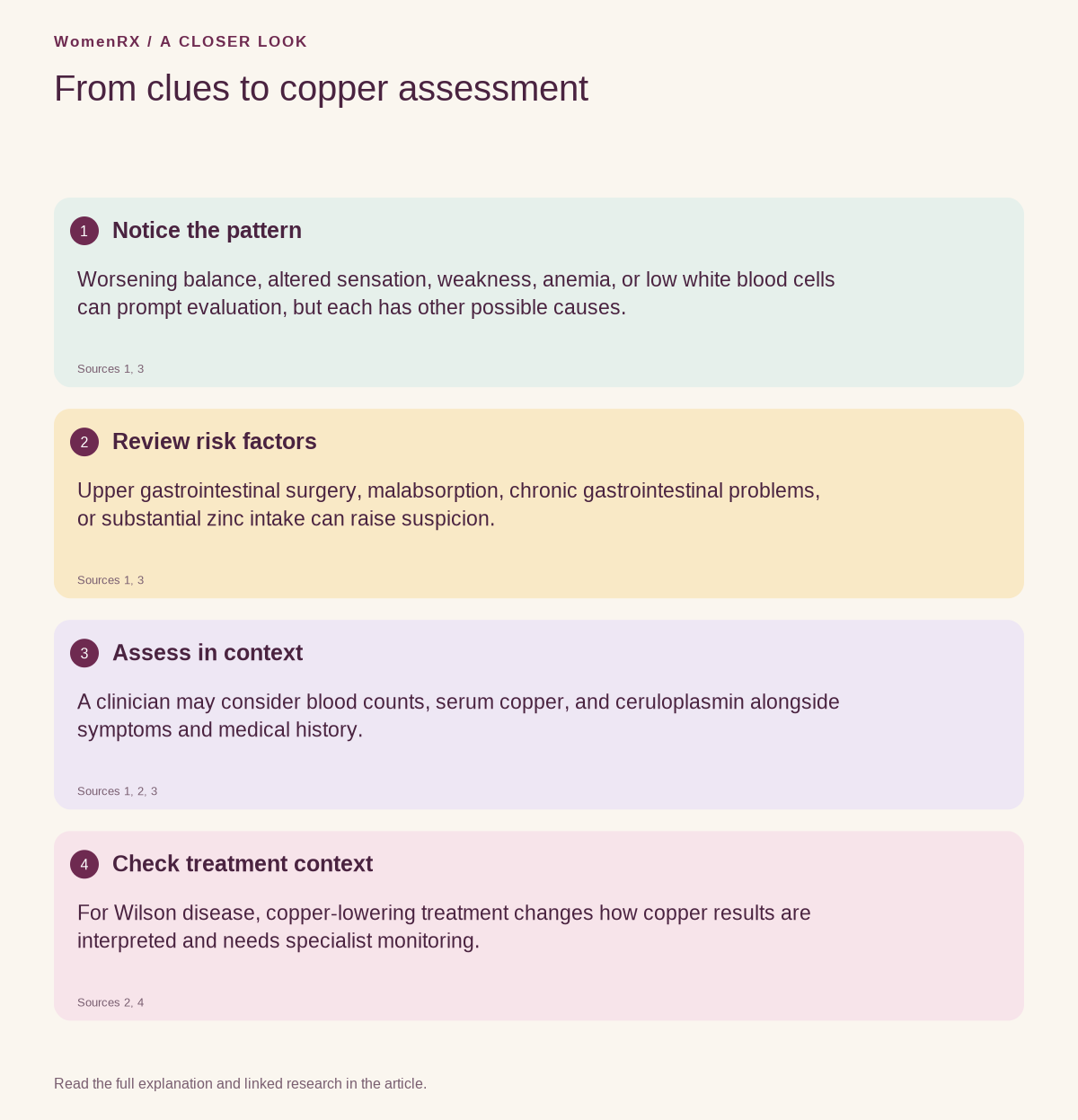
From clues to copper assessment
Notice the pattern: Worsening balance, altered sensation, weakness, anemia, or low white blood cells can prompt evaluation, but each has other possible causes.13
Review risk factors: Upper gastrointestinal surgery, malabsorption, chronic gastrointestinal problems, or substantial zinc intake can raise suspicion.13
Assess in context: A clinician may consider blood counts, serum copper, and ceruloplasmin alongside symptoms and medical history.123
Check treatment context: For Wilson disease, copper-lowering treatment changes how copper results are interpreted and needs specialist monitoring.24
Read the figure as text
Symptoms alone cannot diagnose copper deficiency. These steps show how symptoms, risk factors, and test results fit together.- Notice the pattern: Worsening balance, altered sensation, weakness, anemia, or low white blood cells can prompt evaluation, but each has other possible causes.13
- Review risk factors: Upper gastrointestinal surgery, malabsorption, chronic gastrointestinal problems, or substantial zinc intake can raise suspicion.13
- Assess in context: A clinician may consider blood counts, serum copper, and ceruloplasmin alongside symptoms and medical history.123
- Check treatment context: For Wilson disease, copper-lowering treatment changes how copper results are interpreted and needs specialist monitoring.24
More questions, answered
Should I take copper if I have these symptoms?
No symptom pattern can establish copper deficiency on its own. Testing and medical history help distinguish deficiency from other causes, and copper overload is part of Wilson disease. Don’t start copper supplements as a way to diagnose or treat symptoms without clinical guidance. 1 4
Sources you can check
- Spinal Cord Subacute Combined Degeneration Mimicked by Copper Deficiency: A Case Report.Ayalew ZS, Netsere MW, Abebe MA, Maru ST, Azibte GT, Biza AD, Mossie GY. · Clinical case reports · 2025Return to first citation
- Copper Deficiency as Wilson's Disease Overtreatment: A Systematic Review.Litwin T, Antos A, Bembenek J, Przybyłkowski A, Kurkowska-Jastrzębska I, Skowrońska M, Członkowska A. · Diagnostics (Basel, Switzerland) · 2023Return to first citation
- Myelopathy due to copper deficiency: A case series and review of the literaturePeña I, Sarmiento J, Porras C, Cediel X, Camargo A. · Biomedica : revista del Instituto Nacional de Salud · 2023Return to first citation
- Pitfalls in the Diagnosis of Wilson Disease.Roy D, Mukherjee A, Chakravarty A. · Current neurology and neuroscience reports · 2025Return to first citation