When Perimenopause Symptoms Disrupt Your Day
Start with the symptom taking the biggest toll, then separate what needs treatment from what needs a closer look.
You don’t have to treat every perimenopause symptom as one problem. For disruptive hot flashes or night sweats, menopausal hormone therapy is the most effective treatment; supported nonhormonal options include certain antidepressants, gabapentin, fezolinetant, and cognitive behavioral therapy for hot flashes. If you’re awake without sweats or your mood has changed, those concerns may need separate assessment and care. 3 8 9
Start with what’s costing you the most
You don’t need to arrive with every change explained. Pick the problem taking the biggest toll, and describe what it keeps you from doing. For example: “I wake up hot several times and can’t focus at work the next day,” or “I’m awake for hours before I fall asleep.” If irritability or low mood is straining a relationship, say that too. The effect on your day helps focus the conversation on what you want to change first.
The menopause transition can overlap with other physical and mental health issues. A symptom happening during perimenopause isn’t automatically caused by it. Insomnia, for example, can be linked to stress, medical conditions, medicines, or substances such as caffeine, tobacco, and alcohol. 3
Separate night sweats from other broken sleep
If you wake feeling hot or sweaty, say how often it happens and whether you can get back to sleep. Hot flashes can disrupt sleep during perimenopause. Menopausal hormone therapy is the most effective treatment for hot flashes and night sweats, so it’s reasonable to ask whether it fits your main concern and health history. That’s a question about the night sweats, not a promise that one treatment will fix every kind of sleep difficulty. 6 9
This is the first treatment distinction to make: Would relief from the hot flashes address the problem that bothers you most, or would you still need help sleeping? If you don’t want hormone therapy or it isn’t a good fit, there are evidence-supported alternatives for hot flashes. The Menopause Society recommends cognitive behavioral therapy (CBT) or clinical hypnosis, as well as medication options including certain antidepressants (SSRIs or SNRIs), gabapentin, and fezolinetant. These are choices to compare based on your symptoms and health history, not treatments you need to try all at once. The same statement does not recommend herbal supplements as hot-flash treatments because the evidence does not support them. 9
If you also struggle to fall asleep, lie awake after the heat passes, or wake on nights without sweats, describe that pattern separately. Treating one contributor doesn’t necessarily resolve the others. Cognitive behavioral therapy for insomnia (CBT-I) is an option for ongoing insomnia; a menopause sleep review also describes medication options as part of individualized care. CBT-I addresses insomnia, not the hot flashes themselves. It has a different focus from CBT used to manage hot flashes. 3 7 9
Give other sleep clues their own attention
Difficulty falling asleep or staying asleep may be insomnia, and ongoing insomnia can have more than one contributor. Addressing an underlying cause can matter when one is identified. If sleep problems have lasted for months or are making daily life hard to manage, that’s a reasonable point to seek an assessment. 3 4
Mention the pattern, not just “I sleep badly.” Do you struggle to fall asleep, wake and can’t return to sleep, or wake too early? Are you sleepy or unfocused during the day? Loud snoring, pauses in breathing, or marked daytime drowsiness are worth raising because sleep apnea is assessed using a medical history, exam, and sleep-study results. Not everyone who snores has apnea. 2 3
Also describe an urge to move your legs when you’re resting at night. Restless legs can disrupt sleep; ask whether iron levels should be checked and whether any medicines you take could be contributing. 1
If mood is part of the picture
Tell the clinician what has changed and how it affects daily life. Depressive and anxiety symptoms can occur around the menopause transition, but that doesn’t establish the cause for any one person. A systematic review and meta-analysis pooling studies of perimenopausal women estimated depressive symptoms in about 32% of participants at a point in time; this is a pooled estimate across studies, not an individual diagnosis. 5
Ask for an assessment of mood as well as sleep. Hormone therapy may have a modest effect on depressive symptoms in perimenopausal women, but a 2026 meta-analysis found a small average reduction and limited certainty in the evidence. That finding doesn’t make hormone therapy a substitute for evaluating depression or choosing care based on your specific symptoms. 8
Bring one priority and a few useful details
Before an appointment, jot down your main concern, what it interrupts, and what you want to be different. Bring a short description of when it started and whether you have night sweats, trouble falling or staying asleep, leg discomfort at rest, snoring, or daytime drowsiness. These details can help separate overlapping causes and focus the conversation on a useful next step. 1 2 3 6
If your periods or mood have changed too, mention what’s different for you rather than assuming it explains your sleep. Close by agreeing on what to assess or try first, what change you’ll look for, and when you’ll revisit the plan. If the first approach doesn’t help, that’s useful information for deciding what to address next.
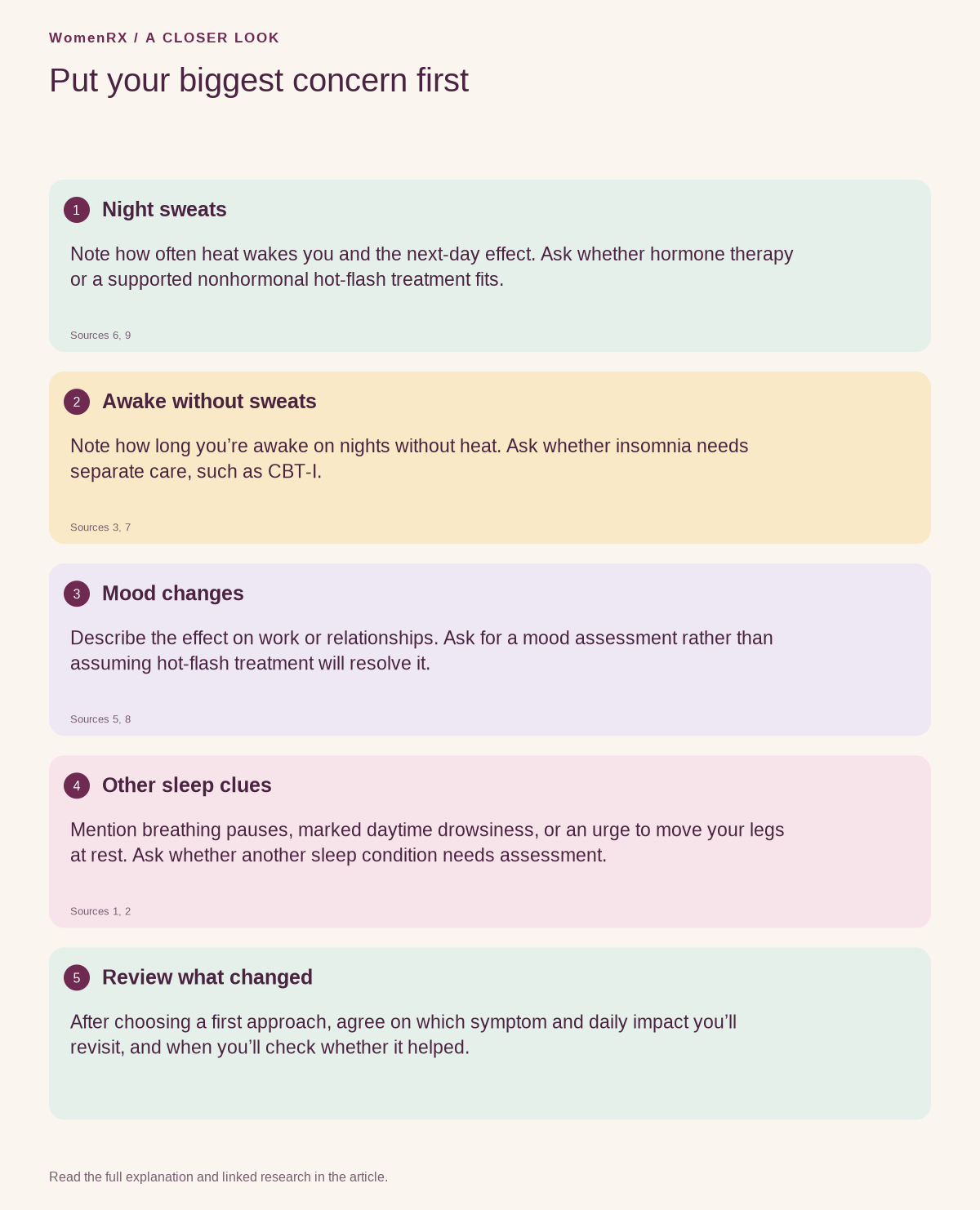
Put your biggest concern first
Night sweats: Note how often heat wakes you and the next-day effect. Ask whether hormone therapy or a supported nonhormonal hot-flash treatment fits.69
Awake without sweats: Note how long you’re awake on nights without heat. Ask whether insomnia needs separate care, such as CBT-I.37
Mood changes: Describe the effect on work or relationships. Ask for a mood assessment rather than assuming hot-flash treatment will resolve it.58
Other sleep clues: Mention breathing pauses, marked daytime drowsiness, or an urge to move your legs at rest. Ask whether another sleep condition needs assessment.12
Review what changed: After choosing a first approach, agree on which symptom and daily impact you’ll revisit, and when you’ll check whether it helped.
Read the figure as text
Rank these by daily impact. For your top concern, note how often it happens, what it interrupts, and what change you’d want to review after trying care. This is not a diagnostic score.- Night sweats: Note how often heat wakes you and the next-day effect. Ask whether hormone therapy or a supported nonhormonal hot-flash treatment fits.69
- Awake without sweats: Note how long you’re awake on nights without heat. Ask whether insomnia needs separate care, such as CBT-I.37
- Mood changes: Describe the effect on work or relationships. Ask for a mood assessment rather than assuming hot-flash treatment will resolve it.58
- Other sleep clues: Mention breathing pauses, marked daytime drowsiness, or an urge to move your legs at rest. Ask whether another sleep condition needs assessment.12
- Review what changed: After choosing a first approach, agree on which symptom and daily impact you’ll revisit, and when you’ll check whether it helped.
More questions, answered
Does hormone therapy treat mood symptoms in perimenopause?
It may modestly reduce depressive symptom severity on average, but the evidence is limited and the average effect was small in a 2026 meta-analysis. Mood symptoms still deserve their own assessment and care discussion. 8
Sources you can check
- Restless legs syndrome - NHSAccessed 2026-09-25Return to first citation
- Sleep Apnea | MedlinePlusAccessed 2026-09-25Return to first citation
- Insomnia | MedlinePlusAccessed 2026-09-25Return to first citation
- Insomnia - NHSAccessed 2026-09-25Return to first citation
- Prevalence and incidence of depressive, anxiety, and insomnia symptoms in perimenopausal and postmenopausal women: Systematic review and meta-analysis.Balasubramanian I, Abhijita B, Krishnamoorthy Y, Gnanadhas J, Beg MJ, Menon V. · General hospital psychiatry · 2026Return to first citation
- Sleep Disturbance and Perimenopause: A Narrative Review.Troìa L, Garassino M, Volpicelli AI, Fornara A, Libretti A, Surico D, Remorgida V. · Journal of clinical medicine · 2025Return to first citation
- Sleep disturbance and menopause.Carmona NE, Solomon NL, Adams KE. · Current opinion in obstetrics & gynecology · 2025Return to first citation
- Efficacy and safety of menopausal hormone therapy for depressive symptoms in perimenopausal women: A systematic review and meta-analysis.Li Y, Sun Y, Bi Y, Yang L, Xu Y, Wu H, Ma X. · Journal of affective disorders · 2026Return to first citation
- The 2023 nonhormone therapy position statement of The North American Menopause Society.Menopause (New York, N.Y.) · 2023Return to first citation