How to Prepare for Online Perimenopause Care
A clear symptom timeline, health history, and list of questions can make a virtual visit more useful, even if the next step is testing or in-person care.
Before an online visit, note what’s changed, when it started, how it affects daily life, and how your periods have changed. Include your health conditions, medicines, and what you hope to discuss. A clinician may be able to assess symptoms and talk through options remotely, but the visit may also lead to testing, an in-person evaluation, or follow-up. Telehealth has been acceptable for many menopause-clinic patients in one Australian study, though it doesn’t guarantee a diagnosis or treatment. 1
Make the visit about your pattern, not one symptom
Perimenopause can involve changes that are easy to describe one at a time, but the pattern often gives the conversation useful context. Before the appointment, jot down the symptoms you want help with and when they happen. For example, you might note that sleep interruptions occur on nights with hot flashes, or that mood changes seem to cluster around irregular periods. Treat these as observations, not proof that menopause is the cause.
Include when your periods last occurred, whether their timing or flow has changed, and whether you use hormonal contraception or other hormone-related medication. Add how symptoms affect work, sleep, sex, exercise, or everyday comfort. If you have a main priority, such as fewer hot flashes or help with vaginal or urinary symptoms, say so plainly.
A short, relevant health history helps make the conversation more specific. List current medicines and supplements, significant health conditions, and any past treatment for these symptoms, including what helped or caused problems. If you don’t know a detail, say that rather than guessing.
What a virtual assessment can and can’t settle
A video or phone appointment can give you space to describe symptoms and discuss your history and preferences. In an Australian specialist menopause clinic, most consultations shifted to telehealth during the pandemic period studied; 70% of the 94 survey respondents said they were satisfied. Many preferred an in-person first visit and telehealth for reviews. This is one service’s experience, not a promise about every clinic or a measure of US access. 1
A virtual visit may not answer every question on its own. In that same clinic audit, fewer investigations were performed during the telehealth period than before the pandemic. The study doesn’t establish which tests should be used for a particular person, or when an online visit is enough. 1
If a clinician recommends a test or an in-person visit, ask what question it is meant to answer and how the result could change the plan. You can also ask whether the appointment will include follow-up to review results or see how a treatment approach is working. A telephone-consultation evaluation in a UK gynecology service found menopause follow-up patients among the groups who benefited most from telephone visits, but it doesn’t establish how every US service should provide care. 2
If treatment comes up, expect a personal discussion
Treatment isn’t automatic. The Endocrine Society guideline says menopausal hormone therapy (MHT) is the most effective treatment for vasomotor symptoms, such as hot flashes, and recommends individualizing decisions based on clinical factors and patient preference. It also recommends screening cardiovascular and breast cancer risk before starting MHT. The guideline’s stated benefit-risk conclusion concerns symptomatic postmenopausal women under 60 or within 10 years of menopause onset; don’t assume that conclusion directly answers the question for every person in perimenopause. 3
Useful questions include: “What else could explain these symptoms?” “What are the options for the symptom that bothers me most?” and “What health history matters for this choice?” If a clinician discusses MHT, ask what benefits they expect for your symptoms, what risks or alternatives apply to you, and what follow-up they recommend. You can take time to consider the options rather than deciding during the appointment.
A practical note to have open during the call
Keep one page nearby with four headings: symptoms and timing, period changes, health history and medicines, and what I want help with. Add a final section for questions and the agreed next step. This makes it easier to notice if the conversation has covered your priorities, whether the plan is testing, treatment discussion, in-person care, or follow-up, and who will contact you next.
Online care can be a useful first conversation, but a good plan may involve more than one kind of visit. Ask how the clinician will handle results or new concerns after the call, and what to do if the plan doesn’t address the problem.
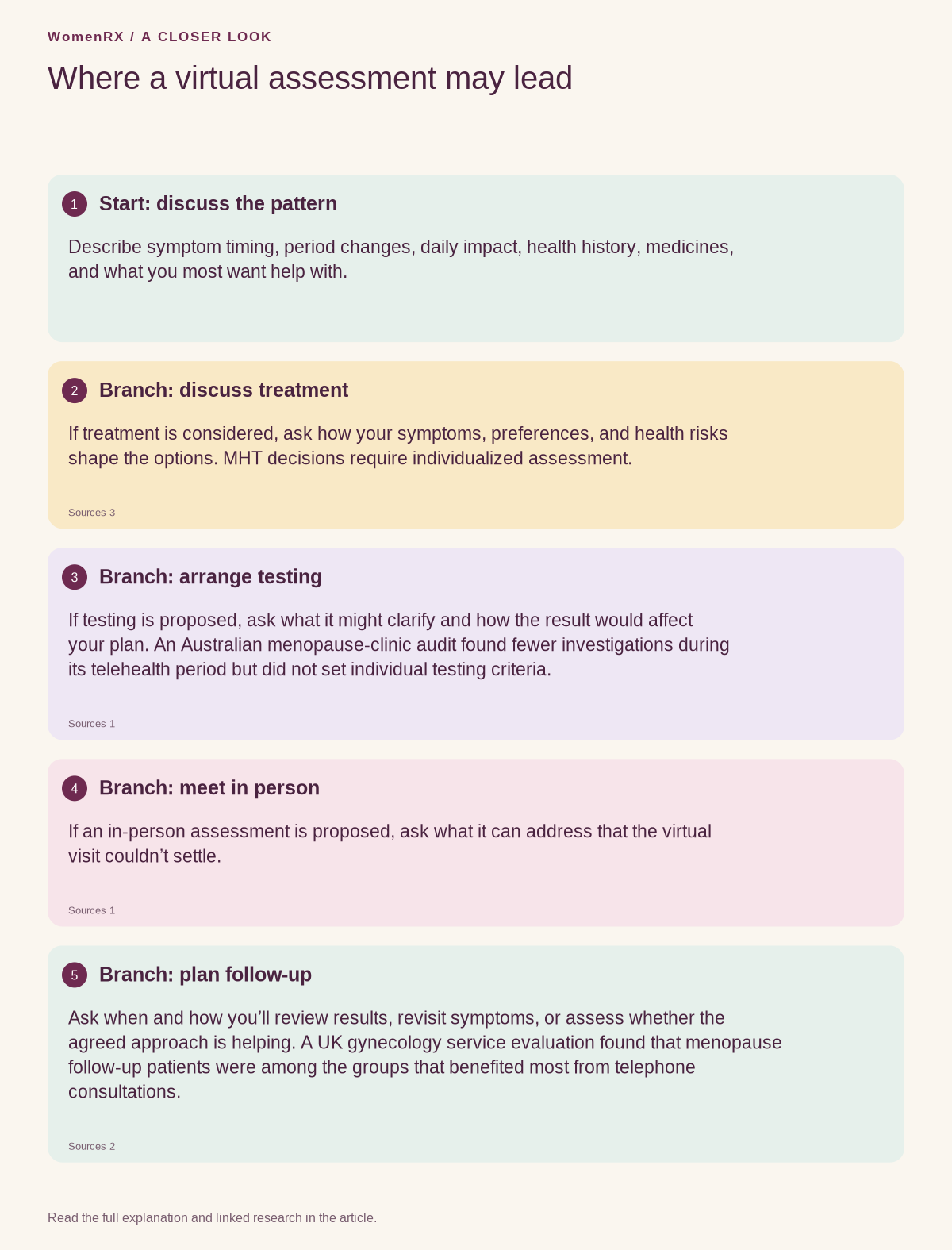
Where a virtual assessment may lead
Start: discuss the pattern: Describe symptom timing, period changes, daily impact, health history, medicines, and what you most want help with.
Branch: discuss treatment: If treatment is considered, ask how your symptoms, preferences, and health risks shape the options. MHT decisions require individualized assessment.3
Branch: arrange testing: If testing is proposed, ask what it might clarify and how the result would affect your plan. An Australian menopause-clinic audit found fewer investigations during its telehealth period but did not set individual testing criteria.1
Branch: meet in person: If an in-person assessment is proposed, ask what it can address that the virtual visit couldn’t settle.1
Branch: plan follow-up: Ask when and how you’ll review results, revisit symptoms, or assess whether the agreed approach is helping. A UK gynecology service evaluation found that menopause follow-up patients were among the groups that benefited most from telephone consultations.2
Read the figure as text
Start with your symptom pattern and health history. From that conversation, the plan may branch toward one or more of these next steps.- Start: discuss the pattern: Describe symptom timing, period changes, daily impact, health history, medicines, and what you most want help with.
- Branch: discuss treatment: If treatment is considered, ask how your symptoms, preferences, and health risks shape the options. MHT decisions require individualized assessment.3
- Branch: arrange testing: If testing is proposed, ask what it might clarify and how the result would affect your plan. An Australian menopause-clinic audit found fewer investigations during its telehealth period but did not set individual testing criteria.1
- Branch: meet in person: If an in-person assessment is proposed, ask what it can address that the virtual visit couldn’t settle.1
- Branch: plan follow-up: Ask when and how you’ll review results, revisit symptoms, or assess whether the agreed approach is helping. A UK gynecology service evaluation found that menopause follow-up patients were among the groups that benefited most from telephone consultations.2
More questions, answered
Should I expect hormone testing at an online perimenopause visit?
The studies summarized here don’t establish which tests are appropriate for a specific person or whether testing is needed. If a test is suggested, ask what it is intended to clarify and how the result would affect the plan. One menopause-clinic audit found fewer investigations during its telehealth period, but it did not define a testing rule for individuals. 1
Can a virtual appointment lead to a treatment discussion?
Yes, treatment can be discussed, but an online visit doesn’t guarantee a prescription or a particular treatment. MHT decisions should be individualized; the Endocrine Society guideline recommends assessing relevant health risks and preferences before starting it. Its benefit-risk statement specifically addresses symptomatic postmenopausal women, so it should not be applied automatically to every person in perimenopause. 3
Sources you can check
- The impact of COVID-19 on a specialised menopause clinic: Changes in practice and women's experiences.Kozica-Olenski SL, Ghelani DP, Boyle JA, Vincent AJ. · The Australian & New Zealand journal of obstetrics & gynaecology · 2023Return to first citation
- Patient experience of telephone consultations in gynaecology: a service evaluation.Khan ZM, Kershaw V, Madhuvrata P, Radley SC, Connor ME. · BJOG : an international journal of obstetrics and gynaecology · 2021Return to first citation
- Treatment of Symptoms of the Menopause: An Endocrine Society Clinical Practice Guideline.Stuenkel CA, Davis SR, Gompel A, Lumsden MA, Murad MH, Pinkerton JV, Santen RJ. · The Journal of clinical endocrinology and metabolism · 2015Return to first citation