How to Choose an Online HRT Service for Perimenopause
A useful online service should help you reach an individualized treatment decision, not simply move you from a symptom quiz to a prescription.
Start by looking past the sign-up form. Ask who will assess your symptoms and medical history, how they’ll weigh breast and cardiovascular risks, which treatments they offer, and who handles follow-up. Hormone therapy decisions should reflect your health and preferences, with periodic reevaluation. An online service also needs a clear plan for concerns that require an in-person exam. 361
Online care may be convenient when you’re dealing with hot flashes, disrupted sleep, or vaginal discomfort. But the useful question isn’t whether a service offers HRT. It’s whether it can help you decide which treatment fits your symptoms and health, then stay involved as that decision changes.
Look for an assessment, not just an intake quiz
A form can collect information. It can’t, by itself, show you how a clinician weighed that information. Before paying or sharing a full medical history, ask who reviews your case and whether you can discuss questions with the prescribing clinician. MedlinePlus suggests considering a service’s accreditation and points readers toward resources for checking clinicians; those are useful starting points if a website makes its clinical team hard to identify. 5
The conversation should cover what’s bothering you, what you hope treatment will change, your medical history, and your preferences. The Endocrine Society guideline calls for individualized menopausal hormone therapy decisions and screening for cardiovascular and breast cancer risk before treatment begins. The North American Menopause Society likewise says benefits and risks vary with the treatment type, route, timing, and whether a progestogen is used. 36
A practical question is: “What in my history could change your recommendation?” You’re looking for an explanation, not a promise that everyone who qualifies by age gets the same prescription. The often-cited favorable benefit-risk balance for younger women applies to those without contraindications and still calls for individual assessment; it isn’t an automatic green light for every person in perimenopause. 6
See whether the options match the symptom
A service that offers only one product may still be able to explain why it fits you. It should also be able to explain when it doesn’t. Systemic hormone therapy is an effective option for bothersome hot flashes. If your main concern is vaginal dryness or irritation, local vaginal estrogen is a different option: it acts locally and won’t treat hot flashes or sleep problems related to them. 32
Ask what the proposed treatment is meant to relieve, what alternatives you could consider, and why that formulation was chosen. If systemic estrogen is discussed and you have a uterus, ask how the plan addresses protection of the uterine lining; progestogen is generally used alongside systemic estrogen for that purpose. The distinction matters because low-dose vaginal estrogen is different and generally doesn’t require a progestogen. 2
Find out what happens after prescribing
A good first visit isn’t the whole service. Hormone therapy calls for periodic reevaluation of whether its benefits still outweigh its risks. A review of clinical guidelines found that follow-up methods and intervals differ, so don’t assume every online service uses the same schedule. Ask when you’ll hear from the clinician again, how to report a side effect or a treatment that isn’t helping, and who can adjust the plan. 64
Also ask what happens if a symptom needs an exam rather than another message. For example, a new breast lump or an unusual nipple change should be checked in person; these symptoms can have causes other than cancer, but they shouldn’t be assessed solely through an HRT refill conversation. 1
Check the practical details before you sign up
You can ask for the clinician’s name and credentials, whether the service can assess and prescribe for someone in your state, and what happens if you travel or move. Don’t infer prescribing availability from a general map of states served: one online service, for example, says medication-specific state restrictions may be confirmed during intake. That’s a reason to get an answer about your proposed treatment, not a rule about every provider. 5
Read the service’s privacy information before entering sensitive health details. Ask who can see your history, how you can obtain your records, and whether your regular clinician can receive the treatment plan if you want them to. MedlinePlus advises sharing sensitive information only through secure websites; a polished sign-up page alone doesn’t answer the broader questions about how your care information is handled. 5
Finally, check the less clinical details that can affect continuity: whether your insurance covers the visits and what hours the service is available. Those are reasonable factors when choosing any health service. 5
The strongest sign of a useful online HRT service is a clear, two-way clinical process. You should understand why a treatment is being offered, how you’ll revisit the decision, and where to turn if your needs go beyond what a screen can assess. 36
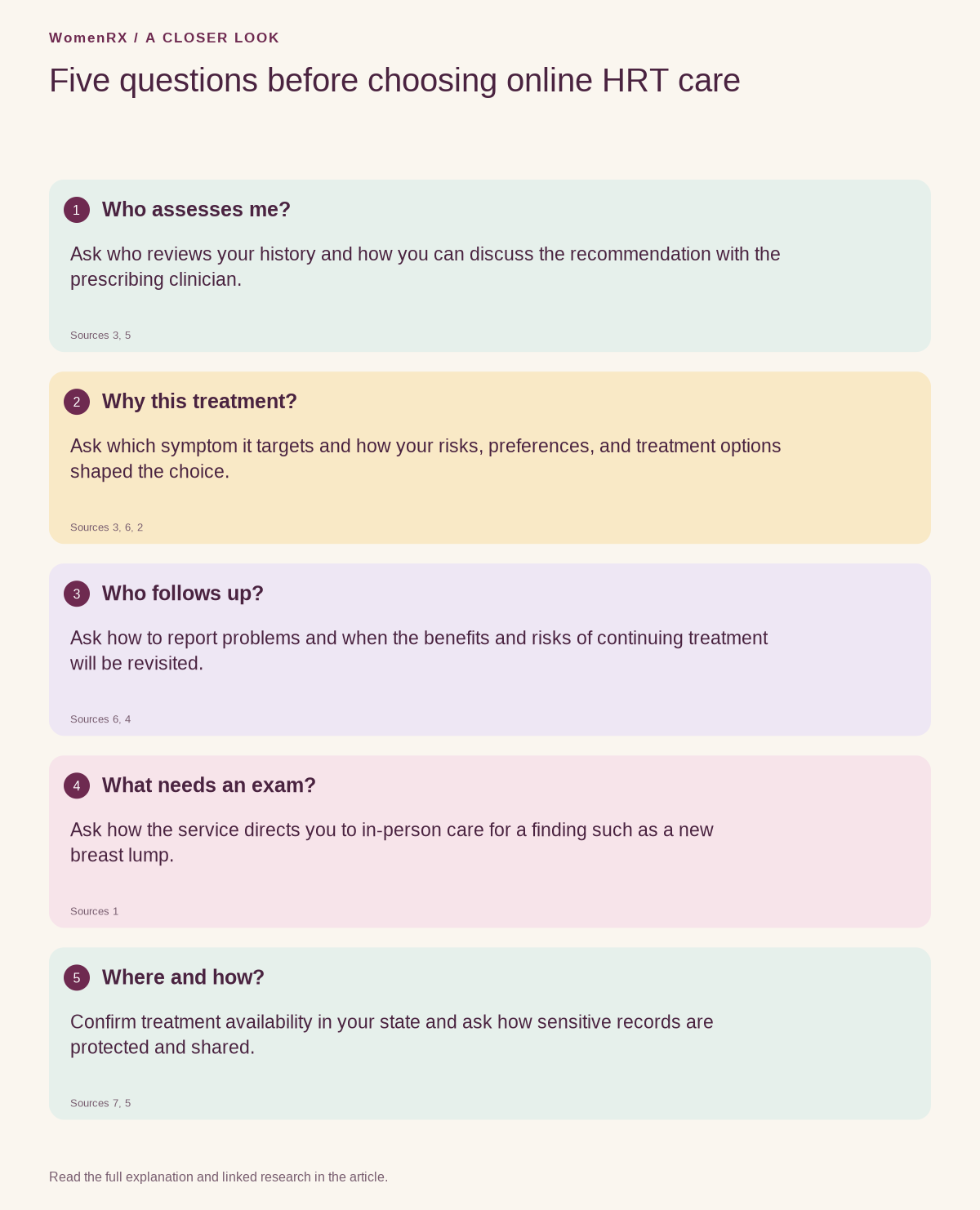
Five questions before choosing online HRT care
Who assesses me?: Ask who reviews your history and how you can discuss the recommendation with the prescribing clinician.35
Why this treatment?: Ask which symptom it targets and how your risks, preferences, and treatment options shaped the choice.362
Who follows up?: Ask how to report problems and when the benefits and risks of continuing treatment will be revisited.64
What needs an exam?: Ask how the service directs you to in-person care for a finding such as a new breast lump.1
Where and how?: Confirm treatment availability in your state and ask how sensitive records are protected and shared.5
Read the figure as text
Use these prompts to find out how a service makes and maintains treatment decisions. They are questions to ask, not a validated safety score.- Who assesses me?: Ask who reviews your history and how you can discuss the recommendation with the prescribing clinician.35
- Why this treatment?: Ask which symptom it targets and how your risks, preferences, and treatment options shaped the choice.362
- Who follows up?: Ask how to report problems and when the benefits and risks of continuing treatment will be revisited.64
- What needs an exam?: Ask how the service directs you to in-person care for a finding such as a new breast lump.1
- Where and how?: Confirm treatment availability in your state and ask how sensitive records are protected and shared.5
More questions, answered
Is vaginal estrogen the same as HRT for hot flashes?
No. Vaginal estrogen is a local treatment for symptoms such as vaginal dryness and irritation. It doesn’t treat hot flashes or other whole-body menopause symptoms, so the distinction is worth raising if a service uses the broad term “HRT.” 2
Does being in perimenopause mean hormone therapy is right for me?
Not automatically. The decision depends on your symptoms, health risks, preferences, and the specific treatment being considered. Clinical guidance recommends individualizing therapy and reassessing its benefits and risks over time. 36
Sources you can check
- Symptoms of breast cancer in women - NHSAccessed 2026-09-25Return to first citation
- About vaginal oestrogen - NHSAccessed 2026-09-25Return to first citation
- Treatment of Symptoms of the Menopause: An Endocrine Society Clinical Practice Guideline.Stuenkel CA, Davis SR, Gompel A, Lumsden MA, Murad MH, Pinkerton JV, Santen RJ. · The Journal of clinical endocrinology and metabolism · 2015Return to first citation
- Menopausal Hormone Therapy in Clinically Vulnerable Women: A Narrative Review of Guidelines and Real-World Evidence.Yanachkova V, Lebanova H, Stoev S. · Medicina (Kaunas, Lithuania) · 2026Return to first citation
- Choosing a Doctor or Health Care Service: MedlinePlusAccessed 2026-09-25Return to first citation
- The 2022 hormone therapy position statement of The North American Menopause Society.“The 2022 Hormone Therapy Position Statement of The North American Menopause Society” Advisory Panel. · Menopause (New York, N.Y.) · 2022Return to first citation