How to Choose Online Perimenopause Care That Follows Through
A good online visit should make room for your whole concern, explain treatment choices, and tell you where care goes next if a video visit isn’t enough.
Before choosing an online service, check whether a clinician can discuss your menstrual pattern, mood, sexual symptoms, current medications, and treatment preferences, not just hot flashes or hormone prescriptions. Ask how follow-up works and what happens if your concern needs an exam, testing, or another kind of care. Menopause guidance supports individualized treatment decisions, but it doesn’t establish a quality standard for online services. 1
Look for an assessment, not just a prescription
Perimenopause care can involve more than deciding whether to use hormones. You might want help with hot flashes, changes in your periods, mood, sexual concerns, or symptoms that don’t fit neatly into one category. Before signing up, find out whether you’ll have time to describe the full picture and get a clinician’s assessment, even if the next step isn’t a prescription from that service.
Try asking: “Can I discuss more than hot flashes, and what happens if you think I need care you can’t provide online?” A service should be able to explain who evaluates you, how you can follow up, and how it handles concerns outside its scope. These are practical questions for comparing services, not a validated quality score.
Use the checklist to test the service’s scope
- Periods: Can you describe changes in your menstrual pattern? Ask how the clinician decides whether your concern can be assessed remotely or needs an in-person evaluation or testing. For example, if you raise a bleeding change, will the service explain how it determines the next step and where to go if a visit or test is needed?
- Mood and mental health: Can you bring up mood or emotional concerns, and will the clinician discuss whether they fit the service’s scope or need a different kind of support? Ask what happens if they recommend additional care.
- Sexual, vaginal, or urinary symptoms: Can you discuss these concerns as well as hot flashes? The North American Menopause Society’s hormone therapy guidance covers bothersome genitourinary symptoms, including options for some people whose symptoms aren’t relieved by over-the-counter therapies. 1
- Current medications and health context: Will the clinician ask what medications and treatments you already use and consider your health history and preferences before discussing options? For hormone therapy, the balance of benefits and risks varies with factors including the type, route, duration, and timing of treatment, and whether a progestogen is used. 1
- Follow-up and referral: Who can you contact after the visit, and how will the service help if an exam, test, or care from another clinician is needed? Ask who is responsible for explaining that handoff and what you should do next. A remote service may not provide those services itself, so get a clear answer before you rely on it.
A useful answer is specific. “We’ll discuss that concern and explain whether it needs another kind of evaluation” tells you more than “we treat menopause.” You don’t need the service to promise it can handle everything. You do need to understand its limits and what happens when your needs go beyond them.
Check that treatment choices fit your concerns
If hot flashes are the main issue, ask whether the clinician can discuss both hormone and nonhormonal approaches. Hormone therapy is the most effective treatment for vasomotor symptoms, according to the 2022 North American Menopause Society position statement. That statement also recommends individualizing treatment and periodically reviewing its benefits and risks. 1
There are evidence-supported nonhormonal options for vasomotor symptoms, too. The 2023 NAMS position statement recommends options that include cognitive behavioral therapy, clinical hypnosis, and certain prescription treatments. It does not recommend supplements or herbal remedies for this purpose. 2 The point isn’t to look for a service that offers every option. It’s to see whether a clinician can discuss choices relevant to you rather than presenting one approach as right for everyone.
Know what telehealth evidence can, and can’t, tell you
A published study describes a simulated menopause telemedicine visit used to teach medical students. It evaluated a training exercise, not the quality of online clinics, patient outcomes, or how well particular services arrange referrals. It therefore can’t tell you which service is better. 3
That makes the service’s own answers especially useful. Before enrolling, make sure you know who will assess you, which concerns you can raise, how medication and health history enter the discussion, and what the service does when remote care isn’t enough. If an answer about evaluation or follow-up is vague, ask for a clearer explanation before deciding.
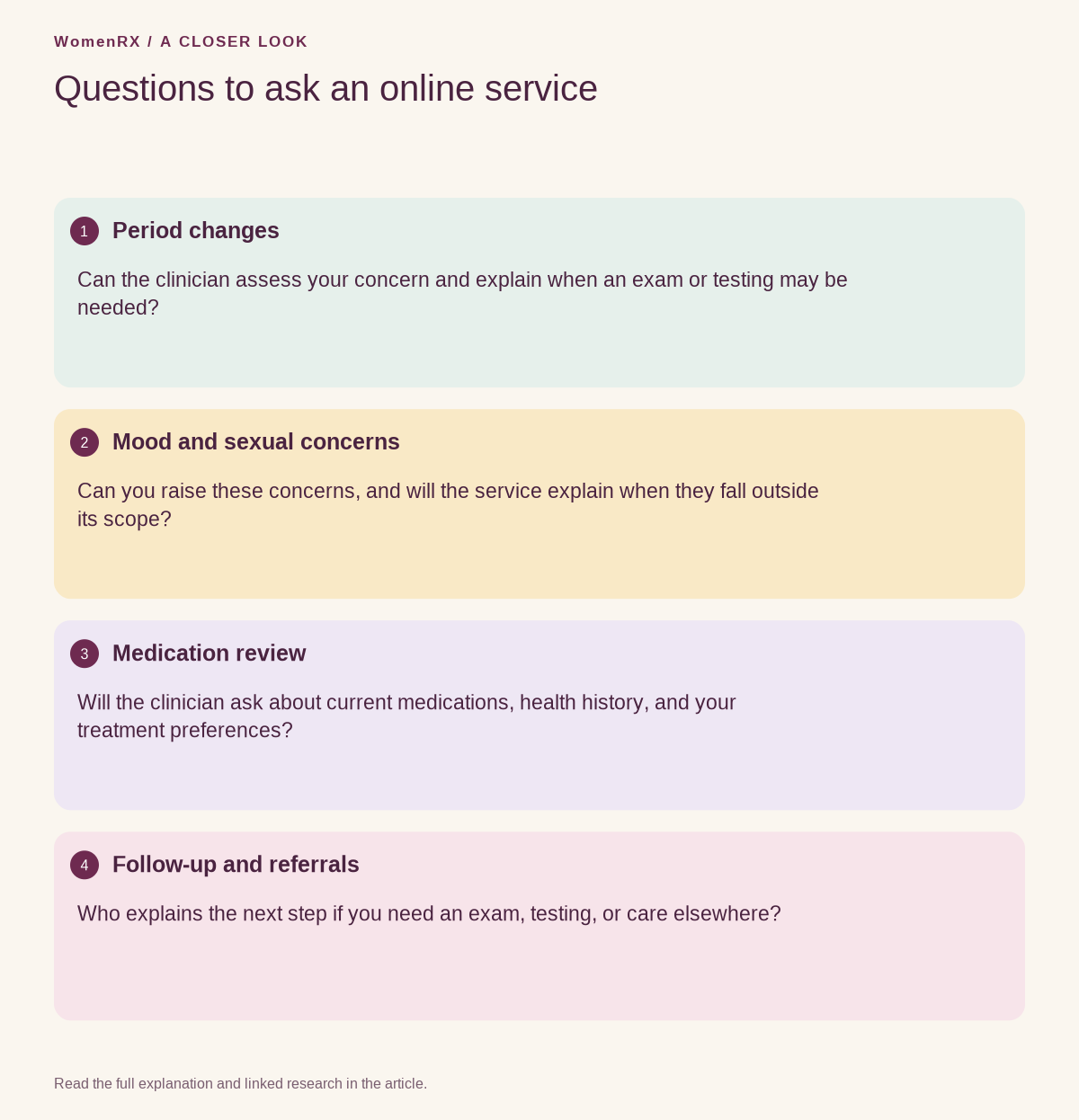
Questions to ask an online service
Period changes: Can the clinician assess your concern and explain when an exam or testing may be needed?
Mood and sexual concerns: Can you raise these concerns, and will the service explain when they fall outside its scope?
Medication review: Will the clinician ask about current medications, health history, and your treatment preferences?
Follow-up and referrals: Who explains the next step if you need an exam, testing, or care elsewhere?
Read the figure as text
Use these prompts to check whether the service can discuss your concerns and explain what happens when you need care beyond a video visit.- Period changes: Can the clinician assess your concern and explain when an exam or testing may be needed?
- Mood and sexual concerns: Can you raise these concerns, and will the service explain when they fall outside its scope?
- Medication review: Will the clinician ask about current medications, health history, and your treatment preferences?
- Follow-up and referrals: Who explains the next step if you need an exam, testing, or care elsewhere?
More questions, answered
Does online perimenopause care have to include hormone therapy?
No. For hot flashes, menopause guidance includes evidence-supported nonhormonal options as well as hormone therapy. Ask whether the clinician can discuss approaches that fit your health context and preferences. 12
Can research tell me which online menopause service is best?
The telemedicine study described here was a training exercise for medical students, not a comparison of services or a study of patient outcomes. It can’t identify a best service. 3
Sources you can check
- The 2022 hormone therapy position statement of The North American Menopause Society.“The 2022 Hormone Therapy Position Statement of The North American Menopause Society” Advisory Panel. · Menopause (New York, N.Y.) · 2022Return to first citation
- The 2023 nonhormone therapy position statement of The North American Menopause Society.Menopause (New York, N.Y.) · 2023Return to first citation
- It's Getting Hot in Here: Piloting a Telemedicine OSCE Addressing Menopausal Concerns for Obstetrics and Gynecology Clerkship Students.Reid HW, Branford K, Reynolds T, Baldwin M, Dotters-Katz S. · MedEdPORTAL : the journal of teaching and learning resources · 2021Return to first citation