Vitamin C Foods and How to Pair Them With Iron
An orange, raw pepper, or serving of broccoli can provide vitamin C, and pairing these foods with beans or lentils may help you absorb plant-based iron.
Fruits and vegetables are the best food sources of vitamin C. A medium orange provides about 70 mg, and half a cup of raw red pepper provides about 95 mg. For women age 19 and older, the recommended amount is 75 mg daily, rising to 85 mg during pregnancy and 120 mg while breastfeeding. Eating vitamin C foods with beans, lentils, tofu, or iron-fortified grains can help your body absorb their iron. 1 2
Start with a portion you’d actually eat
You don’t need a top-ten list to get enough vitamin C. A medium orange provides about 70 mg, while half a cup of raw red pepper provides about 95 mg. Kiwi, strawberries, and cooked broccoli are other useful choices. These amounts describe the listed portions, not an exact value for every piece of produce or preparation. 1
| Food and portion | Vitamin C |
|---|---|
| Raw red pepper, ½ cup | 95 mg |
| Orange juice, ¾ cup | 93 mg |
| Orange, 1 medium | 70 mg |
| Kiwi, 1 medium | 64 mg |
| Cooked broccoli, ½ cup | 51 mg |
| Sliced strawberries, ½ cup | 49 mg |
Portion amounts are from the NIH Office of Dietary Supplements’ selected-food table. 1
For women age 19 and older, the recommended dietary allowance is 75 mg of vitamin C a day. It’s 85 mg during pregnancy and 120 mg while breastfeeding. For ages 14-18, the corresponding amounts are 65 mg, 80 mg, and 115 mg. There isn’t a separate vitamin C recommendation for menstruation. 1
Put vitamin C beside plant-based iron
Iron in beans, lentils, tofu, vegetables, and iron-fortified grain products is called nonheme iron. Vitamin C can help your body absorb this form of iron when they’re eaten together. For example, add raw pepper to a lentil meal, have strawberries with iron-fortified cereal, or serve broccoli alongside tofu. Some vitamin C foods, including broccoli, also contribute iron themselves; the point of the pairing is that vitamin C can help with absorption of nonheme iron in the meal. 1 2
This is especially useful to know if you eat mostly plant-based foods. Nonheme iron is less readily absorbed than heme iron from meat and seafood, which is one reason the recommended iron intake is higher for people following vegetarian diets. But improving absorption from one meal doesn’t necessarily translate into a meaningful change in iron levels over time. 2 4
Heavy menstrual bleeding raises the risk of iron deficiency, and iron needs increase during pregnancy. Those are reasons to pay attention to iron, not reasons to assume you need extra vitamin C. If you have iron deficiency, adding fruit or vegetables to an iron-containing meal can be a useful food choice, but it won’t tell you why your iron is low or replace treatment when treatment is needed. Blood loss and difficulty absorbing iron are among the possible causes. 2 3
Keep preparation simple
Vitamin C is water-soluble and sensitive to heat, so prolonged storage and cooking can reduce the amount in food. Steaming or microwaving may lessen cooking losses. Raw fruit and vegetables are convenient options, but cooked vegetables still count: the listed half-cup serving of cooked broccoli provides 51 mg of vitamin C. 1
A practical approach is to choose foods you like and use them across the day: an orange with breakfast, raw pepper with beans at lunch, or broccoli with tofu at dinner. The food comparison helps you find options; it isn’t a treatment plan for low iron. 1 2
Vitamin C Portions and Meal Pairings
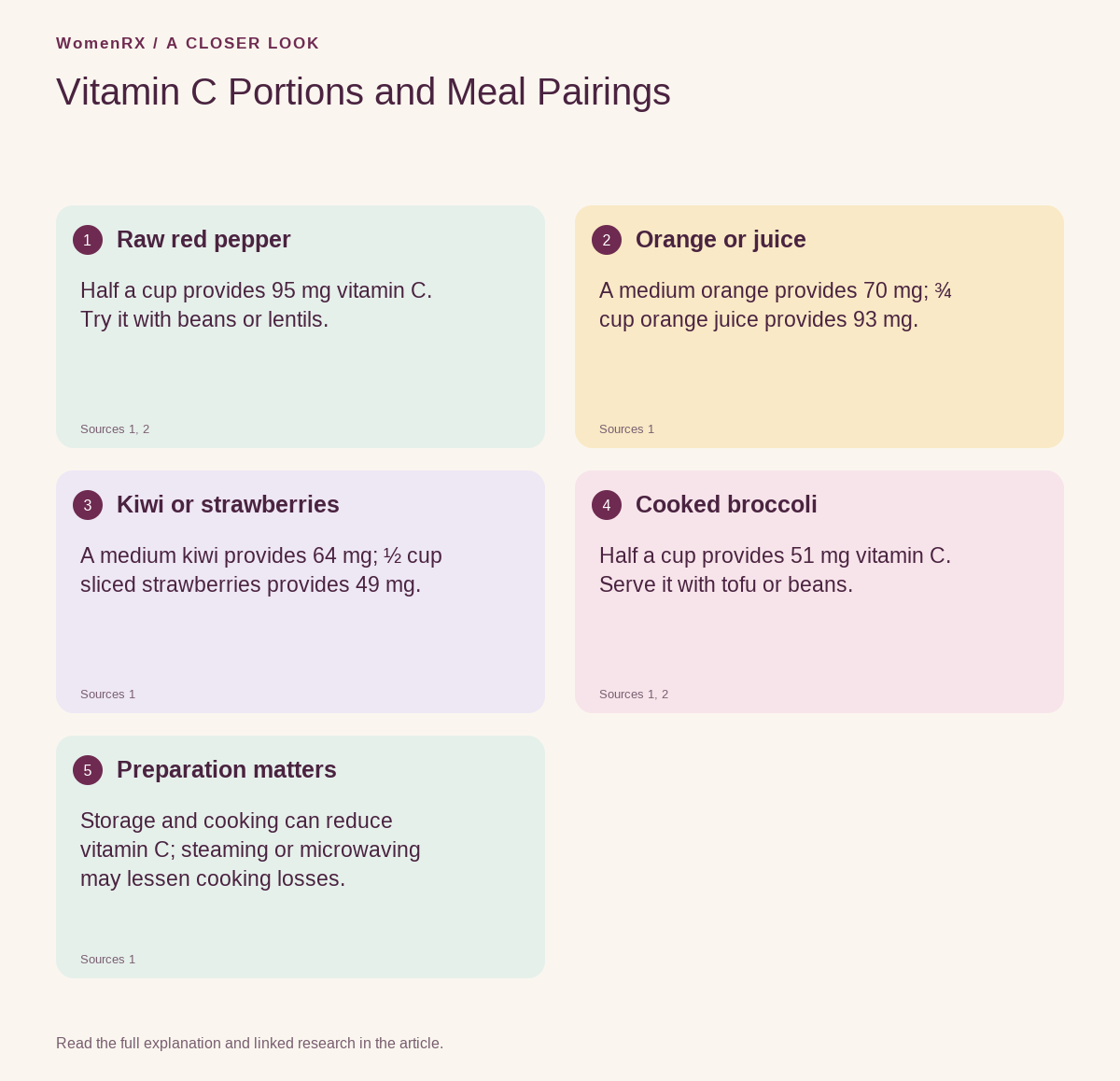
Raw red pepper: Half a cup provides 95 mg vitamin C. Try it with beans or lentils.12
Orange or juice: A medium orange provides 70 mg; ¾ cup orange juice provides 93 mg.1
Kiwi or strawberries: A medium kiwi provides 64 mg; ½ cup sliced strawberries provides 49 mg.1
Cooked broccoli: Half a cup provides 51 mg vitamin C. Serve it with tofu or beans.12
Preparation matters: Storage and cooking can reduce vitamin C; steaming or microwaving may lessen cooking losses.1
Read the figure as text
Compare familiar portions, then see how a vitamin C food can fit alongside plant-based iron.- Raw red pepper: Half a cup provides 95 mg vitamin C. Try it with beans or lentils.12
- Orange or juice: A medium orange provides 70 mg; ¾ cup orange juice provides 93 mg.1
- Kiwi or strawberries: A medium kiwi provides 64 mg; ½ cup sliced strawberries provides 49 mg.1
- Cooked broccoli: Half a cup provides 51 mg vitamin C. Serve it with tofu or beans.12
- Preparation matters: Storage and cooking can reduce vitamin C; steaming or microwaving may lessen cooking losses.1
More questions, answered
Does having heavy periods mean I need extra vitamin C?
Heavy menstrual bleeding increases the risk of iron deficiency, but there’s no separate vitamin C recommendation for menstruation. Vitamin C foods can accompany plant-based iron; they don’t replace finding out whether you’re iron deficient. 1 2
Do I have to eat vitamin C foods raw?
No. Cooking can reduce vitamin C, but cooked vegetables can still provide it. Half a cup of cooked broccoli, for example, provides 51 mg in the NIH selected-food table. 1
Sources you can check
- Vitamin C - Health Professional Fact SheetAccessed 2026-09-25Return to first citation
- Iron - Health Professional Fact SheetAccessed 2026-09-25Return to first citation
- Iron: MedlinePlusAccessed 2026-09-25Return to first citation
- Enhancers of iron absorption: ascorbic acid and other organic acids.Teucher B, Olivares M, Cori H. · International journal for vitamin and nutrition research. Internationale Zeitschrift fur Vitamin- und Ernahrungsforschung. Journal international de vitaminologie et de nutrition · 2004Return to first citation