Tirzepatide: How It Works and What Treatment Involves
Tirzepatide is a weekly injection whose dose increases gradually, with follow-up focused on results, side effects, and whether the treatment still fits your goals.
Tirzepatide acts on two hormone receptors involved in appetite and blood-sugar regulation. It’s injected weekly, and dose increases are spaced at least four weeks apart. Treatment isn’t a straight line toward a predictable weight loss: follow-up looks at your weight trend, troublesome symptoms, and blood-sugar results if you have diabetes. Oral birth control needs particular attention when treatment starts or the dose rises.1245
What the two-receptor action means
Tirzepatide activates receptors for two hormones, GIP and GLP-1. These pathways affect blood-sugar regulation and food intake. The drug also slows stomach emptying, particularly when treatment begins. That helps explain both why eating may feel different and why digestive side effects are a practical part of treatment, not a separate issue to think about later.145
Acting on two receptors doesn’t mean everyone gets the same result. Reviews of clinical trials report weight loss in adults with obesity and improvements in both weight and HbA1c, a measure of longer-term blood sugar, in adults with type 2 diabetes. Head-to-head trials summarized in one review found greater average weight and HbA1c reductions with tirzepatide than with semaglutide in the populations studied. Those are group results, not a forecast for your body.35
A weekly injection, then a series of decisions
Zepbound’s prescribing information says that after four weeks, the dose increases to 5 mg “injected subcutaneously once weekly.” Later increases are separated by at least four weeks at the current dose. The gradual approach leaves room to assess how treatment is going rather than treating every increase as a milestone you must reach. A clinical review identifies digestive side effects as the main tolerability issue and describes gradual escalation and individualization as part of treatment.14
Follow-up has two different jobs. One is to see whether treatment is helping: your weight trend is relevant in weight management, while blood-sugar results matter if you’re being treated for type 2 diabetes. The other is to see whether the treatment is workable. For example, persistent digestive symptoms are worth raising before an increase rather than judging progress by the scale alone. A review of diabetes trials found improvements in weight and HbA1c across several treatment comparisons, but average trial results can’t tell you which dose will balance benefit and tolerability for you.45
If you have diabetes and take insulin or a sulfonylurea, there’s an additional follow-up issue. Zepbound’s prescribing information warns about low blood sugar with these medicines and calls for blood-glucose monitoring in people with diabetes before and during treatment. Make sure the person managing your diabetes knows about all the medicines you take; don’t interpret a falling weight as a substitute for checking glucose.1
Where reproductive questions change the plan
If you use an oral hormonal contraceptive, both Zepbound and Mounjaro carry the same practical advice: use a non-oral contraceptive method or add a barrier method for four weeks after starting tirzepatide and for four weeks after each dose increase. Tirzepatide’s effect on stomach emptying can make oral contraception less reliable, especially early in treatment. The product information says hormonal methods that aren’t taken by mouth should not be affected in this way.12
Pregnancy is a separate conversation from contraception. Zepbound’s patient information says it may harm an unborn baby and asks patients to tell their healthcare provider if they become pregnant during treatment; Mounjaro’s says it isn’t known whether it will harm an unborn baby. If pregnancy is possible or planned, bring that up when discussing treatment, not after several dose increases.12
The outcome summaries here describe adults with obesity or type 2 diabetes. They don’t establish a distinct weight-loss response for women, or show that perimenopause or postmenopause changes how tirzepatide works. Your treatment goals and other health needs still matter, but there’s no reason to assume a different two-receptor mechanism because of your life stage.35
For more detail on one part of treatment, a dedicated dosing guide, digestive-symptom guide, or contraception and pregnancy guide can take you further without making this overview your only reference.
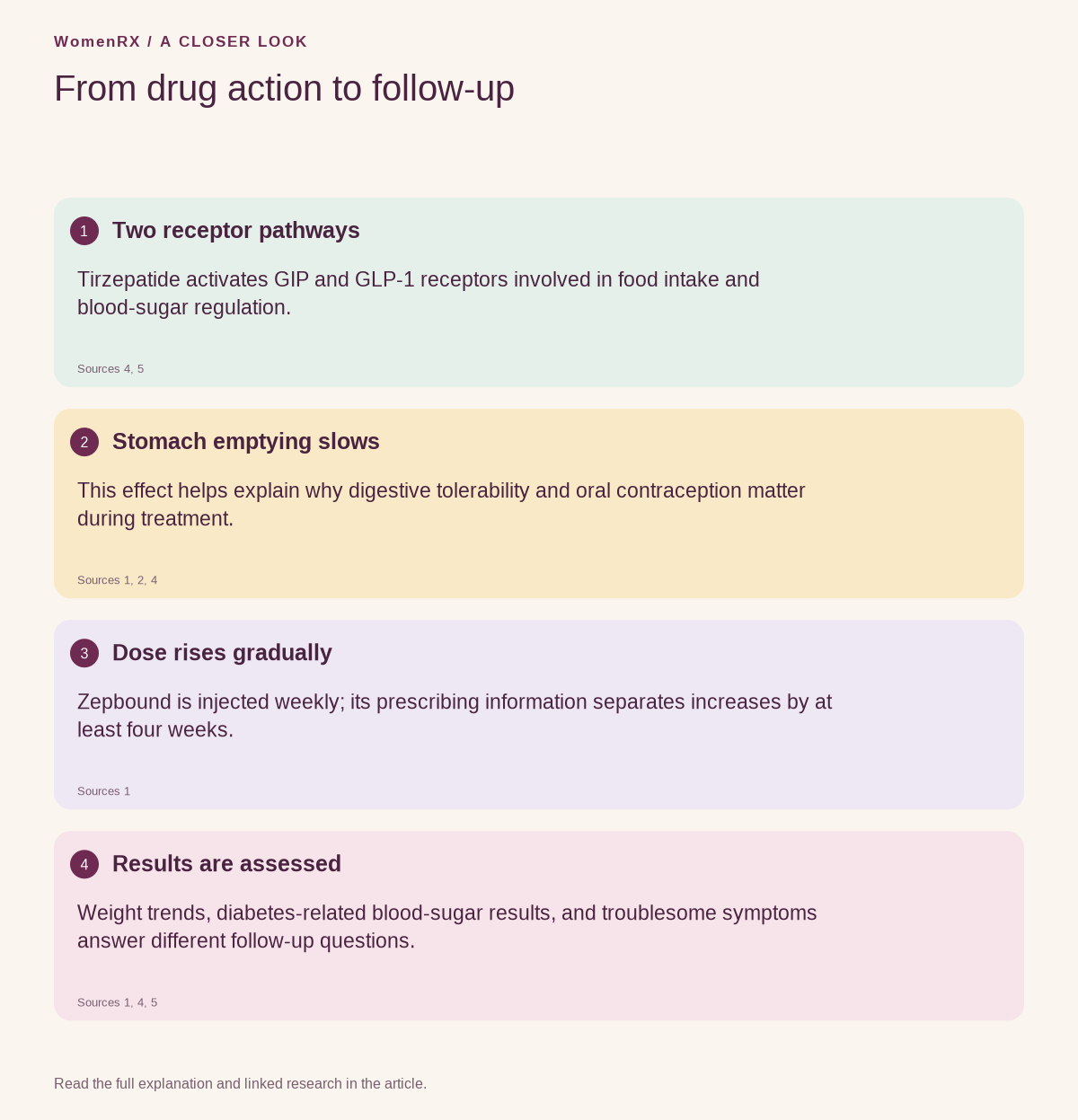
From drug action to follow-up
Two receptor pathways: Tirzepatide activates GIP and GLP-1 receptors involved in food intake and blood-sugar regulation.45
Stomach emptying slows: This effect helps explain why digestive tolerability and oral contraception matter during treatment.124
Dose rises gradually: Zepbound is injected weekly; its prescribing information separates increases by at least four weeks.1
Results are assessed: Weight trends, diabetes-related blood-sugar results, and troublesome symptoms answer different follow-up questions.145
Read the figure as text
The same treatment has a biological action, a gradual course, and outcomes that need to be assessed separately.- Two receptor pathways: Tirzepatide activates GIP and GLP-1 receptors involved in food intake and blood-sugar regulation.45
- Stomach emptying slows: This effect helps explain why digestive tolerability and oral contraception matter during treatment.124
- Dose rises gradually: Zepbound is injected weekly; its prescribing information separates increases by at least four weeks.1
- Results are assessed: Weight trends, diabetes-related blood-sugar results, and troublesome symptoms answer different follow-up questions.145
Sources you can check
- ZEPBOUND (TIRZEPATIDE) INJECTION, SOLUTION ZEPBOUND (TIRZEPATIDE) INJECTION, SOLUTION ZEPBOUND KWIKPEN (TIRZEPATIDE) INJECTION, SOLUTION [ELI LILLY AND COMPANY] | US prescribing information and patient instructionsAccessed 2026-09-25Return to first citation
- MOUNJARO (TIRZEPATIDE) INJECTION, SOLUTION MOUNJARO KWIKPEN (TIRZEPATIDE) INJECTION, SOLUTION [ELI LILLY AND COMPANY] | US prescribing information and patient instructionsAccessed 2026-09-25Return to first citation
- Tirzepatide vs. semaglutide for obesity, glycemic control, and cardiovascular outcomes: a narrative review of clinical trials.Harbi MH, Ashour AM, Alorfi NM, Aldurdunji MM, Wali SM, Alzahrani YA. · Frontiers in medicine · 2026Return to first citation
- Tirzepatide.Brož J, Koželuhová M, Michalec J, Lukáč O. · Ceska a Slovenska farmacie : casopis Ceske farmaceuticke spolecnosti a Slovenske farmaceuticke spolecnosti · 2026Return to first citation
- Revolutionizing type 2 diabetes management: the role of the pharmacist in unlocking the potential of tirzepatide.Banji D, Alshahrani S, Alfarhan M, Banji OJF. · Saudi pharmaceutical journal : SPJ : the official publication of the Saudi Pharmaceutical Society · 2025Return to first citation