How Tirzepatide Affects Appetite, Blood Sugar, and Weight
Tirzepatide activates two hormone receptors, affecting appetite and blood glucose while weight change reflects more than one pathway.
Tirzepatide activates both GIP and GLP-1 receptors. It reduces calorie intake, likely through effects on appetite, and stimulates insulin release in a glucose-dependent way while reducing glucagon, which can lower blood glucose. It also slows stomach emptying, especially early in treatment. Clinical trials have measured weight reductions, but the exact contribution of each pathway, and whether results differ by reproductive or menopause stage, isn't established by these findings. 12
Tirzepatide acts on two hormone receptors involved in appetite and blood sugar regulation: the glucose-dependent insulinotropic polypeptide (GIP) receptor and the glucagon-like peptide-1 (GLP-1) receptor. Its effects can help explain why both calorie intake and blood glucose may fall, but they don't make weight change a simple appetite-only story. 12
Two receptors, overlapping effects
Tirzepatide binds to and activates both GIP and GLP-1 receptors. GLP-1 normally helps regulate appetite and calorie intake. The prescribing information says tirzepatide decreases calorie intake, with the effect likely mediated by appetite. It also says nonclinical studies suggest GIP activity may add to the regulation of food intake. That possible contribution is not the same as proving exactly how much each receptor accounts for weight change in people. 1
The practical takeaway is that appetite-related changes are one supported part of the explanation, while the precise division of labor between the two receptors remains unclear. It would be too simple to say tirzepatide works only by making someone eat less, or that the GIP component has a specific, separately measured effect on weight. 1
Blood sugar effects work alongside appetite effects
Tirzepatide stimulates insulin secretion in a glucose-dependent manner and reduces glucagon secretion. It also increases insulin sensitivity; that effect was demonstrated in a clamp study in people with type 2 diabetes after 28 weeks of treatment. Together, these actions can lower blood glucose. In people with type 2 diabetes, prescribing information also reports lower fasting and after-meal glucose, reduced food intake, and reduced body weight. 12
These blood-glucose effects and weight effects can happen together, but one shouldn't be mistaken for the other. A change in blood sugar is not itself a measure of how much body weight someone will lose. Results can also depend on the population being treated: the clinical findings described in prescribing information include people with type 2 diabetes as well as studies focused on weight reduction. 12
Stomach emptying is part of the picture, not the whole story
Tirzepatide delays gastric emptying, meaning food moves out of the stomach more slowly. This effect is greatest after the first dose and diminishes over time. It's a real part of the drug's action, but it shouldn't be treated as the sole explanation for lasting weight change. The prescribing information also describes reduced calorie intake and appetite-related effects. 1
Clinical trials have measured weight reductions with tirzepatide in people treated for type 2 diabetes and in weight-reduction studies. Those outcomes show that body weight can change during treatment; they don't, by themselves, establish how much of the change comes from appetite, stomach emptying, glucose regulation, or other factors. 123
What these findings say about women
The mechanism described in prescribing information is based on receptor activity, not a separate female-specific pathway. The findings cited here do not break out weight or appetite results by menstrual-cycle phase, pregnancy, postpartum status, perimenopause, or postmenopause. That means they can't tell you whether the effects differ across those stages; it would also be a leap to assume that they do. 12
For an individual woman, the useful distinction is between what the drug is known to do and what the outcomes don't explain: receptor activation, reduced calorie intake, changes in glucose regulation, and slower stomach emptying are described effects; a precise account of why one person loses more weight than another is not. 12
From receptor activity to weight change
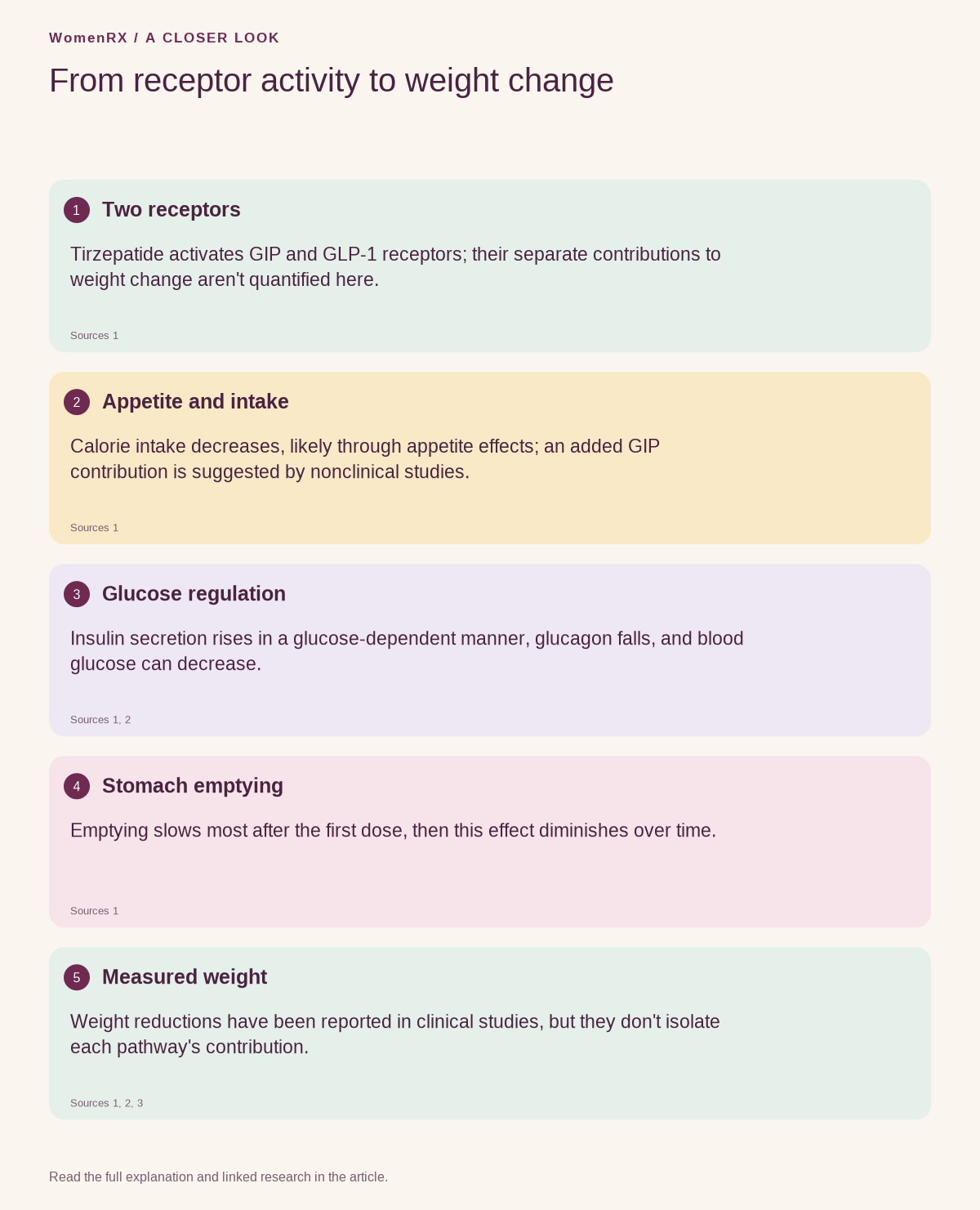
Two receptors: Tirzepatide activates GIP and GLP-1 receptors; their separate contributions to weight change aren't quantified here.1
Appetite and intake: Calorie intake decreases, likely through appetite effects; an added GIP contribution is suggested by nonclinical studies.1
Glucose regulation: Insulin secretion rises in a glucose-dependent manner, glucagon falls, and blood glucose can decrease.12
Stomach emptying: Emptying slows most after the first dose, then this effect diminishes over time.1
Measured weight: Weight reductions have been reported in clinical studies, but they don't isolate each pathway's contribution.123
Read the figure as text
This map separates the drug's described actions from the measured outcomes, without assigning weight loss to a single pathway.- Two receptors: Tirzepatide activates GIP and GLP-1 receptors; their separate contributions to weight change aren't quantified here.1
- Appetite and intake: Calorie intake decreases, likely through appetite effects; an added GIP contribution is suggested by nonclinical studies.1
- Glucose regulation: Insulin secretion rises in a glucose-dependent manner, glucagon falls, and blood glucose can decrease.12
- Stomach emptying: Emptying slows most after the first dose, then this effect diminishes over time.1
- Measured weight: Weight reductions have been reported in clinical studies, but they don't isolate each pathway's contribution.123
Sources you can check
- ZEPBOUND (TIRZEPATIDE) INJECTION, SOLUTION ZEPBOUND (TIRZEPATIDE) INJECTION, SOLUTION ZEPBOUND KWIKPEN (TIRZEPATIDE) INJECTION, SOLUTION [ELI LILLY AND COMPANY] | US prescribing information and patient instructionsAccessed 2026-09-25Return to first citation
- MOUNJARO (TIRZEPATIDE) INJECTION, SOLUTION MOUNJARO KWIKPEN (TIRZEPATIDE) INJECTION, SOLUTION [ELI LILLY AND COMPANY] | US prescribing information and patient instructionsAccessed 2026-09-25Return to first citation
- Nutritional status with tirzepatide in obesity: A post hoc analysis of the SURMOUNT-1-4 randomized clinical trials.Almandoz JP, Pickett-Blakely O, Tewksbury C, Stefanski A, Gonsahn-Bollie S, Dimitriadis GK, Murro AL, Cao D, Meng Q, Neff LM. · Obesity pillars · 2026Return to first citation