PCOS Supplements for Cycles and Fertility: What Studies Show
A more regular cycle, confirmed ovulation, pregnancy, and live birth are different outcomes, and supplement studies don’t measure them all the same way.
Myo-inositol has been studied for PCOS-related cycle and ovulation changes, both by itself and in combinations. One trial also tested it with metformin in a fertility-care pathway and reported live births. Those results apply to the specific groups and treatments studied; they don’t establish a best supplement or show that cycle changes guarantee pregnancy. 2 3 4
If you’re considering a supplement because your periods are irregular or you’re trying to conceive, start by asking what outcome you want to change. Cycle length, ovulation, pregnancy, and live birth are related, but they’re not interchangeable measures. Ovulation means an egg is released; a study that reports a cycle change hasn’t necessarily shown that ovulation occurred. 1
Myo-inositol studies measure different things
In a study of 25 women of childbearing age with PCOS and infrequent or absent periods, everyone took myo-inositol with folic acid. During six months of observation, 22 participants had at least one spontaneous menstrual cycle, and pregnancies were reported. Because there was no comparison group, the study can’t show how much the treatment caused those outcomes or estimate what another person’s chances would be. 3
A separate open-label randomized study assigned 50 anovulatory women with PCOS to myo-inositol alone or myo-inositol with alpha-lactalbumin. After three months, the study reported ovulation in 79.3% of the combination group and 47.6% of the myo-inositol-only group; cycle duration improved in 84.0% and 55.6%, respectively. This small study compared the two regimens, but it didn’t establish that the combination improves live-birth chances. 4
These results also shouldn’t be collapsed into one claim that “inositol works.” The ingredients, comparison groups, and outcomes differ. A product with a similar-sounding ingredient or a different combination isn’t automatically supported by the same findings.
The live-birth result came from fertility care
A randomized trial enrolled 120 infertile women with PCOS. It compared metformin plus myo-inositol with metformin alone. Participants first tried to conceive spontaneously; those who had not conceived after three months were offered three cycles of ovulation induction with intrauterine insemination. Live birth was reported for 33 of 60 participants receiving the combination and 16 of 60 receiving metformin alone. 2
That is a live-birth result, but it answers a specific question: how the combination performed compared with metformin alone in this trial’s fertility-care pathway. It does not show that myo-inositol by itself improves live birth, or that the same result applies outside that setting.
Other combinations don’t identify a winning ingredient
A study of 41 women with PCOS tested D-chiro-inositol with alpha-lipoic acid for six months. It reported improved cycle length in 76.7% of participants and restored ovulation in 40%. Since the ingredients were given together, the study can’t show which one contributed to the reported changes. It did not report a live-birth result. 6
Another study gave a combination of myo-inositol, tyrosine, selenium, chromium, and folic acid to 186 women with different PCOS features. It reported cycle or ovulation changes in some groups after six months. All participants received the combination, so the findings don’t establish that it caused the changes or reveal which ingredient mattered. 5
These studies don’t establish a reproductive benefit for N-acetylcysteine. Don’t assume results for an inositol-containing product apply to NAC or to a multi-ingredient product with a different formula.
Make the discussion match your goal
Bring the exact product label, including all ingredients, to your care team. One trial tested myo-inositol alongside metformin, but that doesn’t establish how every supplement formula fits with your medicines or fertility treatment. Ask what outcome you’re aiming for, how you’ll know whether it has changed, and what the plan is if you become pregnant. 2
Some of these studies reported pregnancies or live births, but that is not the same as testing whether a supplement is safe to take during pregnancy. The study descriptions also mostly identify participants as women with PCOS; one describes women of childbearing age. They don’t establish whether the findings apply to adolescents. 2 3
A useful way to weigh a claim is to match it to the evidence: cycle improvement is evidence about cycles, ovulation findings are evidence about ovulation, and a live-birth result belongs to the particular treatment setting in which it was measured. No result here guarantees that a supplement will restore ovulation or lead to pregnancy.
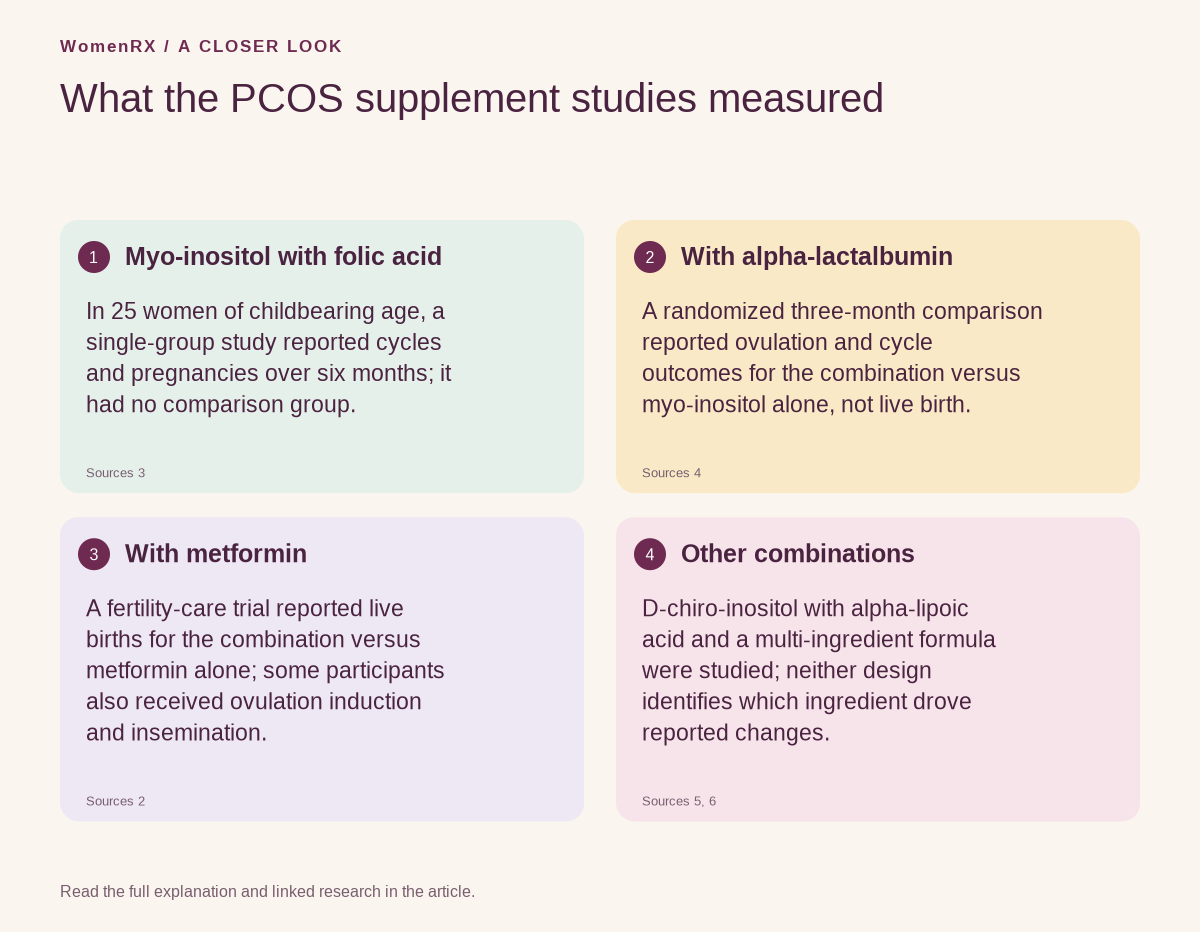
What the PCOS supplement studies measured
Myo-inositol with folic acid: In 25 women of childbearing age, a single-group study reported cycles and pregnancies over six months; it had no comparison group.3
With alpha-lactalbumin: A randomized three-month comparison reported ovulation and cycle outcomes for the combination versus myo-inositol alone, not live birth.4
With metformin: A fertility-care trial reported live births for the combination versus metformin alone; some participants also received ovulation induction and insemination.2
Other combinations: D-chiro-inositol with alpha-lipoic acid and a multi-ingredient formula were studied; neither design identifies which ingredient drove reported changes.56
Read the figure as text
Compare the tested ingredients and treatment settings with the outcome each study reported. Cycle changes, ovulation, and live birth answer different questions.- Myo-inositol with folic acid: In 25 women of childbearing age, a single-group study reported cycles and pregnancies over six months; it had no comparison group.3
- With alpha-lactalbumin: A randomized three-month comparison reported ovulation and cycle outcomes for the combination versus myo-inositol alone, not live birth.4
- With metformin: A fertility-care trial reported live births for the combination versus metformin alone; some participants also received ovulation induction and insemination.2
- Other combinations: D-chiro-inositol with alpha-lipoic acid and a multi-ingredient formula were studied; neither design identifies which ingredient drove reported changes.56
More questions, answered
Does a more regular period mean I’m ovulating?
Not necessarily. A cycle-length change and ovulation are distinct outcomes; some studies assess ovulation separately rather than treating a more regular cycle as proof. 1 4
Sources you can check
- Periods and fertility in the menstrual cycle - NHSAccessed 2026-09-25Return to first citation
- Comparison of metformin plus myoinositol vs metformin alone in PCOS women undergoing ovulation induction cycles: randomized controlled trial.Agrawal A, Mahey R, Kachhawa G, Khadgawat R, Vanamail P, Kriplani A. · Gynecological endocrinology : the official journal of the International Society of Gynecological Endocrinology · 2019Return to first citation
- Myo-inositol in patients with polycystic ovary syndrome: a novel method for ovulation induction.Papaleo E, Unfer V, Baillargeon JP, De Santis L, Fusi F, Brigante C, Marelli G, Cino I, Redaelli A, Ferrari A. · Gynecological endocrinology : the official journal of the International Society of Gynecological Endocrinology · 2007Return to first citation
- Comparing the Efficacy of Myo-Inositol Plus α-Lactalbumin vs. Myo-Inositol Alone on Reproductive and Metabolic Disturbances of Polycystic Ovary Syndrome.Kamenov Z, Gateva A, Dinicola S, Unfer V. · Metabolites · 2023Return to first citation
- Efficacy of the synergic action of myoinositol, tyrosine, selenium and chromium in women with PCOS.Montanino Oliva M, Zuev V, Lippa A, Carra MC, Lisi F. · European review for medical and pharmacological sciences · 2019Return to first citation
- Treatment with d-chiro-inositol and alpha lipoic acid in the management of polycystic ovary syndrome.Fruzzetti F, Capozzi A, Canu A, Lello S. · Gynecological endocrinology : the official journal of the International Society of Gynecological Endocrinology · 2019Return to first citation