Paroxetine for Menopause Symptoms: Benefits and Tradeoffs
The 7.5 mg menopause-specific product has evidence for easing vasomotor symptoms, but tamoxifen and other medicines can affect whether it’s a good fit.
Paroxetine 7.5 mg is a US-approved nonhormonal option for moderate to severe menopause-related vasomotor symptoms, including hot flashes and night sweats. It’s a different treatment plan from higher-dose paroxetine used for depression or anxiety. The decision may depend on your symptom goals, side effects, and other medicines, especially tamoxifen. 3 4 1
The dose and purpose matter
Paroxetine is a selective serotonin reuptake inhibitor, or SSRI. In the United States, a 7.5 mg capsule is approved for moderate to severe vasomotor symptoms (VMS) associated with menopause. The same medicine is also used at higher doses for psychiatric conditions, but that does not make the products or treatment plans interchangeable. 3 4
If you already take paroxetine for depression or anxiety, bring the exact product and strength into the conversation rather than assuming it will work the same way for menopause symptoms. The question is whether your current treatment, symptoms, and other medicines fit together, not whether you should add another product on your own. 3 5
What symptom relief looked like in trials
In two randomized, placebo-controlled studies of postmenopausal women with moderate to severe VMS, paroxetine 7.5 mg reduced VMS frequency and severity more than placebo at weeks 4 and 12. These findings concern vasomotor symptoms, which include hot flashes and night sweats, rather than hot flashes alone. 3
A sleep analysis of the same studies found fewer nighttime awakenings attributed to VMS. At week 4, awakenings had fallen by 39% with paroxetine and 28% with placebo, compared with an average of 3.6 such awakenings a night at the start of the studies. Nighttime sleep duration increased by 31 minutes with paroxetine and 16 minutes with placebo. The groups did not differ significantly in how long it took to fall asleep. These are averages from postmenopausal study participants, not a forecast for any one person. 3
It may help to identify what you most want to change: daytime symptoms, night sweats, or sleep interrupted by symptoms. Improvement in one area doesn’t necessarily mean every sleep problem will resolve.
Review side effects and medicines together
Possible SSRI effects include nausea, dizziness, feeling agitated or shaky, and reduced sex drive. Those are class-level effects; in the menopause trials, low-dose paroxetine was generally well tolerated. Your own experience can depend on the treatment and other medicines you take. 2 3
Tamoxifen deserves a specific discussion. Paroxetine can inhibit CYP2D6, an enzyme involved in producing an active tamoxifen metabolite, and may lower that metabolite’s blood level. Studies have not consistently shown whether this changes breast-cancer outcomes. The product information therefore frames the concern as possible reduced tamoxifen effectiveness and advises weighing that risk against expected VMS benefit, while considering avoiding the combination. If you take tamoxifen for breast cancer treatment or prevention, discuss the combination before starting paroxetine. 1
Also mention any current antidepressant and bring a complete list of prescription and nonprescription medicines. The product information calls for caution with certain medicines metabolized by CYP2D6, including some antidepressants, and separately describes possible increased bleeding when SSRIs are used with medicines such as NSAIDs, aspirin, or warfarin. These are specific interaction checks, not a reason to assume every combination is unsuitable. 1
Place it among your options
Paroxetine is one nonhormonal choice, not a substitute for every SSRI or for every menopause treatment. Hormone therapy is generally the most effective treatment for VMS, but it isn’t suitable for everyone. Other nonhormonal prescription options are available, and their potential benefits and drawbacks differ. The useful comparison is the fit with your symptoms, health priorities, and current medicines. 4 5
A focused discussion might cover:
- Which symptoms are most disruptive, and what would count as a meaningful improvement?
- Is the menopause-specific 7.5 mg product being considered, or are you already taking paroxetine for another reason?
- Do tamoxifen, another antidepressant, or any other medicine change the balance?
- What side effects should you watch for, and what alternatives would make sense if this isn’t a good fit?
Those questions keep the decision centered on both sides of the tradeoff: possible relief from bothersome symptoms and how the treatment fits with the rest of your care.
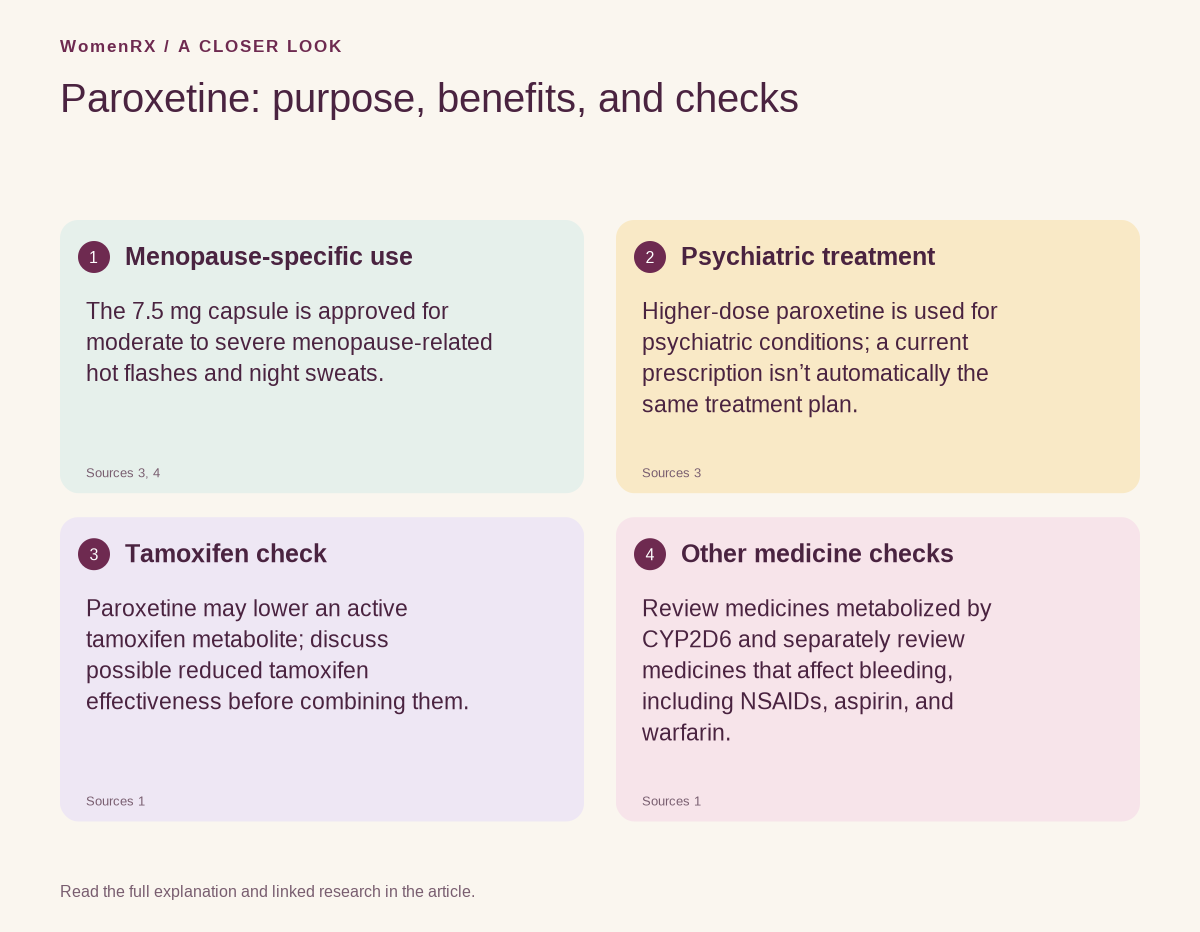
Paroxetine: purpose, benefits, and checks
Menopause-specific use: The 7.5 mg capsule is approved for moderate to severe menopause-related hot flashes and night sweats.34
Psychiatric treatment: Higher-dose paroxetine is used for psychiatric conditions; a current prescription isn’t automatically the same treatment plan.3
Tamoxifen check: Paroxetine may lower an active tamoxifen metabolite; discuss possible reduced tamoxifen effectiveness before combining them.1
Other medicine checks: Review medicines metabolized by CYP2D6 and separately review medicines that affect bleeding, including NSAIDs, aspirin, and warfarin.1
Read the figure as text
These distinctions help separate menopause-specific use from psychiatric treatment and show which medicine questions deserve individual attention.- Menopause-specific use: The 7.5 mg capsule is approved for moderate to severe menopause-related hot flashes and night sweats.34
- Psychiatric treatment: Higher-dose paroxetine is used for psychiatric conditions; a current prescription isn’t automatically the same treatment plan.3
- Tamoxifen check: Paroxetine may lower an active tamoxifen metabolite; discuss possible reduced tamoxifen effectiveness before combining them.1
- Other medicine checks: Review medicines metabolized by CYP2D6 and separately review medicines that affect bleeding, including NSAIDs, aspirin, and warfarin.1
Sources you can check
- BRISDELLE (PAROXETINE) CAPSULE [LEGACY PHARMA USA, INC.] | US prescribing information and patient instructionsAccessed 2026-09-25Return to first citation
- Other medicines for menopause symptoms - NHSAccessed 2026-09-25Return to first citation
- Low-dose paroxetine (7.5 mg) improves sleep in women with vasomotor symptoms associated with menopause.Pinkerton JV, Joffe H, Kazempour K, Mekonnen H, Bhaskar S, Lippman J. · Menopause (New York, N.Y.) · 2015Return to first citation
- Systematic review and network meta-analysis comparing the efficacy of fezolinetant with hormone and nonhormone therapies for treatment of vasomotor symptoms due to menopause.Morga A, Ajmera M, Gao E, Patterson-Lomba O, Zhao A, Mancuso S, Siddiqui E, Kagan R. · Menopause (New York, N.Y.) · 2024Return to first citation
- Management of the Vasomotor Symptoms of Menopause: Twofers in Your Clinical Toolbox.Kling JM, Stuenkel CA, Faubion SS. · Mayo Clinic proceedings · 2024Return to first citation