Menopause Symptoms After Breast Cancer: Options to Discuss
Hot flashes, vaginal symptoms, and urinary changes call for different options, with different safety questions after breast cancer.
Breast cancer treatment can affect ovarian function and bring on menopause symptoms. Nonhormonal options may help hot flashes or vaginal dryness. Local vaginal hormones need an individualized safety discussion, particularly if you take an aromatase inhibitor. Systemic estrogen treatment is a separate, whole-body option that is generally contraindicated after breast cancer. Discuss the specific symptom, your cancer history, and your current medicines with your oncology team. 3 5 6
Treatment-related menopause can happen before, during, or after breast cancer care. The useful first step isn’t to assume every symptom has the same cause. It’s to connect the symptom with the treatment that may be affecting ovarian function or estrogen, then weigh options against your current cancer medicines.
What may be changing, and why
Chemotherapy can damage ovarian follicles, and periods may stop temporarily or permanently. Endocrine treatments can also suppress ovarian or endometrial function. Ovarian suppression and aromatase inhibitors can contribute to low-estrogen symptoms, including hot flashes and vaginal or urinary changes. The effect on your cycle alone doesn’t establish whether ovarian function has recovered or what a symptom’s cause is. 3 5 7
A lumpectomy or mastectomy is breast surgery, not ovarian suppression. If menopause symptoms begin around breast surgery, ask whether chemotherapy, ovarian suppression, or endocrine therapy is also part of the picture. 1 3
Hot flashes: discuss symptom relief and your medicines together
A nonhormonal medicine may be an option for hot flashes. One small, open-label study followed 20 people with hormone-receptor-positive breast cancer taking tamoxifen; 17 were included in the primary symptom analysis. After four weeks, their hot-flash scores had fallen by about half from baseline. The study found no change in measured tamoxifen or metabolite concentrations, but it was a short, single-arm study, not proof that every medicine is appropriate with every treatment. 6
That makes a useful discussion specific: “Could a nonhormonal treatment help my hot flashes, and does it fit with my current cancer medicines?” Bring the names of your prescription medicines and supplements. Don’t stop or change endocrine treatment on your own because of symptoms; ask the oncology team about ways to manage them while protecting the treatment plan.
Vaginal symptoms: start with nonhormonal care
Dryness, burning, itching, discomfort with sex, and pain with penetration can be part of genitourinary syndrome of menopause (GSM), which can follow cancer treatment or anti-estrogen therapy. Vaginal moisturizers and lubricants are nonhormonal options for these symptoms. Minimizing irritants is another approach. 2 3 4
If symptoms continue, ask whether a local prescription option is appropriate for your cancer history and current treatment. Local vaginal treatment is not the same as systemic hormone therapy, but local estrogen can still be absorbed into the body. That distinction matters particularly when you take an aromatase inhibitor, because estrogen exposure is part of the safety discussion. Evidence and recommendations for vaginal hormone treatment in breast cancer survivors remain uncertain; it should not be assumed to be universally safe or universally off limits. 3 5
Systemic estrogen treatment is different: it exposes the body to estrogen rather than targeting vaginal symptoms locally. It is generally contraindicated after breast cancer, so it shouldn’t be treated as the next step when nonhormonal care falls short. That concern does not settle the separate question of whether a specific local vaginal treatment might be appropriate for you. 3 5
A useful question is: “Given my cancer type and whether I take tamoxifen or an aromatase inhibitor, what are the benefits and uncertainties of this specific local option?” If a proposed treatment is a vaginal laser, know that research has often been small or uncontrolled, with limited long-term evidence. It isn’t automatically a proven substitute for other care. 4
Urinary changes deserve their own mention
Urgency, painful urination, and recurrent urinary tract infections can occur among the symptoms associated with GSM. That connection does not establish that menopause is the cause of a particular urinary problem. Tell your care team what you’re experiencing and ask whether the urinary symptom needs its own evaluation, as well as whether GSM treatment is relevant. 4
Make the safety check about the treatment in front of you
Bring three details into the conversation: which symptoms bother you most, whether you’re taking tamoxifen, an aromatase inhibitor, or ovarian suppression, and what you’ve already tried. Then ask what benefit to expect, what is known or uncertain about safety with your specific treatment, and whether an option is local or systemic. A local vaginal treatment and a whole-body hormone treatment should not be treated as interchangeable choices. 3 5
If symptoms are affecting your willingness or ability to continue endocrine therapy, say so plainly. Side effects can interfere with quality of life and treatment continuation, and they deserve attention rather than silent endurance. 3 5
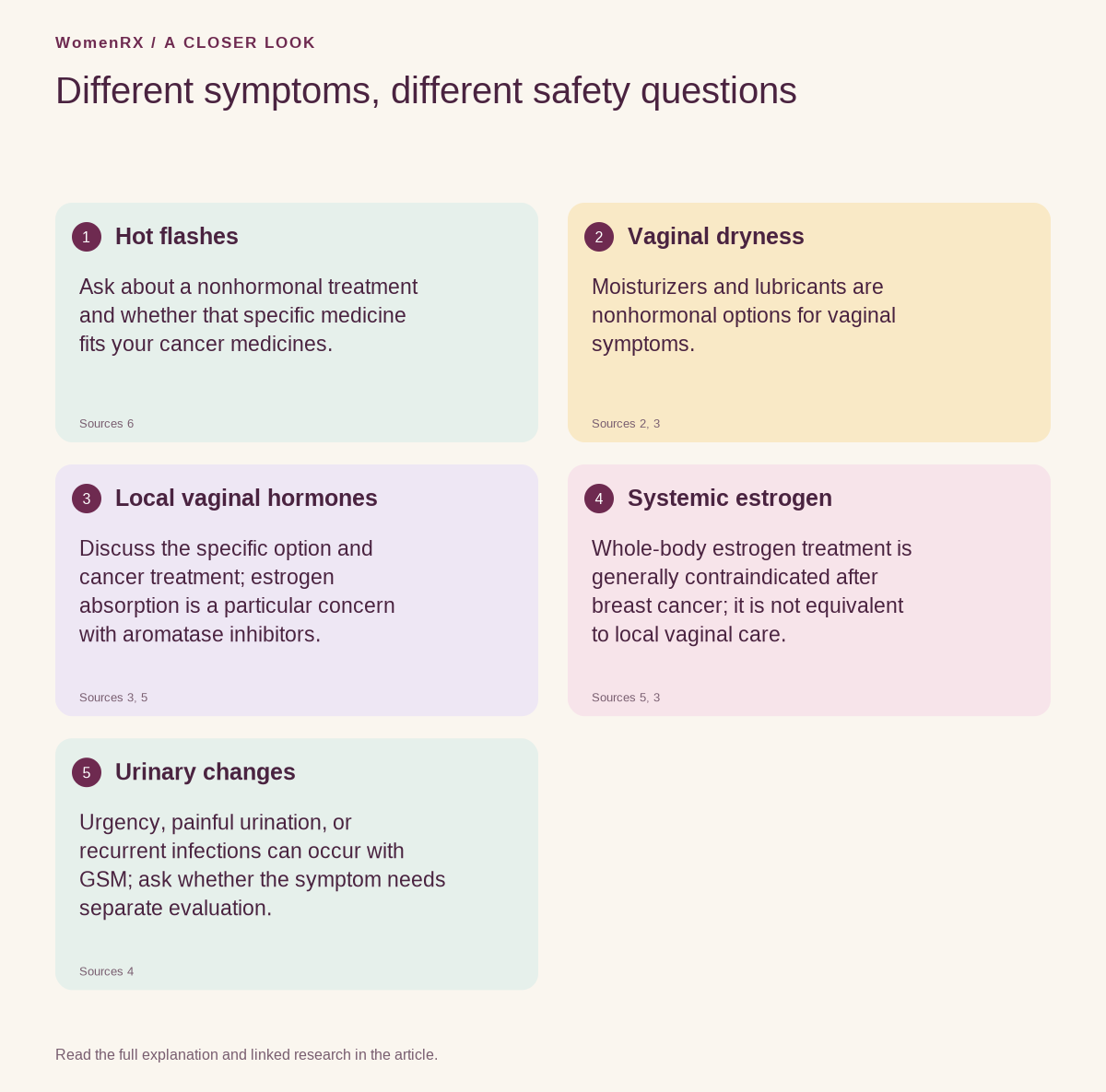
Different symptoms, different safety questions
Hot flashes: Ask about a nonhormonal treatment and whether that specific medicine fits your cancer medicines.6
Vaginal dryness: Moisturizers and lubricants are nonhormonal options for vaginal symptoms.23
Local vaginal hormones: Discuss the specific option and cancer treatment; estrogen absorption is a particular concern with aromatase inhibitors.35
Systemic estrogen: Whole-body estrogen treatment is generally contraindicated after breast cancer; it is not equivalent to local vaginal care.53
Urinary changes: Urgency, painful urination, or recurrent infections can occur with GSM; ask whether the symptom needs separate evaluation.4
Read the figure as text
The symptom and the type of treatment both matter. These approaches shouldn’t be treated as interchangeable.- Hot flashes: Ask about a nonhormonal treatment and whether that specific medicine fits your cancer medicines.6
- Vaginal dryness: Moisturizers and lubricants are nonhormonal options for vaginal symptoms.23
- Local vaginal hormones: Discuss the specific option and cancer treatment; estrogen absorption is a particular concern with aromatase inhibitors.35
- Systemic estrogen: Whole-body estrogen treatment is generally contraindicated after breast cancer; it is not equivalent to local vaginal care.53
- Urinary changes: Urgency, painful urination, or recurrent infections can occur with GSM; ask whether the symptom needs separate evaluation.4
More questions, answered
Are vaginal moisturizers and lubricants hormone treatments?
No. Both are nonhormonal options discussed for vaginal symptoms after breast cancer treatment. If they aren’t helping enough, ask about the benefits and uncertainties of a specific next option rather than assuming all local treatments have the same safety profile. 2 3 5
Does taking tamoxifen mean every hot-flash medicine is safe?
No. A small four-week study found no change in measured tamoxifen or metabolite levels with venlafaxine, but that result does not establish compatibility for every medicine or person. Ask about the specific option and your full medication list. 6
Sources you can check
- Breast Cancer | Breast Cancer Symptoms | MedlinePlusAccessed 2026-09-25Return to first citation
- Strategies for Treating Sexual Health Concerns After Breast and Gynecologic Cancer.Mihulka O, Curran M, Narasimhan RM, Moore JF, Rojas KE. · Journal of minimally invasive gynecology · 2026Return to first citation
- Therapeutic Choices for Genitourinary Syndrome of Menopause (GSM) in Breast Cancer Survivors: A Systematic Review and Update.Merlino L, D'Ovidio G, Matys V, Piccioni MG, Porpora MG, Senatori R, Viscardi MF, Vitale A, Della Rocca C, On Behalf Of Policlinico Umberto I Collaborators. · Pharmaceuticals (Basel, Switzerland) · 2023Return to first citation
- Genitourinary Syndrome of Menopause in Breast Cancer Survivors: Current Perspectives on the Role of Laser Therapy.Cucinella L, Tiranini L, Cassani C, Martella S, Nappi RE. · International journal of women's health · 2023Return to first citation
- Management of genitourinary syndrome of menopause in breast cancer survivors: An update.Lubián López DM. · World journal of clinical oncology · 2022Return to first citation
- Venlafaxine reduces hot flashes in hormone receptor-positive breast cancer patients receiving tamoxifen: a prospective single-arm, open-label trial.Sato R, Kamohara R, Matsuo T, Sawa A, Okazaki M, Hashimoto S, Iguchi-Manaka A, Hara H, Doki K, Mukai Y, Homma M, Ishii R, Shimada K, Bando H. · Breast cancer (Tokyo, Japan) · 2026Return to first citation
- Aromatase InhibitorsFong MK, Patel P. · 2026Return to first citation