Can You Use Vaginal Estrogen After Breast Cancer?
Low-dose vaginal estrogen may be worth discussing for persistent symptoms, but the decision depends in part on your cancer history and current treatment.
Yes, vaginal estrogen can be considered after breast cancer treatment, but it isn’t an automatic yes for everyone. It treats vaginal symptoms locally, with less estrogen generally reaching the rest of the body than with systemic hormone therapy. Studies haven’t settled whether it affects recurrence, particularly for people taking aromatase inhibitors. Your oncology team can help weigh that uncertainty against symptoms that aren’t improving. 2 4 5
Local estrogen answers a different question than systemic therapy
Vaginal estrogen is placed in the vagina to relieve dryness and irritation associated with low estrogen. It acts mainly where it’s used; unlike systemic hormone therapy, little of the medicine generally reaches the rest of the body. It won’t treat symptoms such as hot flashes. 2
That distinction matters after breast cancer. Hormone-therapy risks vary by dose and route, so findings about systemic treatment shouldn’t simply be applied to a low-dose vaginal product. But lower exposure alone cannot establish whether a product affects the chance of cancer returning. 3 4
If dryness or irritation is making sex painful or affecting daily comfort, the potential benefit is concrete. If urinary symptoms are also bothering you, name those separately when you seek care rather than assuming one treatment will address every symptom. The question isn’t just whether a product is called “local”; it’s whether its likely benefit is worth the remaining uncertainty in your treatment situation.
What the safety research can tell you
A systematic review found three relevant randomized trials in breast cancer survivors: two studied vaginal estrogen and one studied vaginal DHEA. None was designed to determine whether these treatments changed breast cancer recurrence. The vaginal-estrogen trials that monitored serious adverse events did not report an increased incidence, and the review found no persistent or significant rise in blood estrogen levels with the preparations studied. Those findings are useful, but they cannot establish long-term recurrence safety. 4
A different kind of study followed survival outcomes in 25,874 women aged 65 or older who had been diagnosed with breast cancer; 1,053 used vaginal estrogen after diagnosis. Use was not associated with worse overall or breast cancer-specific survival. Initial associations suggesting lower mortality disappeared in a time-dependent analysis, which illustrates why this observational result should not be read as a protective effect. The study measured survival, not whether cancer returned, and it may not reflect the situation of a younger person. 6
Taken together, these findings offer some reassurance about the outcomes studied, not a guarantee of no recurrence risk. 4 6
Why your current cancer treatment changes the conversation
If your cancer was hormone receptor-positive, you may be taking endocrine treatment such as tamoxifen or an aromatase inhibitor. These are important details to name, not just “I’ve had breast cancer.” Receptor testing identifies whether cancer tissue has estrogen or progesterone receptors. 1 6
The uncertainty is especially relevant with an aromatase inhibitor. A 2026 review found no association between vaginal estrogen and increased mortality among survivors taking aromatase inhibitors, but described the evidence on recurrence in this group as controversial. It also found no head-to-head studies establishing which vaginal estrogen formulation, if any, is safer for breast cancer survivors. 5
That does not mean tamoxifen users have a proven level of safety, or that everyone taking an aromatase inhibitor faces the same outcome. It means your current medicine and cancer history belong in a discussion of the possible benefit and what remains unknown. 4 5
A useful way to discuss the options
Start with what’s still happening: for example, persistent dryness or irritation, how much it interferes with comfort or sex, and which approaches you’ve already tried. Nonprescription approaches may be part of managing these symptoms; a menopause position statement recommends considering low-dose vaginal estrogen for bothersome symptoms that haven’t been relieved by over-the-counter therapies in the general menopause population. That recommendation does not, on its own, settle safety after breast cancer. 3 4
If symptoms persist, ask the clinician treating them and your oncology team to consider the same specific question: Given my cancer’s receptor status and whether I’m taking tamoxifen, an aromatase inhibitor, or neither, is local vaginal estrogen a reasonable option for these symptoms? You can also ask what benefit to expect for your particular symptoms and how you’ll decide whether an approach is helping. There is no well-supported ranking of vaginal estrogen formulations by recurrence safety for survivors. 5
You don’t have to dismiss symptoms that are affecting your life. You also don’t have to treat “low-dose” as a promise of zero risk. A decision that accounts for both is more useful than a blanket yes or no. 4 5
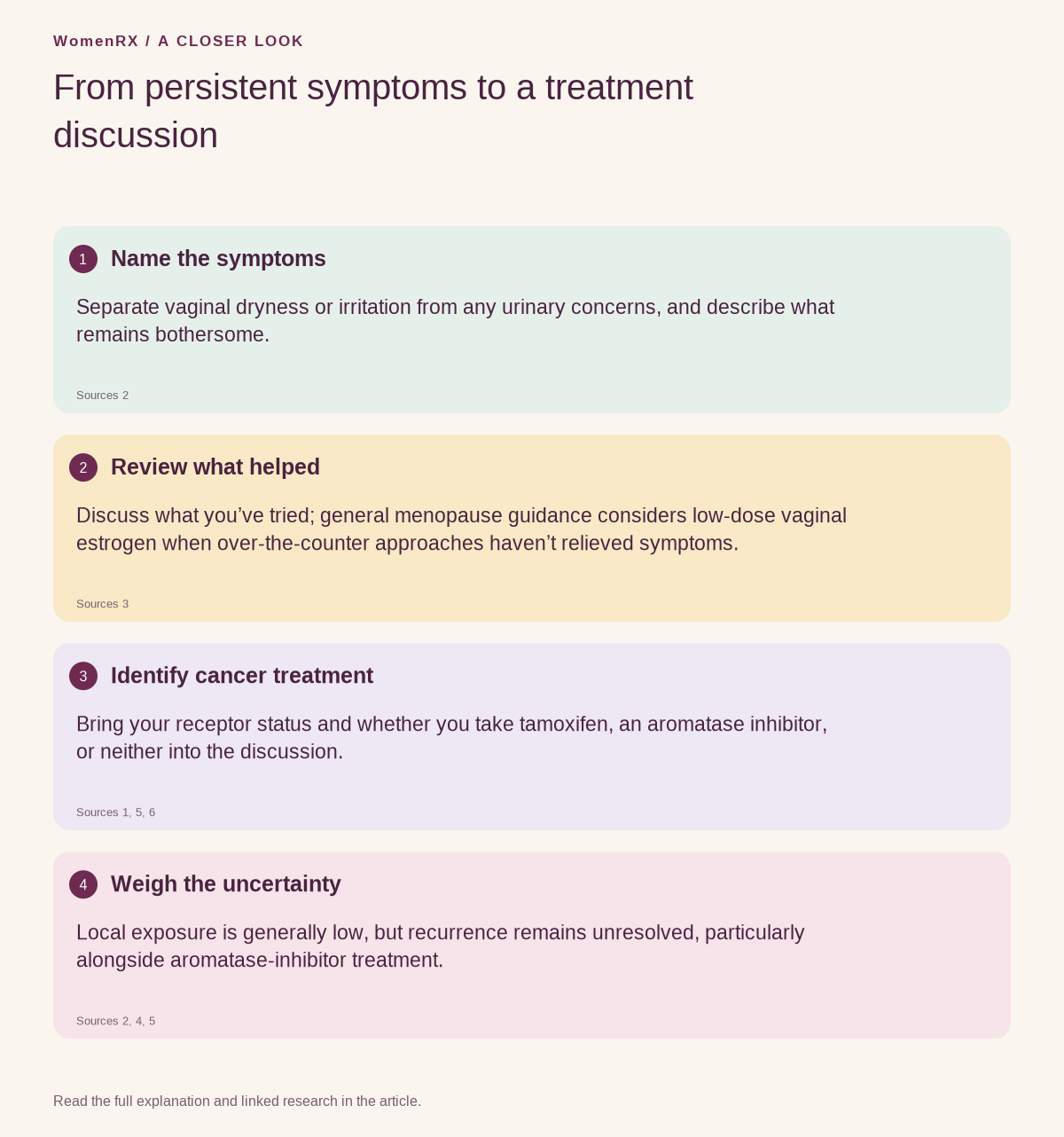
From persistent symptoms to a treatment discussion
Name the symptoms: Separate vaginal dryness or irritation from any urinary concerns, and describe what remains bothersome.2
Review what helped: Discuss what you’ve tried; general menopause guidance considers low-dose vaginal estrogen when over-the-counter approaches haven’t relieved symptoms.3
Identify cancer treatment: Bring your receptor status and whether you take tamoxifen, an aromatase inhibitor, or neither into the discussion.156
Weigh the uncertainty: Local exposure is generally low, but recurrence remains unresolved, particularly alongside aromatase-inhibitor treatment.245
Read the figure as text
A way to keep both symptom relief and cancer-treatment context in view when discussing local estrogen.- Name the symptoms: Separate vaginal dryness or irritation from any urinary concerns, and describe what remains bothersome.2
- Review what helped: Discuss what you’ve tried; general menopause guidance considers low-dose vaginal estrogen when over-the-counter approaches haven’t relieved symptoms.3
- Identify cancer treatment: Bring your receptor status and whether you take tamoxifen, an aromatase inhibitor, or neither into the discussion.156
- Weigh the uncertainty: Local exposure is generally low, but recurrence remains unresolved, particularly alongside aromatase-inhibitor treatment.245
More questions, answered
Does local vaginal estrogen mean none enters the bloodstream?
No. Little generally reaches the rest of the body, and the trials assessed in one review did not find a persistent or significant rise in blood estrogen with the preparations studied. Neither finding means absorption is zero. 2 4
Can survival studies tell me whether my cancer might return?
Not directly. One large observational study found no worse breast cancer-specific survival among users aged 65 or older, but it studied survival rather than recurrence and cannot establish cause and effect. 6
Sources you can check
- Breast Cancer | Breast Cancer Symptoms | MedlinePlusAccessed 2026-09-25Return to first citation
- About vaginal oestrogen - NHSAccessed 2026-09-25Return to first citation
- The 2022 hormone therapy position statement of The North American Menopause Society.“The 2022 Hormone Therapy Position Statement of The North American Menopause Society” Advisory Panel. · Menopause (New York, N.Y.) · 2022Return to first citation
- A systematic review of randomised clinical trials - The safety of vaginal hormones and selective estrogen receptor modulators for the treatment of genitourinary menopausal symptoms in breast cancer survivors.Hussain I, Talaulikar VS. · Post reproductive health · 2023Return to first citation
- Safety of vaginal estrogen in breast cancer survivors: Current evidence on systemic absorption and oncologic outcomes.Mainar LB, Nieto-Pascual L, Bravo EI, García-Ramos BO, Llaneza IP, Vilanova CT, Lloret AM, Alsina JC. · Maturitas · 2026Return to first citation
- Survival Outcomes in Breast Cancer Patients With Use of Vaginal Estrogen Therapy: A SEER Analysis.Mitchel OR, Hsu CP, Millheiser LS, Wapnir IL, Chandak S, Tran M, Erdrich J. · JCO oncology practice · 2026Return to first citation