Magnesium Glycinate: What Benefits Have Actually Been Studied?
Sleep and cramp research can help you assess magnesium claims, but it doesn’t establish a special benefit for glycinate.
For sleep, randomized trials of magnesium supplements have produced inconsistent results, with low to very low certainty. A study of night cramps did not find evidence that magnesium supplements prevented them. Neither finding establishes whether glycinate works for those concerns: the sleep review does not report glycinate-specific results, and the cramp study does not identify the form in its reported findings. 2 4
Start with the symptom, then check the form
Magnesium glycinate is one way to get magnesium. If a claim is about glycinate helping you sleep or easing cramps, though, the useful question is whether the research reports a result for that form. A study of magnesium supplements as a group cannot answer it unless the results are broken out by form.
That distinction doesn’t mean glycinate has been proved ineffective. It means the findings below can inform a decision about magnesium without showing that glycinate has a particular advantage.
For sleep, the overall evidence is uncertain
A systematic review examined 12 randomized trials of oral magnesium for sleep, insomnia, or poor sleep in adults. The trials varied in formulation, participants, duration, and sleep measures. Results were inconsistent, and the reviewers rated the evidence low to very low certainty. They concluded that the findings do not support oral magnesium as a routine insomnia treatment, although some adults might see modest improvements in particular self-reported outcomes. The review’s reported results do not isolate glycinate or provide a separate finding for women. 2
A six-week randomized trial illustrates why one form’s result should stay with that form. It compared magnesium L-threonate with placebo in 100 adults ages 18 to 45 who were dissatisfied with their sleep. Sleep-related impairment improved more on one self-report measure in the L-threonate group, but sleep outcomes measured by a wearable did not differ between groups. The trial included men and women but did not report a separate result for women in the cited findings. It was not a comparison with glycinate. 5
If sleep is your reason for considering glycinate, the research supports a modest expectation at most for magnesium generally, not a promise about this particular form. 2 5
For night cramps, don’t mistake an association for a treatment test
In a population-based study, people reported whether they used magnesium supplements, while researchers assessed sleep and night cramps across study visits. The researchers found no evidence that supplement use prevented night cramps. Supplement users were more likely to report new cramps during follow-up, but this was observational, not a randomized test: it cannot tell us whether magnesium caused cramps or whether people prone to cramps were more likely to take it. The reported findings do not identify the supplement form or give a separate result for women. 4
Magnesium deficiency can cause muscle contractions and cramps. Still, symptomatic deficiency from low dietary intake alone is uncommon in otherwise healthy people. Conditions that affect absorption or increase magnesium loss can change that picture. A cramp by itself doesn’t establish a magnesium deficiency, much less a need for glycinate specifically. 1
What has been studied in postmenopausal women?
A small randomized pilot study involved women with postmenopausal osteoporosis receiving zoledronate. One group also received oral magnesium. The researchers found no significant improvement in the measured pain, anxiety, depression, or sleep outcomes. This is directly a study in postmenopausal women, but it addresses magnesium added to osteoporosis care, not glycinate as a stand-alone treatment for sleep or muscle symptoms. The form is not identified in the reported study details. 3
Comparing bottles without assuming one works better
Magnesium forms differ in absorption, but that doesn’t automatically make one form better for a symptom. The NIH Office of Dietary Supplements describes small studies finding greater bioavailability for aspartate, citrate, lactate, and chloride than for oxide and sulfate. Those comparisons do not establish where glycinate ranks, or show that it improves sleep more than another form. 1
If you’re comparing products, look at the elemental magnesium amount on the Supplement Facts panel. That is the amount of magnesium, not the weight of the entire glycinate compound. The adult upper limit of 350 mg a day applies to magnesium from supplements and medications, not magnesium naturally present in food; it’s a safety limit, not a goal. Larger supplemental amounts can cause diarrhea, nausea, or abdominal cramping, and impaired kidney function raises the risk of magnesium toxicity. 1
If your concern is getting enough magnesium rather than treating a specific symptom, food offers another starting point: legumes, nuts, seeds, whole grains, and leafy greens are sources. If you have persistent cramps or suspect a deficiency, the cause matters more than the form advertised on the bottle. 1
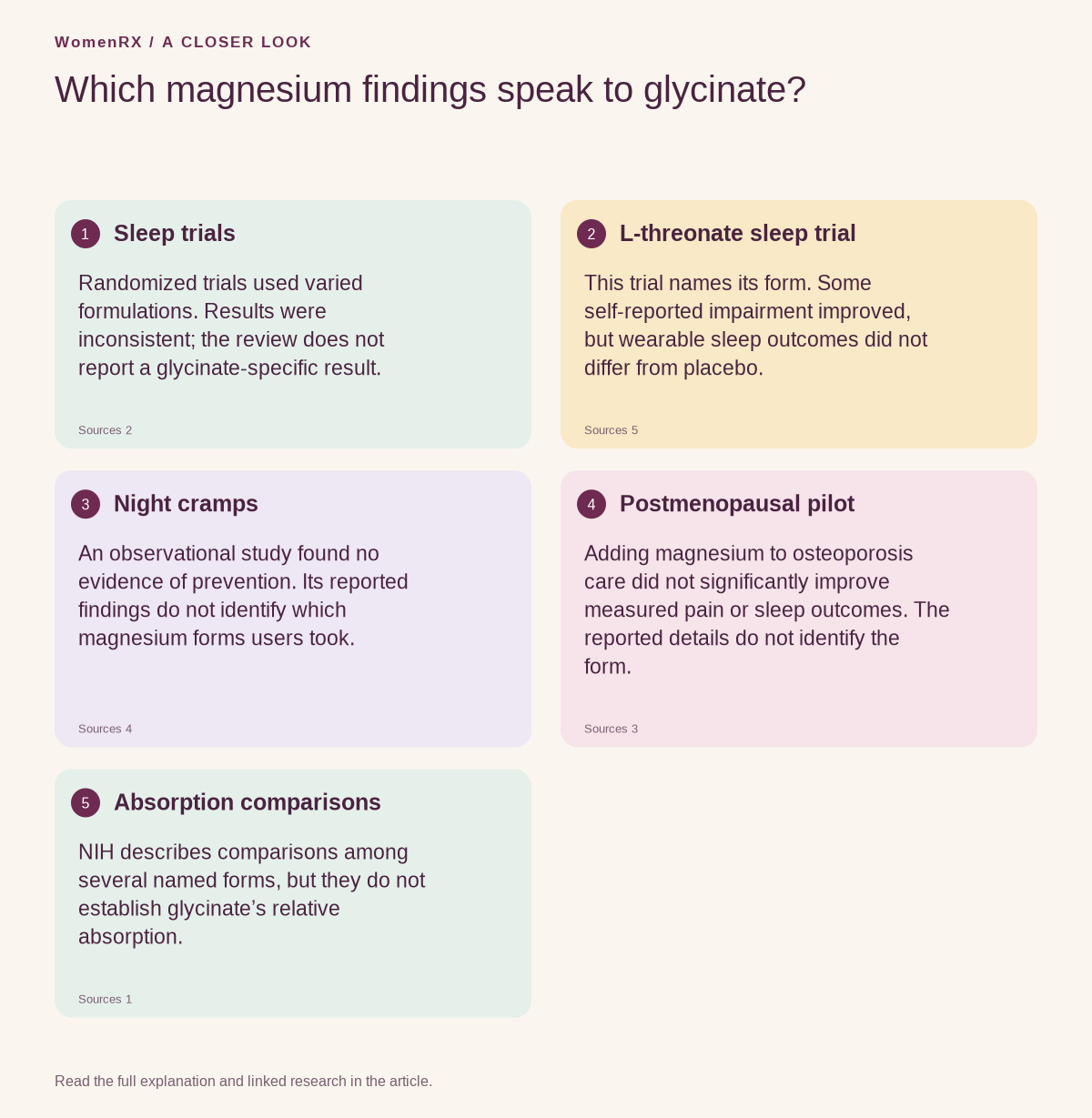
Which magnesium findings speak to glycinate?
Sleep trials: Randomized trials used varied formulations. Results were inconsistent; the review does not report a glycinate-specific result.2
L-threonate sleep trial: This trial names its form. Some self-reported impairment improved, but wearable sleep outcomes did not differ from placebo.5
Night cramps: An observational study found no evidence of prevention. Its reported findings do not identify which magnesium forms users took.4
Postmenopausal pilot: Adding magnesium to osteoporosis care did not significantly improve measured pain or sleep outcomes. The reported details do not identify the form.3
Absorption comparisons: NIH describes comparisons among several named forms, but they do not establish glycinate’s relative absorption.1
Read the figure as text
The identified form and study design determine what each result can tell you about a glycinate claim.- Sleep trials: Randomized trials used varied formulations. Results were inconsistent; the review does not report a glycinate-specific result.2
- L-threonate sleep trial: This trial names its form. Some self-reported impairment improved, but wearable sleep outcomes did not differ from placebo.5
- Night cramps: An observational study found no evidence of prevention. Its reported findings do not identify which magnesium forms users took.4
- Postmenopausal pilot: Adding magnesium to osteoporosis care did not significantly improve measured pain or sleep outcomes. The reported details do not identify the form.3
- Absorption comparisons: NIH describes comparisons among several named forms, but they do not establish glycinate’s relative absorption.1
More questions, answered
Does a normal blood magnesium result rule out low magnesium?
Not necessarily. A serum magnesium test is commonly used, but most magnesium is inside cells or in bone, so the result does not accurately reflect total-body magnesium. The result needs to be considered alongside the clinical picture. 1
Sources you can check
- Magnesium - Health Professional Fact SheetAccessed 2026-09-25Return to first citation
- Magnesium Supplementation for Sleep in Adults: A Systematic Review of Randomized Controlled Trials.Lopresti AL, Smith SJ, Drummond PD. · Journal of dietary supplements · 2026Return to first citation
- Quantitative sensory testing of pain in osteoporosis: a pilot randomized clinical trial with magnesium supplementation.Pickering ME, Morel V, Nicolas M, Dualé C, Sortais E, Graven-Nielsen T, Pereira B, Pickering G. · Aging clinical and experimental research · 2026Return to first citation
- Magnesium supplements, sleep quality, and nocturnal leg cramps: a combination of cross-sectional and prospective studies.Stadie N, Heinzer R, Marques-Vidal P. · European journal of nutrition · 2026Return to first citation
- The effects of magnesium L-threonate (Magtein®) on cognitive performance and sleep quality in adults: a randomised, double-blind, placebo-controlled trial.Lopresti AL, Smith SJ. · Frontiers in nutrition · 2025Return to first citation