Magnesium Glycinate in Perimenopause: What the Evidence Says
Being over 40 or in perimenopause doesn’t, by itself, show that you need magnesium glycinate.
There’s no clear reason to choose magnesium glycinate just because you’re over 40 or in perimenopause. Research on magnesium for sleep is mixed and uses different forms; it doesn’t establish that glycinate treats perimenopause symptoms. One trial in menopausal women tested a multi-ingredient supplement containing magnesium, so it can’t show whether magnesium helped or whether glycinate would work. Start with the symptom and your overall magnesium intake, not your age alone. 351
Start with the symptom, not your age
Magnesium has many roles in the body, but that doesn’t mean taking more will relieve a symptom. For women, the recommended total intake is 320 mg a day at ages 31-50 and 320 mg at 51 and older. These amounts include magnesium from food, drinks, supplements, and medicines. The guidance doesn’t set a higher target for perimenopause. 1
So if you’re considering glycinate for sleep, muscle cramps, or another concern, the useful question is whether there’s evidence for that particular symptom and that form of magnesium. A supplement’s name can sound specific, but results from a different magnesium form, or from a blend of ingredients, don’t establish that glycinate works.
What the sleep research can and can’t tell you
Sleep is a common reason people consider magnesium. A 2026 systematic review of randomized trials in adults found inconsistent results across sleep outcomes and magnesium forms. The reviewers rated the evidence low to very low and concluded that it doesn’t support magnesium as a routine insomnia treatment. That is evidence about magnesium supplements broadly, not proof for magnesium glycinate or for perimenopause specifically. 3
A separate review covered three small trials in 151 older adults. Two trials enrolled people with insomnia or poor sleep; the third involved 12 healthy older volunteers. The trials used magnesium oxide or citrate, not glycinate, and had moderate-to-high risk of bias, with low-to-very-low-quality evidence. Their results shouldn’t be treated as a direct answer for someone in perimenopause choosing a different form. 4
There is also a randomized trial in perimenopausal and postmenopausal women with sleep disturbance and minimal hot flashes and night sweats. The tested supplement combined magnesium with several other ingredients, so the trial can’t isolate magnesium’s effect. The study is relevant as an example of research in menopausal-age women, but it doesn’t establish that magnesium glycinate treats menopausal sleep problems. 5
In other words, a study that includes women in this life stage is not automatically evidence for every ingredient it tests, and a study of magnesium isn’t automatically evidence for every magnesium form.
If you’re weighing a supplement
A practical first step is to look at your usual intake. Magnesium-rich foods include leafy greens, beans, nuts, seeds, and whole grains. If you compare supplements, check the amount of elemental magnesium on the Supplement Facts panel; that’s the amount of magnesium, not the total weight of the glycinate compound. 1
Also count magnesium from medicines such as some antacids and laxatives. For adults, the upper limit of 350 mg a day applies to magnesium from supplements and medicines, not magnesium naturally present in food. Higher supplemental amounts can cause diarrhea, nausea, and abdominal cramping. Kidney problems matter because reduced kidney function can make it harder to clear excess magnesium. 1
Magnesium can also interfere with absorption of some medicines. For example, it can reduce absorption of oral bisphosphonates and interact with tetracycline or quinolone antibiotics. If you take one of these, check with your pharmacist or prescriber about how to separate it from a magnesium product rather than guessing at timing. 1
If sleep is the reason you’re considering glycinate, keep the problem itself in view: trouble falling asleep, repeated waking, or poor-quality sleep can have different causes. Insomnia can be related to stress, medicines, other health conditions, or sleep disorders, among other factors. A supplement aimed at magnesium won’t necessarily address those causes. 2
Bottom line: Glycinate may be a form you’re considering, but age or perimenopause alone isn’t an established reason to take it. Decide based on the symptom, your diet and other magnesium sources, and any relevant health or medication considerations. The evidence for magnesium and sleep is uncertain, and it doesn’t establish a glycinate-specific benefit in perimenopause. 135
Check the evidence before choosing glycinate
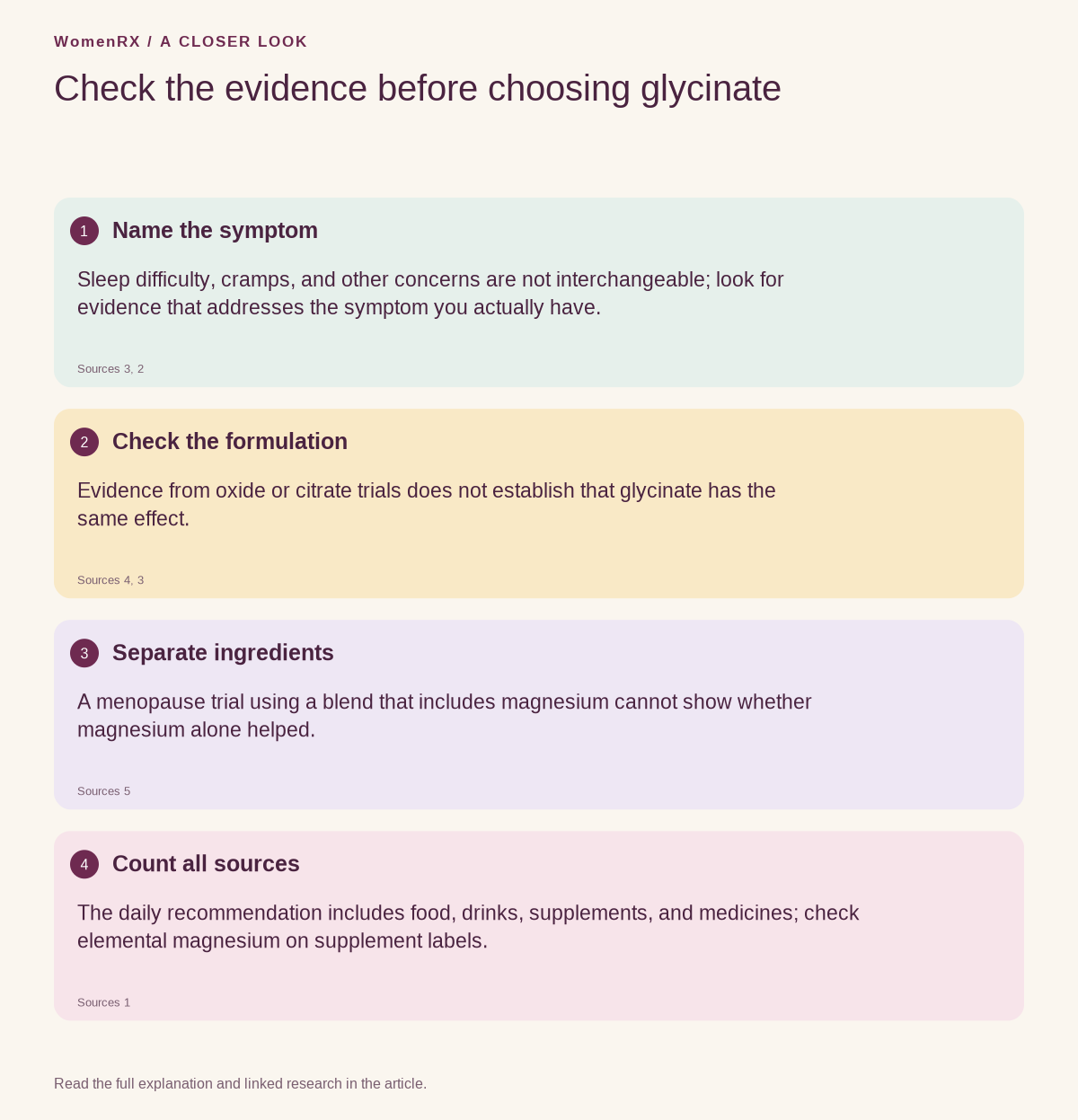
Name the symptom: Sleep difficulty, cramps, and other concerns are not interchangeable; look for evidence that addresses the symptom you actually have.32
Check the formulation: Evidence from oxide or citrate trials does not establish that glycinate has the same effect.43
Separate ingredients: A menopause trial using a blend that includes magnesium cannot show whether magnesium alone helped.5
Count all sources: The daily recommendation includes food, drinks, supplements, and medicines; check elemental magnesium on supplement labels.1
Read the figure as text
A symptom-first checklist to distinguish a relevant result from a study that tested another magnesium form or a multi-ingredient product. It is a decision aid, not a diagnostic tool.- Name the symptom: Sleep difficulty, cramps, and other concerns are not interchangeable; look for evidence that addresses the symptom you actually have.32
- Check the formulation: Evidence from oxide or citrate trials does not establish that glycinate has the same effect.43
- Separate ingredients: A menopause trial using a blend that includes magnesium cannot show whether magnesium alone helped.5
- Count all sources: The daily recommendation includes food, drinks, supplements, and medicines; check elemental magnesium on supplement labels.1
More questions, answered
Does a magnesium study in menopausal women prove glycinate works?
No. The trial in perimenopausal and postmenopausal women used a supplement containing magnesium plus several other ingredients, so it can’t show whether magnesium was responsible for the result or establish a benefit from magnesium glycinate. 5
Does the daily magnesium recommendation mean I should take that amount as a supplement?
No. The recommended intake is a total from food, drinks, supplements, and medicines. The separate adult upper limit of 350 mg applies to magnesium from supplements and medicines, not magnesium naturally found in food. 1
Sources you can check
- Magnesium - Health Professional Fact SheetAccessed 2026-09-25Return to first citation
- Insomnia | MedlinePlusAccessed 2026-09-25Return to first citation
- Magnesium Supplementation for Sleep in Adults: A Systematic Review of Randomized Controlled Trials.Lopresti AL, Smith SJ, Drummond PD. · Journal of dietary supplements · 2026Return to first citation
- Oral magnesium supplementation for insomnia in older adults: a Systematic Review & Meta-Analysis.Mah J, Pitre T. · BMC complementary medicine and therapies · 2021Return to first citation
- Nonsedating neurotransmitter-modulating supplement for nonvasomotor sleep disturbance in menopause.Carbonneau S, Mysliwiec V, Doyle AL, Stratton M, Dweck A, Tartar J, Alesi M, Mason L, Komorowski J, VanDusseldorp TA. · Menopause (New York, N.Y.) · 2026Return to first citation