Maca or Ashwagandha? Compare Them by Concern
Ashwagandha has short-term stress and sleep trials, while evidence for maca in women is harder to separate from other ingredients.
For stress or sleep, ashwagandha has short-term placebo-controlled evidence in adults, but the results don’t establish an effect specifically in women. Both supplements appear in research on mood and perceived feelings, without a direct comparison. For fertility, a study in women tested maca only in a blend, so it can’t show what maca does alone. These findings don’t establish a safer or more effective overall choice. 1 3 4
The better fit depends on what you want help with
Ashwagandha has traditionally been described as an “adaptogen,” but that label doesn’t establish its effects or make it comparable to maca. The practical comparison is by concern: ashwagandha has been studied for stress and sleep; the women’s reproductive claim for maca is harder to interpret because the study described here tested it alongside other ingredients. Neither supplement has a demonstrated universal advantage for women. 1 3
These are separate lines of research, so their results can’t show that one supplement is more effective than the other. The participants, products, and outcomes differ.
For stress or sleep, ashwagandha has relevant trials
A 2021 review summarized seven placebo-controlled studies of ashwagandha for stress or anxiety. The studies enrolled 491 adults in India, including people with self-reported high stress or anxiety and people with diagnosed anxiety disorders. They lasted six to eight weeks, and the review found improvements in reported stress and anxiety compared with placebo. The review information does not give a women-only result. 1
What about maca for the same concern? A scoping review of randomized trials identified both maca and ashwagandha as ingredients worth further study for mood and perceived feelings. That is a broader category than stress or a diagnosed anxiety disorder. The review does not provide a direct comparison between the two or establish that maca works as well as ashwagandha for stress. 4
Sleep has also been studied, though the evidence is limited. A review of five trials involving 372 adults found a small improvement in sleep with ashwagandha compared with placebo. Participants were followed for six to twelve weeks; some had insomnia and some described themselves as healthy. The studies were all conducted in India, and the reported results don’t establish how well the supplement works specifically for women. 1
The scoping review singled out ashwagandha, but not maca, among ingredients considered promising for further sleep research. That is not a head-to-head finding or proof that maca cannot help with sleep. Together with the ashwagandha sleep trials, it leaves a clearer short-term sleep signal for ashwagandha, not a measured advantage over maca. 1 4
These findings are relevant if your goal is stress or sleep. They don’t show that every product works the same way: trials used different preparations, and results from one extract can’t automatically be applied to another. 1
Maca’s women-specific claims are harder to assess
A study of 189 women trying to conceive reported pregnancies among participants using a blend that contained maca, vitex, and active folate. Both study groups received that blend; one group also received a separate vitamin and mineral product. Because maca was not tested on its own, the study can’t show that maca caused the pregnancies or changes in ovulation. 3
That distinction matters if you’re considering maca for fertility. A result from a combination product isn’t evidence that maca alone improves fertility. The study also doesn’t establish maca as a treatment for infertility. This study addresses fertility, not menopause, and its blend design can’t establish maca’s individual effect on fertility. Ashwagandha’s stress and sleep trials don’t answer the fertility question either. 1 3
Safety isn’t a tie-breaker you can assume
Ashwagandha has been studied for short periods, generally up to about three months. Reported side effects are often mild, such as nausea, loose stools, or drowsiness, but there are reports of liver injury, and its longer-term safety isn’t known. It may affect thyroid function and interact with thyroid medicines, sedatives, immunosuppressants, blood-pressure medicines, and diabetes medicines. 1
Pregnancy and breastfeeding call for particular caution with ashwagandha. Some experts advise against its use during pregnancy and breastfeeding; evidence about pregnancy risk is not definitive, but uncertainty isn’t proof of safety. MedlinePlus advises checking with your care team before taking herbs or supplements during pregnancy. 1 2
In the maca-containing fertility study, researchers reported no side effects in either group. But both groups took a blend containing maca, vitex, and active folate, so that finding doesn’t establish maca’s individual or broader safety. The study doesn’t establish whether maca is safe during pregnancy or breastfeeding, and it provides no basis for comparing maca’s risks with ashwagandha’s. 3
A practical way to choose
Start with the outcome, not the supplement’s reputation. For stress or sleep, ashwagandha has short-term human trial evidence, but it is not specific to women. Research on mood and perceived feelings mentions both supplements, but doesn’t tell you which works better. For fertility, neither the maca blend study nor ashwagandha’s stress and sleep trials establish a benefit from either supplement alone. If you take thyroid, sedating, blood-pressure, diabetes, or immune-suppressing medicine, ashwagandha’s potential interactions are relevant to your decision. 1 3 4
If a product promises fertility, hormone, or menopause results, check whether the cited study tested that exact ingredient by itself, in women, and for the outcome you care about. A study of a blend, or an adult study without separately reported women’s results, can’t answer those questions on its own. 1 3
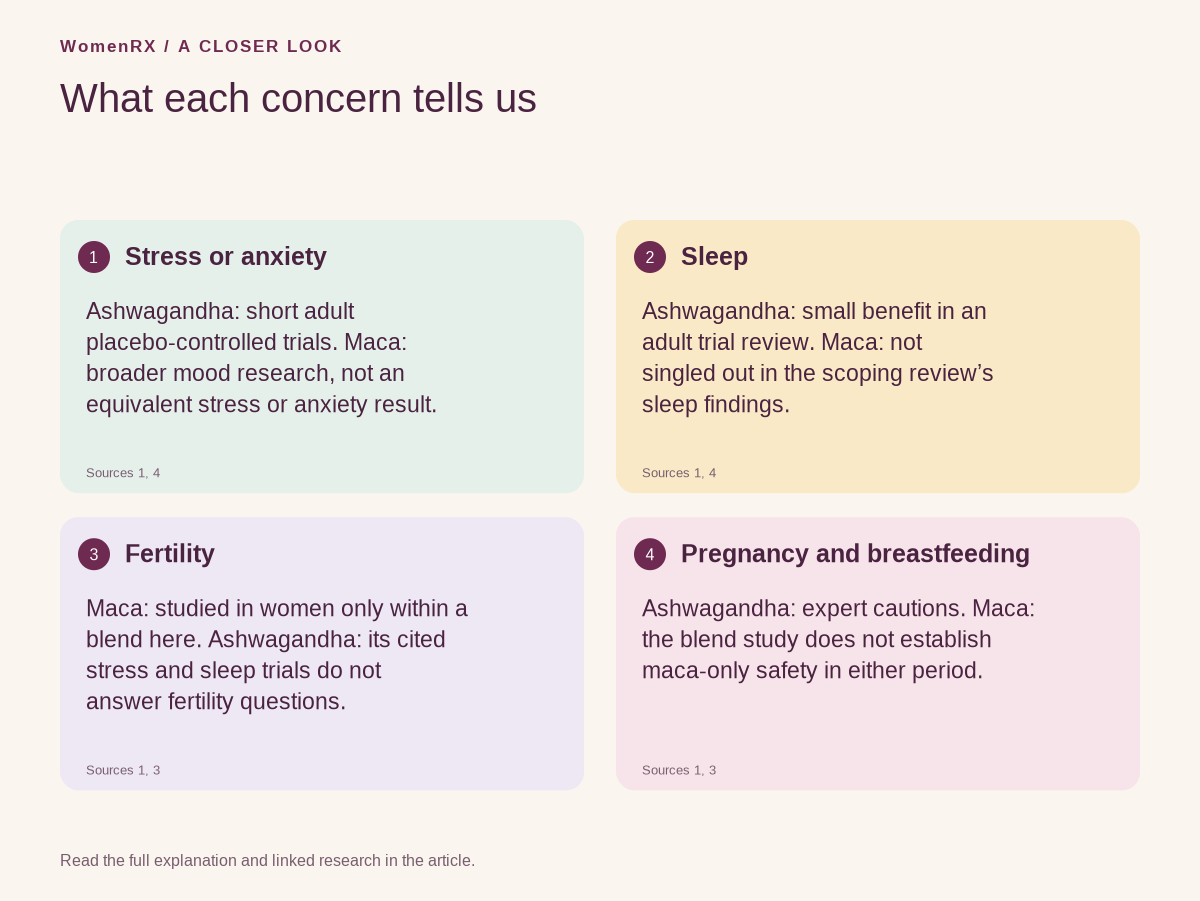
What each concern tells us
Stress or anxiety: Ashwagandha: short adult placebo-controlled trials. Maca: broader mood research, not an equivalent stress or anxiety result.14
Sleep: Ashwagandha: small benefit in an adult trial review. Maca: not singled out in the scoping review’s sleep findings.14
Fertility: Maca: studied in women only within a blend here. Ashwagandha: its cited stress and sleep trials do not answer fertility questions.13
Pregnancy and breastfeeding: Ashwagandha: expert cautions. Maca: the blend study does not establish maca-only safety in either period.13
Read the figure as text
Read each row across both supplements. The studies differ in outcome and design, and none of these findings directly compares maca with ashwagandha.- Stress or anxiety: Ashwagandha: short adult placebo-controlled trials. Maca: broader mood research, not an equivalent stress or anxiety result.14
- Sleep: Ashwagandha: small benefit in an adult trial review. Maca: not singled out in the scoping review’s sleep findings.14
- Fertility: Maca: studied in women only within a blend here. Ashwagandha: its cited stress and sleep trials do not answer fertility questions.13
- Pregnancy and breastfeeding: Ashwagandha: expert cautions. Maca: the blend study does not establish maca-only safety in either period.13
More questions, answered
Does maca improve fertility in women?
The study described here tested a blend of maca, vitex, and active folate, not maca alone. It therefore can’t establish that maca improves fertility or caused the reported pregnancies. The researchers reported no side effects in either group, but that finding also can’t establish maca-only safety. 3
Is ashwagandha safe while breastfeeding?
Its safety during breastfeeding isn’t established, and the NIH Office of Dietary Supplements notes that some experts advise against its use during this period. 1
What about maca during pregnancy or breastfeeding?
The maca-containing fertility study doesn’t establish safety in either period. Its report of no side effects in women taking a blend cannot answer what happens with maca alone during pregnancy or breastfeeding. 3
Sources you can check
- Ashwagandha: Is it helpful for stress, anxiety, or sleep? - Health Professional Fact SheetAccessed 2026-09-25Return to first citation
- Pregnancy and Medicines | MedlinePlusAccessed 2026-09-25Return to first citation
- A Patented Blend Consisting of a Combination of Vitex agnus-castus Extract, Lepidium meyenii (Maca) Extract and Active Folate, a Nutritional Supplement for Improving Fertility in Women.Antoine E, Chirila S, Teodorescu C. · Maedica · 2019Return to first citation
- The Role of Dietary Ingredients in Mental Energy - A Scoping Review of Randomized Controlled Trials.Nieman KM, Zhu Y, Tucker M, Koecher K. · Journal of the American Nutrition Association · 2024Return to first citation