Iron-Rich Foods: What to Eat and When to Get Tested
Beans, fortified grains, meat, and seafood all contribute iron, but the best next step depends on your life stage, bleeding, and whether a test shows deficiency.
For everyday meals, include iron-containing foods such as beans, lentils, tofu, fortified cereal, meat, or seafood. Plant-based iron is absorbed less readily, so pairing it with a vitamin-C-containing food can help; meat, poultry, or seafood can also boost absorption from plant foods. Heavy periods, pregnancy, or symptoms such as persistent fatigue are reasons to discuss testing, not to assume you need a supplement. 12
Choose foods by type and serving
Iron comes in two forms. Heme iron is found in meat, seafood, and poultry and is generally easier for the body to absorb. Plant foods and iron-fortified foods provide nonheme iron. A meal can contain both forms, and animal foods can also help your body absorb some nonheme iron. 1
Here are useful serving-size comparisons. Amounts vary by food and preparation, so use the serving on the label or in the table as your guide.
| Food | Serving | Iron | Type |
|---|---|---|---|
| Fortified breakfast cereal (fortified to 100% Daily Value) | 1 serving | 18 mg | Nonheme |
| Eastern oysters, cooked with moist heat | 3 oz | 8 mg | Heme and nonheme |
| Canned white beans | 1 cup | 8 mg | Nonheme |
| Cooked lentils | ½ cup | 3 mg | Nonheme |
| Firm tofu | ½ cup | 3 mg | Nonheme |
| Beef, braised bottom round, fat trimmed | 3 oz | 2 mg | Heme and nonheme |
| Chickpeas, boiled and drained | ½ cup | 2 mg | Nonheme |
These are examples, not a ranking of what you should eat. The cereal figure applies to a serving fortified to 100% of the Daily Value; other cereals may contain less, so check the label. 1
Make plant-based iron work in a meal
Vitamin C helps your body absorb nonheme iron. Try pairing beans, lentils, tofu, or iron-fortified cereal with a vitamin-C-containing fruit or vegetable. For example, serve lentils alongside seafood: animal foods in the same meal can also improve absorption of nonheme iron. 1
Some foods contain compounds that can reduce nonheme iron absorption. Phytate is found in beans and grains, and some cereals and legumes contain polyphenols. That doesn’t make these foods poor choices: they still contribute iron and other nutrients. In a typical Western diet, the effects of absorption enhancers and inhibitors are often smaller than they appear when individual foods are studied alone. You don’t need to avoid beans or grains to get iron from them. 1
Your needs change with life stage
Iron needs are higher during the years when menstrual blood loss is common, and pregnancy increases iron needs further. The U.S. Recommended Dietary Allowance is 18 mg a day for women ages 19-50, 27 mg during pregnancy, and 9 mg while breastfeeding for ages 19-50. For breastfeeding women ages 14-18, it is 10 mg a day. For women age 51 and older, it is 8 mg a day. These are reference amounts for healthy people, not a diagnosis or a treatment plan. 1
If you eat a vegetarian diet, iron from food is all nonheme, which is less readily absorbed. The National Academies’ reference allowances account for this by setting iron needs 1.8 times higher for people following vegetarian diets. Combining plant sources with vitamin-C-containing foods can help make meals more absorption-friendly. 1
Menopause is not a reason to start taking iron automatically. The reference amount changes by age, and individual needs can differ. If a blood test shows deficiency after your periods have stopped, it’s worth looking for a cause rather than assuming that eating more iron will address it. Blood loss and problems absorbing iron are among the possible reasons for low iron. 12
Pregnancy deserves separate attention: iron requirements rise, and recommendations for routine screening and preventive supplementation in people without symptoms are not identical across U.S. groups. The NIH fact sheet describes ACOG recommendations for anemia screening during pregnancy and notes the USPSTF’s finding that evidence is insufficient to assess routine screening and supplementation in asymptomatic pregnant women. Ask about your own prenatal plan, especially if you have symptoms or a history that may affect iron status. 1
When food isn’t the whole answer
Iron deficiency can develop before anemia appears, and fatigue alone can’t tell you whether your iron is low. Fatigue, weakness, and trouble concentrating can occur with iron-deficiency anemia, but testing is needed to assess iron status. Clinicians may use ferritin, which reflects iron stores, along with blood measures such as hemoglobin; ferritin can be affected by inflammation, so results may need context. 12
Heavy menstrual bleeding raises the risk of iron deficiency. If you often need to change a pad or tampon every one to two hours, need to use two types of period products together, or bleeding is interfering with daily life, bring it up with a clinician. Those signs don’t diagnose iron deficiency, but they make it useful to discuss both the bleeding and whether testing is appropriate. 13
Food choices can help you meet everyday iron needs. But if testing confirms iron deficiency or iron-deficiency anemia, food alone may not be the treatment: iron supplements are commonly used, and the cause of the deficiency matters. Don’t start an iron supplement just because you feel tired; extra iron can cause side effects, and not everyone needs it. 12
Iron in food: source, serving, pairing
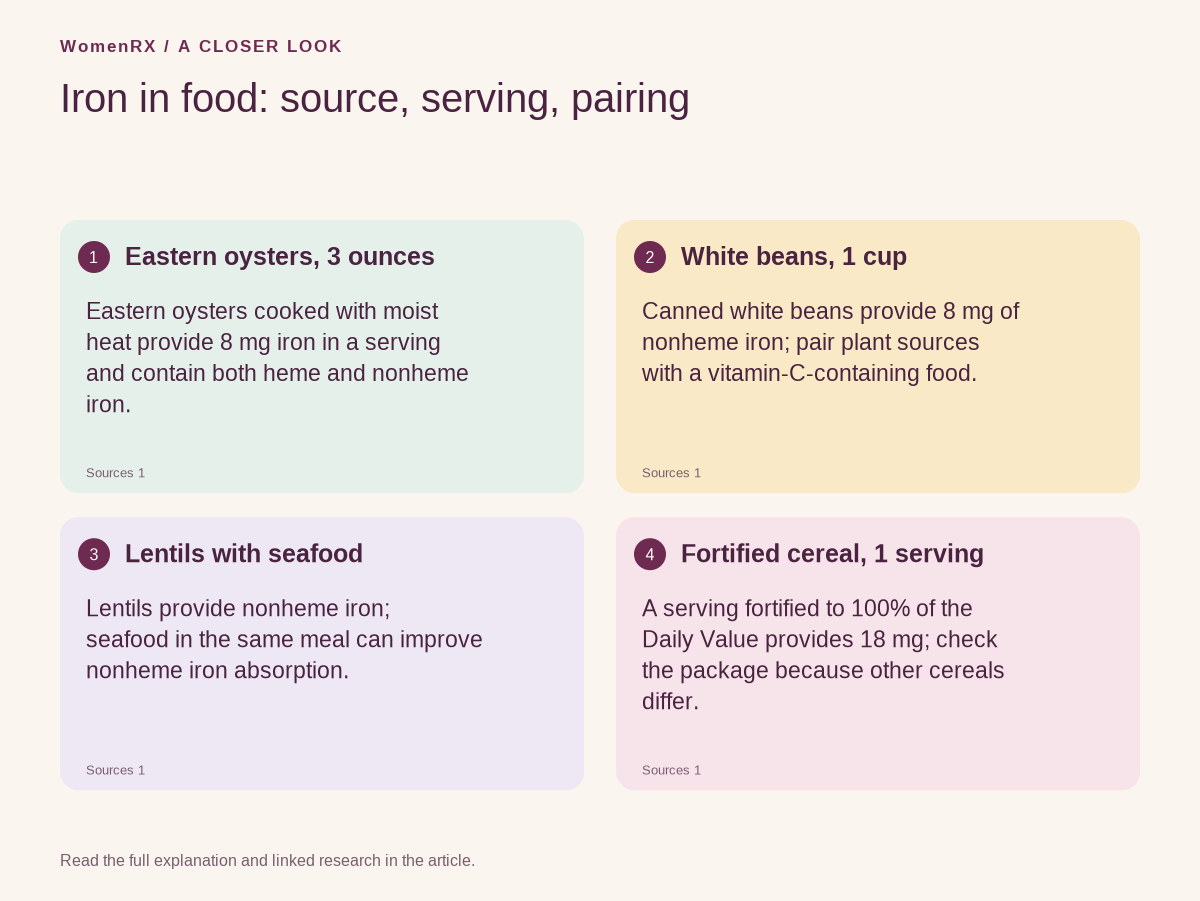
Eastern oysters, 3 ounces: Eastern oysters cooked with moist heat provide 8 mg iron in a serving and contain both heme and nonheme iron.1
White beans, 1 cup: Canned white beans provide 8 mg of nonheme iron; pair plant sources with a vitamin-C-containing food.1
Lentils with seafood: Lentils provide nonheme iron; seafood in the same meal can improve nonheme iron absorption.1
Fortified cereal, 1 serving: A serving fortified to 100% of the Daily Value provides 18 mg; check the package because other cereals differ.1
Read the figure as text
Compare representative heme and nonheme sources by serving, then see how meal choices can support nonheme iron absorption.- Eastern oysters, 3 ounces: Eastern oysters cooked with moist heat provide 8 mg iron in a serving and contain both heme and nonheme iron.1
- White beans, 1 cup: Canned white beans provide 8 mg of nonheme iron; pair plant sources with a vitamin-C-containing food.1
- Lentils with seafood: Lentils provide nonheme iron; seafood in the same meal can improve nonheme iron absorption.1
- Fortified cereal, 1 serving: A serving fortified to 100% of the Daily Value provides 18 mg; check the package because other cereals differ.1
More questions, answered
Can I get iron from plant foods alone?
Yes. Beans, lentils, tofu, nuts, vegetables, and fortified grains provide nonheme iron. It is less readily absorbed than heme iron, so pairing these foods with a vitamin-C-containing food can help. 1
Does spinach have as much usable iron as its number suggests?
Spinach contains iron, but its iron is nonheme and absorption can be limited by compounds in the food, including polyphenols. A listed iron amount doesn’t tell you exactly how much your body absorbs. 1
Sources you can check
- Iron - Health Professional Fact SheetAccessed 2026-09-25Return to first citation
- Iron: MedlinePlusAccessed 2026-09-25Return to first citation
- Heavy periods - NHSAccessed 2026-09-25Return to first citation