Yeast-Like Symptoms Around Menopause: When to Get Tested
Itching or discharge alone can’t confirm a yeast infection, and menopause-related vaginal changes can add another possible explanation.
Around perimenopause and menopause, itching or discharge isn’t enough to tell whether Candida is causing an infection. Vaginal symptoms overlap across several conditions, while postmenopausal genitourinary changes can include dryness, painful sex, and urinary symptoms. If symptoms keep returning, don’t keep assuming they’re yeast: ask about an exam and testing, such as microscopy or culture, to help guide treatment. 3 4 5
Start with the pattern, not the label
Itching, soreness, and changes in discharge can happen with vulvovaginal candidiasis (a yeast infection), but those symptoms aren’t specific to Candida. Other vaginal conditions can cause changes too. For example, discharge that smells fishy or looks green or yellow can point to a different cause, but appearance alone can’t diagnose it. 1 3
That distinction matters around menopause. After menopause, genitourinary syndrome of menopause (GSM) can involve vaginal dryness, pain during sex, and urinary symptoms. These symptoms suggest a possible menopause-related pattern, but they don’t rule yeast in or out. Studies in postmenopausal women do not establish how often GSM-related changes explain symptoms during perimenopause. 4 5
A practical path from symptoms to next steps
One episode with familiar symptoms: Symptoms can raise the possibility of yeast, but they can’t confirm it. If this is your first episode, the symptoms feel different from what you’ve had before, or you’re unsure of the cause, seek an evaluation rather than choosing treatment based on symptoms alone. 1 3
Symptoms that return or don’t settle: Arrange an evaluation instead of repeatedly treating each flare as yeast. Ask whether an exam and vaginal testing make sense. Microscopy can look for yeast; culture can help identify Candida species. Testing still needs to be interpreted alongside symptoms: Candida can be present without causing an active infection, and detecting it doesn’t automatically prove it’s the reason you feel uncomfortable. 3
Discharge with a different pattern: A strong or fishy smell, a new color or texture, or discharge with pelvic pain or bleeding can have causes other than yeast. Those changes are a reason to get checked rather than relying on an antifungal. 1
A pattern of dryness, painful sex, or urinary symptoms after menopause: Bring up GSM as another possibility. Treatment decisions depend on what’s causing the symptoms; evidence that a treatment helps GSM symptoms does not mean it treats Candida. For instance, a review of trials in postmenopausal women found vaginal DHEA improved dryness and painful sex, but those findings concern GSM, not yeast infection. 4
Why repeating antifungals can miss the real problem
Antifungal medicines target fungi. They won’t address a different cause of vaginal symptoms, and symptoms alone can’t show whether Candida is responsible. Repeatedly self-treating may delay finding the right explanation. When symptoms recur, a useful question is: “Can we check whether Candida is actually causing this, and whether another vaginal condition or menopause-related change could explain the symptoms?” 2 3
Testing isn’t a perfect shortcut either. Microscopy may miss Candida, while culture can identify it without proving that it caused the symptoms. A clinician can interpret the result alongside your symptoms and examination, rather than treating a lab result or a familiar-feeling itch in isolation. 3
The useful distinction is not “yeast or menopause” based on symptoms alone. It’s whether the pattern and an appropriate evaluation support Candida as the cause, another condition, or a menopause-related change. If episodes keep returning, getting that distinction checked is more useful than repeating the same assumption.
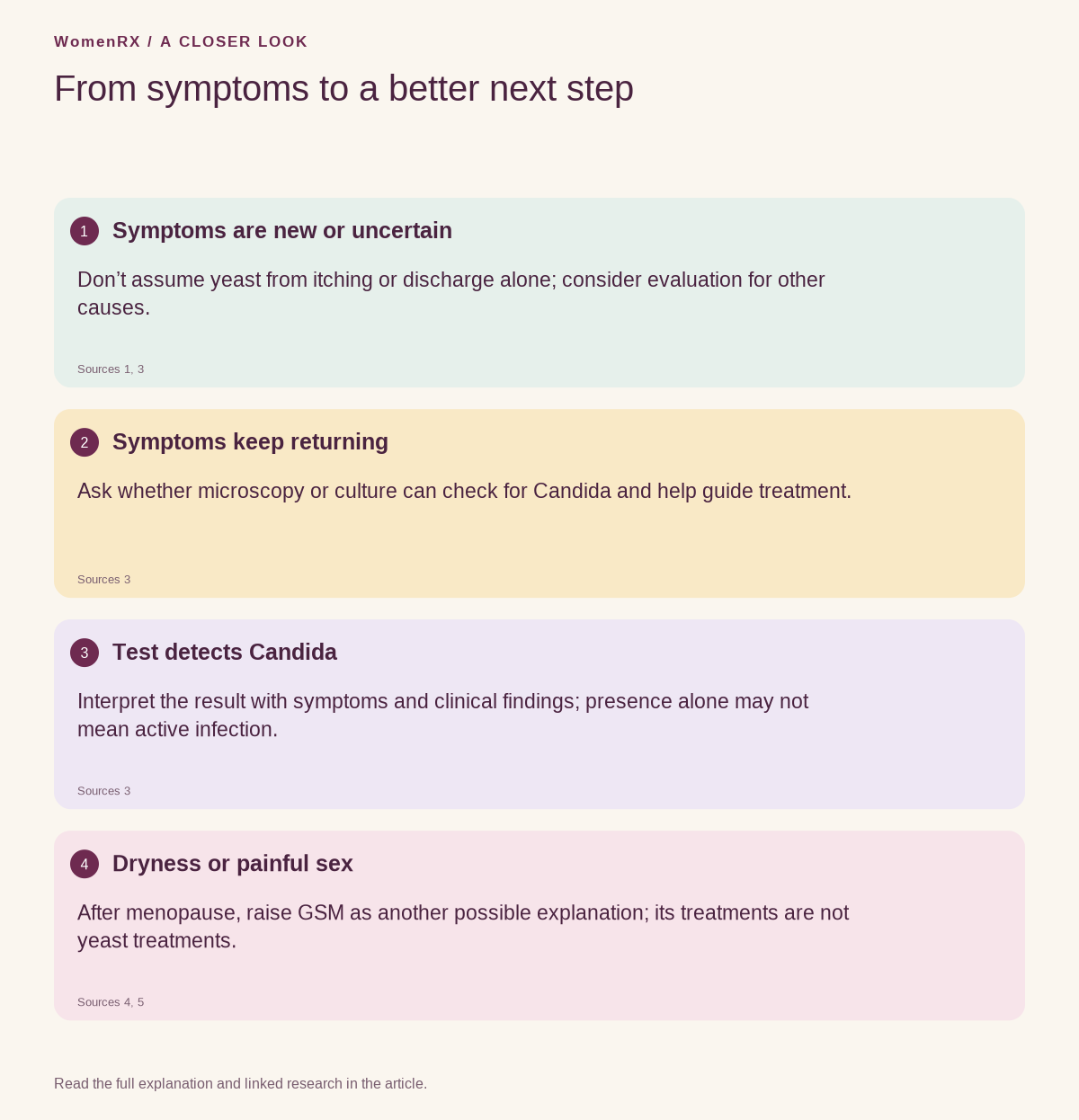
From symptoms to a better next step
Symptoms are new or uncertain: Don’t assume yeast from itching or discharge alone; consider evaluation for other causes.13
Symptoms keep returning: Ask whether microscopy or culture can check for Candida and help guide treatment.3
Test detects Candida: Interpret the result with symptoms and clinical findings; presence alone may not mean active infection.3
Dryness or painful sex: After menopause, raise GSM as another possible explanation; its treatments are not yeast treatments.45
Read the figure as text
Symptoms can guide what to ask about, but they cannot confirm Candida or distinguish it from menopause-related changes on their own.- Symptoms are new or uncertain: Don’t assume yeast from itching or discharge alone; consider evaluation for other causes.13
- Symptoms keep returning: Ask whether microscopy or culture can check for Candida and help guide treatment.3
- Test detects Candida: Interpret the result with symptoms and clinical findings; presence alone may not mean active infection.3
- Dryness or painful sex: After menopause, raise GSM as another possible explanation; its treatments are not yeast treatments.45
More questions, answered
Does perimenopause cause yeast infections?
Studies of genitourinary syndrome of menopause in postmenopausal women don’t establish whether perimenopause changes yeast-infection risk. Itching and discharge can also have causes besides Candida. 3 5
Can a positive yeast test prove that yeast is causing my symptoms?
Not by itself. Candida may be present without causing an active infection, so results need to be interpreted alongside symptoms and clinical findings. 3
Sources you can check
- Vaginal discharge - NHSAccessed 2026-09-25Return to first citation
- About fluconazole - NHSAccessed 2026-09-25Return to first citation
- Advances in vulvovaginal candidiasis research: a comprehensive review from epidemiology, diagnosis, treatment to resistance mechanisms.Zhu W, Guo L. · Frontiers in microbiology · 2026Return to first citation
- Intravaginal dehydroepiandrosterone for the treatment of vulvovaginal atrophy: a systematic review and meta-analysis.Lemos MJ, Queiroz LF, Diniz AF, Longo da Silva CM, Dos Santos PL, de Oliveira Gomide P, Ferraz JM, De Marco Novellino AM. · Menopause (New York, N.Y.) · 2026Return to first citation
- Gut, vaginal, and urinary microbiome alterations in women with genitourinary syndrome of menopause: A systematic review.Tsuboi I, Inoue S, Hirayama T, Mitsui Y, Watanabe M, Hirakawa H, Sadahira T. · Maturitas · 2026Return to first citation