Heartburn Around Menopause: Causes and When to Get Help
Heartburn that starts in midlife deserves attention to reflux triggers and warning signs, not an automatic explanation of changing hormones.
Heartburn can begin or worsen around menopause, but research hasn’t established that the menopausal transition itself causes reflux. Meal timing, abdominal weight, smoking, and certain medicines offer other possibilities to consider. If symptoms keep returning or swallowing becomes difficult, get them assessed. Seek urgent care for new or unexplained chest pain rather than assuming it’s heartburn. 2 3 5 7
Why the timing doesn’t tell the whole story
If heartburn appeared around the same time as changes in your periods, it’s reasonable to wonder whether the two are connected. Researchers have examined digestive symptoms across women’s hormonal stages, including perimenopause and menopause, but more work is needed to understand those differences. A paper on hormone therapy and reflux also describes the relationship between hormones, menopause, and GERD as unclear. Timing alone can’t tell you what’s causing your symptoms. 5 7
GERD means stomach contents repeatedly flow back into the esophagus and cause troublesome symptoms or complications. Heartburn is a common symptom, as is regurgitation, the sensation of contents coming back up. But having heartburn doesn’t, by itself, establish a GERD diagnosis. 1 3
What else might have changed?
Think about the circumstances around the burning, not just your menopausal stage. Does it tend to happen after a late meal or when you lie down? Did it begin after a change in medication? Is there a food or drink that reliably precedes it? These questions can help you spot a pattern without assuming that every commonly named “trigger” affects you. Evidence for some individual diet and lifestyle triggers is limited. 2
Abdominal obesity can increase pressure in the stomach and make reflux more likely. Smoking and late-night meals are also among the contributors discussed in reflux research. If symptoms occur at night, avoiding a late meal or raising the head of the bed are approaches studied for reflux; if excess weight is a factor, weight loss may help. None of these steps requires you to cut out a long list of foods without knowing whether they bother you. 2
Medicines are worth considering too. NSAID use is listed among GERD risk factors. In a database study specifically of postmenopausal women with osteoporosis, those taking raloxifene had more new GERD diagnoses than women who had not started hormone therapy. That observational finding concerns raloxifene in a particular group; it doesn’t show that menopause, or every hormone-related treatment, causes heartburn. If symptoms began after a medicine change, discuss the timing with its prescriber rather than stopping a prescribed medicine on your own. 1 6
Know when the pattern needs a closer look
New or unexplained chest pain needs urgent assessment. Reflux-related chest pain can resemble heart-related pain, so the fact that it feels like burning isn’t a reliable way to tell them apart. Don’t wait to test whether a food change helps. 1
Difficulty swallowing needs medical assessment. It’s a warning sign that can call for diagnostic evaluation rather than continued self-treatment. 3
If heartburn keeps coming back, is worsening, or isn’t improving with treatment, arrange an assessment instead of settling on “it’s menopause.” A clinician can consider the symptom pattern, your medicines, and whether testing is appropriate. That distinction matters: noticing a possible trigger can help you make a useful change, but it can’t establish the cause of persistent symptoms. 3
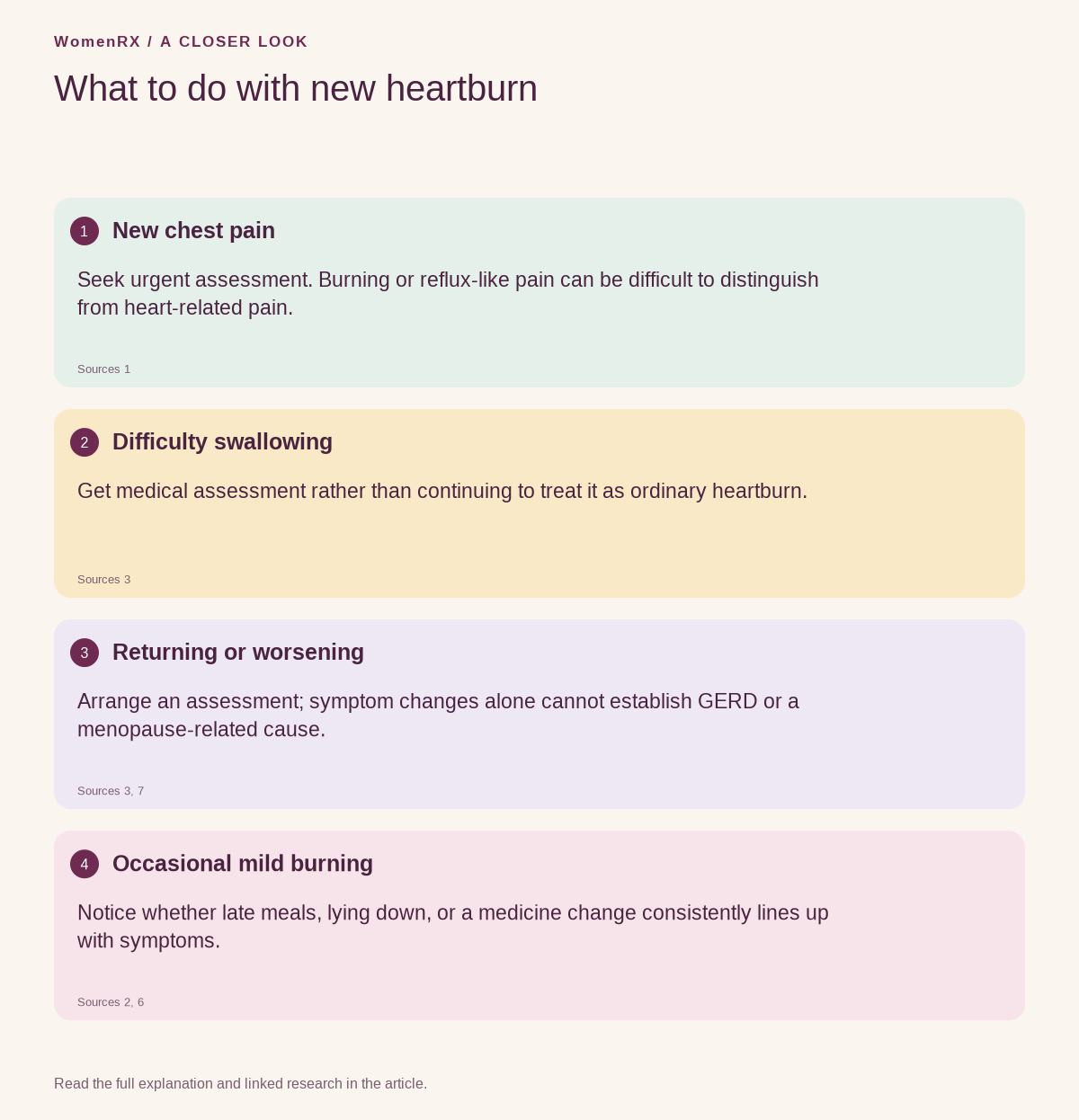
What to do with new heartburn
New chest pain: Seek urgent assessment. Burning or reflux-like pain can be difficult to distinguish from heart-related pain.1
Difficulty swallowing: Get medical assessment rather than continuing to treat it as ordinary heartburn.3
Returning or worsening: Arrange an assessment; symptom changes alone cannot establish GERD or a menopause-related cause.37
Occasional mild burning: Notice whether late meals, lying down, or a medicine change consistently lines up with symptoms.26
Read the figure as text
Start with the symptom that needs the quickest response, then consider patterns if no warning sign is present.- New chest pain: Seek urgent assessment. Burning or reflux-like pain can be difficult to distinguish from heart-related pain.1
- Difficulty swallowing: Get medical assessment rather than continuing to treat it as ordinary heartburn.3
- Returning or worsening: Arrange an assessment; symptom changes alone cannot establish GERD or a menopause-related cause.37
- Occasional mild burning: Notice whether late meals, lying down, or a medicine change consistently lines up with symptoms.26
More questions, answered
Does hormone therapy treat menopause-related heartburn?
Heartburn isn’t an established reason to use menopause hormone therapy. The relationship between hormone therapy and GERD remains unclear, while the North American Menopause Society’s hormone therapy statement identifies hot flashes, genitourinary symptoms, and prevention of bone loss and fracture among its established uses. If heartburn changed after starting treatment, discuss that change with the prescriber. 4 5
Sources you can check
- Gastroesophageal Reflux Disease (GERD) and Risk of Incident Acute Myocardial Infarction: A Systematic Review and Meta-Analysis of Cohort Studies.Anebo T, Srikulmontri T, Byfield K, Obomanu E, Wattanachayakul P, Davis M. · JGH open : an open access journal of gastroenterology and hepatology · 2025Return to first citation
- Role of Non-pharmacological Interventions and Weight Loss in the Management of Gastroesophageal Reflux Disease in Obese Individuals: A Systematic Review.Mukhtar M, Alzubaidee MJ, Dwarampudi RS, Mathew S, Bichenapally S, Khachatryan V, Muazzam A, Hamal C, Velugoti LSDR, Tabowei G, Gaddipati GN, Khan S. · Cureus · 2022Return to first citation
- Baclofen as a therapeutic option for gastroesophageal reflux disease: A systematic review of clinical trials.Arabpour E, Khoshdel S, Akhgarzad A, Abdi M, Tabatabaie N, Alijanzadeh D, Abdehagh M. · Frontiers in medicine · 2023Return to first citation
- The 2022 hormone therapy position statement of The North American Menopause Society.“The 2022 Hormone Therapy Position Statement of The North American Menopause Society” Advisory Panel. · Menopause (New York, N.Y.) · 2022Return to first citation
- Effect of Hormonal Replacement Therapy on Gastroesophageal Reflux Disease and its Complications in Postmenopausal Women.Saleh S, Trujillo S, Ghoneim S, Thomas C, Fass R. · Clinical gastroenterology and hepatology : the official clinical practice journal of the American Gastroenterological Association · 2023Return to first citation
- Raloxifene increases the risk of gastroesophageal reflux disease, Barrett's esophagus, and esophageal stricture in postmenopausal women with osteoporosis.Liu BD, Udemba SC, Saleh S, Hill H, Song G, Fass R. · Neurogastroenterology and motility · 2023Return to first citation
- Upper Gastrointestinal Tract Motility Disorders in Women, Gastroparesis, and Gastroesophageal Reflux Disease.Zia JK, Heitkemper MM. · Gastroenterology clinics of North America · 2016Return to first citation