Dry Mouth Around Menopause: Causes and When to Get Help
Dry mouth can happen during the menopause years, but ongoing dryness deserves attention for your comfort and teeth, whatever the cause.
Dry mouth during perimenopause or after menopause may be related to hormonal changes, but timing alone can’t tell you why it’s happening. Medicines, dehydration, mouth-breathing, and some health conditions can also contribute. If dryness persists, affects eating or speaking, or comes with other symptoms, a dentist or medical clinician can help assess the cause. 123
Menopause may be part of the picture
Dry mouth, also called xerostomia, means there isn’t enough saliva to keep your mouth wet. It can make chewing, swallowing, or talking uncomfortable. Reviews describe possible links between menopause-related hormonal changes and oral dryness, but a dry mouth during this stage of life isn’t proof that hormones are the cause. 135
In a cross-sectional survey of 3,211 women aged 40 to 90, researchers found no significant difference in the probability of dry-mouth symptoms between perimenopausal and postmenopausal women. That comparison doesn’t tell us whether either group has more dry mouth than women outside those stages, and a survey taken at one point in time can’t establish what caused anyone’s symptoms. 4
Look at what else changed
Some medicines can cause dry mouth, including certain medicines for high blood pressure, depression, or bladder-control problems. Dehydration, breathing through your mouth at night, alcohol, tobacco, and cancer treatments are other possible contributors. Dryness that doesn’t go away can sometimes occur with conditions such as diabetes or Sjögren’s syndrome. 12
The pattern may offer a clue, though it won’t give you a diagnosis. For example, dryness after an illness or heavy sweating raises a different question from dryness that began around a medication change. Waking with a dry mouth may be worth mentioning if you also have a blocked nose or sleep with your mouth open. Dry eyes or needing to urinate a lot alongside dry mouth are reasons to seek medical assessment. 2
If you suspect a prescribed medicine, don’t stop it on your own. Ask the prescribing clinician or a pharmacist to review whether it could be contributing. A dentist or medical clinician can also review your health and medicines, examine your mouth, and, when useful, consider tests such as a measure of saliva production. 12
Give your mouth relief while protecting your teeth
Saliva does more than make your mouth feel comfortable. When you don’t have enough, eating and speaking can become harder, and the risk of tooth decay or mouth infections rises. That makes persistent dryness worth bringing up at a dental visit, even if you’ve found ways to tolerate it. 1
Regular sips of water and sugar-free gum or candy may ease dryness. Avoiding tobacco and alcohol may help, too. These steps can make your mouth more comfortable, but water alone won’t address every cause of persistent dryness. Brush your teeth twice a day, and choose an alcohol-free mouthwash if you use one. 12
Know when relief isn’t enough
Arrange an assessment if your mouth is still dry after a few weeks of trying simple relief measures, or if dryness makes talking, eating, or eating regularly difficult. Seek medical advice if you have sore white patches in your mouth, dry eyes, frequent urination, or a suspected medication effect. A dentist can check your mouth and teeth; a medical clinician can assess symptoms that may point beyond the mouth. 12
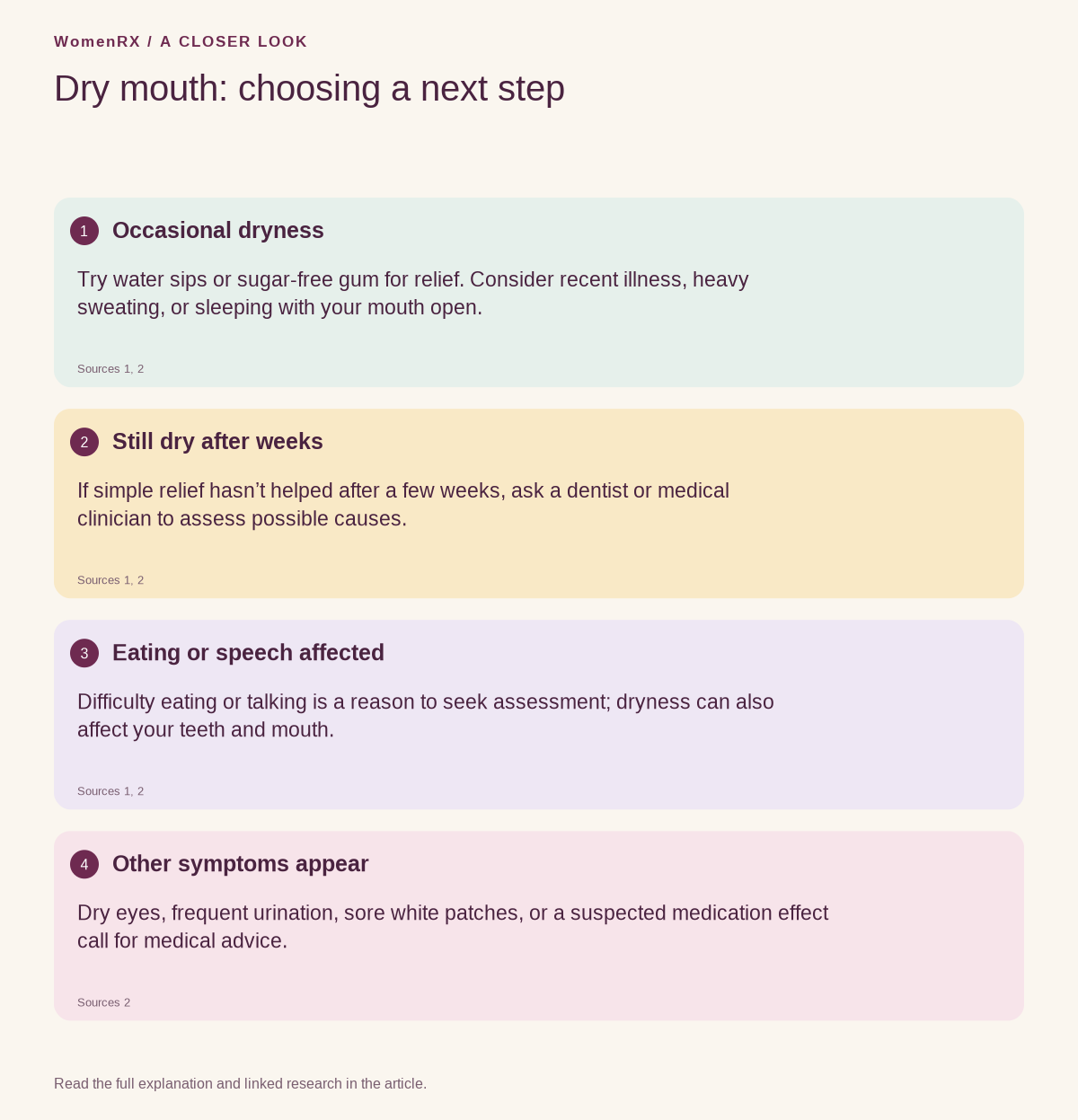
Dry mouth: choosing a next step
Occasional dryness: Try water sips or sugar-free gum for relief. Consider recent illness, heavy sweating, or sleeping with your mouth open.12
Still dry after weeks: If simple relief hasn’t helped after a few weeks, ask a dentist or medical clinician to assess possible causes.12
Eating or speech affected: Difficulty eating or talking is a reason to seek assessment; dryness can also affect your teeth and mouth.12
Other symptoms appear: Dry eyes, frequent urination, sore white patches, or a suspected medication effect call for medical advice.2
Read the figure as text
How long dryness lasts and what comes with it can help you choose between symptom relief and an assessment. These clues don’t diagnose the cause.- Occasional dryness: Try water sips or sugar-free gum for relief. Consider recent illness, heavy sweating, or sleeping with your mouth open.12
- Still dry after weeks: If simple relief hasn’t helped after a few weeks, ask a dentist or medical clinician to assess possible causes.12
- Eating or speech affected: Difficulty eating or talking is a reason to seek assessment; dryness can also affect your teeth and mouth.12
- Other symptoms appear: Dry eyes, frequent urination, sore white patches, or a suspected medication effect call for medical advice.2
Sources you can check
- Dry Mouth: MedlinePlusAccessed 2026-09-25Return to first citation
- Dry mouth - NHSAccessed 2026-09-25Return to first citation
- The Silent Shift of Menopause: The Intersection between Salivary Glands, Oral Cavity Status, and Cardiovascular Health.Lourenço SV, Florezi GP, Pelissari C, Hojaij FC, Otoch JP, Ramires JAF. · Arquivos brasileiros de cardiologia · 2026Return to first citation
- Xerostomia and oral health-related quality of life in peri- and postmenopausal women.García-Alfaro P, Pérez-López FR, Martínez SG, Rodríguez I. · Maturitas · 2025Return to first citation
- Menopause and Oral Health: Clinical Implications and Preventive Strategies.Shrivastava S. · Journal of mid-life health · 2024Return to first citation