Iron Bisglycinate vs Ferrous Sulfate: What to Compare
Compare the elemental iron on the label, the reason you’re taking it, and what the evidence says about side effects.
Neither iron bisglycinate nor ferrous sulfate is the right choice for everyone. Compare the amount of elemental iron, not the total weight of the compound. Ferrous sulfate has a clearer result in one trial of mostly iron-replete, nonpregnant Cambodian women, while evidence about tolerability is limited and dose differences complicate comparisons. To compare cost, estimate the price of the product needed for your recommended amount and planned duration. Pregnancy and heavy menstrual bleeding call for context-specific decisions. 1 2 3
Start with the elemental iron
The number on an iron label can refer to the iron compound or to the elemental iron it supplies. Those aren’t the same thing: different iron compounds contain different proportions of elemental iron. Ferrous sulfate, for example, is about 20% elemental iron by weight. Supplement Facts panels list the elemental iron, so use that amount when comparing products, rather than comparing milligrams of bisglycinate with milligrams of ferrous sulfate. 1
For example, two bottles might list very different weights of their iron compounds but supply the same amount of elemental iron per serving. The useful comparison is the elemental iron per serving your clinician recommended, alongside the serving size. For a meaningful cost comparison, use the current price and serving size of each specific product to estimate how many servings, and how many packages, you’d need to cover the clinician-recommended amount for the planned duration. Compare that total, not just the price per bottle or the compound weight. There’s no universal price comparison between the two forms; the cost depends on the products and treatment plan.
What the head-to-head evidence can tell you
One randomized trial compared 18 mg of elemental iron as ferrous bisglycinate with 60 mg as ferrous sulfate for 12 weeks in 480 nonpregnant women in Cambodia. At the start, 17% had anemia and 6% had iron deficiency, so this was a predominantly iron-replete group. At 12 weeks, ferritin was higher in the sulfate group; the researchers concluded that the lower-dose bisglycinate treatment was not as effective as the 60 mg sulfate treatment in increasing ferritin. Since the doses differed substantially and most participants weren’t iron-deficient, this result doesn’t establish which form works better for a woman being treated for confirmed deficiency at a different dose. 2
Tolerability is harder to compare cleanly. In a 90-day study of 120 women with iron deficiency or anemia related to heavy menstrual bleeding, the bisglycinate group reported fewer gastrointestinal effects than the sulfate group. But the bisglycinate product also included folate, and the groups received different amounts of elemental iron: 60 mg daily in the bisglycinate group and 160 mg daily in the sulfate group. The reported difference can’t be credited to the iron form alone. 3
Iron supplements, especially at higher amounts, can cause nausea, constipation, abdominal pain, and other digestive symptoms. Some other iron forms may cause fewer gastrointestinal effects than iron salts, but that broad finding doesn’t mean bisglycinate will be easier for every person to tolerate. 1
Your reason for taking iron matters
Heavy menstrual bleeding can raise the risk of iron deficiency because menstrual blood loss removes iron. If your periods are heavy, replacing iron and addressing the source of ongoing blood loss are related but separate parts of the conversation. The amount and duration of supplementation should fit your test results and treatment plan, not just the name of the iron form. 1
Pregnancy is a different context: iron needs rise as a woman’s blood volume and red blood cell mass increase. Guidance differs on routine supplementation for pregnant women without symptoms, while iron-deficiency anemia in pregnancy is treated with iron supplementation. A 2026 network meta-analysis of 17 trials in Indian pregnant women reported better hemoglobin improvement with newer oral forms, including bisglycinate, than with ferrous sulfate. That finding comes from trials in one country and doesn’t make bisglycinate a universal first choice for every pregnancy or treatment situation. 1 4
Make a practical comparison
When you review options with your clinician or pharmacist, compare the elemental iron per serving, the product’s cost for the full planned course, and whether the product contains other ingredients. To estimate course cost, use the recommended elemental iron amount and treatment duration to work out how many servings and packages each product would require. Ask what outcome is being treated, such as low iron stores or iron-deficiency anemia, and how progress will be checked. These details matter because an iron form that feels easier to take is not useful if its elemental amount or response doesn’t fit the treatment goal.
Also mention your regular medicines. Iron can reduce the absorption of levothyroxine when taken together, so ask a pharmacist or clinician how to separate them. 1
The most useful choice is the one that matches your reason for treatment, supplies the intended elemental iron, and is workable for you. If digestive effects make your current option difficult, bring that up rather than assuming you have to tolerate it or that a different form will automatically solve the problem.
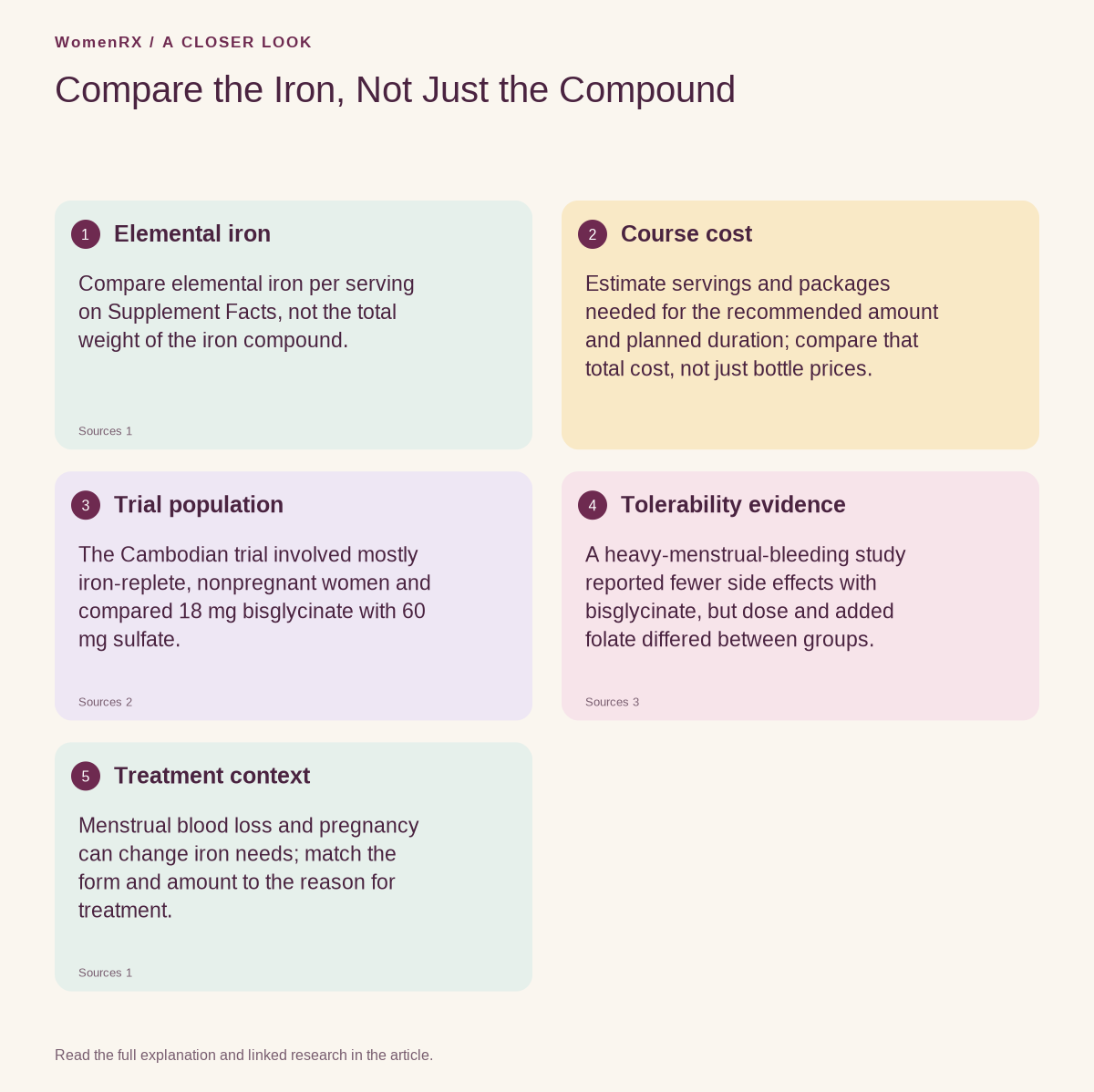
Compare the Iron, Not Just the Compound
Elemental iron: Compare elemental iron per serving on Supplement Facts, not the total weight of the iron compound.1
Course cost: Estimate servings and packages needed for the recommended amount and planned duration; compare that total cost, not just bottle prices.
Trial population: The Cambodian trial involved mostly iron-replete, nonpregnant women and compared 18 mg bisglycinate with 60 mg sulfate.2
Tolerability evidence: A heavy-menstrual-bleeding study reported fewer side effects with bisglycinate, but dose and added folate differed between groups.3
Treatment context: Menstrual blood loss and pregnancy can change iron needs; match the form and amount to the reason for treatment.1
Read the figure as text
Use these distinctions to compare a recommended iron product without assuming that one form is best for every woman.- Elemental iron: Compare elemental iron per serving on Supplement Facts, not the total weight of the iron compound.1
- Course cost: Estimate servings and packages needed for the recommended amount and planned duration; compare that total cost, not just bottle prices.
- Trial population: The Cambodian trial involved mostly iron-replete, nonpregnant women and compared 18 mg bisglycinate with 60 mg sulfate.2
- Tolerability evidence: A heavy-menstrual-bleeding study reported fewer side effects with bisglycinate, but dose and added folate differed between groups.3
- Treatment context: Menstrual blood loss and pregnancy can change iron needs; match the form and amount to the reason for treatment.1
Sources you can check
- Iron - Health Professional Fact SheetAccessed 2026-09-25Return to first citation
- Is a Lower Dose of More Bioavailable Iron (18-mg Ferrous Bisglycinate) Noninferior to 60-mg Ferrous Sulfate in Increasing Ferritin Concentrations While Reducing Gut Inflammation and Enteropathogen Detection in Cambodian Women? A Randomized Controlled Noninferiority Trial.Fischer JAJ, Pei LX, Elango R, Hou K, Goldfarb DM, Karakochuk CD. · The Journal of nutrition · 2023Return to first citation
- Experience of using modern oral iron formulations for the correction of iron deficiency conditions in women of reproductive age.Kondratiuk VK, Nikitina IM, Нorban NY, Kondratiuk KO, Dzis NP. · Wiadomosci lekarskie (Warsaw, Poland : 1960) · 2026Return to first citation
- Comparative Effectiveness of Iron Supplementation in Indian Pregnant Women: A Network Meta-Analysis of Randomized Controlled Trials.Joshi U, Shah T, Shah V, Dave B, Shrimali S, Mehta M, Baisil S, Kini BS. · Indian journal of community medicine : official publication of Indian Association of Preventive & Social Medicine · 2026Return to first citation