How to Compare Iron Supplements Without Guessing
The most useful number on an iron supplement label is the amount of elemental iron, not the weight of the iron compound.
Compare products by the elemental iron listed in Supplement Facts, then consider the form and how well you tolerate it. Ferrous sulfate, fumarate, and gluconate contain different proportions of elemental iron, so their compound weights aren’t interchangeable. The right amount depends on why your iron may be low and your life stage; a supplement’s daily value isn’t a treatment dose. 1

Start with the elemental iron
Look in the Supplement Facts panel for the nutrient amount labeled Iron. That’s the elemental iron, the amount to compare across products. The name and milligrams of a compound such as ferrous sulfate describe the iron salt, not an equivalent amount of elemental iron.
The difference is substantial: by weight, ferrous fumarate is about 33% elemental iron, ferrous sulfate 20%, and ferrous gluconate 12%. The label should list elemental iron, so you don’t have to calculate it from the compound weight. 1
The Daily Value is another number, but it isn’t a personal target or a treatment plan. The NIH Office of Dietary Supplements notes that iron-only supplements often provide more than the Daily Value, while many multivitamins provide less. Compare the actual iron amount rather than choosing a product just because its front label says “100% DV.” 1
Form and stomach comfort are a tradeoff
Ferrous salts, including sulfate, fumarate, and gluconate, are common supplement forms. Ferrous iron is more bioavailable than ferric iron in supplements, but that doesn’t mean one product will work best for every person or feel best in every stomach. Higher supplemental iron amounts can cause nausea or constipation; other reported digestive effects include diarrhea and abdominal discomfort. 12
Some other forms may be easier to tolerate, but the evidence doesn’t establish one universally gentler choice. For example, a 14-day randomized crossover study in healthy premenopausal women found fewer gastrointestinal complaints with one microencapsulated ferric saccharate product than with ferrous sulfate at the same elemental-iron amount. It was a short study of specific products, not proof that all alternative forms are better tolerated or equally effective for treating deficiency. 5
A separate randomized trial in 57 women with low iron stores found that ferrous sulfate increased ferritin more over 12 weeks than iron (III)-hydroxide polymaltose, while the polymaltose group reported fewer symptoms. Those results illustrate the tradeoff between iron-store response and comfort, but they don’t settle which form is right for you. 4
If a form bothers your stomach, don’t assume you have to give up on treatment or simply switch to a different compound weight. Tell the clinician who recommended it what you’re experiencing. They can consider the elemental amount, product form, and schedule together.
The amount depends on the reason for taking it
An intake recommendation for healthy people is different from a dose used to treat confirmed iron deficiency or anemia. For adults ages 19-50, the recommended dietary allowance is 18 mg per day for women, 27 mg during pregnancy, and 9 mg during lactation. From age 51 onward, the adult recommendation is 8 mg per day. These figures describe total daily iron intake, not a prescribed supplement dose. 1
Menstruation, pregnancy, and other circumstances can change the question, but they don’t diagnose low iron. Heavy menstrual bleeding is a recognized risk factor. Blood loss, limited dietary iron, and problems absorbing iron can also contribute. 12 If you’re pregnant, iron needs are higher, and guidance differs on routine screening and supplementation for pregnant people without symptoms; recommendations for someone with identified anemia or other specific risks aren’t the same question. 1
Before starting or changing a supplement, ask what indicates that you need it, what may be causing the low iron, and what elemental amount is intended. Mention heavy periods, pregnancy or recent delivery, breastfeeding, your diet, and any digestive condition that could affect absorption. That gives the clinician a better basis for choosing an amount and deciding whether the underlying cause also needs attention. 12
Make the instructions workable
Ferrous sulfate is generally absorbed best on an empty stomach, but food may be an option if it upsets your stomach. Tea, coffee, dairy products, and eggs can reduce absorption when taken around the same time; guidance for ferrous sulfate advises leaving a gap. Calcium may also interfere with iron absorption, although that effect isn’t definitively established. Ask a pharmacist or clinician how to time iron around your specific medicines and supplements rather than guessing. 13
A useful comparison, then, isn’t simply “Which form is best?” It’s: How much elemental iron does this provide, why am I taking it, and can I tolerate and take it as directed?
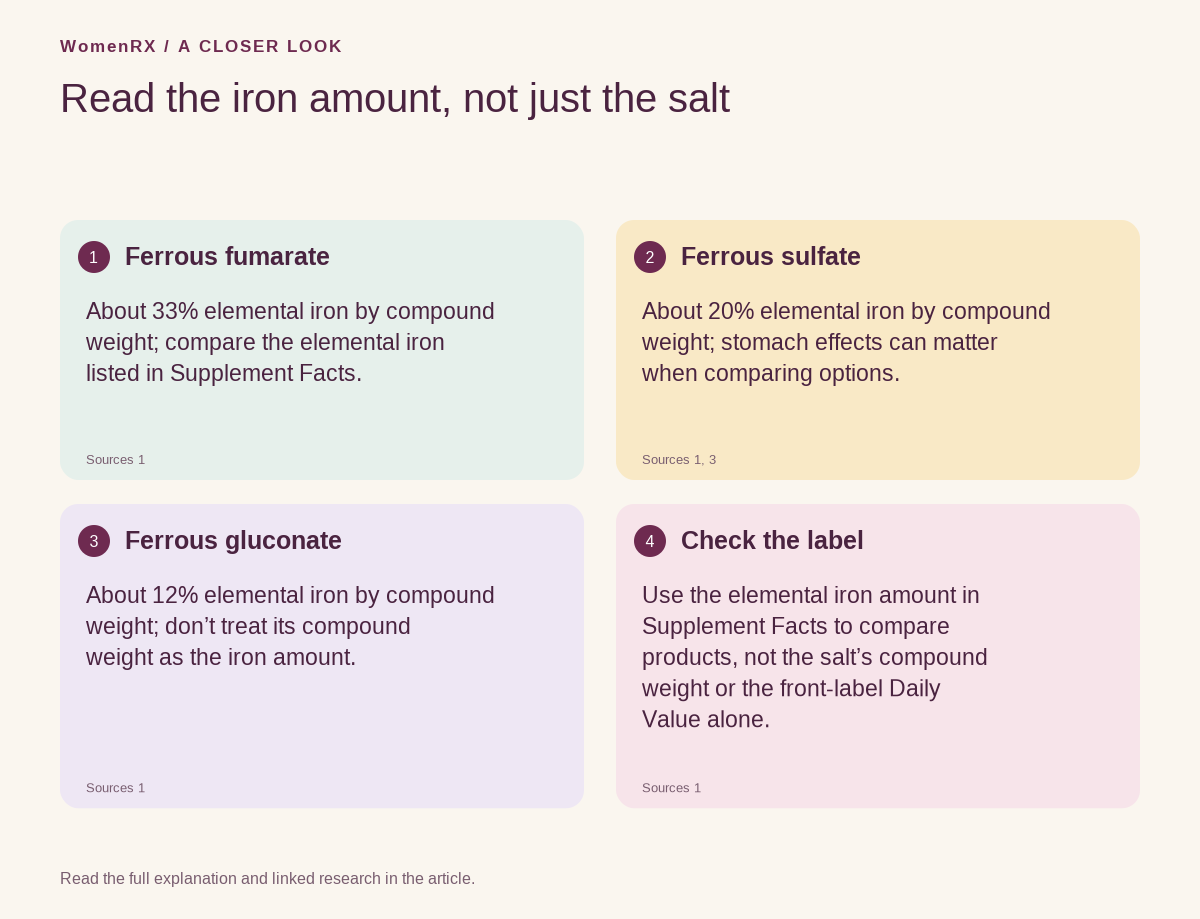
Read the iron amount, not just the salt
Ferrous fumarate: About 33% elemental iron by compound weight; compare the elemental iron listed in Supplement Facts.1
Ferrous sulfate: About 20% elemental iron by compound weight; stomach effects can matter when comparing options.13
Ferrous gluconate: About 12% elemental iron by compound weight; don’t treat its compound weight as the iron amount.1
Check the label: Use the elemental iron amount in Supplement Facts to compare products, not the salt’s compound weight or the front-label Daily Value alone.1
Read the figure as text
The compound and its elemental iron are different label concepts. Compare products by elemental iron, then weigh form and tolerability in context.- Ferrous fumarate: About 33% elemental iron by compound weight; compare the elemental iron listed in Supplement Facts.1
- Ferrous sulfate: About 20% elemental iron by compound weight; stomach effects can matter when comparing options.13
- Ferrous gluconate: About 12% elemental iron by compound weight; don’t treat its compound weight as the iron amount.1
- Check the label: Use the elemental iron amount in Supplement Facts to compare products, not the salt’s compound weight or the front-label Daily Value alone.1
More questions, answered
Does a higher percentage of Daily Value mean a better iron supplement?
No. Daily Value helps compare label amounts, but it doesn’t tell you what amount is appropriate for treating a confirmed deficiency. Recommended intake also differs by age and life stage, and those intake figures aren’t treatment doses. 1
What if iron upsets my stomach?
Nausea, constipation, diarrhea, and abdominal discomfort can occur with oral iron. Food may make ferrous sulfate easier to tolerate, although it can affect absorption. Tell the person advising your treatment what symptoms you’re having before changing the amount or form. 123
Sources you can check
- Iron - Health Professional Fact SheetAccessed 2026-09-25Return to first citation
- Iron: MedlinePlusAccessed 2026-09-25Return to first citation
- About ferrous sulfate - NHSAccessed 2026-09-25Return to first citation
- Oral ferrous sulphate supplementation has greater efficacy, but lower tolerance than iron (III)-hydroxide polymaltose complexes in exercising women with low iron stores.McKay AK, Broome S, Tee N, Yim KL, Sim M, Peeling P, Burke LM. · Clinical nutrition (Edinburgh, Scotland) · 2026Return to first citation
- Tolerability of Oral Supplementation with Microencapsulated Ferric Saccharate Compared to Ferrous Sulphate in Healthy Premenopausal Woman: A Crossover, Randomized, Double-Blind Clinical Trial.Friling M, García-Muñoz AM, Perrinjaquet-Moccetti T, Victoria-Montesinos D, Pérez-Piñero S, Abellán-Ruiz MS, Luque-Rubia AJ, García-Guillén AI, Cánovas F, Ivanir E. · International journal of molecular sciences · 2022Return to first citation