Iron Supplements: What Improves First, and When to Recheck
You may feel better before your iron stores are fully rebuilt, so symptom changes and blood tests answer different questions.
Track how you feel, but use blood tests to check whether treatment is correcting anemia and rebuilding iron stores. A clinician may recheck blood work after several weeks, then follow results over the next few months; timing depends on your results and situation. If you’re pregnant, recently gave birth, have ongoing bleeding, or struggle with side effects, ask how those factors affect your follow-up plan. 1 2 3
Two kinds of progress
Iron helps your body make hemoglobin, the protein in red blood cells that carries oxygen. When iron deficiency anemia is present, replacing iron can address a cause of symptoms such as fatigue or weakness. But feeling better and restoring iron stores are not the same milestone: treatment may continue after someone feels better so depleted stores can be replenished. 1 4
For example, you might note whether everyday activities feel easier, whether fatigue is changing, and whether symptoms are getting worse. Those observations help describe your experience, but they cannot show on their own whether hemoglobin or iron stores have recovered. Symptoms can also have causes besides iron deficiency. 1 3
What blood tests can tell you
A complete blood count includes hemoglobin, which helps show whether anemia is improving. Ferritin gives information about stored iron and can be low before hemoglobin falls. Clinicians may use more than one blood measure because no single result captures every stage of iron deficiency. Ferritin can also be raised by inflammation, which can make it harder to interpret. 1
A follow-up blood test may be planned after several weeks. One official medicine reference describes checking iron levels after about four weeks, while another describes repeat blood tests over the following months. These are examples of follow-up timing, not a promise that everyone needs the same schedule. Your starting results, symptoms, treatment, and circumstances shape what should be checked and when. 2 3
Even if a result improves, ask whether the goal is only to correct anemia or also to replenish stores. One medicine reference says treatment may continue for three to six months after improvement to rebuild iron supply; the right duration for you depends on your clinician’s plan and follow-up results. 4
Keep looking for the reason iron is low
Iron deficiency can result from blood loss, increased iron needs, or reduced absorption. Replacing iron may help correct a shortage, but it does not by itself stop ongoing blood loss or resolve an absorption problem. If results do not improve as expected, it is reasonable to ask whether the amount of iron being absorbed, the treatment’s tolerability, or the original cause needs another look. 1 5
Heavy menstrual bleeding can raise the risk of iron deficiency. If your periods are heavy or continue to be so, ask how that may affect your iron results and whether the bleeding itself needs evaluation or treatment. Otherwise, iron may be lost again while you are trying to replace it. 1 3
Pregnancy is a separate context: iron needs rise as maternal blood volume and red-cell mass expand. Guidance on routine screening and supplementation for pregnant people without symptoms is not uniform, while anemia during pregnancy should be evaluated for its cause. If you are pregnant, ask how your blood count and iron stores are being assessed in your care. 1
After delivery, consider blood loss and prior anemia
Postpartum follow-up is a separate question from pregnancy screening. If you were treated for iron deficiency during pregnancy or had substantial blood loss during delivery, ask whether your plan should include a repeat blood count and assessment of iron stores. The need and timing depend on your circumstances; the follow-up examples above are not a universal postpartum schedule. Blood loss and pregnancy are both associated with iron deficiency, and hemoglobin and ferritin provide different information about anemia and stored iron. 1 3
If taking iron is difficult
Iron supplements can cause stomach upset, nausea, constipation, abdominal pain, or diarrhea. Tell your prescriber if side effects make it hard to take the supplement as planned. Ask whether a change in formulation, timing, or schedule could help rather than silently stopping or changing the treatment. Taking iron with food may reduce side effects. 1
Mention your other medicines, too. Iron can reduce absorption of levothyroxine and levodopa, and medicines that reduce stomach acid, such as proton pump inhibitors, may affect iron absorption. Ask your pharmacist or prescriber how to time your specific medicines together. 1
Useful follow-up questions include: Which results are we tracking, and what change are we hoping to see? When should I repeat the blood tests? If I feel better, do I still need treatment to rebuild stores? Could my bleeding, pregnancy, or another health issue be contributing? If I recently gave birth, does my history of anemia or delivery blood loss change the follow-up plan? What should I do if side effects interfere with taking iron?
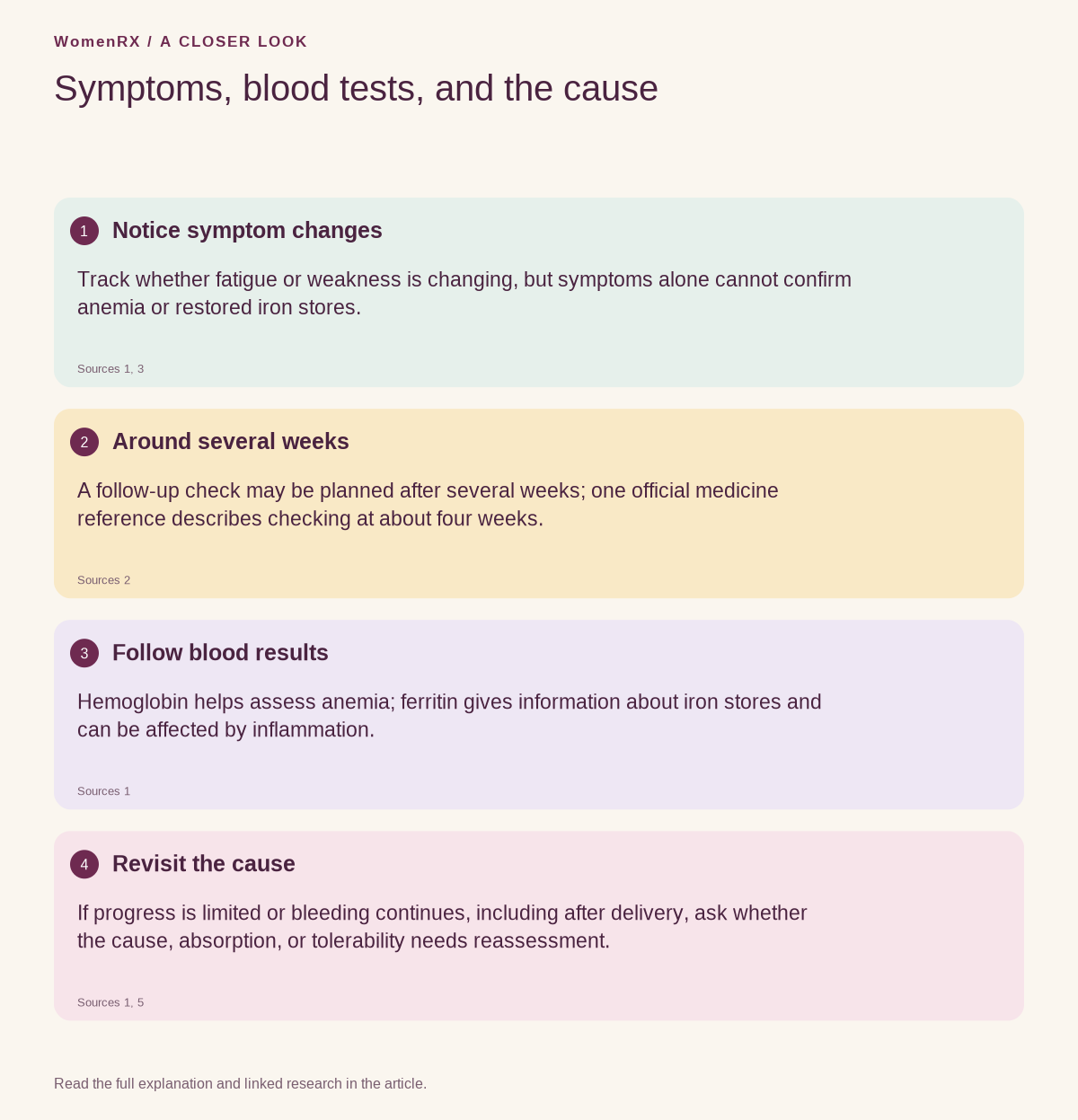
Symptoms, blood tests, and the cause
Notice symptom changes: Track whether fatigue or weakness is changing, but symptoms alone cannot confirm anemia or restored iron stores.13
Around several weeks: A follow-up check may be planned after several weeks; one official medicine reference describes checking at about four weeks.2
Follow blood results: Hemoglobin helps assess anemia; ferritin gives information about iron stores and can be affected by inflammation.1
Revisit the cause: If progress is limited or bleeding continues, including after delivery, ask whether the cause, absorption, or tolerability needs reassessment.15
Read the figure as text
These checkpoints answer different questions. The test timing is an example, not a schedule that fits everyone.- Notice symptom changes: Track whether fatigue or weakness is changing, but symptoms alone cannot confirm anemia or restored iron stores.13
- Around several weeks: A follow-up check may be planned after several weeks; one official medicine reference describes checking at about four weeks.2
- Follow blood results: Hemoglobin helps assess anemia; ferritin gives information about iron stores and can be affected by inflammation.1
- Revisit the cause: If progress is limited or bleeding continues, including after delivery, ask whether the cause, absorption, or tolerability needs reassessment.15
More questions, answered
Does feeling better mean my iron stores are back to normal?
Not necessarily. Symptoms describe how you feel; blood tests such as hemoglobin and ferritin help assess anemia and stored iron. Ask whether follow-up suggests your stores are replenished, not just whether symptoms have eased. 1 4
What if my blood tests do not improve?
Ask whether the treatment is tolerable and being taken as planned, and whether ongoing blood loss, reduced absorption, or another cause could be affecting the result. Iron deficiency can have more than one cause, so a lack of improvement may call for reassessing the explanation as well as the supplement plan. 1 5
Sources you can check
- Iron - Health Professional Fact SheetAccessed 2026-09-25Return to first citation
- Ferrous fumarate: a medicine to treat iron deficiency anaemia (low iron levels) - NHSAccessed 2026-09-25Return to first citation
- Iron deficiency anaemia - NHSAccessed 2026-09-25Return to first citation
- How and when to take ferrous sulfate - NHSAccessed 2026-09-25Return to first citation
- [Iron-refractory iron deficiency anemia].Kawabata H. · [Rinsho ketsueki] The Japanese journal of clinical hematology · 2016Return to first citation