Iron and Constipation: Which Changes Are Worth Discussing?
Iron can help correct deficiency, but the form and amount may affect bowel symptoms, so it’s worth discussing options before changing a prescribed plan.
Constipation is a recognized side effect of oral iron, and no form can be promised to prevent it. Ask whether the amount of elemental iron or a different formulation makes sense for your situation; pregnancy research suggests some formulations may be easier to tolerate, but that finding doesn’t settle treatment for everyone. Don’t stop prescribed iron on your own. 3 4 6
Start with the reason you need iron
Iron supplements can replenish iron and reduce anemia, but constipation is a real tradeoff. In a Cochrane review of trials in menstruating women, constipation was more common among those taking daily iron than among those taking a control. The review also found that iron reduced anemia and iron deficiency. The practical goal is to find a plan that treats the problem and is tolerable, not simply to pick the product with the most appealing label. 6
If iron was recommended after heavy menstrual bleeding, mention both the bleeding and the constipation when you discuss the plan. If you’re pregnant or recently gave birth, say so too: iron needs and bowel symptoms can both be part of that period, and the research on one group or purpose does not automatically apply to another. 2 4 5
What to ask about the form and amount
Iron products can contain different iron compounds, including ferrous sulfate, ferrous gluconate and ferrous fumarate. They don’t all provide the same amount of elemental iron, the amount of iron itself. The NIH Office of Dietary Supplements notes that forms differ in elemental iron and that higher supplemental amounts may cause gastrointestinal effects, including constipation. So when comparing labels with your clinician or pharmacist, compare the elemental iron amount, not just the compound name or tablet size. 3
You could ask: “Is this amount what I need for my test results, and would a different amount or formulation be appropriate?” That’s a discussion, not a reason to reduce or switch a prescribed supplement on your own. The right choice depends on why you’re taking iron and the treatment goal.
A randomized study in healthy women with uncomplicated pregnancies compared several forms and amounts used for prevention, not treatment of diagnosed anemia. In the smaller comparison of formulations, ferrous bisglycinate was associated with fewer gastrointestinal complaints than ferrous fumarate or ferrous sulfate. In the separate fumarate groups, the higher amount studied was associated with more constipation and laxative use than the lower amounts. These results are useful to raise in a pregnancy discussion, but they don’t establish a constipation-free product or prove that the same choice is best for treating anemia outside that study. 4
Ask before changing the schedule
If your current plan is hard to tolerate, ask whether a different amount, formulation or schedule could still meet your treatment goal. This evidence doesn’t establish one schedule as best for everyone, so don’t assume that taking iron less often will work just as well for you. A clinician can weigh the reason for treatment, your iron results and the side effects you’re having.
If you’re postpartum and have anemia, a small randomized trial offers one example of a different tradeoff. It included 60 East Asian women with anemia and low iron stores. The group given intravenous iron had fewer reported gastrointestinal symptoms, including constipation, than the group taking oral ferrous sulfate. The trial also reported asymptomatic low phosphate in the intravenous group. This is a comparison to discuss with a clinician, not a reason to seek an infusion on your own; it applies to a specific postpartum group and treatment protocol. 5
Make constipation easier to manage while you discuss it
General steps that may help constipation include eating more fiber-rich fruits, vegetables and grains, getting exercise, and taking time to use the bathroom when you feel the urge. Ask before using a laxative, especially if you’re pregnant, postpartum or taking other medicines. Pregnancy and the period after birth can themselves bring constipation, so the timing of symptoms is useful context rather than proof that iron is the only cause. 1 2
Tell your clinician if constipation is persistent, worsening or a major reason you’re missing doses. Also mention a sudden change in bowel habits, blood in your stool or abdominal pain rather than treating those as routine supplement effects. 2
The useful question isn’t “Which iron never causes constipation?” It’s “What form and plan are appropriate for the reason I need iron, and what should I do if this side effect continues?”
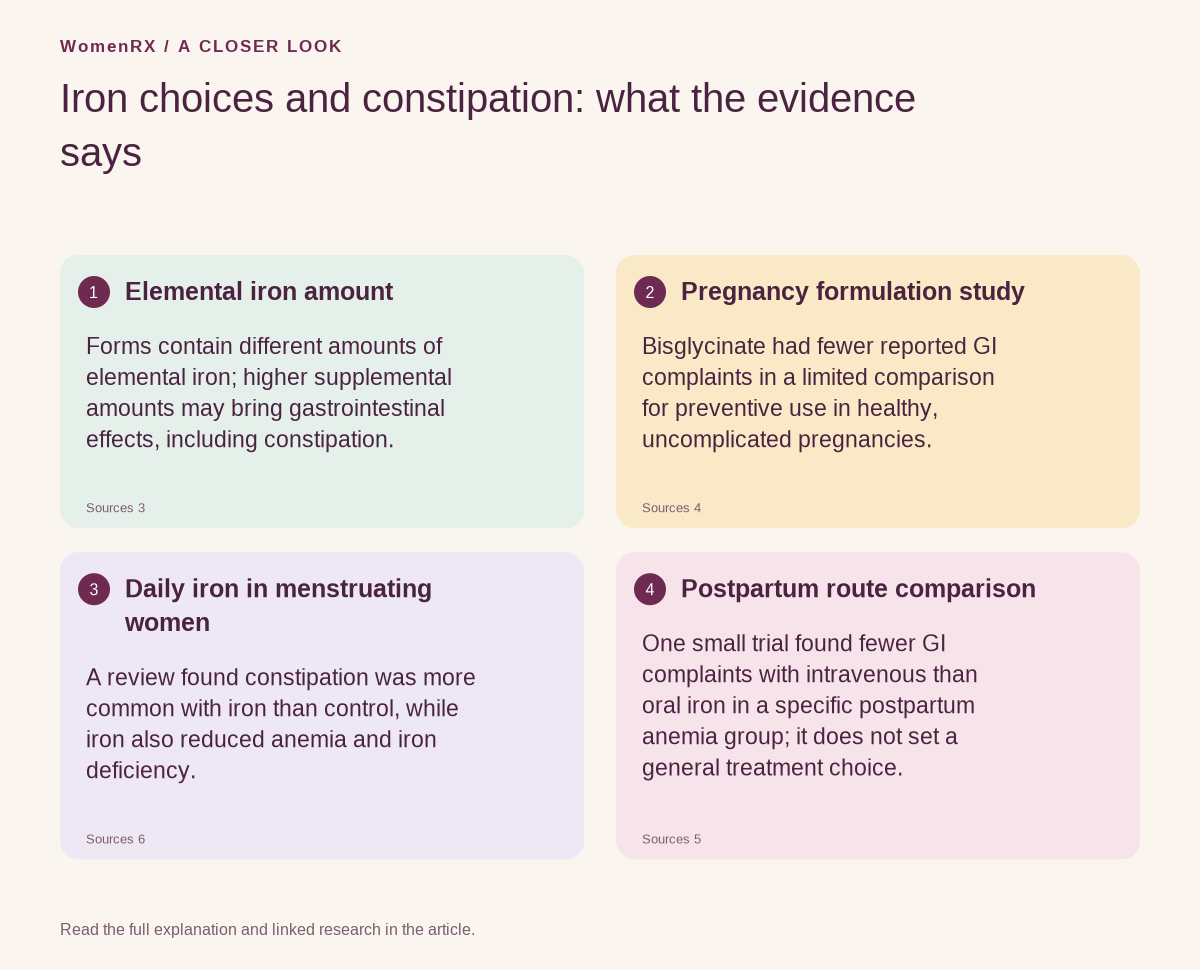
Iron choices and constipation: what the evidence says
Elemental iron amount: Forms contain different amounts of elemental iron; higher supplemental amounts may bring gastrointestinal effects, including constipation.3
Pregnancy formulation study: Bisglycinate had fewer reported GI complaints in a limited comparison for preventive use in healthy, uncomplicated pregnancies.4
Daily iron in menstruating women: A review found constipation was more common with iron than control, while iron also reduced anemia and iron deficiency.6
Postpartum route comparison: One small trial found fewer GI complaints with intravenous than oral iron in a specific postpartum anemia group; it does not set a general treatment choice.5
Read the figure as text
These distinctions can help you frame a discussion about tolerability without assuming one formulation or route is right for everyone.- Elemental iron amount: Forms contain different amounts of elemental iron; higher supplemental amounts may bring gastrointestinal effects, including constipation.3
- Pregnancy formulation study: Bisglycinate had fewer reported GI complaints in a limited comparison for preventive use in healthy, uncomplicated pregnancies.4
- Daily iron in menstruating women: A review found constipation was more common with iron than control, while iron also reduced anemia and iron deficiency.6
- Postpartum route comparison: One small trial found fewer GI complaints with intravenous than oral iron in a specific postpartum anemia group; it does not set a general treatment choice.5
More questions, answered
Does ferrous bisglycinate prevent constipation?
It can’t be promised to prevent constipation. A pregnancy study found fewer gastrointestinal complaints with ferrous bisglycinate than with two other forms in a limited formulation comparison, but it studied healthy pregnancies and prevention, not every person or treatment situation. 4
Should I stop iron if it makes me constipated?
Don’t stop prescribed iron without discussing it with the prescriber. Ask whether the amount, form or schedule could be adjusted while still addressing why iron was recommended. 2 3
Sources you can check
- Constipation | MedlinePlusAccessed 2026-09-25Return to first citation
- Constipation - NHSAccessed 2026-09-25Return to first citation
- Iron - Health Professional Fact SheetAccessed 2026-09-25Return to first citation
- Low-Dose Prophylactic Oral Iron Supplementation (Ferrous Fumarate, Ferrous Bisglycinate, and Ferrous Sulphate) in Pregnancy Is Not Associated With Clinically Significant Gastrointestinal Complaints: Results From Two Randomized Studies.Milman NT, Bergholt T. · Journal of pregnancy · 2024Return to first citation
- Low-dose ferric carboxymaltose vs. oral iron for improving hemoglobin levels in postpartum East Asian women: A randomized controlled trial.Nagao T, Takahashi K, Takahashi S, Yokomizo R, Samura O, Okamoto A. · PloS one · 2025Return to first citation
- Daily iron supplementation for improving anaemia, iron status and health in menstruating women.Low MS, Speedy J, Styles CE, De-Regil LM, Pasricha SR. · The Cochrane database of systematic reviews · 2016Return to first citation