Estrogen and Blood Pressure: What Changes at Menopause and With Therapy?
Blood pressure often rises with age around menopause, but that pattern doesn’t prove estrogen is the cause or predict how a particular hormone therapy will affect you.
Blood pressure tends to increase with age, and reviews report further increases around the menopause transition. That population pattern doesn’t show that estrogen loss is the sole cause of your reading. Hormone therapy’s effects vary by formulation and route, and it isn’t a blood-pressure treatment. Age, time since menopause, your cardiovascular risk, and whether therapy is systemic all belong in the decision. 3 4
A midlife trend isn’t an individual diagnosis
Blood pressure can rise during midlife and after menopause. A recent review summarizes an accelerated age-related increase around menopause, alongside changes in other cardiovascular risk factors. But these observations describe patterns across groups. They can’t tell you why your own blood pressure changed, or show that falling estrogen caused it. Age and other metabolic and vascular changes are part of the picture, too. 3 4
Estrogen does interact with blood vessels and systems that help regulate blood pressure. Researchers are still working to clarify how those changes relate to menopause and cardiovascular risk. That biology makes a connection plausible, but it doesn’t mean estrogen therapy will reliably lower blood pressure, or that every rise in a reading is hormone-related. 3 5
High blood pressure often has no symptoms. A reading that seems out of character is worth understanding through its pattern, not just how you feel that day. 1
Why therapy route and formulation matter
“Estrogen therapy” can refer to different treatments. Systemic therapy, such as pills or patches, differs from low-dose vaginal estrogen used for genitourinary symptoms. A review of cardiovascular effects reports that blood-pressure findings vary across hormone formulations and routes. The direction of a reported change in one setting should not be treated as a dependable prediction for another. 2 4
That distinction matters when weighing benefits and risks. The North American Menopause Society’s position statement says hormone therapy risks vary with the type, dose, duration, route, timing of initiation, and whether a progestogen is used. It describes hormone therapy primarily as treatment for bothersome menopause symptoms and prevention of bone loss, not as a way to treat hypertension. 2
Low-dose vaginal estrogen for genitourinary symptoms is a separate option from systemic therapy. The position statement recommends considering it for those symptoms when over-the-counter therapies haven’t helped and there’s no indication for systemic hormone therapy. That recommendation addresses genitourinary symptoms, not blood-pressure control. 2
Age and cardiovascular risk belong in the conversation
Blood pressure is one part of a broader cardiovascular picture. When considering systemic hormone therapy, discuss your age, how long it’s been since menopause, your blood-pressure history, and other cardiovascular risk factors. A 2025 review describes a person-centered assessment that considers traditional risk factors and relevant female-specific risk factors. It also emphasizes that more research is needed on long-term cardiovascular outcomes. 4
Timing matters to the overall benefit-risk discussion, but it doesn’t make blood pressure irrelevant. The menopause society’s 2022 statement says the balance is generally more favorable for women younger than 60 or within 10 years of menopause onset who have no contraindications and are treating bothersome symptoms or preventing bone loss. For people starting therapy later, the balance appears less favorable because absolute risks of coronary heart disease, stroke, blood clots, and dementia are greater. These are overall benefit-risk recommendations, not a blood-pressure rule. 2
Make the discussion specific to your readings
If you’re considering therapy or have noticed a change, the most useful comparison is between your actual blood-pressure pattern and the treatment being considered. For example, bring recent readings you already have and note when therapy began or changed. Ask whether the proposed treatment is systemic or vaginal, what formulation it uses, and how your age and cardiovascular risk affect the overall decision. If you take blood-pressure medicine, include it in that conversation rather than changing it on your own.
The practical takeaway is straightforward: don’t start or stop hormone therapy to manage a blood-pressure reading. Evaluate the blood pressure itself and decide about hormone therapy for its supported menopause-related uses, with the route, formulation, timing, and your risk profile in view. 1 2 4
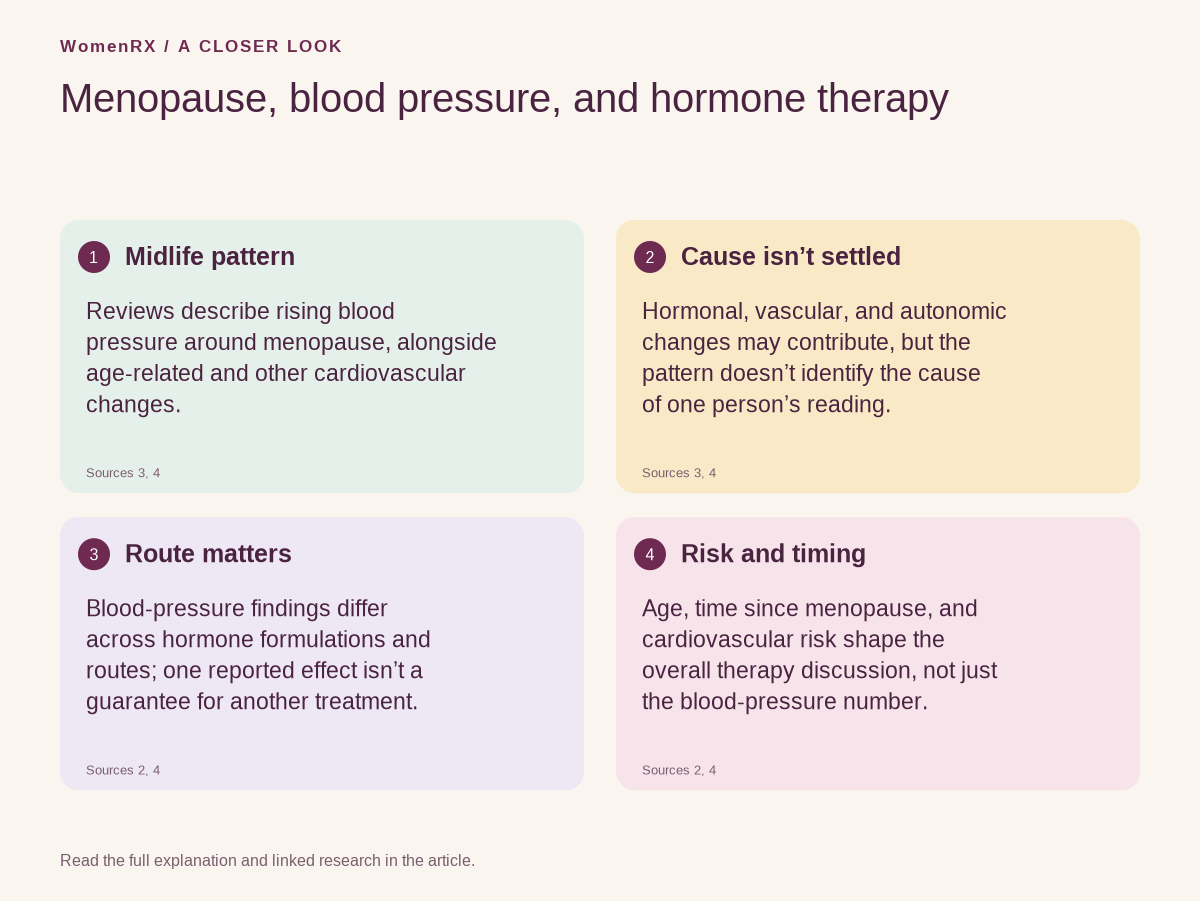
Menopause, blood pressure, and hormone therapy
Midlife pattern: Reviews describe rising blood pressure around menopause, alongside age-related and other cardiovascular changes.34
Cause isn’t settled: Hormonal, vascular, and autonomic changes may contribute, but the pattern doesn’t identify the cause of one person’s reading.34
Route matters: Blood-pressure findings differ across hormone formulations and routes; one reported effect isn’t a guarantee for another treatment.24
Risk and timing: Age, time since menopause, and cardiovascular risk shape the overall therapy discussion, not just the blood-pressure number.24
Read the figure as text
Separate what population patterns suggest from what therapy studies and menopause guidance can support for an individual decision.- Midlife pattern: Reviews describe rising blood pressure around menopause, alongside age-related and other cardiovascular changes.34
- Cause isn’t settled: Hormonal, vascular, and autonomic changes may contribute, but the pattern doesn’t identify the cause of one person’s reading.34
- Route matters: Blood-pressure findings differ across hormone formulations and routes; one reported effect isn’t a guarantee for another treatment.24
- Risk and timing: Age, time since menopause, and cardiovascular risk shape the overall therapy discussion, not just the blood-pressure number.24
More questions, answered
Can hormone therapy be used to treat high blood pressure?
The menopause society identifies hormone therapy for bothersome menopause symptoms and prevention of bone loss, not as a hypertension treatment. Its blood-pressure effects vary, so a change in pressure is not a reason to use it as a substitute for blood-pressure care. 1 2 4
Is vaginal estrogen the same as systemic hormone therapy?
No. Low-dose vaginal estrogen is described as an option for genitourinary symptoms, while systemic therapy is considered for other indications such as bothersome hot flashes. The distinction matters when discussing which treatment is being considered; the vaginal-estrogen recommendation isn’t a blood-pressure treatment recommendation. 2
Sources you can check
- Blood Pressure Medicines | MedlinePlusAccessed 2026-09-25Return to first citation
- The 2022 hormone therapy position statement of The North American Menopause Society.“The 2022 Hormone Therapy Position Statement of The North American Menopause Society” Advisory Panel. · Menopause (New York, N.Y.) · 2022Return to first citation
- Menopause and its effects on autonomic regulation of blood pressure: Insights and perspectives.Lee EJ, Keller-Ross ML. · Autonomic neuroscience : basic & clinical · 2025Return to first citation
- Cardiovascular Risk Associated with Menopause and Menopause Hormone Therapy: A Review and Contemporary Approach to Risk Assessment.D'Costa Z, Spertus E, Hingorany S, Patil R, Horwich T, Press MC, Shah J, Watson KE, Jafari L. · Current atherosclerosis reports · 2025Return to first citation
- Hormone Replacement Therapy and Cardiovascular Health in Postmenopausal Women.Xia W, Khalil RA. · International journal of molecular sciences · 2025Return to first citation