Do Women Over 50 Need a Multivitamin?
Some nutrient targets change with age, but the best reason to consider a multivitamin is a specific gap in what you get.
Not automatically. Being over 50 or postmenopausal is a reason to pay attention to your nutrient intake, not a reason by itself to buy a multivitamin. These products can help fill dietary gaps, but a trial in older adults did not find that a daily multivitamin significantly reduced total invasive cancer, cardiovascular events, or deaths. Check what you need and what you already take before comparing bottles. 1 4
A new nutrient target isn’t a shopping list
If you’ve seen “50+” on a bottle, it’s reasonable to wonder whether your needs changed overnight. Some recommendations do change around this age. For women, the recommended calcium intake rises from 1,000 mg a day through age 50 to 1,200 mg a day starting at 51. After menopause, lower estrogen can reduce calcium absorption and increase calcium loss from bone. That makes your total calcium intake worth a look. It doesn’t tell you that a multivitamin is the right way to get it. 2
Vitamin D is another nutrient to consider in context. Recommended intakes for adults range from 600 to 800 IU a day, depending on age. Fortified foods provide much of the vitamin D in U.S. diets, and factors such as limited sun exposure can affect vitamin D status. A “50+” label can’t account for those differences in your life. 3
The useful question is more specific than “Am I old enough for a multivitamin?” It’s “What, if anything, am I getting too little of, and would this product help?” For example, someone who rarely eats dairy could look at calcium from fortified foods and other sources before assuming a multivitamin covers the difference. Calcium is also found in foods such as yogurt, calcium-fortified soy beverages, certain tofu, and canned fish with edible bones. 2
Filling a gap is different from preventing disease
A multivitamin/mineral supplement can raise nutrient intake when food alone doesn’t provide recommended amounts. But improving an intake number doesn’t automatically mean preventing a heart attack or cancer. Supplements can also raise some nutrient intakes above recommended upper limits, particularly when a multivitamin overlaps with single-nutrient products. 1
The COSMOS randomized trial offers a useful check on broad health promises. It assigned 21,442 U.S. adults, including 12,666 women age 65 and older, to a daily multivitamin or placebo. Over a median of 3.6 years, the multivitamin did not significantly reduce total invasive cancer, cardiovascular events, or all-cause mortality. Those results describe the study group as a whole; the reported main outcomes do not establish a separate effect for women, or tell us what happens with every formula sold for women over 50. 4
That’s why the strongest reason to consider a multivitamin is a gap it can actually address, not a promise of general protection. A health condition or a nutrient need identified with your care team may also change what you’re looking for. In either case, check the ingredients rather than assuming a broad formula matches the need.
Compare the whole label with your whole routine
Start with the Supplement Facts panel, then put every other supplement you use beside it. This quick comparison is more revealing than the age claim on the front of the bottle:
- Name the gap. Think about foods you regularly eat, foods you avoid, and any nutrient need already identified for you. If you can’t name what the product is meant to add, pause before choosing one.
- Read amounts per serving. Compare the amount of each relevant nutrient, not just the product name. Percent Daily Value helps compare nutrient contents across labels, but it’s a general reference for a total diet, not a calculation of your personal need. 2 3
- Spot repeated nutrients. Count what’s in single-nutrient supplements as well as the multivitamin. Excessive intakes are more likely when people combine multivitamin/mineral products with individual vitamin or mineral supplements. 1
- Check calcium separately. Multivitamins commonly contain about 200 to 300 mg of calcium, although amounts vary. Compare that number with calcium from food and any separate calcium product. Even some calcium-containing antacids add to your intake. 2
For example, adding a multivitamin to a separate calcium-and-vitamin-D supplement may duplicate both nutrients. That doesn’t tell you whether your total is too high or too low; it tells you which amounts to add up and review. The same check applies to any other nutrient that appears on more than one label. 1 2
Age 50 and menopause can prompt a closer look at nutrition, especially calcium. They don’t, on their own, settle whether you need a standard multivitamin. Let the gap you’re trying to fill guide the choice, then make sure the label fits without unnecessary overlap. 1 2
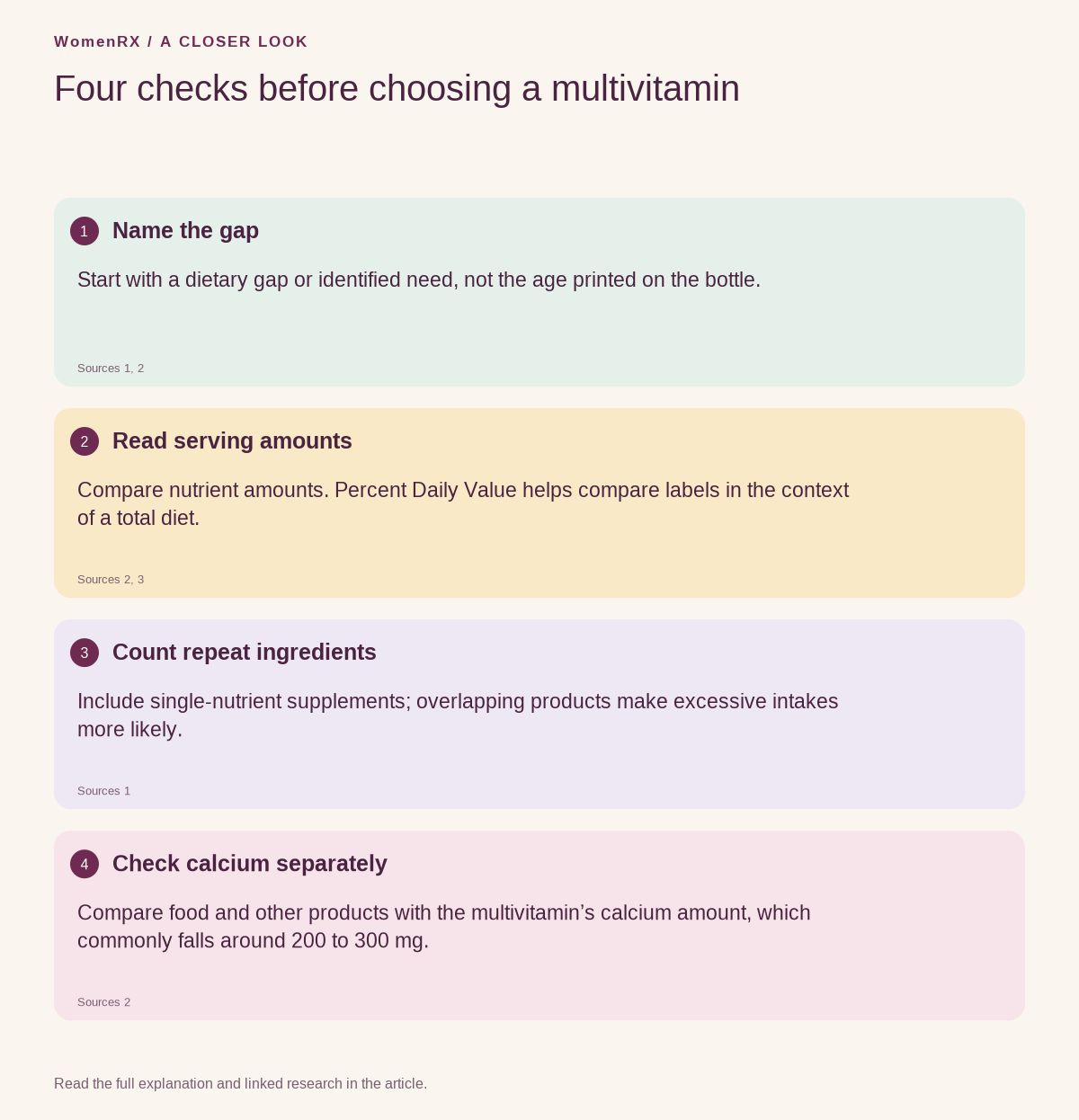
Four checks before choosing a multivitamin
Name the gap: Start with a dietary gap or identified need, not the age printed on the bottle.12
Read serving amounts: Compare nutrient amounts. Percent Daily Value helps compare labels in the context of a total diet.23
Count repeat ingredients: Include single-nutrient supplements; overlapping products make excessive intakes more likely.1
Check calcium separately: Compare food and other products with the multivitamin’s calcium amount, which commonly falls around 200 to 300 mg.2
Read the figure as text
Use this label check to connect a product to a need and catch nutrients you may already be getting elsewhere.- Name the gap: Start with a dietary gap or identified need, not the age printed on the bottle.12
- Read serving amounts: Compare nutrient amounts. Percent Daily Value helps compare labels in the context of a total diet.23
- Count repeat ingredients: Include single-nutrient supplements; overlapping products make excessive intakes more likely.1
- Check calcium separately: Compare food and other products with the multivitamin’s calcium amount, which commonly falls around 200 to 300 mg.2
More questions, answered
Will a multivitamin meet my calcium needs after menopause?
Don’t assume it will. The recommended calcium intake for women rises to 1,200 mg a day starting at age 51, while multivitamins commonly provide about 200 to 300 mg, with amounts varying by product. Food and other supplements also count toward your total. 2
Sources you can check
- Multivitamin/mineral Supplements - Health Professional Fact SheetAccessed 2026-09-25Return to first citation
- Calcium - Health Professional Fact SheetAccessed 2026-09-25Return to first citation
- Vitamin D - Health Professional Fact SheetAccessed 2026-09-25Return to first citation
- Multivitamins in the prevention of cancer and cardiovascular disease: the COcoa Supplement and Multivitamin Outcomes Study (COSMOS) randomized clinical trial.Sesso HD, Rist PM, Aragaki AK, Rautiainen S, Johnson LG, Friedenberg G, Copeland T, Clar A, Mora S, Moorthy MV, Sarkissian A, Wactawski-Wende J, Tinker LF, Carrick WR, Anderson GL,... · The American journal of clinical nutrition · 2022Return to first citation