Choline: How Much You Need and Whether Timing Matters
Your daily choline intake from food and supplements matters more than choosing a particular hour to take it.
For women 19 and older, the US Adequate Intake for choline is 425 mg a day, rising to 450 mg during pregnancy and 500 mg while breastfeeding. Those are targets for total daily intake, not doses for a separate supplement. Check your usual foods and any prenatal label first. Pregnancy studies of dietary intake do not establish a preferred time of day for taking choline. 3456
Start with the amount you get each day
Choline helps your body build cell membranes and make acetylcholine, a chemical messenger. Your liver makes some choline, but food also supplies it. Pregnancy and breastfeeding raise the amount needed to support fetal and infant growth. 4
The US Adequate Intake (AI) for women 19 and older is 425 mg a day. It rises to 450 mg during pregnancy and 500 mg while breastfeeding. If you’re planning a pregnancy but aren’t pregnant yet, the adult-woman figure is the relevant starting point. An AI is a daily intake benchmark, not an instruction to take that amount in a pill. Count what comes from food and supplements together. 34
That distinction can keep a simple question from becoming a supplement puzzle. For example, if your meals regularly include choline-containing foods and your prenatal lists choline, both contribute to your daily total. A separate product isn’t automatically needed just because the pregnancy AI is higher.
Look at food, then read the label
Eggs, meat and poultry, fish, and dairy are sources of choline. Plant foods contribute too, including soybeans, peanuts, broccoli, Brussels sprouts, and whole grains such as quinoa. Animal-derived sources tend to contain more choline than plant-derived ones, so a mostly plant-based diet may call for a closer look at the mix of foods you eat. 4
Next, check the Supplement Facts panel on any prenatal or other supplement you already take. Look for the listed amount of choline rather than assuming a product supplies a particular amount. Consider that figure alongside your usual meals, not in place of them. Research that assesses nutrient intake distinguishes food alone from the combined contribution of food and supplements. 3
If you’re pregnant and considering adding a separate product, take the labels of what you already use to a prenatal care visit. That gives you and your care team a concrete way to consider your diet and supplements together before you make a change. MedlinePlus advises checking before taking supplements during pregnancy. 12
What pregnancy research says about timing
The pregnancy studies here ask about how much choline women ate, not whether taking a supplement at breakfast works better than taking it at night. In one study of 7,310 women in China, researchers asked about diet after delivery and found an association between higher estimated dietary choline intake and birth weight. Another study followed 256 mother-infant pairs and found associations between dietary intake in late pregnancy and some early infant development scores. Neither design establishes a benefit from a choline supplement or identifies a preferred dosing hour. 57
So make the intake decision first: which life-stage benchmark applies, what foods you usually eat, and what your existing products list. If a separate supplement makes sense for you, the cited pregnancy research offers no reason to expect a better outcome from choosing morning over evening. 456
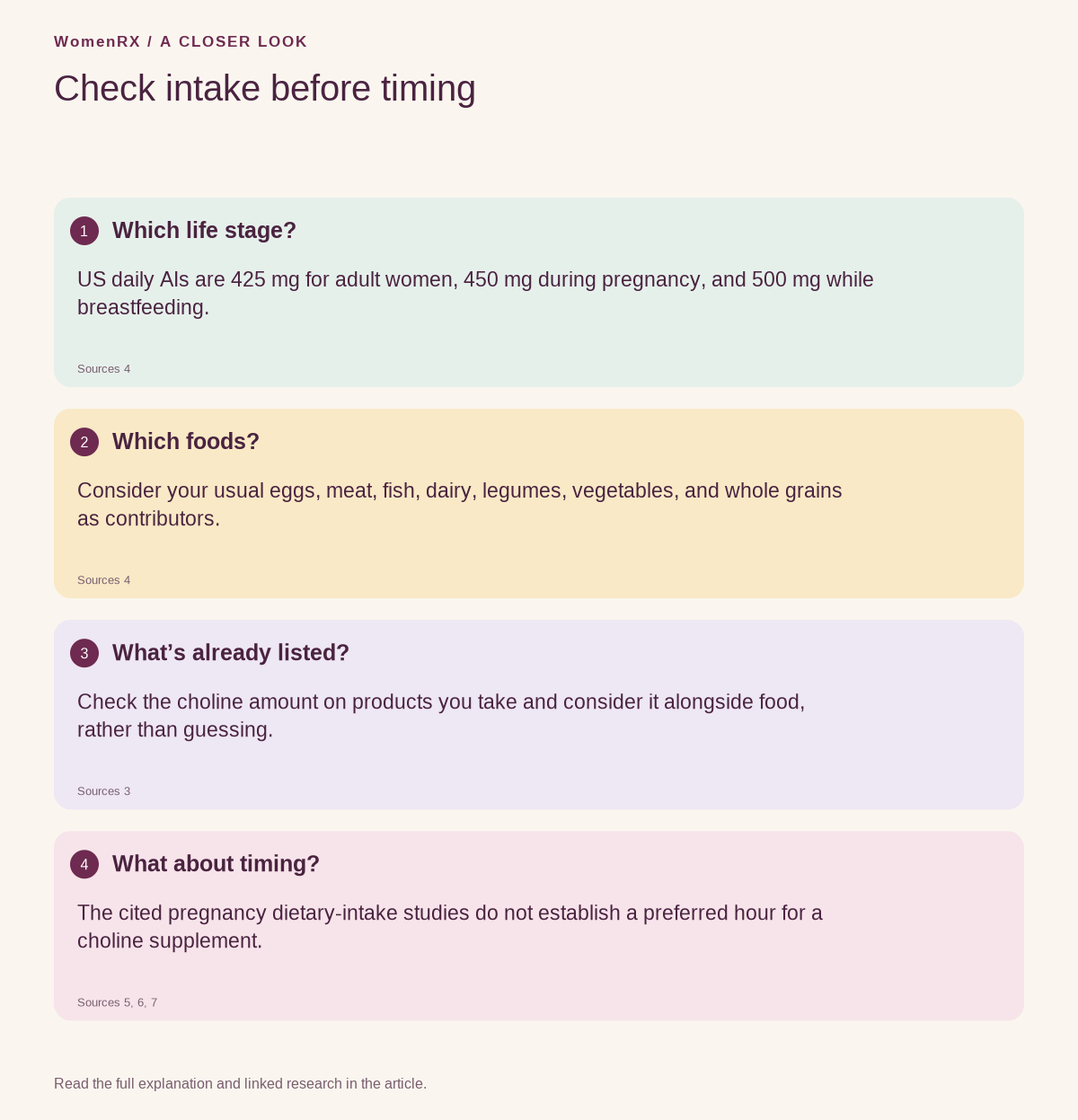
Check intake before timing
Which life stage?: US daily AIs are 425 mg for adult women, 450 mg during pregnancy, and 500 mg while breastfeeding.4
Which foods?: Consider your usual eggs, meat, fish, dairy, legumes, vegetables, and whole grains as contributors.4
What’s already listed?: Check the choline amount on products you take and consider it alongside food, rather than guessing.3
What about timing?: The cited pregnancy dietary-intake studies do not establish a preferred hour for a choline supplement.567
Read the figure as text
Four distinct questions help you decide what to assess before considering a separate choline supplement.- Which life stage?: US daily AIs are 425 mg for adult women, 450 mg during pregnancy, and 500 mg while breastfeeding.4
- Which foods?: Consider your usual eggs, meat, fish, dairy, legumes, vegetables, and whole grains as contributors.4
- What’s already listed?: Check the choline amount on products you take and consider it alongside food, rather than guessing.3
- What about timing?: The cited pregnancy dietary-intake studies do not establish a preferred hour for a choline supplement.567
More questions, answered
Does choline replace folic acid when I’m planning a pregnancy?
No. Choline and folic acid are different nutrients. MedlinePlus notes that getting enough folic acid before and during pregnancy helps prevent certain birth defects of the brain or spine. Checking your choline intake doesn’t replace that pregnancy guidance. 24
Sources you can check
- Dietary Supplements: MedlinePlusAccessed 2026-09-25Return to first citation
- Pregnancy and Medicines | MedlinePlusAccessed 2026-09-25Return to first citation
- Application of the Total Nutrient Index as a Precision Nutrition Tool to Address Dietary Recommendations Across the Life Course.Cowan-Pyle AE, Tooze JA, Reynolds LM, Gahche JJ, Dwyer JT, Mitchell DC, Carroll RJ, Mallick BK, Bailey RL. · Journal of the Academy of Nutrition and Dietetics · 2026Return to first citation
- Choline in Pregnancy and Lactation: Essential Knowledge for Clinical Practice.Derbyshire EJ. · Nutrients · 2025Return to first citation
- Dietary choline intake during pregnancy and birth weight in a Chinese population: a cross-sectional study.Yang J, Xiao Z, Hu W, Rekemubieke B, Li YH. · Nutrition journal · 2026Return to first citation
- Dietary Choline Intake During Pregnancy and Congenital Heart Defects in a Chinese Population.Li YH, Xiao Z, Guo R, Rekemubieke B, Hu W, Liu X, Yang J. · Nutrients · 2025Return to first citation
- Association of dietary choline intake in late pregnancy with the early neurobehavioral development of offspring.Weng Y, Liu Y, Qin Y, Zhang A, Dong H, Chen Z. · European journal of nutrition · 2026Return to first citation