When to Take Melatonin, and Whether Food Matters
Your product’s release type and bedtime directions matter more than a blanket rule to take melatonin on an empty stomach.
Start with the directions for your specific melatonin product and count backward from the bedtime you’re aiming for. Food instructions aren’t universal: NHS guidance for particular medicines says to take slow-release tablets with food, but standard tablets two hours before or after food.2 A study comparing release types tested them only while participants were fasting, so it cannot show what a meal would change.6
Start with bedtime, then check the meal instruction
“When should I take it?” has two parts: when the product says to take it relative to bedtime, and whether it says anything about food. Keep those instructions separate. Taking melatonin without food doesn’t, by itself, put it at the right point in your sleep schedule.
Here’s a concrete timing example, not a schedule for every product: NHS guidance for a 2 mg slow-release medicine used for short-term sleep problems in adults places it one to two hours before bedtime and says slow-release tablets are best taken with food. If your intended bedtime were 11 p.m., that medicine’s bedtime instruction would point to 9-10 p.m. The same guidance gives a different bedtime window for slow-release medicine used for longer-term sleep problems, which is one reason not to borrow a time from another product.2
Food advice can differ even within that guidance. It says standard tablets are best taken two hours before or two hours after food, rather than with food.2 If your own product has both a bedtime direction and a food direction, check that both fit your evening. For example, an instruction to take a tablet before bed does not tell you to skip dinner; a separate instruction about food tells you how to place the tablet relative to dinner. The NHS examples describe particular medicines, not a universal rule for US melatonin supplements.2
What a meal may change, and what we can’t infer
The immediate-release and sustained-release capsules in the study below had different blood-level profiles, but the study did not establish different dosing times. Follow the timing directions for your specific product.62 In a randomized crossover study, 16 healthy adults ages 18-45 received one of each type on separate occasions while fasting. The sustained-release capsule produced a later peak and a longer-lasting blood-level profile than the immediate-release capsule. The study measured melatonin in the blood; it did not compare taking either capsule with a meal or establish which timing improved sleep.6
That distinction explains why “empty stomach” is a poor shortcut. A fasting comparison can show how those two formulations differed under fasting conditions, but it cannot tell you that fasting will make your product work better, prevent morning grogginess, or override its food directions.6 If the directions on your package are unclear about the release type or food, a pharmacist can help interpret that particular label rather than substituting instructions from a different formulation.
Leave room for the following morning
Think beyond the moment you get into bed, especially if you need to be alert early. A review focused on sleep medicines in older adults found that melatonin can produce residual daytime sedation, although its average effect on falling asleep was small.5 That finding doesn’t establish a safe cutoff time for everyone. If you feel sleepy the next morning, don’t assume taking the same product without food will fix it; the product, its timing, and the reason you’re sleeping poorly all deserve a closer look.53
If trouble sleeping keeps happening, the pattern matters. Difficulty falling asleep, repeated waking, and waking at the wrong time can have different causes. Insomnia can also be related to another condition, a medicine, caffeine, or a sleep disorder, so changing melatonin timing may not address what’s keeping you awake.13
If you’re pregnant, breastfeeding, or sleeping differently around menopause
A review notes that melatonin supplementation is not recommended during pregnancy or breastfeeding because studies are lacking. That is a reason to discuss a sleep problem and possible options with your pregnancy or postpartum care team before using it, rather than treating a supplement as automatically suitable.4
Around menopause, a change in sleep doesn’t automatically mean you need melatonin. A review describes lower melatonin production during menopause, but that observation doesn’t establish that a supplement will resolve an individual woman’s sleep problem.4 Whether you’re struggling to fall asleep, waking repeatedly, or feeling unrefreshed can be more useful than assuming one cause. Persistent insomnia may call for addressing an underlying problem, and cognitive behavioral therapy is one treatment approach for ongoing insomnia.3
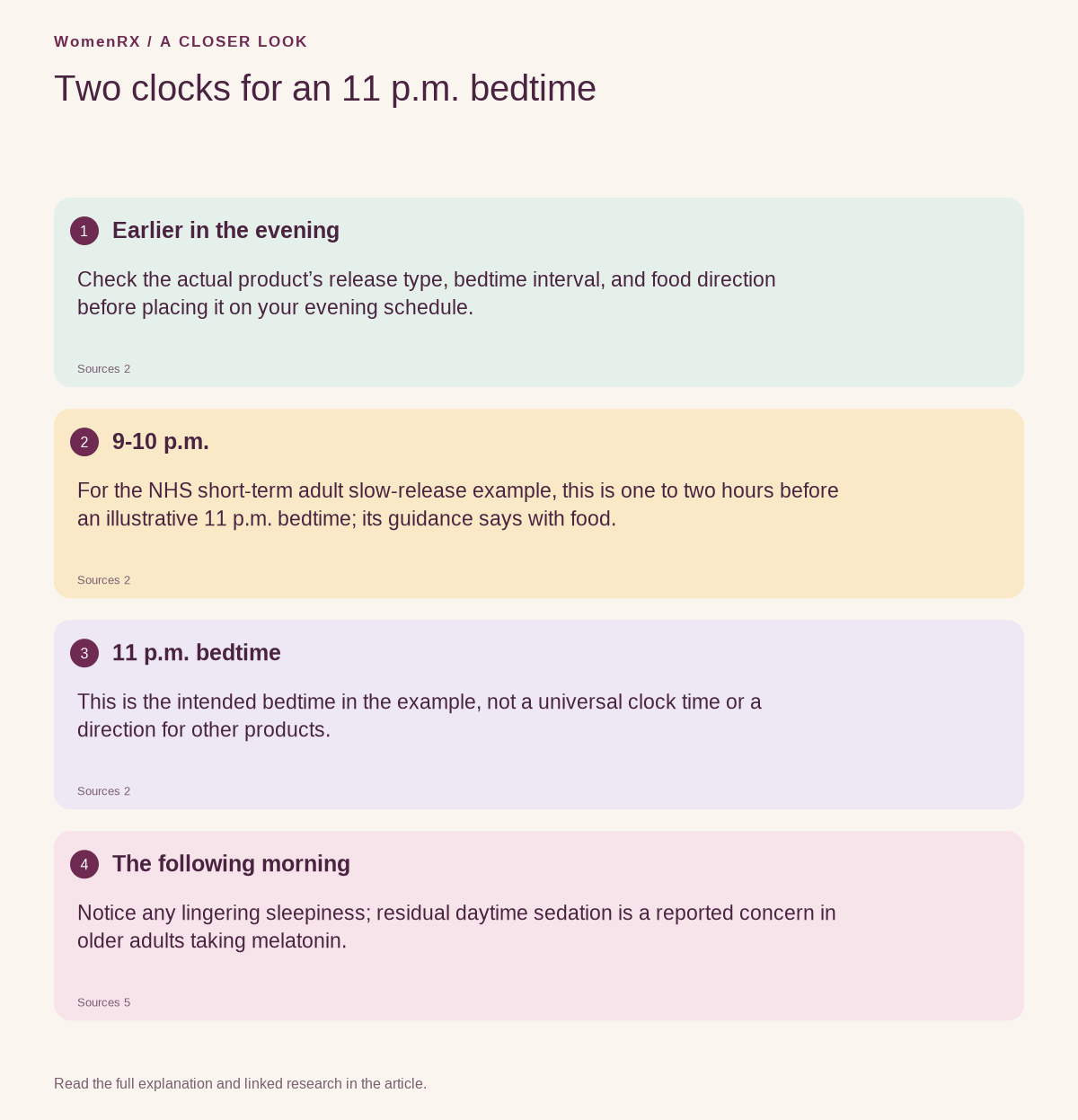
Two clocks for an 11 p.m. bedtime
Earlier in the evening: Check the actual product’s release type, bedtime interval, and food direction before placing it on your evening schedule.2
9-10 p.m.: For the NHS short-term adult slow-release example, this is one to two hours before an illustrative 11 p.m. bedtime; its guidance says with food.2
11 p.m. bedtime: This is the intended bedtime in the example, not a universal clock time or a direction for other products.2
The following morning: Notice any lingering sleepiness; residual daytime sedation is a reported concern in older adults taking melatonin.5
Read the figure as text
An illustrative evening using one NHS slow-release medicine example, with its meal instruction kept distinct from its bedtime interval.- Earlier in the evening: Check the actual product’s release type, bedtime interval, and food direction before placing it on your evening schedule.2
- 9-10 p.m.: For the NHS short-term adult slow-release example, this is one to two hours before an illustrative 11 p.m. bedtime; its guidance says with food.2
- 11 p.m. bedtime: This is the intended bedtime in the example, not a universal clock time or a direction for other products.2
- The following morning: Notice any lingering sleepiness; residual daytime sedation is a reported concern in older adults taking melatonin.5
More questions, answered
What if I miss the time on my melatonin directions?
For the medicines covered by its guidance, the NHS advises skipping a dose missed at bedtime and starting again the next night, rather than taking it later in the night.2 Check your own product’s directions for the instruction that applies to it.
Sources you can check
- Sleep Disorders | MedlinePlusAccessed 2026-09-25Return to first citation
- How and when to take melatonin - NHSAccessed 2026-09-25Return to first citation
- Insomnia | MedlinePlusAccessed 2026-09-25Return to first citation
- Melatonin in Medicinal and Food Plants: Occurrence, Bioavailability, and Health Potential for Humans.Salehi B, Sharopov F, Fokou PVT, Kobylinska A, Jonge L, Tadio K, Sharifi-Rad J, Posmyk MM, Martorell M, Martins N, Iriti M. · Cells · 2019Return to first citation
- Review of Safety and Efficacy of Sleep Medicines in Older Adults.Schroeck JL, Ford J, Conway EL, Kurtzhalts KE, Gee ME, Vollmer KA, Mergenhagen KA. · Clinical therapeutics · 2016Return to first citation
- Comparative Pharmacokinetics of Sustained-Release versus Immediate-Release Melatonin Capsules in Fasting Healthy Adults: A Randomized, Open-Label, Cross-Over Study.Thanawala S, Abiraamasundari R, Shah R. · Pharmaceutics · 2024Return to first citation