Can Breastfeeding Make Menopause Harder to Recognize?
Breastfeeding can keep periods away and may contribute to vaginal dryness, making those signs less useful for judging whether menopause is beginning.
Yes. Breastfeeding can suppress ovarian activity and keep periods away; it may also contribute to vaginal dryness. Those changes can resemble signs of menopause, but they don’t mean menopause has begun. If periods have returned and then become irregular, consider pregnancy, hormonal contraception, and other causes rather than assuming breastfeeding explains the change. 2 6 7
A missed period means something different while you’re nursing
Breastfeeding can affect the signals between the brain and ovaries. Suckling-related prolactin may suppress ovarian activity and keep estrogen lower, particularly while periods are absent. That gives you a reason not to read a missed period during lactation as proof of menopause. 6
Pregnancy, lactation, and menopause are distinct explanations for absent periods. Natural menopause is generally identified after 12 consecutive months without a period when there’s no other reported cause. If breastfeeding may explain the absence, counting those months alone won’t settle the question. 5 7
Age still matters. Menopause usually occurs between ages 45 and 55, and irregular periods become more likely as it approaches. If you’re breastfeeding in that age range, perimenopause may be worth considering too. That doesn’t mean the two are happening together, or that either one explains every symptom. 2
Which symptoms overlap, and which need another look?
Vaginal dryness is one overlap. It can occur with menopause, while a review of postpartum symptoms describes dryness and other vulvovaginal or urinary concerns that may be linked to the hormonal environment of breastfeeding. The review also cautions against assuming every postpartum symptom is hormonal: birth-related scar pain, pelvic floor problems, infections, skin conditions, and other factors can contribute. 1 6
If dryness is uncomfortable, a water-based lubricant during sex or a vaginal moisturizer may help. If it persists despite what you’ve tried, affects daily life, or comes with unusual discharge or bleeding after sex, it’s worth having the cause assessed. 1
Hot flashes are a recognized menopause symptom, but feeling hot doesn’t tell you why it’s happening. The menopause treatment guidance establishes that vasomotor symptoms occur with menopause; it doesn’t show that a hot feeling while breastfeeding identifies perimenopause. 3 4
Irregular bleeding is a different question from periods that haven’t returned. If your periods had resumed and their pattern changes, don’t automatically attribute that change to breastfeeding. Pregnancy, hormonal contraception, approaching menopause, and thyroid problems are among the possibilities clinicians consider for missed or irregular periods. Bleeding between periods also warrants assessment. 2
What to sort out first
If pregnancy is possible, make that your first question rather than using breastfeeding or age to explain a missed period. Pregnancy is a common cause, and clinical assessment of absent periods begins by ruling it out. If you’re using hormonal contraception, mention which kind: some methods can also change bleeding patterns. 2 7
Then consider what actually changed. Had periods returned before they became irregular, or have they stayed absent while you’ve been breastfeeding? Are dryness or hot feelings the main concern, or is there unusual bleeding or discharge? These details help separate a possible lactation effect from a symptom that needs its own explanation. They’re more useful than trying to diagnose menopause from one sign. 1 2 6 7
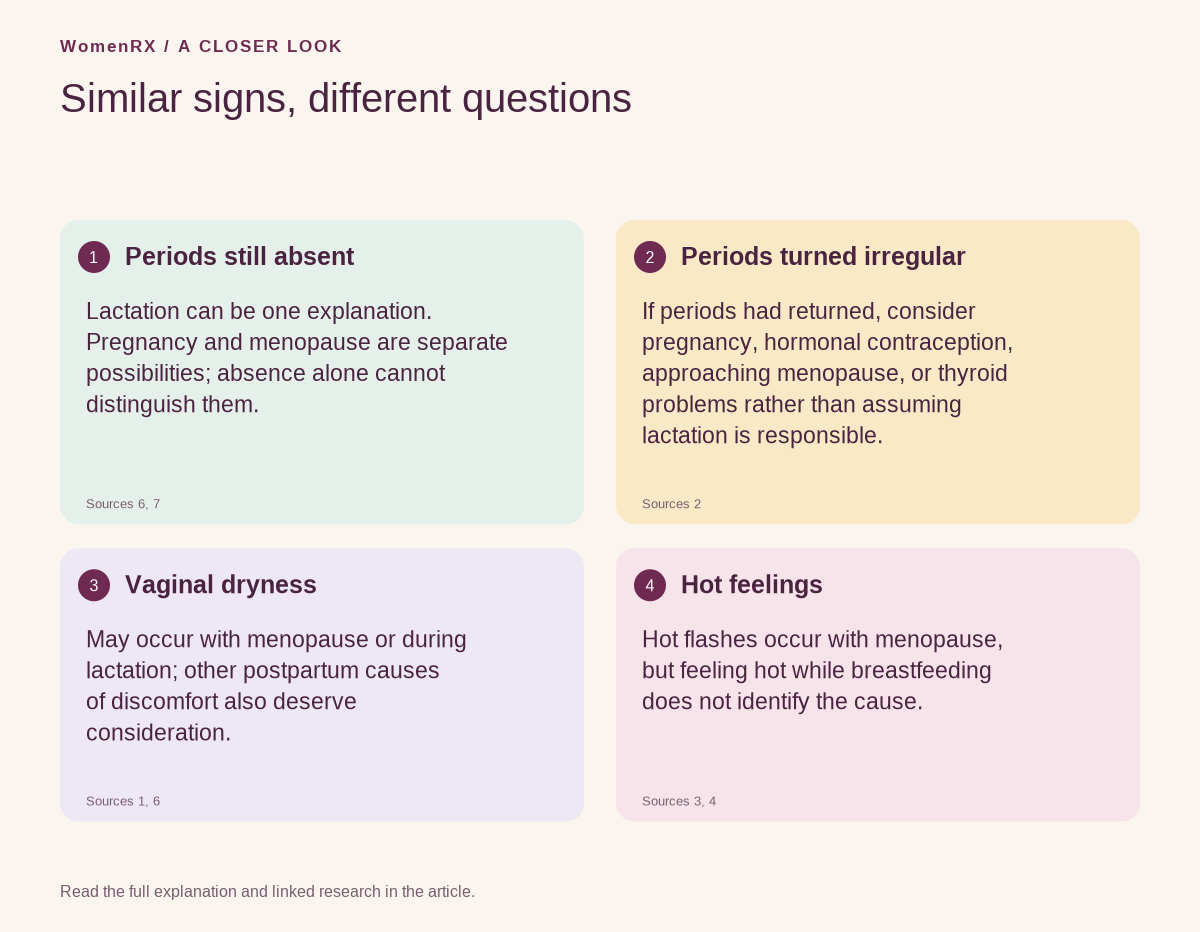
Similar signs, different questions
Periods still absent: Lactation can be one explanation. Pregnancy and menopause are separate possibilities; absence alone cannot distinguish them.67
Periods turned irregular: If periods had returned, consider pregnancy, hormonal contraception, approaching menopause, or thyroid problems rather than assuming lactation is responsible.2
Vaginal dryness: May occur with menopause or during lactation; other postpartum causes of discomfort also deserve consideration.16
Hot feelings: Hot flashes occur with menopause, but feeling hot while breastfeeding does not identify the cause.34
Read the figure as text
An absent period, changed bleeding, dryness, and hot feelings don’t all point to the same explanation.- Periods still absent: Lactation can be one explanation. Pregnancy and menopause are separate possibilities; absence alone cannot distinguish them.67
- Periods turned irregular: If periods had returned, consider pregnancy, hormonal contraception, approaching menopause, or thyroid problems rather than assuming lactation is responsible.2
- Vaginal dryness: May occur with menopause or during lactation; other postpartum causes of discomfort also deserve consideration.16
- Hot feelings: Hot flashes occur with menopause, but feeling hot while breastfeeding does not identify the cause.34
More questions, answered
Does breastfeeding change when menopause starts?
In a prospective cohort of 2,377 women followed for about 10 years, lifetime breastfeeding duration was not associated with age at natural menopause after adjustment for several factors. That group-level finding can’t tell you what’s causing symptoms while you’re breastfeeding now. 5
Sources you can check
- Vaginal dryness - NHSAccessed 2026-09-25Return to first citation
- Irregular periods - NHSAccessed 2026-09-25Return to first citation
- The 2022 hormone therapy position statement of The North American Menopause Society.“The 2022 Hormone Therapy Position Statement of The North American Menopause Society” Advisory Panel. · Menopause (New York, N.Y.) · 2022Return to first citation
- The 2023 nonhormone therapy position statement of The North American Menopause Society.Menopause (New York, N.Y.) · 2023Return to first citation
- Association of lifetime lactation and age at natural menopause: a prospective cohort study.Scime NV, Shea AK, Faris PD, Brennand EA. · Menopause (New York, N.Y.) · 2022Return to first citation
- Genitourinary syndrome of lactation: An underrecognized postpartum condition affecting women's vulvovaginal, urinary and sexual health.Orozco Fernández R, Gil-Antuñano SP. · Women's health (London, England) · 2026Return to first citation
- Secondary AmenorrheaLord M, Jenkins SM, Sahni M. · 2024Return to first citation