B-Complex and Hormones: What the Evidence Actually Shows
B vitamins have different jobs, and evidence about one vitamin’s effect on PMS symptoms doesn’t show that a B-complex changes hormone levels.
Research on B vitamins and women’s health is specific, not evidence that a B-complex “balances hormones.” A review of randomized trials found some support for vitamin B6 for psychological PMS symptoms, but not enough evidence for vitamin B1 or multivitamins. The review’s symptom findings don’t establish an effect on estrogen or progesterone, fertility, or menopause concerns. 4
Start with the outcome, not the label
“B-complex” groups several distinct vitamins together: thiamine (B1), riboflavin (B2), niacin (B3), pantothenic acid (B5), B6, biotin (B7), folate (B9), and B12. Each has its own roles in the body. A study of one vitamin, or a combination product, can’t automatically tell you what a different formula will do. 1
That distinction matters because “hormone balance” can mean very different things: changing estrogen or progesterone levels, easing premenstrual symptoms, supporting fertility, or improving menopause symptoms. Those are separate outcomes. In particular, improvement in a symptom rating is not proof that hormone levels changed.
Riboflavin, for example, is involved in the metabolism of steroids. That describes a role in the body’s biochemical processes; it doesn’t show that taking extra riboflavin raises, lowers, or balances reproductive hormones. 3
What the PMS research found
The clearest relevant evidence concerns premenstrual syndrome (PMS) symptoms; it doesn’t establish effects on hormone levels. A 2025 systematic review examined 31 randomized trials involving 3,254 participants ages 15 to 50. It found consistent positive results for vitamin B6, calcium, and zinc on psychological symptoms of PMS. The review found insufficient evidence for vitamin B1 and multivitamin supplementation. Only one included study was judged at low risk of bias, so the overall evidence has important limitations. 4
This doesn’t make B6 and a B-complex interchangeable. The review assessed particular nutritional interventions; its findings about B6 don’t establish that taking a formula containing several B vitamins will have the same effect. Nor does the review show that B6 works by changing estrogen or progesterone. Its question was whether interventions affected psychological symptoms.
A small randomized trial illustrates why formulas need to be considered on their own terms. It compared B6 with a broad-spectrum micronutrient formula in 78 regularly menstruating women with PMS; 72 completed the three-cycle study. Both groups reported symptom improvement, but there was no placebo group. The study therefore compared two treatments rather than establishing how either performed against placebo or no treatment. And the micronutrient formula was not simply a B-complex. 5
Combination products can make attribution harder still. In a trial of 76 university students, a group taking calcium plus B6 had a greater reduction in PMS symptoms than a group taking B6 alone. That comparison can’t tell you whether a B-complex by itself would help, and it doesn’t demonstrate a change in hormone levels. 6
PMS findings don’t answer fertility or menopause questions
PMS research in women who menstruate shouldn’t be carried over to fertility, pregnancy, perimenopause, or postmenopause as if they were the same condition. PMS symptom findings don’t establish that B-complex supplements improve fertility or menopause-related symptoms. That is a limit of what these findings show, not proof that no research on those questions exists.
If a supplement claim promises to “balance hormones,” look for the specific vitamin, the population studied, and the measured outcome. A trial tracking PMS symptoms is different from one measuring reproductive hormones, pregnancy outcomes, or menopause symptoms. Those results shouldn’t be treated as interchangeable.
One practical check: biotin and lab tests
Some B-complex products contain biotin. High biotin intake can interfere with certain laboratory assays and produce falsely high or low results, including tests used to measure thyroid hormones. If you take a biotin-containing supplement and are having blood tests, tell the person ordering the tests what you take; don’t assume a thyroid result is unaffected. 2
For any supplement, check the specific ingredients and amounts on the label rather than relying on the phrase “B-complex.” B vitamins have individual roles, and evidence for one nutrient or one outcome doesn’t establish a hormone-balancing effect for the whole group.
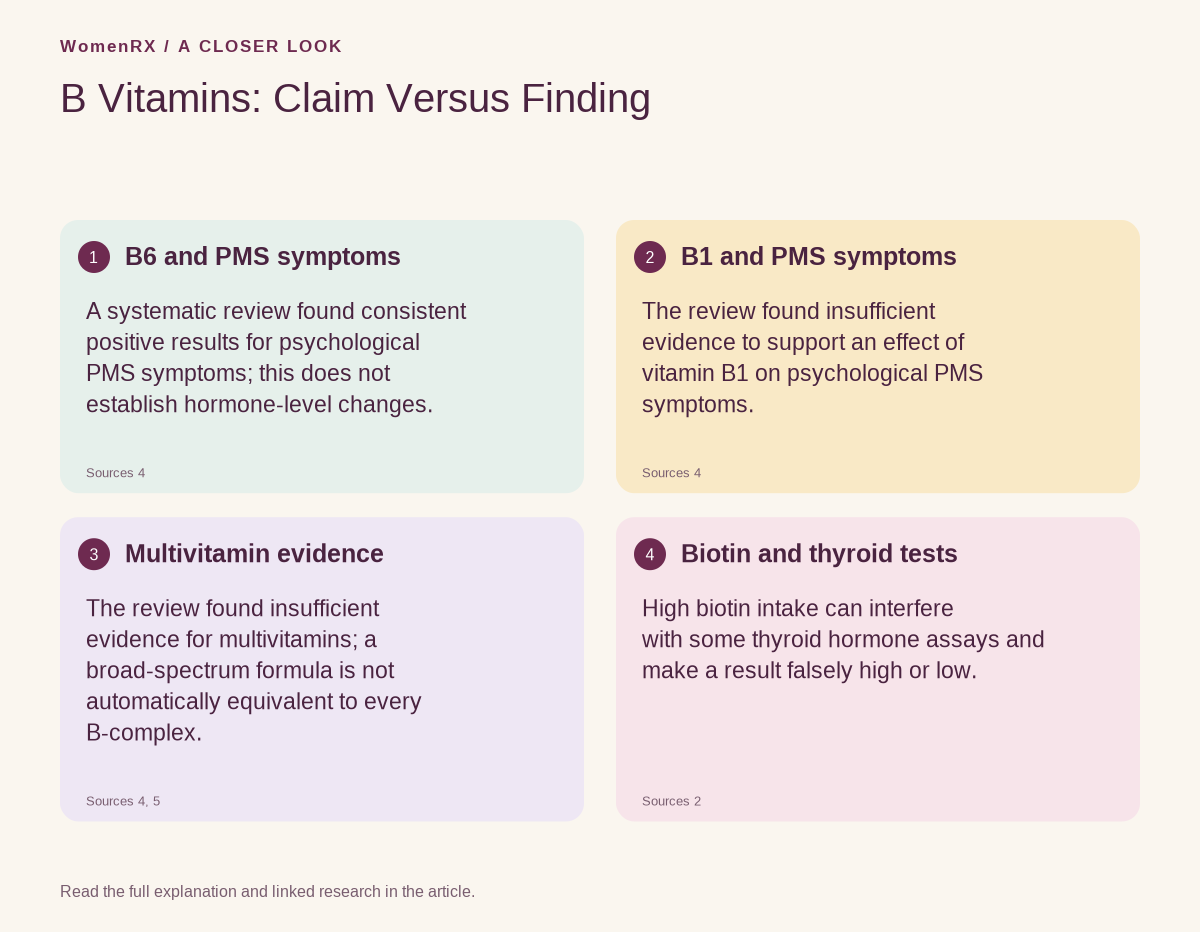
B Vitamins: Claim Versus Finding
B6 and PMS symptoms: A systematic review found consistent positive results for psychological PMS symptoms; this does not establish hormone-level changes.4
B1 and PMS symptoms: The review found insufficient evidence to support an effect of vitamin B1 on psychological PMS symptoms.4
Multivitamin evidence: The review found insufficient evidence for multivitamins; a broad-spectrum formula is not automatically equivalent to every B-complex.45
Biotin and thyroid tests: High biotin intake can interfere with some thyroid hormone assays and make a result falsely high or low.2
Read the figure as text
The evidence differs by vitamin and outcome. PMS symptom findings are not the same as proof of changes in hormone levels.- B6 and PMS symptoms: A systematic review found consistent positive results for psychological PMS symptoms; this does not establish hormone-level changes.4
- B1 and PMS symptoms: The review found insufficient evidence to support an effect of vitamin B1 on psychological PMS symptoms.4
- Multivitamin evidence: The review found insufficient evidence for multivitamins; a broad-spectrum formula is not automatically equivalent to every B-complex.45
- Biotin and thyroid tests: High biotin intake can interfere with some thyroid hormone assays and make a result falsely high or low.2
More questions, answered
Does vitamin B6 change estrogen or progesterone?
The review reports effects on PMS symptom ratings but doesn’t establish whether B6 changes estrogen or progesterone levels. 4
Can biotin in a B-complex affect thyroid blood tests?
Yes. High biotin intake can interfere with some laboratory assays, including thyroid hormone tests, and can make results falsely high or low. Tell the person ordering your test if you take a biotin-containing supplement. 2
Sources you can check
- Vitamins: MedlinePlusAccessed 2026-09-25Return to first citation
- Biotin - Health Professional Fact SheetAccessed 2026-09-25Return to first citation
- Riboflavin - Health Professional Fact SheetAccessed 2026-09-25Return to first citation
- Effect of nutritional interventions on the psychological symptoms of premenstrual syndrome in women of reproductive age: a systematic review of randomized controlled trials.Robinson J, Ferreira A, Iacovou M, Kellow NJ. · Nutrition reviews · 2025Return to first citation
- A Pilot Randomized Treatment-Controlled Trial Comparing Vitamin B6 with Broad-Spectrum Micronutrients for Premenstrual Syndrome.Retallick-Brown H, Blampied N, Rucklidge JJ. · Journal of alternative and complementary medicine (New York, N.Y.) · 2020Return to first citation
- Effect of Combined Use of Calcium and Vitamin B6 on Premenstrual Syndrome Symptoms: a Randomized Clinical Trial.Masoumi SZ, Ataollahi M, Oshvandi K. · Journal of caring sciences · 2016Return to first citation