Ashwagandha and Hormones: What Studies Actually Measured
A few human studies measured specific thyroid, fertility, and menopause outcomes, but they don’t support a general claim that ashwagandha “balances hormones.”
Researchers have measured different things under the broad “hormone balance” label. A small trial in menopausal women tracked symptoms alongside estradiol, progesterone, FSH, and LH; a review identified just one human study in subclinical hypothyroidism and one on female fertility. These findings don’t establish benefits for menstrual cycles or women’s fertility overall, and a hormone change alone isn’t proof of feeling better. 4 5
Start by asking: which hormone, and what outcome?
“Balances hormones” isn’t a measurable result. A study might measure a blood marker, such as estradiol or thyroid hormones, or a health outcome, such as hot flashes or menstrual regularity. Those are related questions, but they’re not interchangeable: a marker shifting doesn’t automatically mean a symptom improved or a health problem was treated.
That distinction matters when reading a supplement claim. Look for the specific hormone tested, the outcome people experienced, who took part, and how long they were followed. A result in men, for example, can’t establish an effect on women’s cycles or fertility.
Menstrual cycles and female fertility
For menstrual claims, the direct questions would be whether ashwagandha changes cycle regularity, bleeding, or premenstrual symptoms. The clinical findings described in the human reviews and trial report here don’t establish those benefits. Results on other hormone markers or on menopause symptoms don’t answer those cycle-specific questions.
Female fertility is a separate endpoint. A systematic review of human studies identified one study of ashwagandha related to fertility promotion in females, but its summary doesn’t provide enough detail to tell whether it improved ovulation, conception, or pregnancy outcomes. That is a thin basis for broad claims about fertility. 4
It’s also easy to see male reproductive research in supplement marketing. Reviews have examined ashwagandha and other botanicals for sperm measures and male infertility, including evidence from different kinds of studies. That research is about male reproductive outcomes; it doesn’t demonstrate an effect on women’s reproductive hormones or fertility. 1 2 3
Thyroid claims: one clinical lead, not a general answer
A review of human ashwagandha studies identified one study in people with subclinical hypothyroidism. The review’s summary doesn’t give enough detail to judge the study’s design or outcomes, so it can’t support a confident claim that ashwagandha treats hypothyroidism or generally “balances” thyroid hormones. 4
When an ad makes a thyroid claim, check whether it names a diagnosed thyroid condition and a meaningful health outcome, rather than just saying a lab value changed. Evidence in one specific group would not, by itself, show a benefit for people with other thyroid conditions or for people without a diagnosis.
Menopause: one small trial measured symptoms and hormones
A randomized, placebo-controlled study enrolled 60 women aged 45-55 and followed them for 56 days. Researchers measured menopause symptoms, hot flashes, quality of life, perceived stress, and blood levels of estradiol, progesterone, FSH, and LH. The report described improvement in both symptom measures and hormone levels in the ashwagandha group compared with placebo. 5
This is more informative than a claim based on hormone levels alone because the study also assessed how participants felt. Still, it was a short study with 60 participants. The report doesn’t establish long-term effects or show that ashwagandha can replace established menopause treatments. Treat it as an early finding, not a settled answer.
A quick way to check a product claim
Before taking “hormone balance” at face value, look for four specifics:
- The marker: Which hormone or lab value was measured?
- The outcome: Did researchers also measure a symptom or health result you care about?
- The participants: Were they women, and were they menstruating, trying to conceive, or menopausal? Evidence in men doesn’t answer those questions.
- The preparation and timeframe: Was the study on the same plant part and type of extract the product describes, and how long did it last?
For example, a menopause study that reports changes in four hormone markers and hot flashes is more specific than an ad promising to balance hormones. But even that trial doesn’t prove benefits for cycle regularity, fertility, or every person experiencing menopause. The useful question isn’t whether a product sounds “hormonal.” It’s whether research tested the particular outcome behind its claim.
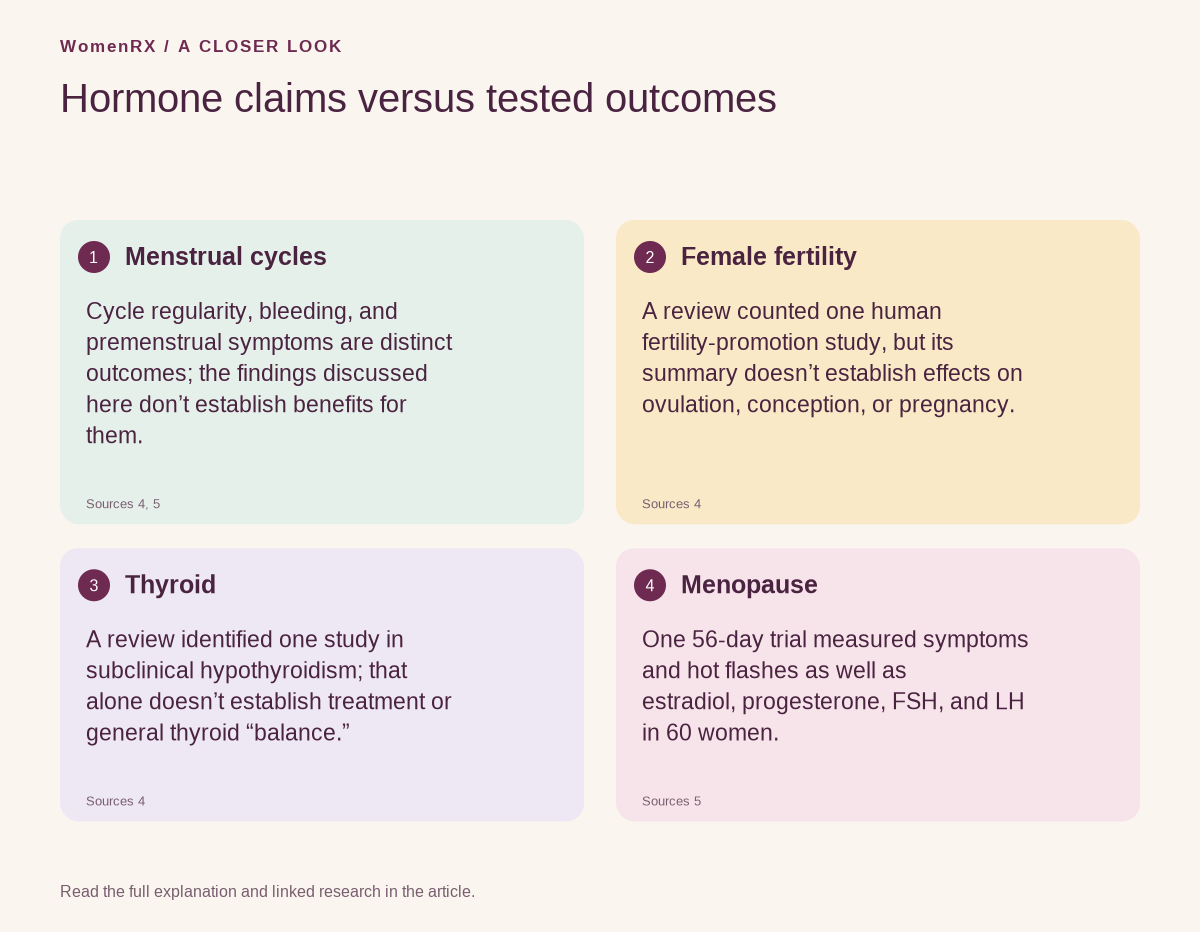
Hormone claims versus tested outcomes
Menstrual cycles: Cycle regularity, bleeding, and premenstrual symptoms are distinct outcomes; the findings discussed here don’t establish benefits for them.45
Female fertility: A review counted one human fertility-promotion study, but its summary doesn’t establish effects on ovulation, conception, or pregnancy.4
Thyroid: A review identified one study in subclinical hypothyroidism; that alone doesn’t establish treatment or general thyroid “balance.”4
Menopause: One 56-day trial measured symptoms and hot flashes as well as estradiol, progesterone, FSH, and LH in 60 women.5
Read the figure as text
The phrase “hormone balance” covers distinct questions. This comparison shows what human evidence described in the article measured and what those findings can’t establish.- Menstrual cycles: Cycle regularity, bleeding, and premenstrual symptoms are distinct outcomes; the findings discussed here don’t establish benefits for them.45
- Female fertility: A review counted one human fertility-promotion study, but its summary doesn’t establish effects on ovulation, conception, or pregnancy.4
- Thyroid: A review identified one study in subclinical hypothyroidism; that alone doesn’t establish treatment or general thyroid “balance.”4
- Menopause: One 56-day trial measured symptoms and hot flashes as well as estradiol, progesterone, FSH, and LH in 60 women.5
More questions, answered
Does research in men show that ashwagandha affects women’s hormones?
No. Research on sperm, testosterone, or male infertility measures different outcomes in a different population. It can’t establish effects on women’s menstrual cycles, fertility, or menopause symptoms. 1 2 3
Does a change in a hormone test prove a supplement is helping?
Not on its own. A lab marker and a lived health outcome are separate measures. The menopause trial is notable because it assessed both hormone levels and symptoms, but its short duration and small group still limit what it can establish. 5
Sources you can check
- The most important medicinal plants affecting sperm and testosterone production: a systematic review.Boroujeni SN, Malamiri FA, Bossaghzadeh F, Esmaeili A, Moudi E. · JBRA assisted reproduction · 2022Return to first citation
- Herbal Medicines for Idiopathic Male Infertility: A Systematic Review.Ahmadian M, Salari R, Noras MR, Bahrami-Taghanaki HR. · Current drug discovery technologies · 2022Return to first citation
- Botanicals in health and disease of the testis and male fertility: A scoping review.Shepherd A, Brunckhorst O, Ahmed K, Xu Q. · Phytomedicine : international journal of phytotherapy and phytopharmacology · 2022Return to first citation
- Safety and clinical effectiveness of Withania Somnifera (Linn.) Dunal root in human ailments.Tandon N, Yadav SS. · Journal of ethnopharmacology · 2020Return to first citation
- A prospective, randomized, double-blind, placebo-controlled study on efficacy and safety of Ashwagandha root extract (Withania somnifera) for managing menopausal symptoms in women.Vani I, Muralidhar G, Rao BS. · Frontiers in reproductive health · 2025Return to first citation