Working out in the evening during perimenopause: what the science says
TL;DR: Evening exercise is not automatically bad during perimenopause. But high-intensity training within two hours of bed raises core temperature and cortisol enough to delay sleep in women already fighting night sweats. Moderate strength training or yoga finished by 8 p.m. appears safe and may even reduce hot flash severity. Intensity and timing matter far more than the fact that you trained at night.
Is it bad to work out in the evening during perimenopause?
Not categorically, no. The old advice to never exercise after 6 p.m. came from studies done mostly on young men, and the data for perimenopausal women reads differently.
Here's what does hold up. Vigorous exercise raises core body temperature, heart rate, and cortisol for 60 to 90 minutes after you finish [1]. In perimenopause, when estrogen is dropping and your internal thermostat is already unstable, that post-workout heat spike collides with night sweats and makes falling asleep harder. If you're waking two or three times a night soaked through the sheets, a 7:30 p.m. HIIT session is not doing you any favors.
Moderate exercise is a different animal. A 2023 review in Sports Medicine found that evening moderate-intensity aerobic exercise did not significantly impair sleep quality in adults, and in some subgroups it improved slow-wave sleep [2]. Lower intensity means a smaller cortisol spike and a faster return to baseline temperature.
So the honest translation is this: a brisk walk or a 45-minute strength session at 65 to 70% of max heart rate finished by 8 p.m. is nothing like a 9 p.m. spin class. The first is probably fine. The second is worth testing carefully and tracking honestly.
How does perimenopause change the way your body responds to exercise?
Perimenopause is not one hormonal state. It can last two to twelve years, and most women enter it in their mid-40s [3]. Across that span, estrogen and progesterone swing chaotically before trending down, and those swings touch almost every system that governs recovery.
Estrogen acts directly on muscle protein synthesis, tendon stiffness, and glycogen storage. When it drops, muscle recovery slows. You may need an extra day between hard sessions you used to stack back to back. That's not deconditioning. That's biology.
Progesterone is thermogenic. It nudges your resting body temperature up during the luteal phase. As cycles turn irregular and progesterone output gets erratic, your thermal set point shifts unpredictably. Exercise heat piled on top of an already dysregulated thermostat is part of why evening workouts feel hotter and harder than they did a decade ago. Understanding how perimenopause age and hormonal shifts line up helps explain why timing your workouts matters at all.
Cortisol changes too. Perimenopausal women tend to show a blunted morning cortisol awakening response and a sloppier wind-down at night [4]. High-intensity evening exercise pushes cortisol up at exactly the hour it should be falling, and that fights the brain's shift into sleep.
Bone is the other piece. From late perimenopause onward, women can lose 1 to 3% of bone mass per year [5]. That is a strong argument for evening strength and impact work if mornings don't fit your life. The bone stimulus is real and time-sensitive. Skipping it entirely over timing worries would be a bad trade. Get a bone density test if you haven't had one, and let the numbers guide how hard you push load-bearing work.
What does the research actually show about evening exercise and sleep in midlife women?
Honest answer: the research on perimenopausal women and exercise timing specifically is thin. Most sleep-exercise studies enroll college-aged or broadly adult populations, and few sort results by menopausal status. Nobody has run a large randomized trial of perimenopausal women assigned to morning versus evening exercise, tracked for six months with polysomnography. What we have is smaller studies and reasonable extrapolation.
A 2019 meta-analysis in Sleep Medicine Reviews reviewed 23 studies and concluded that "evening exercise did not disturb sleep and may improve it," with the exception that vigorous exercise ending less than one hour before bed could delay sleep onset [1]. More recent work has stretched that one-hour buffer closer to 90 minutes.
A 2021 study in Menopause looked at exercise timing and hot flash frequency in 112 women in the menopause transition. Women who exercised in the morning reported significantly fewer nighttime hot flashes than those who trained mainly in the evening, though both groups had fewer flashes than sedentary controls [6]. That is one of the more useful data points we have. It suggests morning exercise carries a thermoregulatory edge for women with heavy vasomotor symptoms. It does not mean evening exercise causes harm. It means morning has an advantage on that one symptom.
The North American Menopause Society recommends exercise broadly for vasomotor symptoms and heart protection, and sets 150 minutes of moderate-intensity aerobic activity per week as the evidence-based target, with no time of day attached [7]. That silence on timing is honest. The evidence isn't strong enough to name an hour.
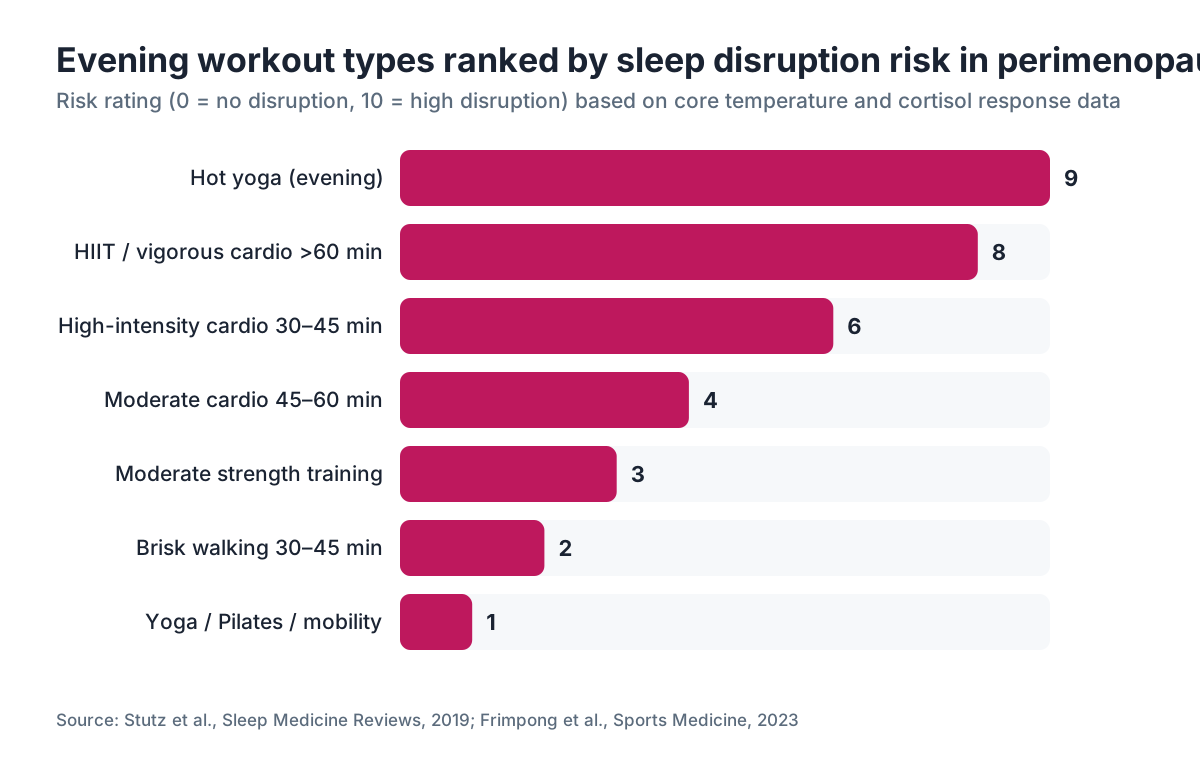
Which types of evening workouts are best and worst for perimenopausal sleep?
This is where specifics beat general rules.
Better evening options:
Moderate strength training (3 to 4 sets, 8 to 12 reps, 60 to 90 second rests) is probably the best overall choice for perimenopausal women at any hour, evenings included. It holds muscle, loads bone, and skips the long cardiovascular activation that hard cardio brings. A session done by 8 p.m. gives your nervous system time to settle before a 10 to 11 p.m. bedtime.
Yoga, Pilates, and mobility work are low-risk at night. They lower cortisol rather than raise it, and restorative yoga has reduced subjective sleep disturbance in small trials of menopausal women.
Moderate walking (20 to 45 minutes, conversational pace) is almost always fine in the evening. A 2022 study in Menopause found women who walked 30 minutes at moderate intensity in the evening had no worsening of sleep efficiency compared to non-exercisers [8].
Worse evening options:
High-intensity interval training pushes cortisol and core temperature hard. Finish a real HIIT session at 8:30 p.m., try to sleep at 10, and you're working against your own physiology. Save HIIT for mornings or early afternoons, when cortisol is already up and the day gives it time to fall.
Long high-intensity cardio (60+ minutes at 75% or more of max heart rate) has the same issue. The metabolic bill keeps heart rate and temperature elevated well past the finish.
Hot yoga is the worst offender for women with vasomotor symptoms. External heat plus exercise heat reliably triggers hot flashes, and doing it at night stacks the sleep disruption on top.
| Workout type | Evening timing risk | Notes | |---|---|---| | Moderate strength training | Low | End 90 min before bed | | Yoga / Pilates | Very low | Can be done close to bed | | Brisk walking (30 to 45 min) | Low | Generally fine | | HIIT | High | Better in morning | | Long cardio >60 min at high intensity | Moderate to high | Timing matters a lot | | Hot yoga | High | Avoid evening for vasomotor symptoms |
Can evening exercise actually help hot flashes and night sweats?
Yes, with the same caveat about intensity and timing that keeps surfacing.
Regular exercise, at any hour, is one of the few non-hormonal interventions with steady evidence for cutting hot flash frequency and severity. A 2014 Cochrane review of 11 trials found exercise reduced vasomotor symptom scores versus controls, while noting the effect was smaller than hormone therapy [9].
The mechanism runs through several pathways. Exercise raises beta-endorphin levels, which appear to steady the hypothalamic thermostat that misfires in perimenopause. Regular aerobic training also widens the thermoneutral zone, the temperature band inside which your body doesn't trigger a sweat or a chill. Perimenopause narrows that band. Anything that widens it helps.
For women who can't or won't use hormone therapy, consistent exercise is the most defensible behavioral tool available. If evenings are the only realistic time you have, the payoff from training regularly at night almost certainly beats the theoretical cost of imperfect timing, as long as you stay strategic about intensity and keep that 90-minute buffer before sleep.
On hormone therapy: if vasomotor symptoms are wrecking both your workouts and your sleep, treating them hormonally is a legitimate move. Hormone replacement therapy and the estrogen patch are worth raising with a clinician who works in menopause care.
How does body weight and metabolism factor into evening workouts in perimenopause?
Perimenopausal women often gain weight around the middle without changing diet or activity. The cause is layered: falling estrogen shifts fat from hips and thighs toward the belly, resting metabolic rate drifts down as muscle is lost, and disrupted sleep drives appetite and fat storage through ghrelin and leptin [10].
Evening exercise can push back on this, but the cortisol angle matters for visceral fat in particular. Chronically high evening cortisol, whether from stress, bad sleep, or mistimed hard exercise, is independently tied to belly fat. So if your evening HIIT is keeping you awake and running cortisol high, you may be fighting the exact goal you're training toward.
Strength training in the evening sidesteps most of this. The anabolic signal from resistance work (muscle protein synthesis driven by mechanical load and post-exercise growth hormone) tends to peak several hours after the session, overlapping with nighttime recovery if you train at 6 to 7 p.m. and sleep by 10 to 11. That is a reasonable hormonal sequence.
For women using GLP-1 medications like semaglutide or tirzepatide during perimenopause, the muscle-preservation case for resistance training gets sharper. These drugs cut total calorie intake and can strip lean mass if resistance training isn't paired with them. Evening strength sessions are a perfectly workable way to meet that need. For a fuller comparison, semaglutide vs tirzepatide covers the metabolic differences that matter for midlife women.
What time should you actually finish your workout before bed during perimenopause?
Finish 90 minutes before you plan to sleep. That is the most defensible guideline in the current literature. Ninety minutes gives core temperature time to fall back toward the level that cues the brain to start sleep, and it lets the post-exercise cortisol curve begin its descent [1].
For women with heavy night sweats or trouble falling asleep, I'd stretch that to two hours and add a cool shower afterward. The shower speeds the temperature drop and works as a cue for the parasympathetic system. No magic here. It's the same thermoregulatory principle applied on purpose.
If your realistic bedtime is 10:30 p.m., that means finishing by 8:30 to 9 p.m. for moderate work, and by 8 p.m. for anything high-intensity. Plenty of perimenopausal women with jobs, kids, and commutes can make those windows work.
If the only slot you have is 9 p.m. or later, lean toward strength training and yoga over cardio, keep intensity moderate, take a cool shower, and track your sleep honestly for two weeks. Some women simply don't show the disruption pattern and are fine. You don't owe your schedule to a population average. You owe it to your own data.
Does progesterone affect how well you sleep after evening workouts?
Progesterone calms the brain through its conversion to allopregnanolone, a neurosteroid that acts on GABA receptors, the same system benzodiazepines target. When progesterone is adequate, you get a built-in sleep-promoting signal working in your favor.
In perimenopause, progesterone often drops earlier and steeper than estrogen, especially as ovulation gets irregular. Low or erratic progesterone means you lose that GABA sleep signal right as night sweats and hot flashes start attacking sleep from the other side.
For some women, taking progesterone orally at night (rather than a patch or gel) partly restores that sedating effect and meaningfully improves sleep. If evening workouts keep disrupting your sleep, it's worth asking whether low progesterone is amplifying the problem, and whether treating it changes the math.
This is not a reason to skip evening exercise. It's a reason to see the whole hormonal picture instead of blaming your 7 p.m. strength session for a sleep problem that may have a different root cause.
Should you change your evening workout routine at different stages of perimenopause?
Perimenopause has recognizable early, middle, and late phases, and your training should shift across them.
In early perimenopause, cycles still happen but turn irregular. Hormones fluctuate, but estrogen hasn't bottomed out. Most women here can handle evening HIIT or hard cardio without wrecking sleep, as long as they keep the 90-minute buffer. The bigger move at this stage is adding strength training if you haven't, because the window to build bone and muscle before estrogen fully withdraws is short.
In middle perimenopause, hot flashes get more frequent, sleep disruption climbs, and cycles start skipping. This is usually when women notice evening high-intensity work starting to backfire. Shift HIIT to mornings and keep evenings for strength or moderate cardio. That's a sensible adaptation.
In late perimenopause and the transition to menopause, vasomotor symptoms often peak before settling. Sleep architecture is frequently poor. This is the phase where the 90-minute buffer, cool showers, and intensity control matter most. To place yourself on the timeline, when does menopause start has the clinical benchmarks.
At WomenRx, clinicians who work specifically with perimenopausal women can help you map hormone status to exercise timing in a way general fitness advice rarely does. The overlap of hormones and recovery is where telehealth for women's health actually earns its keep.
Post-menopause, once hormones settle at their new lower level, many women can return to harder evening training with fewer sleep consequences. The thermoregulatory chaos of the transition tends to quiet down.
What about strength training specifically: is evening the right time to build muscle in perimenopause?
Muscle preservation is arguably the top physical priority for women in perimenopause, and strength training is the main tool. The research is clear: resistance training two to three times per week preserves lean mass, improves insulin sensitivity, protects bone, and cuts fall risk in midlife women [5].
Evening is a perfectly reasonable time for it, and some evidence says it may even be favorable. A 2022 paper in Frontiers in Physiology found that strength training in the late afternoon and early evening produced larger gains in strength and power than morning training in women, likely because muscle temperature, nervous system activation, and reaction time peak later in the day [11]. The same paper found no meaningful sleep disruption from the evening sessions.
So the practical call: if evenings are your most consistent slot, use them for strength training without guilt. Keep cardio, especially HIIT, in the morning when you can. That split serves the muscle goal and the sleep goal at once.
For women also using semaglutide for weight loss during perimenopause, this hits harder. Holding muscle while in a GLP-1 calorie deficit takes deliberate resistance work, and the hour of day matters far less than the consistency.
Practical evening workout routine for perimenopausal women
Here's a framework that survives both the physiology and a busy midlife schedule.
If you have heavy vasomotor symptoms or sleep problems: Keep evening sessions to 45 minutes or less. Prioritize strength over cardio. Finish by 8 p.m. if bedtime is 10 to 10:30. Take a cool (not ice cold) shower afterward. Track sleep quality for two weeks and adjust based on what you actually see.
If sleep isn't currently a problem: You have more room. Moderate cardio up to 60 minutes is reasonable. Occasional HIIT is fine if you finish by 7:30 p.m. and keep a steady 10:30 to 11 bedtime. Watch for sleep quality slipping over time.
Year-round adjustments: In summer, skip outdoor high-intensity evening workouts in the heat. Heat plus exercise plus dropping estrogen is a reliable hot-flash trigger. Morning or air-conditioned indoor work is safer in hot months.
Nutrition timing: A small protein-focused meal or shake after your evening session supports muscle protein synthesis without hurting sleep. Skip large high-carb meals within two hours of bed. Digestion itself raises body temperature.
One thing that often gets ignored: track your cycle if you still have one, even if it's irregular. The luteal phase (roughly days 15 to 28, the two weeks after ovulation) is when progesterone peaks and resting temperature runs high. Hard evening training in the luteal phase may hit sleep harder than the same session in the follicular phase. Not everyone notices this. Many do once they start paying attention.
Frequently asked questions
Is it okay to work out at night if I already have bad night sweats?
It depends on the type of workout. Moderate strength training or yoga finished 90 minutes before bed is generally fine and may reduce hot flash frequency over time. High-intensity cardio within two hours of bed raises core temperature and cortisol, which can worsen night sweats and delay sleep. Try lower-intensity evening sessions and track whether your night symptoms change.
What time should I stop exercising before bed in perimenopause?
The evidence points to finishing at least 90 minutes before your target sleep time for moderate work. For vigorous exercise like HIIT or hard cardio, a two-hour buffer is more protective, especially if vasomotor symptoms are significant. If bedtime is 10:30 p.m., that means finishing moderate exercise by 9 p.m. and intense exercise by 8:30 p.m. at the latest.
Can evening exercise make perimenopause symptoms worse overall?
Regular exercise is broadly good for perimenopause symptoms, including hot flashes, mood, weight, and bone density. The risk is narrow: vigorous evening exercise disrupting sleep, because poor sleep independently worsens hot flashes, insulin resistance, and mood. The fix is adjusting timing and intensity, not stopping exercise.
Does it matter whether I do cardio or strength training in the evening?
Yes, meaningfully. Evening strength training carries lower sleep-disruption risk than high-intensity cardio and may produce better muscle gains in the late afternoon. HIIT and long high-intensity cardio push cortisol and core temperature higher for longer. For perimenopausal women with sleep trouble, strength in the evening and HIIT in the morning is the most practical split.
Why do I feel hotter during evening workouts now than I used to?
Estrogen loss during perimenopause narrows the thermoneutral zone, the temperature band in which your body doesn't trigger a hot flash or heavy sweat. Exercise heat now pushes you past that narrower band more easily. That's why workouts that felt comfortable at 40 can feel overwhelming at 47. The response is physiological, not a fitness problem.
Can working out in the evening help with perimenopausal weight gain?
Yes. Evening strength training is especially useful because the anabolic recovery process (muscle repair and growth hormone release) overlaps with nighttime sleep when you train by 7 to 8 p.m. Preserving muscle is the main defense against the metabolic slowdown that drives perimenopausal weight gain. Paired with adequate protein, consistent evening strength sessions work.
How does cortisol from evening workouts interact with perimenopause hormones?
Perimenopausal women often have a blunted cortisol awakening response and a sloppier nighttime wind-down. Vigorous evening exercise spikes cortisol at the wrong hour, interfering with melatonin onset and sleep architecture. Moderate training produces a smaller cortisol response that falls faster, so it's much less likely to disrupt sleep. This is the central reason intensity matters as much as timing.
Should I stop doing HIIT workouts altogether during perimenopause?
No. HIIT is useful for heart health and metabolic function in perimenopausal women. The adjustment is timing, not elimination. Move HIIT to mornings or early afternoons, when cortisol is already up and the day allows it to fall. HIIT two to three mornings per week while keeping evenings for strength or yoga is sustainable and supported by the evidence.
Does exercise timing affect bone density during perimenopause?
The bone-loading stimulus from weight-bearing and resistance exercise depends more on regularity and load than time of day. What matters most is that you do load-bearing exercise consistently, because estrogen decline speeds bone loss at 1 to 3% per year in the transition. If evenings are your only consistent option, evening strength and impact work beats not exercising by a wide margin.
Can melatonin or other supplements help offset evening workout sleep disruption?
Low-dose melatonin (0.5 to 1 mg taken 30 to 60 minutes before bed) may help cue sleep onset in women whose post-exercise arousal is delaying it. The evidence for melatonin in perimenopause specifically is limited but generally safe. Magnesium glycinate at 200 to 400 mg in the evening has modest evidence for sleep quality. Neither replaces managing workout timing and intensity.
Is morning exercise always better than evening exercise in perimenopause?
For women with heavy vasomotor symptoms and disrupted sleep, morning exercise has a modest edge because it avoids the evening cortisol and temperature spike. For bone density, muscle, and heart benefit, the evidence doesn't favor morning. Consistency beats perfect timing. A workout you actually do at 7 p.m. beats a 6 a.m. session you keep skipping.
How long does it take for regular evening exercise to improve perimenopause sleep?
Studies showing sleep improvement from regular exercise usually run eight to twelve weeks before objective sleep measures change. Subjective improvements (feeling more rested, falling asleep faster) sometimes show up sooner. Expect four to six weeks before drawing conclusions about whether your evening routine helps or hurts. Track sleep quality consistently during that window rather than relying on memory.
Are there any supplements that support evening workouts in perimenopause?
Creatine monohydrate (3 to 5 g daily, timing flexible) has good evidence for preserving muscle in perimenopausal women and doesn't interfere with sleep. Protein intake of 1.2 to 1.6 g per kilogram of body weight daily supports muscle protein synthesis from evening strength work. Ashwagandha has preliminary evidence for reducing cortisol and may soften evening exercise arousal, though perimenopause-specific data is limited.
Will hormone therapy change how I respond to evening workouts?
Likely yes, in helpful ways. Estrogen therapy steadies the thermoregulatory system, widening the thermoneutral zone so exercise heat is less likely to trigger hot flashes. Women on hormone therapy typically report fewer exercise-induced vasomotor events. Oral progesterone at night adds a sedating effect that may buffer the sleep-disrupting impact of evening workouts. This is one reason some women find timing matters much less on HRT.
Sources
- Sleep Medicine Reviews, Stutz et al. 2019, "Effects of evening exercise on sleep in healthy participants"
- Sports Medicine, Frimpong et al. 2023, "Effects of evening exercise on sleep in adults"
- National Institute on Aging, NIH — Menopause overview
- Endocrine Society — Menopause and hormonal changes clinical resources
- National Institute of Arthritis and Musculoskeletal and Skin Diseases (NIAMS) — Osteoporosis and menopause bone loss
- Menopause (journal), Moilanen et al. 2021 — exercise timing and hot flash frequency
- The Menopause Society (formerly NAMS) — exercise and vasomotor symptom guidance
- Menopause (journal), Berin et al. 2022 — walking and sleep efficiency in menopausal women
- Cochrane Database of Systematic Reviews, Daley et al. 2014 — exercise for vasomotor menopausal symptoms
- NIH Office on Women's Health — Menopause and weight gain
- Frontiers in Physiology, Küüsmaa-Schildt et al. 2022 — time of day effects on strength and muscle in women