17-OH progesterone: what the test means and when levels matter
TL;DR: 17-hydroxyprogesterone (17-OH progesterone) is a steroid made by the adrenal glands and ovaries on the way to producing cortisol and sex hormones. Doctors measure it mainly to screen for congenital adrenal hyperplasia (CAH). Normal adult female levels run roughly 15 to 70 ng/dL in the follicular phase. Elevated levels point to CAH or, less often, PCOS or adrenal tumors.
What is 17-OH progesterone and what does it do?
17-hydroxyprogesterone (17-OH progesterone) is a steroid hormone made mostly in the adrenal cortex and, in smaller amounts, in the ovaries and placenta. It sits in the middle of the steroid pathway. The body makes it from progesterone, then converts it onward into cortisol (via the enzyme 21-hydroxylase) or into the androgen androstenedione (via the enzyme 17,20-lyase). [1]
That middle position is exactly why the test matters. If 21-hydroxylase is working poorly or not at all, 17-OH progesterone builds up upstream like water behind a dam. That backup is the biochemical fingerprint of congenital adrenal hyperplasia (CAH), the most common reason doctors order this test. [2]
17-OH progesterone is not the same thing as progesterone, even though the names sound close. Regular progesterone prepares the uterine lining for pregnancy and gets measured to check for ovulation or to guide hormone replacement therapy. 17-OH progesterone is more of a metabolic intermediate than an end-use reproductive hormone. It does not thicken the uterine lining or support early pregnancy the way progesterone does.
The ovaries also add 17-OH progesterone during the luteal phase of the menstrual cycle, which is why levels peak in the second half of the cycle. That is also why the timing of your blood draw matters so much.
What are normal 17-OH progesterone levels in women?
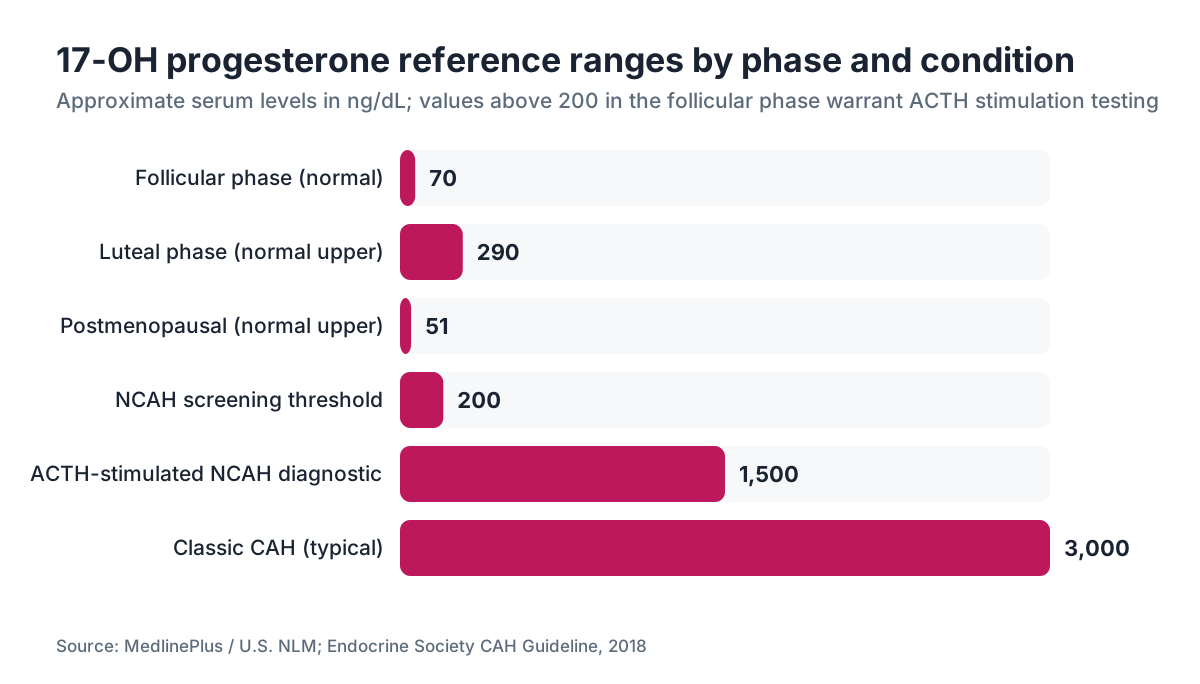
Reference ranges shift by laboratory, by cycle phase, and by whether a woman is pregnant or postmenopausal. The numbers below reflect what major endocrinology labs and the Endocrine Society cite for adult women. Always compare your result to your own lab's reference range, because assay methods differ. [3][8]
| Phase / Status | Typical range (ng/dL) | |---|---| | Follicular phase | 15 to 70 | | Luteal phase | 35 to 290 | | Postmenopausal | < 51 | | First trimester pregnancy | 26 to 660 | | Newborn (first 24 to 48 h) | Variable; can be very high |
Levels above 200 ng/dL in the follicular phase, or above 1,000 ng/dL at any time in a non-pregnant adult, are suspicious for classic CAH or an adrenal tumor and call for more workup. [2]
The luteal-phase spike is real and it fools people. If a woman's blood gets drawn mid-cycle or in the second half, a result in the 100 to 290 ng/dL range can look alarming but may just be normal ovarian output. This is one of the most common ways routine labs get misread. Your clinician should note where you are in your cycle when the draw is ordered, and ideally draw the sample in the early follicular phase (days 1 to 7) unless there's a specific reason to do otherwise.
Pregnancy raises 17-OH progesterone sharply throughout gestation, and values drop again postpartum. Postmenopausal women run lower overall because the ovarian contribution falls away, so anything above about 70 ng/dL in a confirmed postmenopausal woman deserves a second look.
What does a high 17-OH progesterone level mean?
A markedly high result most often means congenital adrenal hyperplasia, a group of inherited enzyme deficiencies affecting adrenal steroid production. More than 90% of CAH cases come from mutations in the CYP21A2 gene, which encodes 21-hydroxylase. When that enzyme is deficient, 17-OH progesterone piles up and the adrenal glands shift production toward androgens instead of cortisol. [2]
CAH exists on a spectrum. Classic CAH (split into salt-wasting and simple-virilizing forms) is severe and usually caught at birth or in early childhood through newborn screening. Nonclassic CAH (NCAH), also called late-onset CAH, is milder and often stays hidden until adolescence or adulthood. NCAH is genuinely common: prevalence estimates run from 1 in 100 to 1 in 1,000 in the general population, making it one of the most frequent autosomal recessive conditions in humans. [2][3]
In adult women, NCAH can look almost identical to polycystic ovary syndrome (PCOS): irregular periods, excess hair growth (hirsutism), acne, and trouble getting pregnant. The Endocrine Society's 2018 CAH guideline recommends measuring early-morning follicular-phase 17-OH progesterone to screen for NCAH in women with signs of androgen excess. A level above 200 ng/dL in the early follicular phase strongly suggests it; levels between 200 and 1,000 ng/dL usually prompt an ACTH stimulation test to confirm. [3]
Other causes of a high 17-OH progesterone include adrenal tumors or carcinomas (rare), steroid-producing ovarian tumors (rare), and the luteal-phase bump described above (common and harmless). Stress and acute illness can raise cortisol precursors for a short time too.
A moderately high result, say 80 to 200 ng/dL in the follicular phase, sits in a gray zone. It is not high enough to diagnose CAH with confidence but not clearly normal either. These cases usually get an ACTH stimulation test to sort out.
What does a low 17-OH progesterone level mean?
Low levels tell you far less than high ones. A result below the lab's reference range in an adult woman is rarely a problem by itself. It can simply mean the blood was drawn in the follicular phase, when levels are naturally lower, or that the woman is postmenopausal.
In theory, a very low 17-OH progesterone could point to adrenal insufficiency or to a different, rarer enzyme deficiency such as 3-beta-hydroxysteroid dehydrogenase deficiency. But those conditions usually announce themselves through other abnormalities first: low cortisol, low sodium, high potassium, or low levels of other adrenal steroids.
For women worried about adrenal function during perimenopause or menopause, a low 17-OH progesterone alone is not a marker of adrenal exhaustion or burnout, despite what wellness marketing claims. The adrenal gland does not run out of precursor hormones with age in healthy women. Cortisol output declines modestly across the lifespan, but it does not crater the way estrogen does at menopause. [4]
How is the 17-OH progesterone test done and when should it be drawn?
The test is a simple blood draw. No special prep is needed beyond noting where you are in your menstrual cycle. Because levels swing with the cycle and with the time of day (cortisol and its precursors peak in the early morning), the standard advice is to draw the sample between 7 and 9 AM in the early follicular phase, days 1 to 7 after the first day of bleeding. [3]
For women without regular cycles (from PCOS, anovulation, or perimenopause), timing is harder to control. Some clinicians use a random early-morning draw and read it cautiously. Others use progesterone levels or ultrasound to pin down cycle phase first.
Newborn screening for CAH uses a heel-stick blood sample collected on filter paper, usually 24 to 48 hours after birth in most U.S. states. The CDC and the Health Resources and Services Administration (HRSA) include 21-hydroxylase CAH on the Recommended Uniform Screening Panel (RUSP). [5][9] Newborn screening has a high false-positive rate for 17-OH progesterone in premature or sick infants, a well-known limitation of the test.
The ACTH stimulation test, used to confirm borderline results, draws a baseline 17-OH progesterone, then injects synthetic ACTH (cosyntropin 250 mcg), then draws again 30 to 60 minutes later. A post-stimulation level above 1,500 ng/dL is diagnostic for NCAH. [3]
How does 17-OH progesterone relate to CAH diagnosis and treatment?
CAH from 21-hydroxylase deficiency gets treated by replacing the cortisol the adrenal gland cannot make efficiently, which also lowers the ACTH drive pushing precursors toward androgens. In adults, treatment usually means daily oral hydrocortisone, prednisone, or dexamethasone. The goal is the lowest glucocorticoid dose that keeps 17-OH progesterone and androgens in an acceptable range without causing steroid side effects. [3]
The Endocrine Society's 2018 guideline, written by Speiser et al. and published in the Journal of Clinical Endocrinology and Metabolism, states: "We recommend that all patients with classic CAH receive glucocorticoid therapy to replace deficient cortisol and to suppress adrenocorticotropin (ACTH)-mediated adrenal androgen production." [3][10] The target 17-OH progesterone on treatment usually lands in the normal-to-mildly-high range. Complete suppression would take doses that cause Cushing's syndrome.
Women with NCAH who want to get pregnant may take low-dose glucocorticoids to normalize ovulation and calm the androgen environment that can interfere with implantation. Women with NCAH who are not trying to conceive and whose symptoms are mild (minimal hirsutism, regular-enough periods) sometimes need no treatment at all.
Mineralocorticoid replacement (fludrocortisone) gets added for salt-wasting classic CAH to replace aldosterone. 17-OH progesterone alone does not predict salt-wasting severity; that takes measuring renin and electrolytes.
Gender matters here. Women with classic CAH are often born with ambiguous or virilized genitalia from prenatal androgen exposure. Adult women with NCAH typically have normal anatomy but may struggle with fertility, hirsutism, or acne. The diagnosis changes management even when the outward picture is subtle.
Does 17-OH progesterone connect to PCOS?
Yes, and the link matters enough that screening for NCAH is built into standard PCOS workup guidelines. The two conditions overlap so heavily in symptoms (irregular cycles, high androgens, skin and hair changes) that you cannot confidently diagnose PCOS without first ruling out NCAH. [6]
The Endocrine Society's 2013 PCOS guideline recommends measuring early-morning 17-OH progesterone as part of the initial workup for hyperandrogenism. [6] A follicular-phase level below 200 ng/dL makes NCAH unlikely without further testing. A level above that triggers the ACTH stimulation test.
About 1 to 9% of women with PCOS-like symptoms turn out to have NCAH on thorough testing, depending on the population and ethnic background (NCAH runs higher in Ashkenazi Jewish, Hispanic, Slavic, and Mediterranean populations). [2] Missing NCAH matters because the treatment differs: PCOS usually gets managed with hormonal contraceptives, metformin, or spironolactone, while NCAH gets managed with glucocorticoids. Handing glucocorticoids to someone with true PCOS causes harm.
Say it plainly. If your doctor diagnosed PCOS but never checked your 17-OH progesterone, you have every right to ask for that test.
How does 17-OH progesterone change during perimenopause and menopause?
The ovaries add meaningfully to 17-OH progesterone in reproductive-age women, especially in the luteal phase. As women approach menopause, ovarian function declines and the ovarian contribution to 17-OH progesterone declines with it. Total levels drop modestly. Adrenal output continues, so levels do not fall to zero.
For most perimenopausal women, 17-OH progesterone is not a monitored hormone the way estradiol or FSH are. It does not drive menopausal symptoms. Hot flashes, sleep disruption, brain fog, and mood changes in perimenopause come mostly from estrogen volatility, not from shifts in 17-OH progesterone. [4]
That said, women previously diagnosed with NCAH and managed with glucocorticoids may find their hormone balance shifts again in perimenopause, because the ovarian contribution that once partly drove their androgen excess fades. Some of these women can reduce or stop glucocorticoid therapy in their postmenopausal years, though that call belongs to an endocrinologist.
For women weighing HRT at midlife, hormone replacement therapy decisions rest on estrogen and progesterone status, not 17-OH progesterone. If you have known NCAH and are entering perimenopause, find a specialist who knows both conditions, because managing them together takes some nuance.
What is the ACTH stimulation test and when is it needed?
The ACTH stimulation test (also called a cosyntropin stimulation test) is the gold-standard confirmatory test for NCAH when a baseline 17-OH progesterone lands in a borderline range. It separates NCAH from normal variation and from PCOS far more reliably than a single random measurement. [3]
The protocol goes like this. A baseline blood draw for 17-OH progesterone (and often cortisol) happens in the early morning. Then 250 mcg of synthetic ACTH (cosyntropin) gets injected intravenously or intramuscularly. Blood gets drawn again at 30 and/or 60 minutes. In a woman without enzyme deficiency, ACTH stimulation causes only a modest rise in 17-OH progesterone. In NCAH, the enzyme bottleneck drives 17-OH progesterone to very high levels, typically above 1,500 ng/dL. [3]
The test happens in a clinic or infusion center, takes about an hour with wait time, and is generally well tolerated. Cosyntropin has a very short half-life and does not suppress the adrenal-pituitary axis. It usually does not require stopping any medications beforehand, though your ordering clinician should review your specific list.
If the ACTH stimulation test comes back normal but your 17-OH progesterone was high on the baseline draw, the most likely explanation is cycle-phase timing or a lab error. Repeat testing in the early follicular phase is the next step.
Can functional medicine or direct-to-consumer testing panels reliably measure 17-OH progesterone?
This is where honest skepticism earns its keep. Several direct-to-consumer hormone panels marketed to midlife women include 17-OH progesterone alongside estradiol, testosterone, DHEA-S, and cortisol. The pitch sounds good: one full picture of your adrenal and hormonal health. The reality is messier.
Dry blood spot and saliva assays for 17-OH progesterone have poorer analytical precision than serum immunoassay, which itself has known cross-reactivity problems that liquid chromatography-tandem mass spectrometry (LC-MS/MS) largely solves. Reference ranges on consumer panels are often not validated for the specific assay used, so the same result might read as normal on one platform and flagged as high on another. [7]
For real clinical decisions, including whether you have NCAH, the Endocrine Society guidelines are built on serum measurements using validated immunoassay or LC-MS/MS methods run in accredited labs. If a consumer panel shows a high result, confirm it with a serum draw at a standard clinical lab before acting on it.
At WomenRx, clinicians ordering hormone workups for women with androgen-excess symptoms follow the same standard: serum early-morning follicular-phase draw, read against the assay-specific reference range, with confirmatory ACTH stimulation if borderline.
The consumer panel space is not worthless. These tests can spark conversations and push women to seek a formal evaluation. But a flagged result on a consumer panel is a reason to see a clinician, not a reason to self-treat with supplements or herbs sold as adrenal support.
How does genetic testing relate to 17-OH progesterone?
Once a 17-OH progesterone and ACTH stimulation test point to CAH, genetic testing for CYP21A2 mutations can confirm the diagnosis and grade its severity. More than 100 mutations in CYP21A2 have been described; the common ones include p.Val281Leu (linked to NCAH), p.Ile172Asn, and the large-scale gene deletion or conversion that causes the most severe salt-wasting form. [2]
Genetic testing matters most for family planning. CAH is autosomal recessive, so a child needs a defective copy from each parent to develop classic CAH. If one parent is a known carrier and the other has NCAH, there is a 50% chance their child has CAH of some form. Genetic counseling before pregnancy is recommended for couples with a family history of CAH.
Prenatal treatment of pregnancies at risk for classic CAH (the virilizing form affecting female fetuses) with maternal dexamethasone has been used experimentally to reduce fetal androgen exposure and limit genital virilization. This remains controversial and is not standard of care. The Endocrine Society's 2018 guideline says prenatal dexamethasone treatment should be considered investigational and done only in research settings with IRB oversight. [3]
Genotype does not perfectly predict phenotype. Some women with genotypes tied to classic CAH have milder presentations than expected, and the reverse happens too. Biochemical testing (17-OH progesterone and ACTH stimulation) stays the functional measure that guides treatment dosing.
What questions should you ask your doctor about a 17-OH progesterone result?
If you got a 17-OH progesterone result that was flagged or that you don't fully understand, bring these questions to your clinician.
First: what phase of your cycle was the blood drawn in? If nobody knows, the result may need repeating with proper timing. Second: what laboratory method was used? LC-MS/MS is more precise than standard immunoassay; if the result came from an immunoassay, a borderline-high finding may or may not hold up on a sharper method. Third: did your doctor compare your result to the specific reference range for your lab's assay and your cycle phase, not a generic textbook number? Fourth: if your result was above 200 ng/dL in the early follicular phase, has an ACTH stimulation test been discussed? Fifth: are your other androgen markers (total testosterone, free testosterone, DHEA-S) also high? NCAH tends to raise multiple androgen precursors, more than 17-OH progesterone alone.
You are within your rights to ask for a referral to an endocrinologist if your primary care provider or OB-GYN is uncertain about reading the result. NCAH is genuinely uncommon in general practice, and misdiagnosis in both directions (calling it PCOS when it is CAH, or flagging a normal luteal-phase result as disease) happens.
For broader hormonal concerns at midlife, including PCOS, adrenal function, and HRT decisions, connecting with a clinician who specializes in women's hormones can save months of back-and-forth on isolated lab values taken out of context. Resources like hormone replacement therapy guides and perimenopause evaluations can help you frame those conversations.
Frequently asked questions
What is 17-OH progesterone tested for?
The test is ordered most often to screen for congenital adrenal hyperplasia (CAH), especially the nonclassic late-onset form that can mimic PCOS in adult women. It also monitors treatment in women already diagnosed with CAH, and sometimes rounds out an androgen-excess workup when a woman has hirsutism, acne, or irregular periods unexplained by other causes.
What is a normal 17-OH progesterone level for a woman?
In the early follicular phase, roughly 15 to 70 ng/dL counts as normal at most labs. Levels rise naturally to 35 to 290 ng/dL in the luteal phase. Postmenopausal women typically run below 51 ng/dL. These are general ranges; your specific lab's reference interval is the one that matters for your result, since assay methods vary between labs.
What does it mean if my 17-OH progesterone is high?
A high result most often points to nonclassic congenital adrenal hyperplasia (NCAH), particularly if you also have signs of androgen excess like extra hair growth, acne, or irregular cycles. Values above 200 ng/dL in the early follicular phase need follow-up with an ACTH stimulation test. Less common causes include an adrenal or ovarian tumor, or simply a blood draw taken in the luteal phase.
How do I know if I need a 17-OH progesterone test?
Reasons your doctor might order it include signs of androgen excess (excess facial hair, male-pattern hair thinning, acne), irregular or absent periods with a suspected PCOS diagnosis, a family history of CAH, difficulty conceiving without an obvious cause, or a newborn sibling diagnosed with CAH. It is not a routine screening test for the general population.
Is 17-OH progesterone the same as progesterone?
No. Regular progesterone is the reproductive hormone that prepares the uterine lining for pregnancy and surges after ovulation. 17-OH progesterone is a metabolic intermediate on the pathway from progesterone to cortisol and androgens. The two are chemically related but measured for entirely different reasons. A progesterone test tells you about ovulation and luteal function; a 17-OH progesterone test tells you about adrenal enzyme activity.
Can a high 17-OH progesterone cause weight gain or fatigue?
A high 17-OH progesterone itself does not directly cause weight gain or fatigue. But in NCAH, the elevated 17-OH progesterone reflects excess androgen production, which can drive insulin resistance, irregular cycles, and the metabolic features tied to PCOS, including weight gain in some women. Fatigue here may come from cortisol deficiency (in severe CAH) or from the metabolic effects of excess androgens.
What is the ACTH stimulation test and how does it relate to 17-OH progesterone?
The ACTH stimulation test injects synthetic ACTH (cosyntropin) to stress the adrenal gland and measures how much 17-OH progesterone rises in response. In a normal adrenal gland, the rise is modest. In someone with 21-hydroxylase deficiency (CAH), the enzyme bottleneck causes a dramatic rise, typically above 1,500 ng/dL. It is the confirmatory test when a baseline 17-OH progesterone lands in the borderline range, roughly 200 to 1,000 ng/dL.
Does 17-OH progesterone affect fertility?
Indirectly, yes. In NCAH, an elevated 17-OH progesterone reflects excess androgen production that can interfere with ovulation and implantation, cutting fertility. Women with NCAH who are trying to conceive often take low-dose glucocorticoids to quiet the excess androgen drive, which can restore more regular ovulation. The 17-OH progesterone level itself gets used to track whether treatment is working.
Should I get my 17-OH progesterone tested if I have PCOS?
Most endocrinology guidelines say yes, at least once. The Endocrine Society recommends measuring early-morning follicular-phase 17-OH progesterone as part of the androgen-excess workup to rule out NCAH before confirming a PCOS diagnosis. About 1 to 9% of women with PCOS-like symptoms actually have NCAH, and the treatment is different. If you have a PCOS diagnosis and this test was never done, ask your doctor about it.
Can 17-OH progesterone be checked at home with a urine or saliva test?
Some direct-to-consumer panels include 17-OH progesterone, but saliva and dried blood spot methods have lower precision than serum testing and often lack validation for the specific assay used. For clinical decisions, like diagnosing or ruling out NCAH, a serum blood draw at an accredited lab is required. A consumer panel result can prompt a conversation with your doctor, but it should not stand alone to diagnose or treat adrenal conditions.
How does 17-OH progesterone change during pregnancy?
17-OH progesterone rises substantially during pregnancy, reaching levels in the hundreds of ng/dL in the first trimester and climbing through the third trimester as placental production increases. This is normal and expected. Some practitioners use supplemental progesterone (not 17-OH progesterone) to support early pregnancy in women with a history of pregnancy loss, but 17-OH progesterone monitoring is not part of routine prenatal care.
What does 17-OH progesterone have to do with newborn screening?
In the U.S., 17-OH progesterone is measured in all newborns as part of universal heel-stick screening for classic CAH. Classic CAH can cause a dangerous salt-wasting crisis in the first weeks of life if untreated. Early identification through newborn screening has sharply reduced CAH-related infant deaths. The test has a meaningful false-positive rate in premature or sick newborns, so a high newborn screen triggers confirmatory testing rather than immediate treatment.
Can I have nonclassic CAH without knowing it until adulthood?
Yes, and it happens fairly often. Nonclassic CAH is mild enough that many women go undiagnosed until they seek help for acne, excess hair growth, irregular periods, or trouble conceiving in their teens or twenties. Some women are never diagnosed at all because their symptoms stay subtle. NCAH is one of the most common autosomal recessive disorders in humans, with estimated prevalence as high as 1 in 100 in some populations.
What medications affect 17-OH progesterone test results?
Glucocorticoids (prednisone, dexamethasone, hydrocortisone) suppress ACTH and lower 17-OH progesterone, which is the point in CAH treatment but makes the test harder to read in people taking steroids for other reasons. Hormonal contraceptives can also affect adrenal androgen production and may modestly shift baseline levels. Always tell your ordering clinician what medications you take before the test.
Sources
- StatPearls, NCBI Bookshelf: 17-Hydroxyprogesterone
- StatPearls, NCBI Bookshelf: Congenital Adrenal Hyperplasia
- Endocrine Society: Congenital Adrenal Hyperplasia Clinical Practice Guideline (Speiser et al., J Clin Endocrinol Metab, 2018)
- The Menopause Society (NAMS): Menopause Practice: A Clinician's Guide
- HRSA: Recommended Uniform Screening Panel (RUSP)
- Endocrine Society: Polycystic Ovary Syndrome (PCOS) Clinical Practice Guideline (2013)
- JAMA: Variability in Laboratory Reference Intervals for Steroid Hormones, Handelsman et al.
- MedlinePlus, U.S. National Library of Medicine: 17-Hydroxyprogesterone
- CDC: Newborn Screening Portal
- Journal of Clinical Endocrinology and Metabolism: Speiser et al. 2018 CAH Guideline full text