Where to put your estrogen patch: the complete placement guide
TL;DR: Apply your estrogen patch to clean, dry skin on your lower abdomen, upper buttocks, or outer hip. Avoid breasts, waistline, and irritated skin. Rotate sites with each change to prevent skin reactions. Press firmly for 10 seconds. FDA-approved labeling names the lower abdomen as the primary site for most transdermal estradiol patches.
What does the FDA actually say about where to put an estrogen patch?
The FDA-approved prescribing information for transdermal estradiol patches names the lower abdomen as the primary application site, generally below the navel and away from the waistband. Most patch labels, including those for Climara, Vivelle-Dot, and Minivelle, also list the upper buttocks and outer hip as acceptable alternatives. The prescribing information for Climara states that the patch "should be applied to a smooth, fold-free area of skin on the lower abdomen or the upper quadrant of the buttock" and explicitly says "the breasts should not be used as application sites." [1]
This matters because estradiol absorption varies by body region. The skin on your abdomen and buttocks is relatively uniform in thickness and vascularity, which means you get more predictable delivery into the bloodstream compared to areas with highly variable fat layers or high friction.
The FDA also requires that patch manufacturers test absorption at the specific body sites they list on the label. If a label only lists the abdomen and buttocks, the company has not demonstrated consistent pharmacokinetics at other locations. That doesn't mean other sites won't work, but it does mean your dose assumptions are built on abdomen and buttock data. [1]
What are the best places to put an estrogen patch?
The best place to put an estrogen patch is on your lower abdomen, roughly between your navel and your pubic hairline, on either side of center. This is the site used in most pharmacokinetic studies and the one your prescriber's dose calculation was calibrated to. Second best is the upper outer buttock, which many women find even more comfortable because clothing doesn't press on it as much.
Here are the sites most estradiol patch labels approve, with practical notes on each:
| Site | Why it works | Watch out for | |---|---|---| | Lower abdomen | Best-studied, most consistent absorption | Waistbands can peel edges; avoid bony prominences | | Upper outer buttock | Easy to keep flat and dry | Harder to reach solo; some women need help | | Outer hip / flank | Approved on some labels, flat skin | Waistband friction; varies more by label | | Upper thigh (inner) | Approved on a few specific brands | More friction, sweat; check your specific label |
The one site that appears on zero approved labels is the breast. The concern isn't just absorption variability. Localized estrogenic stimulation of breast tissue is a theoretical concern, and the FDA has consistently excluded breasts from all transdermal estradiol labeling. [1]
For context on estrogen patches more broadly, including which brands differ in site approvals, that page covers brand-by-brand details.
Starting a patch for the first time during menopause? The lower abdomen is the safest place to begin. It's where the pharmacokinetic data is strongest, and you'll be able to check adhesion easily in a mirror.
Does it matter which side of the abdomen you use?
No strong evidence says the left side outperforms the right or vice versa. What matters is rotation. Each time you change your patch, you should shift to a different spot, at minimum a few inches away from the prior application site, to give skin time to recover between exposures.
A common rotation pattern for twice-weekly patches (changed Monday and Thursday, for example) is to alternate left and right lower abdomen, or alternate abdomen and upper buttock. For once-weekly patches like Climara, many clinicians recommend a four-site rotation: left lower abdomen, right lower abdomen, left upper buttock, right upper buttock. That gives each spot three weeks of rest between applications.
Skin irritation from patches, which affects somewhere between 10 and 17 percent of users in clinical trials, is strongly linked to reusing the same spot repeatedly. [2] Rotating properly reduces cumulative irritation substantially.
Where should you NOT put an estrogen patch?
A few places to always avoid:
Breasts. Every FDA-approved transdermal estradiol label prohibits this. Full stop.
Waistline. The elastic band of pants or underwear lifts patch edges, breaks the seal, and causes uneven delivery. If your lower abdomen placement is right at your waistband, move it an inch lower or switch to the buttock.
Irritated, cut, or broken skin. Estradiol absorbs faster through compromised skin barriers, which risks delivering more hormone than intended and slows healing of the skin itself. [1]
Under your bra strap or anywhere with consistent rubbing. Friction degrades adhesion and can cause localized skin trauma.
Inside skin folds. Patches are designed for flat, smooth surfaces. A fold traps moisture, which softens the adhesive and causes the patch to peel.
Areas with heavy hair. Body hair disrupts contact between the patch membrane and skin, reducing how much estradiol gets through.
Areas you've applied lotion, oil, or powder within the last several hours. These products coat the skin surface and block adhesion. Apply the patch to bare, thoroughly dry skin only.
One thing that surprises many women: sunscreen on the patch site also reduces adhesion and can affect absorption, so if you're applying sunscreen to your abdomen before the beach, either protect the patch with a piece of medical tape around the edges or avoid sunscreen directly on the patch.
How do you actually apply the patch correctly?
Application technique matters more than most people expect. A patch applied carelessly can deliver 20 to 30 percent less estradiol than the labeled dose, simply because of poor skin contact.
Here is the step-by-step that follows FDA labeling and manufacturer instructions:
- Wash and thoroughly dry the application site. Pat dry, don't rub, and wait a full minute. Even a faint damp film degrades adhesion.
- Tear open the pouch at the notch. Don't use scissors, which can nick the patch membrane.
- Peel back one half of the protective liner. Touch only the liner, not the adhesive surface.
- Apply the exposed adhesive half to your skin, then fold back the other liner half and smooth down the rest.
- Press the entire patch firmly with your palm for a full 10 seconds. Press harder around the edges, which are the first to lift.
- Run a fingertip around the perimeter to confirm full contact.
- Wash your hands. Estradiol does transfer from adhesive residue on fingers to other surfaces, including other people's skin. [1]
If an edge lifts within the first day, you can press it back and secure it with a small piece of first-aid paper tape. If the whole patch falls off, most prescribing information says to apply a fresh one and continue on your original schedule. If it falls off close to your change day, change it as scheduled. If you're unsure, call your prescriber or pharmacist rather than guessing.
For a full picture of how patches compare to other delivery methods, the hormone replacement therapy overview is worth reading alongside this.
Does skin preparation change how much estrogen you absorb?
Yes, and the differences can be clinically meaningful. The skin's stratum corneum, its outermost layer, acts as the rate-limiting barrier for transdermal estradiol. Anything that thickens it, dries it out excessively, or coats it reduces absorption. Anything that disrupts it accelerates absorption.
A few specific factors:
Body temperature. Heat, from a hot bath, sauna, or direct sunlight on the patch, increases skin blood flow and can meaningfully increase the rate of estradiol absorption for as long as the heat is applied. Some women feel symptoms of estrogen excess (breast tenderness, bloating, headache) after prolonged hot tub use with a patch on. You can leave the patch on during a quick warm shower but avoid prolonged heat directly on the site. [1]
Skin hydration. Well-hydrated skin absorbs more consistently than very dry, flaky skin. If you have very dry skin at your preferred patch site, a light, fragrance-free moisturizer applied the night before can help, but the skin must be completely free of it at application time.
Body site fat thickness. Subcutaneous fat under the skin doesn't actually impede transdermal absorption much, which is why the abdomen remains a good site even in women with higher body fat. The relevant factor is the skin itself, not what's underneath it.
Age. Older skin tends to be thinner and may absorb more variably. Some studies note lower steady-state estradiol levels in older postmenopausal women using the same patch dose compared to younger perimenopausal women, though this is modest and highly individual. [3]
If you're in perimenopause and your levels seem inconsistent, rotating sites carefully and checking application technique is worth doing before assuming the dose is wrong.
Can you swim, shower, or exercise with an estrogen patch on?
Most modern transdermal estradiol patches are water-resistant, meaning a brief shower or swim won't cause them to fall off or compromise delivery significantly. The key word is brief. Prolonged water immersion, think a 30-minute soak, softens the adhesive over time.
For exercise, sweat is the bigger concern than water itself. Sweat breaks down adhesion at the edges, particularly in warm climates. If you exercise heavily several days a week, placing the patch on the upper buttock rather than the lower abdomen tends to reduce sweat exposure at the site.
After swimming or exercising, pat the area around the patch dry and press the edges down firmly again. Don't peel the patch off to dry under it; that disrupts the adhesive entirely.
There's no restriction on exercising vigorously with a patch on from a pharmacokinetic standpoint. Blood flow increases during exercise, which may transiently increase absorption slightly, but clinical evidence of meaningful dose variability from exercise is limited and the effect is not considered clinically significant for most women. [2]
Why does skin irritation happen and how do you reduce it?
Skin irritation under estrogen patches is common. In the Vivelle-Dot clinical trials, erythema (redness) at the patch site occurred in about 16 percent of users. [2] Most of this is contact dermatitis from the adhesive itself, not the estradiol.
The adhesives used in transdermal patches are typically acrylic or silicone-based. Some women are more reactive to acrylic adhesives, in which case switching to a patch with a silicone-based adhesive can reduce irritation dramatically. Your pharmacist can tell you what adhesive type each brand uses.
If you have mild redness after removing a patch, a small amount of hydrocortisone 1% cream applied to the site and allowed to fully absorb before the next application can help. Do not apply hydrocortisone immediately before sticking a new patch there.
Persistent blistering, weeping, or intense itching suggests a true allergic contact sensitization rather than simple irritation. This is less common (roughly 1 to 3 percent of patch users) and typically means switching delivery method entirely, to a gel, spray, or oral form, rather than trying a different patch brand. If you develop this, talk to your prescriber before switching on your own, because the dose equivalences between delivery methods aren't one-to-one.
For women who react this way and are also managing body weight alongside hormone replacement therapy, note that semaglutide for weight loss and progesterone both come in delivery formats that don't share this adhesive problem.
Does the patch site affect how well your estrogen symptoms are controlled?
It can, indirectly. The primary driver of symptom control is the plasma estradiol level you achieve and maintain. The patch site affects this through absorption consistency. A patch applied to the same spot repeatedly on irritated skin absorbs less reliably. A patch applied carelessly, with air bubbles or lifted edges, delivers less than expected.
Women who report that their patch "stopped working" after a few months sometimes discover, when they return to careful technique and proper rotation, that their symptoms improve again without a dose change. This isn't universal, but it's common enough that technique review should come before a dose adjustment.
That said, real pharmacokinetic variation does occur between individuals at the same nominal dose. Blood levels of estradiol at the same patch dose can differ by a factor of two or more between women with similar characteristics. [3] If you've corrected technique and symptoms remain poorly controlled, a serum estradiol level drawn at a consistent time relative to your patch change (typically midway through the wear period) gives your prescriber real information to work from.
The estrogen patch article goes deeper on how different patch brands and doses compare in achieving target serum levels.
How does patch placement differ for different estradiol patch brands?
Not all patches list the same approved sites. This matters practically.
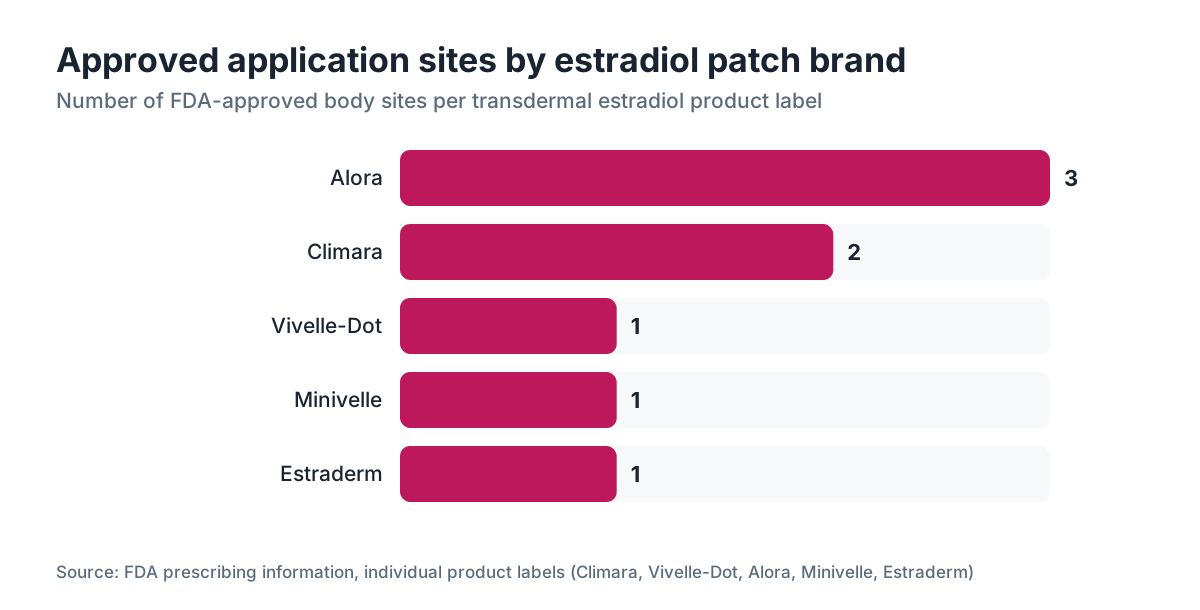
| Brand | Dosing | Approved sites per FDA label | |---|---|---| | Vivelle-Dot | Twice weekly | Lower abdomen only [2] | | Climara | Once weekly | Lower abdomen, upper outer buttock [1] | | Minivelle | Twice weekly | Lower abdomen | | Alora | Twice weekly | Lower abdomen, upper outer buttock, upper arm (outer aspect) | | Estraderm | Twice weekly | Abdomen | | Generic transdermal estradiol | Varies | Check individual label |
Alora is somewhat unusual in including the outer upper arm as an approved site. For women who find abdomen and buttock placement uncomfortable, this can be a practical option if their prescriber switches them to Alora specifically for this reason.
If you use a compounded transdermal estradiol patch rather than an FDA-approved branded or generic product, the site guidance defaults to what your compounding pharmacy specifies, which should follow the same general principles. For more on compounded options, the compounded semaglutide page explains how compounding pharmacy regulation works in a parallel context.
Always read the package insert that comes with your specific prescription, even if you've used a different patch brand before. Site approvals and application instructions vary enough that generic advice can steer you wrong.
What if your patch keeps falling off?
This is one of the most common practical frustrations with transdermal patches. Before assuming the patch itself is faulty, run through this checklist:
Did you dry the skin completely? Even light moisture from a shower or perspiration before application dramatically reduces initial adhesion.
Did you press firmly for 10 full seconds? Most people press for two or three seconds. The adhesive needs sustained pressure to bond to skin.
Is there lotion, sunscreen, or body spray on the skin? These create an invisible film that prevents bonding.
Are you placing it near your waistband? Elastic pressure cycles peel edges repeatedly throughout the day.
Is the climate very hot and humid? Some women find patches fail more in summer. The upper buttock is usually the best site for high-sweat situations because it stays drier under clothing.
If technique is solid and patches still fail, a few practical fixes exist. A thin ring of Tegaderm film or medical-grade paper tape around the patch perimeter extends wear without affecting the membrane or absorption. Some dermatologists also recommend a thin layer of tincture of benzoin applied to the skin and allowed to dry completely before patch application to increase surface tack, though this is off-label and not universally recommended.
WomenRx providers, who manage transdermal estradiol prescriptions alongside other women's hormonal care, routinely coach patients through adhesion troubleshooting as part of follow-up, rather than treating a fallen patch as a reason to switch delivery methods immediately.
Does where you put the patch matter for blood clot or cardiovascular risk?
This is a question worth answering directly because it comes up often. The cardiovascular risk profile of transdermal estradiol compared to oral estrogen is not about patch placement on the body. It's about the delivery route itself.
Oral estradiol is metabolized through the liver on first pass, which raises clotting factors including fibrinogen and C-reactive protein. Transdermal estradiol bypasses first-pass liver metabolism entirely, regardless of where on the skin it's placed. [4] This is why observational data, most prominently from the ESTHER study published in Circulation in 2007, found that transdermal estradiol did not increase venous thromboembolism risk while oral estradiol did. [4]
The ESTHER study found that "the risk of VTE was not increased among current users of transdermal estrogen" with an odds ratio of 0.9 (95% CI 0.5 to 1.6) compared to non-users, while oral estrogen users had a significantly elevated risk. [4]
So if you're asking whether applying the patch to your buttock versus your abdomen changes your cardiovascular risk profile, the answer is no. What changes cardiovascular risk is whether you're using transdermal versus oral delivery, and that's decided at the prescription level, not the placement level.
For more on how menopause timing affects cardiovascular considerations, when does menopause start is a useful companion read, as is the overview of menopause age patterns.
How do you safely dispose of a used estrogen patch?
Used estrogen patches still contain a significant amount of residual estradiol, sometimes more than half the original drug load. This is not a minor issue. The FDA and EPA both flag used hormonal patches as a disposal concern because improperly discarded patches can expose children, pets, and other household members to meaningful doses of estrogen through skin contact with the adhesive surface.
The FDA-recommended method is to fold the patch in half, sticky side inward, and dispose of it in the household trash in a sealed container or bag. Some brands specify wrapping the folded patch in the original pouch before discarding. Do not flush patches down the toilet unless the specific label says to, because most transdermal patches are not safe to flush and contribute to environmental estrogen contamination in waterways. [5]
If you're in a household with young children or curious pets, treat a used patch like a used medication, stored safely until disposed of, rather than dropped in an open wastebasket.
Frequently asked questions
Where is the best place to put an estrogen patch?
The lower abdomen, below the navel and away from the waistband, is the best place to apply an estrogen patch for most brands. It's the most studied site and gives the most consistent absorption. The upper outer buttock is a good alternative, especially if you experience waistband friction. Always check your specific brand's label, because approved sites vary by product.
Can I put my estrogen patch on my thigh?
A few brands, like Alora, list the outer upper arm as an approved site, but the inner thigh is not on most approved site lists. Higher friction, sweat, and less predictable absorption make the inner thigh a less reliable spot. Check your patch's package insert. If the thigh isn't listed, absorption data from that site simply doesn't exist for your specific product.
Can I put my estrogen patch on my arm?
Only certain brands specifically approve the outer upper arm. Alora lists it; Vivelle-Dot and Climara do not. Using an arm site with a brand that hasn't tested it there means your actual estradiol levels may not match what your prescriber intended. If arm placement is important to you for lifestyle reasons, ask your prescriber if switching to Alora is appropriate.
How often should I rotate my estrogen patch sites?
Rotate to a new spot every time you change your patch. For twice-weekly patches, that's every 3 to 4 days. For once-weekly patches, many clinicians recommend a four-site rotation, alternating between left abdomen, right abdomen, left buttock, and right buttock, giving each site about three weeks of rest between applications. Repeated use of the same spot causes skin irritation and reduces absorption.
Can I put an estrogen patch on my breast?
No. Every FDA-approved transdermal estradiol patch label explicitly prohibits breast application. The concern involves both localized estrogenic stimulation of breast tissue and unpredictable absorption. This applies to all approved brands without exception.
What happens if my estrogen patch falls off?
Apply a fresh patch to a new site and continue on your original change schedule. If it fell off near your scheduled change day, just change it as planned. If it fell off shortly after you applied it, replace it immediately. Don't double up patches to compensate unless your prescriber specifically tells you to.
Can I shower or swim with my estrogen patch on?
Yes. Most modern estradiol patches are water-resistant enough for a normal shower or brief swim. Prolonged soaking, like a 30-minute bath or extended hot tub use, can soften adhesive and increase absorption rate. After water exposure, pat the area dry and press the patch edges down firmly. Avoid prolonged heat directly on the patch site.
Does the estrogen patch placement affect my blood clot risk?
No. The VTE risk advantage of transdermal estradiol over oral estradiol comes from bypassing first-pass liver metabolism, which happens regardless of where on the skin the patch is placed. The ESTHER study (2007) found transdermal estradiol did not raise VTE risk, while oral estradiol did. Patch placement location on the body doesn't change this.
Why is my estrogen patch causing a rash?
Skin redness under a patch is usually contact dermatitis from the adhesive, affecting roughly 10 to 17 percent of users. Rotating sites and applying mild hydrocortisone 1% to healed sites before re-use can help. If you develop blistering, weeping, or intense itching that spreads beyond the patch edge, that suggests allergic sensitization and you should contact your prescriber, as you may need to switch to a gel or other delivery form.
Does it matter if I put the patch near my stomach versus my lower belly?
Labels specify the lower abdomen, below the navel. The mid-abdomen or stomach area higher up is not where pharmacokinetic testing was done for most brands, so absorption there is less predictable. Stay at or below the navel and well away from the waistband. This keeps your actual dose closest to what your prescriber calculated.
How do I get my estrogen patch to stick better?
Dry skin thoroughly after washing, wait a full minute before applying, press firmly for 10 seconds with sustained palm pressure, and avoid lotion or sunscreen on the site. Placing the patch on the upper outer buttock often improves adhesion compared to the abdomen because it stays drier and faces less waistband friction. A border of medical paper tape around the patch perimeter also helps in warm climates.
Can I use the same spot twice in a row for my estrogen patch?
You should avoid this. Reusing the same spot before the skin has recovered increases cumulative irritation, which can reduce absorption and cause persistent redness. Give each site at least one full patch cycle, ideally two for once-weekly patches, before returning to it. Clinical trial data links repeated same-site use to the higher end of reported skin irritation rates.
Will putting the estrogen patch in different places change how I feel?
Possibly, if placement problems change your absorption. Women who repeatedly apply to irritated skin or fail to achieve good adhesion may notice symptom fluctuation or breakthrough hot flashes. Good technique at any approved site should give consistent results. If you feel better with buttock versus abdomen placement specifically, that's worth noting to your prescriber, though it's not a common reported difference.
How do I dispose of a used estrogen patch safely?
Fold the used patch in half, sticky side inward, and place it in a sealed bag in the household trash. Do not flush it. Used patches retain substantial residual estradiol and can expose children or pets who touch the adhesive. The FDA recommends the fold-and-trash method for most transdermal hormonal patches.
Sources
- FDA, Climara (estradiol transdermal system) prescribing information
- FDA, Vivelle-Dot (estradiol transdermal system) prescribing information
- Nachtigall et al., Menopause 2000, Serum estradiol variability with transdermal delivery
- Canonico et al., Circulation 2007, ESTHER study on transdermal vs oral estrogen and VTE
- EPA, Pharmaceutical disposal and environmental estrogen contamination guidance
- North American Menopause Society (NAMS), Hormone Therapy Position Statement 2022
- Endocrine Society Clinical Practice Guideline, Menopause Hormone Therapy 2015
- FDA, Alora (estradiol transdermal system) prescribing information
- Archer DF, Menopause 2010, Transdermal estradiol patch adhesion and irritation review