When does menopause finish? What to expect after the final period
TL;DR: Menopause is officially over 12 months after your last period, at which point you enter postmenopause. Most hot flashes peak in perimenopause and fade within 4-7 years for most women, but about 10% have symptoms into their 70s. There is no hard end date for postmenopause. It is the rest of your life after that final period.
What does 'menopause finishing' actually mean?
Menopause is not a phase that ends. It is a single point in time: the day that marks 12 consecutive months without a menstrual period [1]. Once you cross that line, you are in postmenopause. Permanently.
The confusion is understandable. Most people use the word "menopause" to describe years of hot flashes, irregular cycles, and brain fog. That experience is technically perimenopause (the years leading up to the final period) plus early postmenopause. The word "menopause" itself names only the finish line, not the race.
So when women ask "when does menopause finish," they are usually asking one of two different things: when does the 12-month waiting period end, or when do the symptoms finally stop? Those have very different answers. The waiting period ends exactly 12 months after your last bleed. The symptoms? That depends on your biology, your hormones, and whether you treat them.
Read more about the full arc in our menopause overview.
When does the 12-month waiting period end?
The 12-month rule is the clinical standard used by the North American Menopause Society (NAMS) and the World Health Organization to define natural menopause [1][2]. You count 12 uninterrupted months from your very last period. If you bleed at month 11, the clock resets.
The average age for that final period in the United States is 51 to 52 [1]. If your last period was at age 50, you are considered postmenopausal at age 51. If it happened at 45 (early menopause) or 40 (premature menopause, called premature ovarian insufficiency or POI), your postmenopause starts that much earlier.
A few things can complicate the count. Hormonal contraception can mask cycles entirely, making it hard to know if you have had a "real" bleed. Intrauterine devices (IUDs) often suppress bleeding even when the ovaries are still cycling. In these cases, some clinicians use FSH (follicle-stimulating hormone) levels to estimate where you are, though FSH alone is not perfectly reliable.
Surgically induced menopause is different. If your ovaries are removed (bilateral oophorectomy), menopause starts immediately, not after a waiting period. There is no clock to run out.
For context on timing earlier in the transition, see when does menopause start and perimenopause age.
How long do menopause symptoms last after the final period?
This is the question most women actually want answered, and the honest answer is: it varies more than any textbook suggests.
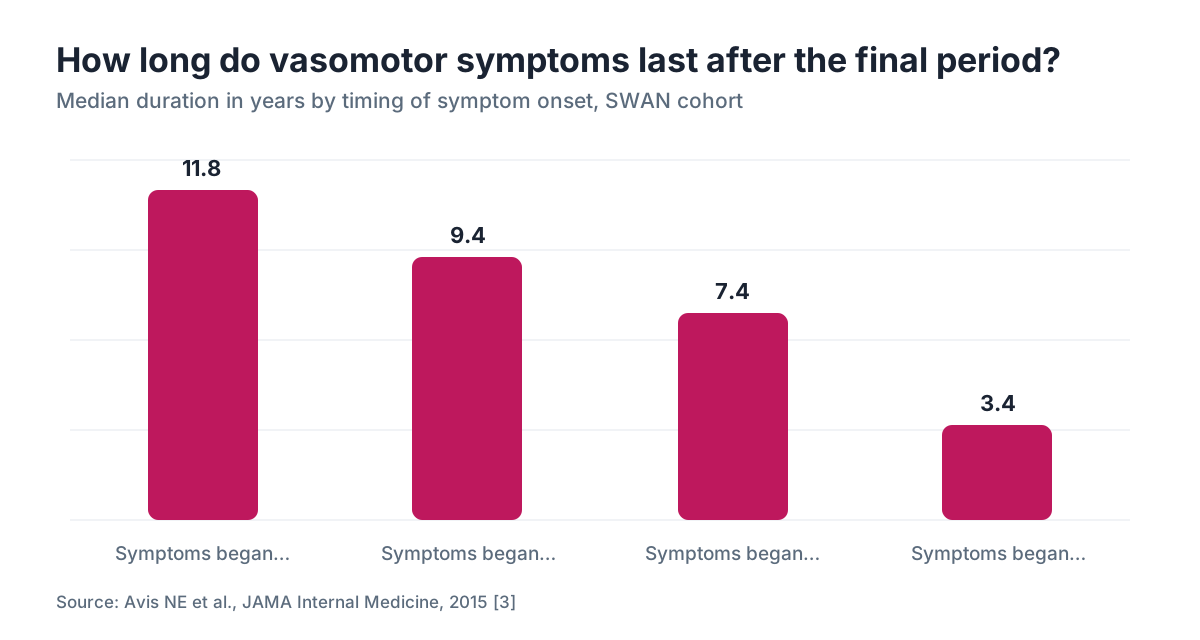
The SWAN study (Study of Women's Health Across the Nation) followed over 1,400 women through the transition and found that the median total duration of frequent vasomotor symptoms (hot flashes and night sweats) was 7.4 years [3]. Women who entered the symptom phase before their final period had the longest total duration. Women who first noticed symptoms after their final period had a shorter run, around 3.4 years.
About 10 percent of women in the SWAN cohort had vasomotor symptoms for 10 or more years. A smaller share reported them well into their late 60s and 70s [3]. So "menopause symptoms finish" is not a promise. It is a probability.
Here is a rough breakdown by symptom category:
| Symptom | Typical peak | When most women see improvement | |---|---|---| | Hot flashes / night sweats | Late perimenopause to 2 yrs postmenopause | 4-7 yrs after final period (median) | | Vaginal dryness / GSM | Worsens progressively postmenopause | Does NOT resolve without treatment [4] | | Sleep disruption | Tied to hot flashes; improves with them | Parallel to vasomotor timeline | | Mood changes | Often peaks in perimenopause | Tends to improve postmenopause for most | | Joint aches | Can persist or appear postmenopause | Variable; no reliable timeline | | Brain fog / memory | Perimenopause peak | Most women report improvement by 2-3 yrs post |
Genitourinary syndrome of menopause (GSM), which includes vaginal dryness, irritation, painful sex, and recurrent UTIs, deserves special mention. Unlike hot flashes, GSM does not resolve on its own. Estrogen levels continue dropping through postmenopause, and without local or systemic estrogen, these tissues thin progressively [4]. Treating it is not optional if it is affecting your quality of life.
What is postmenopause and how long does it last?
Postmenopause starts the day after your menopause anniversary and lasts the rest of your life. There is no stage after it.
The term gets used loosely to mean "the years after your last period," but clinicians sometimes break it into early postmenopause (roughly the first 6 years, when symptoms are often most active) and late postmenopause [2]. The distinction matters clinically because the health risks that build in this phase, bone loss, cardiovascular changes, and metabolic shifts, accelerate at different rates.
Bone density loss is fastest in the first 5 to 10 years after the final period, with women losing roughly 1 to 3 percent of bone mass per year in early postmenopause [5]. That is why the National Osteoporosis Foundation recommends a bone density test at age 65 for most women, or earlier if you have risk factors or went through early menopause.
Cardiovascular risk also shifts. Before menopause, estrogen offers some protective effects on lipid profiles and blood vessel flexibility. After menopause, LDL cholesterol tends to rise and HDL can fall, nudging women toward the same cardiovascular risk profile as men of the same age [6].
Postmenopause is long. If your final period is at 51 and you live to 85, you spend 34 years postmenopausal. How you manage bone health, cardiovascular risk, and hormone status in those years matters enormously.
Do hot flashes eventually stop on their own?
For most women, yes. But "eventually" is doing a lot of work in that sentence.
The SWAN data make clear that the majority of women see their hot flash frequency drop significantly by 4 to 7 years after the final menstrual period [3]. For women who entered perimenopause symptoms early (before the final period), that clock starts earlier, so their symptoms may be winding down just as the final period occurs.
Race and ethnicity affect this meaningfully. The SWAN study found that Black women had more frequent and longer-lasting vasomotor symptoms on average than white, Asian, or Hispanic women in the cohort [3]. This is not a minor difference. It is a documented disparity that should inform clinical conversations.
Body weight is another factor. Women with higher BMI tend to have more hot flashes postmenopause, partly because adipose tissue produces a form of estrogen but the conversion is not efficient enough to suppress the LH surges that trigger vasomotor events [7].
If you are five years postmenopause and still having daily hot flashes, this is not you failing to "get through" menopause. It is a recognized pattern that benefits from evaluation and treatment. Hormone therapy, certain antidepressants (SNRIs like venlafaxine), gabapentin, and the newer neurokinin-3 receptor antagonist fezolinetant (FDA-approved in 2023) are all evidence-based options [8].
Can symptoms start or get worse after menopause is complete?
Yes, and this surprises a lot of women.
GSM symptoms, as noted above, worsen progressively. But vasomotor symptoms can also spike late. Some women have relatively mild perimenopause and then notice worsening hot flashes 2 to 3 years into postmenopause. Stress, illness, certain medications (tamoxifen is a significant trigger), and rapid weight changes can all provoke symptom flares even years after the final period.
Women who go through chemotherapy or take aromatase inhibitors for breast cancer often experience a pharmacologically induced estrogen drop on top of natural postmenopause, which can intensify symptoms dramatically.
The idea that symptoms "should be done" by a certain age is not backed by data. If you are 60 and suddenly having night sweats, that warrants a conversation with a clinician, both to treat the symptom and to rule out secondary causes like thyroid disease.
Does hormone replacement therapy delay or extend the menopause transition?
No. Starting hormone replacement therapy does not extend perimenopause or push back the biological clock. Your ovaries have already made their decision.
What HRT does is replace the estrogen (and often progesterone) that your ovaries are no longer producing. This reduces hot flash frequency, protects bone, and addresses GSM, but it does not change the underlying biology of ovarian aging [9].
The timing question that does matter is when to start. The "window of opportunity" or timing hypothesis, backed by data from the Women's Health Initiative and the Nurses' Health Study, suggests that women who start systemic hormone therapy within 10 years of their final period, or before age 60, get cardiovascular and possibly cognitive benefits that women who start later do not [9][10]. Starting after age 60 or 10-plus years postmenopause is not automatically contraindicated, but the risk-benefit calculation is different.
Stopping HRT does not mean symptoms come back exactly where they left off, though many women do experience a return of hot flashes when they stop. Tapering slowly is generally preferred over abrupt discontinuation, though the evidence base for tapering vs. stopping cold turkey is not as strong as many assume.
Progesterone matters here too. Any woman with a uterus who takes systemic estrogen needs progesterone to protect the uterine lining. Unopposed estrogen raises endometrial cancer risk. This is not negotiable.
For a deeper look at delivery options, see estrogen patch.
What health risks increase after menopause is complete?
The end of estrogen production has real downstream consequences. The three biggest clinically are bone loss, cardiovascular disease, and metabolic changes.
Bone loss: Estrogen inhibits osteoclast activity (the cells that break down bone). Without it, bone resorption speeds up. Women can lose 20 percent of their bone density in the 5 to 7 years after menopause [5]. This is the reason osteoporosis is far more common in women than men, especially in the 60s and 70s.
Cardiovascular disease: Women's rates of heart disease rise sharply after menopause. By age 70 to 75, cardiovascular disease rates in women catch up to and eventually exceed those in men of the same age [6]. LDL tends to rise, HDL can fall, and arterial stiffness increases.
Metabolic and weight changes: Fat redistribution toward the abdomen is well-documented in postmenopause. Insulin sensitivity often decreases. This is the environment where many women find that previous approaches to weight management stop working. Semaglutide for weight loss has become increasingly relevant here, given that GLP-1 receptor agonists work differently from caloric restriction alone and address the insulin signaling changes postmenopause accelerates.
WomenRx works with women navigating exactly this postmenopause metabolic shift, with both hormone care and GLP-1 options in the same clinical framework.
Urogenital health: The urethra and bladder are estrogen-sensitive tissues. Postmenopausal women have significantly higher rates of urgency incontinence, recurrent UTIs, and pelvic organ prolapse [4].
Cognitive health: The data are more contested here. Some studies suggest estrogen has neuroprotective effects and that women who start HRT in early postmenopause have lower rates of Alzheimer's disease, but this remains an area of active research, not settled science.
How do you know if a period in your 50s is perimenopause or something else?
Any bleeding that occurs more than 12 months after what you thought was your final period is not menopause-related bleeding. It is postmenopausal bleeding and it requires evaluation [12].
About 90 percent of postmenopausal bleeding has a benign cause: endometrial atrophy (the lining thinning), endometrial polyps, or vaginal atrophy. But roughly 5 to 10 percent is caused by endometrial cancer [12]. The workup typically involves a pelvic ultrasound to measure endometrial thickness and, if the lining is thickened (generally above 4 mm postmenopause), an endometrial biopsy.
Do not assume unexpected bleeding is "just hormones." Call your clinician.
For irregular cycles in your late 40s that have not yet resolved into a final period, see menopause age for context on the range of normal.
What tests confirm you are fully postmenopausal?
The honest clinical answer is: for most women, no test is needed. The 12-month rule is diagnostic [1].
FSH levels are sometimes checked but are less reliable than people expect. FSH fluctuates wildly in perimenopause, and a single high reading does not confirm postmenopause. NAMS does not recommend routine FSH testing to confirm menopause in women over 45 with the typical symptom pattern [1]. Where FSH becomes useful: women under 45 where POI is suspected, women using hormonal contraception that masks cycles, and clinical situations where the diagnosis genuinely affects treatment decisions [11].
Estradiol levels can also be checked, and values consistently below 30 pg/mL are consistent with postmenopause, but again, single measurements are snapshots of a moving target in perimenopause.
Thyroid function (TSH) is worth checking in women with atypical symptoms because hypothyroidism mimics many menopause symptoms, including fatigue, weight gain, and cognitive changes. Getting the diagnosis right matters.
What should you actually do once you are postmenopausal?
Postmenopause is not a waiting room. It is the longest reproductive phase of your life, and there are concrete things worth doing.
First, get a baseline bone density scan. If you are under 65 and postmenopausal, discuss it with your clinician, especially if you entered menopause early [5]. A bone density test gives you a number to track.
Second, revisit cardiovascular risk. Get a lipid panel. Know your blood pressure. The window for HRT to reduce cardiovascular risk is roughly the first 10 years of postmenopause or before age 60, so if you are in that window and on the fence, the conversation is worth having now rather than later [9][10].
Third, address GSM if it is affecting you. Local vaginal estrogen is safe for most women, has minimal systemic absorption, and is even an option for many breast cancer survivors under oncologist guidance. The barrier to treating GSM is almost entirely stigma and lack of information, not medicine.
Fourth, look at your weight and metabolic health honestly. Postmenopausal metabolic shifts are real, not a personal failing. For women where lifestyle changes are not moving the needle, options like semaglutide or semaglutide vs tirzepatide comparisons are worth understanding.
Fifth, keep the symptom conversation open. There is no rule that says you must suffer through symptoms because you are "through" menopause. Effective treatments exist for hot flashes, sleep disruption, GSM, and low libido at every stage of postmenopause.
Frequently asked questions
Is there a specific age when menopause is completely over?
There is no universal age. Menopause is confirmed 12 months after your last period, which happens at an average age of 51 to 52 in the US. Postmenopause then continues for the rest of your life. Symptoms like hot flashes typically ease within 4 to 7 years for most women, but for roughly 10% they continue past age 60.
Can menopause symptoms last into your 60s and 70s?
Yes. The SWAN study found a median symptom duration of 7.4 years, but about 10% of women had frequent vasomotor symptoms for more than a decade. Some women report hot flashes into their 70s. This is not unusual. Genitourinary symptoms like vaginal dryness do not resolve without treatment and can worsen throughout postmenopause regardless of age.
What happens to your body after menopause is complete?
Estrogen stays permanently low, which speeds bone density loss (roughly 1 to 3% per year in early postmenopause), shifts cardiovascular risk upward, redistributes body fat toward the abdomen, and causes progressive thinning of vaginal and urethral tissues. These are not symptoms that "finish." They are ongoing physiological changes that require active health management.
How do you know when perimenopause ends and postmenopause begins?
Perimenopause ends and postmenopause begins the day you hit 12 consecutive months without a period. You can only know this in retrospect: once 12 months have passed, you look back and call that last period your menopause date. There is no test that tells you in real time. FSH levels can suggest where you are but are not definitive on their own.
Can you get pregnant after menopause is confirmed?
No. Once you have gone 12 full months without a period, natural conception is not possible. You are no longer ovulating. During perimenopause, however, ovulation can still occur sporadically, which is why contraception is recommended until the 12-month mark is reached, or until age 55 in some guidelines, whichever comes first.
Does weight gain after menopause ever stop?
The hormonal contribution to weight gain, mainly the shift toward abdominal fat storage and reduced insulin sensitivity, stabilizes eventually as the body adapts to persistently low estrogen. But postmenopausal women are not immune to ongoing weight gain from age-related muscle loss and lifestyle factors. Addressing this early, including discussing GLP-1 options if appropriate, tends to be more effective than waiting.
Is vaginal dryness permanent after menopause?
Without treatment, yes. Genitourinary syndrome of menopause (GSM) is caused by chronically low estrogen and worsens over time without intervention. Unlike hot flashes, it does not resolve on its own. Local vaginal estrogen, DHEA suppositories (prasterone), and the oral SERM ospemifene are all FDA-approved treatments with strong evidence for effectiveness.
When is it too late to start hormone replacement therapy?
There is no absolute cutoff, but the strongest evidence for cardiovascular and possibly cognitive benefits applies to women who start within 10 years of their final period, or before age 60. Starting after 60 or 10-plus years postmenopause is not automatically unsafe, but the benefit-risk balance changes, and the conversation with a clinician becomes more individualized. Local vaginal estrogen has no meaningful systemic absorption and has no age-related window restriction.
What is the difference between early menopause and premature menopause?
Early menopause refers to the final period occurring between ages 40 and 45. Premature menopause (premature ovarian insufficiency or POI) occurs before age 40. Both carry greater long-term bone and cardiovascular risks than average-age menopause because of the extended years of low estrogen. Hormone therapy is generally recommended until at least the average menopause age of 51 for women with POI.
Do hot flashes get worse before they get better?
For many women, yes. Vasomotor symptoms often intensify in the 1 to 2 years around the final menstrual period, a phase sometimes called the late perimenopausal transition. The SWAN study found this is the period of peak frequency for most women. Symptoms then gradually decline over the following 4 to 7 years for the majority, though the timeline is individual.
Can stress make menopause symptoms last longer?
There is genuine evidence that psychological stress amplifies hot flash perception and may extend symptom duration. The SWAN study identified stress, anxiety, and depressive symptoms as independent predictors of longer vasomotor symptom duration, separate from hormone levels. This does not mean symptoms are psychosomatic. It means the nervous system's stress response genuinely lowers the threshold at which a thermal event becomes a perceptible hot flash.
What does a doctor check to confirm postmenopause?
For most women over 45 with typical symptoms, no test is needed. The 12-month rule is diagnostic. FSH above 40 mIU/mL is consistent with postmenopause but can fluctuate in perimenopause. Estradiol below 30 pg/mL is consistent but not definitive alone. Thyroid function (TSH) is worth checking if symptoms are atypical or include significant fatigue and weight changes.
Is postmenopausal bleeding ever normal?
No. Any vaginal bleeding more than 12 months after your final period requires evaluation. While most causes are benign (endometrial atrophy, polyps), roughly 5 to 10% of postmenopausal bleeding is caused by endometrial cancer. A pelvic ultrasound and possible endometrial biopsy are the standard workup. Do not assume it is hormonal without investigation.
How does surgical menopause differ from natural menopause in terms of when it finishes?
Surgical menopause from bilateral oophorectomy is immediate. There is no 12-month waiting period. Estrogen drops sharply within 24 to 48 hours of surgery, and symptoms are often more abrupt and intense than with natural menopause. Postmenopause begins at the moment of surgery. Women who undergo this before the natural average age carry the same long-term bone and cardiovascular risks as those with POI.
Sources
- North American Menopause Society (NAMS), Menopause Practice: A Clinician's Guide
- WHO, Research on the Menopause in the 1990s: Report of a WHO Scientific Group
- Avis NE et al., Duration of Menopausal Vasomotor Symptoms over the Menopause Transition, JAMA Internal Medicine, 2015
- Portman DJ, Gass ML; Vulvovaginal Atrophy Terminology Consensus Conference Panel, Genitourinary syndrome of menopause, Menopause, 2014
- National Osteoporosis Foundation, Clinician's Guide to Prevention and Treatment of Osteoporosis
- American Heart Association, Menopause and Heart Disease
- Thurston RC, Joffe H, Vasomotor symptoms and menopause: findings from the Study of Women's Health Across the Nation, Obstetrics and Gynecology Clinics of North America, 2011
- FDA, Drug Approval Package: Veozah (fezolinetant), 2023
- Manson JE et al., Menopausal Hormone Therapy and Long-term All-Cause and Cause-Specific Mortality, JAMA, 2017
- Rossouw JE et al., Postmenopausal Hormone Therapy and Risk of Cardiovascular Disease by Age and Years Since Menopause, JAMA, 2007
- Stuenkel CA et al., Treatment of Symptoms of the Menopause: An Endocrine Society Clinical Practice Guideline, Journal of Clinical Endocrinology and Metabolism, 2015
- ACOG, guidance on the diagnosis of abnormal uterine bleeding and postmenopausal bleeding