When do women hit menopause? Age, timing, and what shifts it
TL;DR: Most women in the United States reach menopause, defined as 12 straight months without a period, between ages 45 and 55. The median is 51. Perimenopause, the transition before it, usually starts in the mid-to-late 40s and runs 4 to 8 years. Genetics, smoking, ovary surgery, chemotherapy, and radiation can shift your timing years earlier or later.
What is the average age women hit menopause in the United States?
The median age of natural menopause in the United States is 51, and the normal range runs from about 45 to 55. [1] That one number is the most-quoted figure in reproductive medicine. It also hides enormous individual variation. Some women finish with periods at 43. Others still cycle at 58. Both ends are normal.
Menopause is a single point in time, not a process. The North American Menopause Society defines it as "the permanent cessation of menstrual periods that occurs naturally or is induced by surgery, chemotherapy, or radiation." [1] Clinically, that point is confirmed after 12 consecutive months without a period and no other medical cause for the absence.
Why 51? Population studies across decades and multiple ethnic groups keep landing near that age for spontaneous menopause. The Study of Women's Health Across the Nation (SWAN), which followed roughly 3,300 women for years, confirmed the median in a racially diverse US sample. [2] The figure has barely moved in the data, which points to biology doing most of the work rather than lifestyle.
Here is the part most women miss. Nobody wakes up at 51 suddenly in menopause. The transition into it, called perimenopause, takes years. Menopause is the finish line, not the starting gun.
What is perimenopause and what age does it usually begin?
Perimenopause is the hormonal transition leading up to your final period. Estrogen and progesterone go erratic, cycles lengthen or shorten without warning, and hot flashes, broken sleep, and mood changes often start here, sometimes years before periods actually stop. [1]
For most women, perimenopause begins between 44 and 50. SWAN put the median age for the start of the transition at roughly 47 to 48. [2] Duration varies a lot. The average is 4 to 8 years, but some women clear it in a year and others sit in it for a decade. Our article on perimenopause age covers the timing in more detail.
The early tell is a change in cycle regularity. Clinicians look for cycles that vary by 7 or more days from what used to be normal for you. That is the marker for early perimenopause. Later perimenopause is defined by gaps of 60 or more days between periods. [2]
One thing trips women up constantly. You can be deep in perimenopause and still ovulate now and then. Pregnancy stays possible until you hit that 12-month mark, so contraception still matters until menopause is confirmed.
What factors make menopause happen earlier or later?
Genetics is the biggest single driver. If your mother or older sisters went through menopause early, your odds of doing the same climb sharply. Twin studies put the heritability of menopause age somewhere around 50 to 60 percent. [3]
Smoking is the most consistent modifiable factor. Current smokers reach menopause on average 1 to 2 years earlier than nonsmokers, and heavier smokers see a bigger shift. The mechanism looks like direct toxic damage to ovarian follicles. [3]
Body weight has a messier relationship with timing. Lower body weight and low BMI track with earlier menopause in some studies, while higher body weight may nudge it slightly later, probably because fat tissue makes estrogen. That is not a reason to gain weight. The trade-offs are real.
Other things that can pull menopause earlier:
- Surgical menopause from oophorectomy (removal of both ovaries) causes immediate menopause at any age
- Chemotherapy and pelvic radiation can damage ovarian reserve, sometimes for good
- Autoimmune conditions linked to premature ovarian insufficiency
- Certain epilepsy medications
- Never having been pregnant, in some studies, tracks with slightly earlier timing
Things that may push timing slightly later include oral contraceptive use (possibly by preserving follicles, though the evidence is mixed), higher parity (more pregnancies), and some genetic variants found in genome-wide association studies. [3]
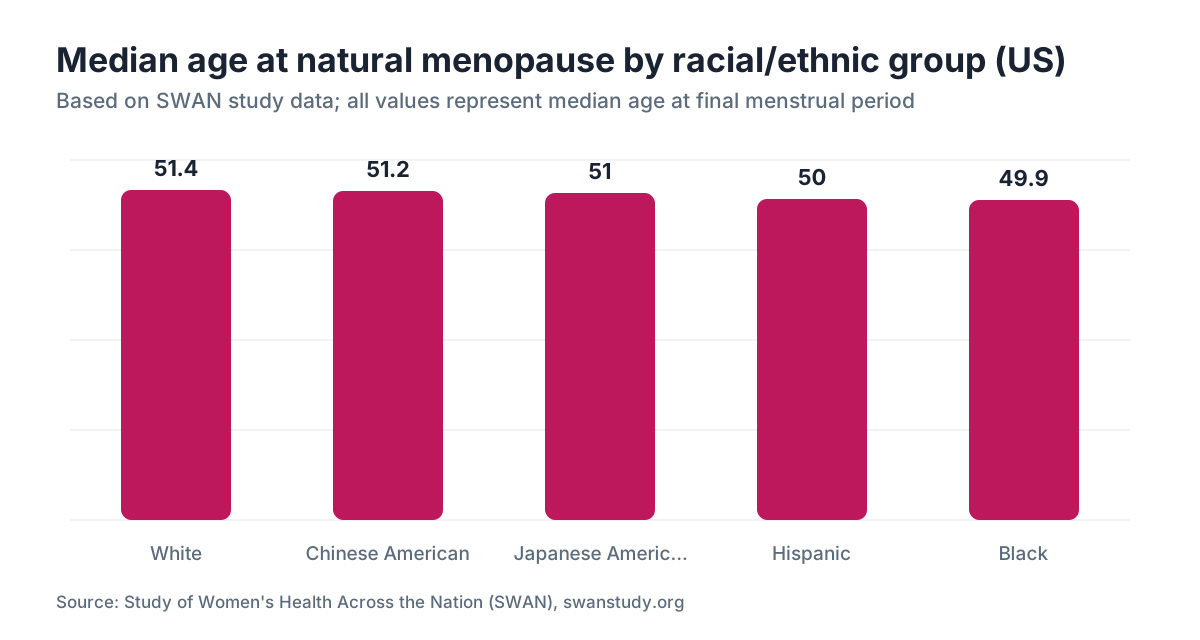
Ethnicity matters in ways researchers are still sorting out. SWAN data showed Black women reached menopause about 8.5 months earlier than white women on average, and Hispanic women somewhat earlier too, while Japanese and Chinese women sat closer to the white median. [2] Socioeconomic factors alone do not explain the gap.
How does timing vary by race and ethnicity?
SWAN is the best evidence we have on this in the United States, and the differences hold up across analyses. [2] Black women had a median menopause age around 49 to 50. Hispanic women clustered near 49.5. White and Chinese women sat closest to 51. Japanese women looked similar to white women.
These differences change what care should look like. Earlier menopause means a longer stretch of estrogen deficiency, which affects bone density, heart risk, and cognitive aging. It also means a Black woman in her late 40s reporting hot flashes and cycle changes is not "too young" for the transition, and shouldn't be treated that way.
SWAN also found Black women reported more frequent and more bothersome hot flashes and night sweats than other groups, even after controlling for other variables. [2] That shapes who gets offered treatment and when. Our full article on menopause digs into symptom differences across groups.
How much of this is genetic versus tied to stress, environment, diet, or healthcare access is still an open question. It is almost certainly a mix of all of them.
What is premature menopause and early menopause?
Premature menopause means menopause before age 40. The preferred clinical term is premature ovarian insufficiency (POI). It affects roughly 1 percent of women under 40 and about 0.1 percent under 30. [4] POI is not always permanent, and it is not always complete. Some women with POI ovulate intermittently and can occasionally conceive, which is why the older label "premature ovarian failure" has mostly been dropped.
Early menopause means menopause between 40 and 45. It is more common than POI, affecting an estimated 5 percent of women. [4]
POI can come from chromosomal abnormalities (Turner syndrome, fragile X premutation), autoimmune disease, or medical treatments. Often no cause turns up at all.
Women with POI face a much longer window of estrogen deficiency than women who reach natural menopause at 51, which raises their odds of osteoporosis and cardiovascular disease. The Endocrine Society and NAMS both recommend hormone therapy for women with POI up to at least the average age of natural menopause, unless there is a specific contraindication, partly to offset those long-term risks. [4] A bone density test is recommended shortly after diagnosis for the same reason.
If you are under 40 and your periods have been absent for more than 3 months with no pregnancy, that earns a workup including FSH levels. Not a "wait and see."
How do you know menopause is starting? What are the signs?
The clearest early sign is a change in your cycle pattern. Periods that ran a reliable 28 days start showing up at 21, or 35, or skipping a month entirely. That variability, especially cycles that swing by 7 or more days from your baseline, is the clinical signal of early perimenopause. [2]
As the transition deepens, these show up or get worse:
- Hot flashes and night sweats (vasomotor symptoms): the most common and best-studied menopause symptom, hitting roughly 75 percent of women in North America [1]
- Sleep disruption, often tied to night sweats but also happening on its own
- Vaginal dryness and pain with sex, technically called genitourinary syndrome of menopause (GSM)
- Mood shifts, anxiety, and irritability that can feel out of proportion
- Brain fog and trouble concentrating
- Joint aches
- Changes in skin and hair
No single symptom confirms menopause. Thyroid disease produces a lot of the same complaints. So do chronic stress, sleep disorders, and certain medications.
Blood tests can help. Follicle-stimulating hormone (FSH) climbs as the ovaries get less responsive. An FSH level consistently above 30 mIU/mL, paired with 12 months without a period, confirms natural menopause in women over 45. [1] In women under 45 with suspected POI, two FSH measurements at least 4 to 6 weeks apart are recommended. Anti-Mullerian hormone (AMH) reflects ovarian reserve and can add information, though it shows up more often in fertility testing.
Does surgical menopause happen differently?
Yes, and the difference is stark. Surgical menopause, caused by bilateral oophorectomy (removal of both ovaries), drops estrogen and progesterone immediately and completely instead of the slow decline of natural menopause. [5] There is no perimenopause runway. Symptoms can hit hard and fast.
A woman who has a hysterectomy but keeps her ovaries does not go through surgical menopause. Her ovaries keep making hormones until they wind down naturally, though some research suggests her natural menopause may arrive slightly earlier than it would have, possibly from changes in blood supply to the ovaries.
Hysterectomy with oophorectomy before natural menopause is linked to higher risks of cardiovascular disease, osteoporosis, and cognitive changes. That is why many surgeons now try to keep at least one ovary in premenopausal women when it is medically reasonable. [5]
For women who reach surgical menopause before the average natural age, hormone therapy is generally recommended to protect long-term health, more than to manage symptoms. That is a different calculation than the one for women reaching natural menopause at 51 or later. [4]
How does menopause affect weight, and do GLP-1 medications help?
The hormone shifts of menopause do change body composition in real ways. Estrogen decline moves fat storage from hips and thighs toward the abdomen. Metabolic rate slows. Insulin sensitivity can drop. Plenty of women find the diet and exercise habits that held their weight steady in their 30s stop working in their late 40s and 50s. [6]
GLP-1 receptor agonists like semaglutide and tirzepatide cut appetite and slow gastric emptying, which can help with the weight gain that often rides along with the transition. They don't fix the underlying hormonal cause of the shift, but they are effective weight loss tools on their own.
Honest caveat: there isn't strong dedicated trial data on GLP-1 use in menopausal or perimenopausal women as a defined subgroup, tracked separately over many years. The STEP trials for semaglutide enrolled women across a range of ages and showed meaningful weight loss, but menopause status wasn't a primary stratification variable. [7] The SURMOUNT trials for tirzepatide showed similar results. [8] Researchers are only starting to look at this more closely.
If you are perimenopausal or postmenopausal and thinking about a GLP-1, pairing it with hormone therapy to address the hormonal root of the body composition change is a conversation worth having with your clinician. WomenRx works with women on exactly this combination, including semaglutide for weight loss alongside hormonal evaluation.
Our comparison of semaglutide vs tirzepatide helps if you are weighing the two.
What are the long-term health risks after menopause?
The estrogen drop at menopause reaches well past the reproductive tract. Knowing the risks isn't meant to scare you. It's practical, because most of them are modifiable.
Bone loss: estrogen holds back osteoclasts, the cells that break down bone. Loss speeds up sharply in the first 5 to 10 years after the final period. Women can lose 1 to 3 percent of bone density per year in those early postmenopause years. [9] Osteoporosis affects roughly 1 in 5 women over 50 in the United States. A bone density test (DEXA scan) is recommended for all women at 65, or earlier with risk factors.
Cardiovascular disease: before menopause, women have much lower heart disease rates than men. After menopause, that gap closes. The risk of cardiovascular events rises after the final period, and it rises faster in women who went through menopause early. [6]
Genitourinary syndrome of menopause (GSM): vaginal and urethral tissue thins and irritates easily without estrogen. Unlike hot flashes, which often ease over time, GSM tends to get worse without treatment. Local estrogen therapy works well and has a favorable safety profile. [1]
Cognitive health: estrogen has neuroprotective effects, and the timing of menopause relative to when hormone therapy starts seems to matter for cognitive outcomes. This is the "timing hypothesis." The evidence is still developing, but it suggests a window in early menopause where hormone therapy may help the brain most. [10]
Most of these risks drop meaningfully with hormone therapy, started at the right time in the right woman. [10]
What treatments are available for menopause symptoms?
Hormone therapy (HT) is still the most effective treatment for hot flashes, night sweats, broken sleep, and GSM. The 2022 Hormone Therapy Position Statement from NAMS concluded that for healthy women under 60, or within 10 years of menopause onset, the benefits of hormone therapy generally outweigh the risks for most women without contraindications. [10]
The options:
- Systemic estrogen (pills, patches, gels, sprays): treats hot flashes, sleep, mood, and bone
- Progestogen added for women with a uterus (to protect the uterine lining): options include oral progesterone and synthetic progestins
- Low-dose vaginal estrogen: for GSM only, with minimal systemic absorption
- An estrogen patch delivers estrogen through the skin, skipping first-pass liver metabolism, which may carry a more favorable clotting risk profile than oral estrogen
Non-hormonal options with reasonable evidence include fezolinetant (FDA-approved in 2023 specifically for moderate to severe hot flashes), low-dose SSRIs and SNRIs (paroxetine at 7.5 mg has FDA approval for menopause-related hot flashes), and gabapentin. [11]
Lifestyle measures form the base regardless of what else you do: regular weight-bearing exercise, enough calcium and vitamin D, not smoking, limiting alcohol, and protecting your sleep.
For women who want to work through hormone replacement therapy in detail, including how to start and which form fits best, that guide covers the full picture. WomenRx offers telehealth hormone evaluation for women going through this transition.
Can you predict when you will personally hit menopause?
Not precisely, but you can build a reasonable estimate. The best predictors:
- Your mother's age at menopause: if she hit it at 48, your chance of landing in that range is meaningfully higher
- Your current cycle regularity: persistent irregularity in your mid-to-late 40s signals the transition has started
- Ovarian reserve markers: AMH declines steadily as you age and gives a rough read on remaining follicular reserve, though it is not a precise predictor of menopause timing
- Your FSH trend: rising FSH over time, especially values consistently above 10 to 25 mIU/mL in a woman still having periods, points to declining ovarian function
Genetic testing for menopause timing is a research area. Several variants tied to earlier or later menopause have turned up in genome-wide studies, but no clinically validated genetic test exists for routine prediction yet. [3]
Smoke if you want to get there sooner. That is not a recommendation. It is the data. Smoking is the one behavioral factor with consistent, replicated evidence for earlier timing.
For most women, the honest answer is this: expect the transition to start somewhere in your mid-to-late 40s, expect it to run 4 to 8 years, and schedule your healthcare conversations around that rather than waiting for symptoms to become unbearable.
Frequently asked questions
When do women hit menopause on average?
The median age of natural menopause in the United States is 51, with the normal range from about 45 to 55. Most women land somewhere in that window. Menopause is confirmed after 12 consecutive months without a period and no other medical cause. Perimenopause, the years of hormonal change before it, usually begins in the mid-to-late 40s.
Can menopause start in your 30s?
Yes, though it is uncommon. Menopause before 40 is called premature ovarian insufficiency (POI) and affects about 1 percent of women under 40. Between 40 and 45 is early menopause, hitting roughly 5 percent of women. Both warrant prompt evaluation, since a long stretch of estrogen deficiency sharply raises risks for bone loss and cardiovascular disease.
How long does perimenopause last?
On average, 4 to 8 years. Some women move through it in about a year. Others experience 10 or more years of transition. It typically starts with irregular cycles and ends 12 months after the final period. Hot flashes, sleep problems, and mood changes are common throughout and can persist for years after the final period too.
What is the earliest sign that menopause is approaching?
Cycle irregularity is the clearest early signal. When your cycles start varying by 7 or more days from your usual pattern, that marks early perimenopause under the SWAN study criteria. Hot flashes can also begin in perimenopause, sometimes before cycles turn noticeably irregular. A rising FSH blood level can confirm declining ovarian function.
Does smoking affect when menopause happens?
Yes. Current smokers reach menopause an average of 1 to 2 years earlier than nonsmokers, and heavier smokers tend to see a bigger shift. The likely mechanism is toxic damage to ovarian follicles. This is one of the most consistently replicated findings in menopause timing research. Quitting earlier in life may partly offset the effect, though data on reversal is limited.
Is menopause different after a hysterectomy?
It depends on whether the ovaries came out. Hysterectomy with both ovaries removed (bilateral oophorectomy) causes immediate surgical menopause at any age, with an abrupt hormone drop instead of a gradual decline. Hysterectomy with ovaries intact means your ovaries keep working and natural menopause still happens, though you cannot track it by the absence of periods.
Does race affect menopause age?
Yes, meaningfully. SWAN found Black women reached menopause about 8.5 months earlier than white women on average, with Hispanic women somewhat earlier too. Chinese and Japanese women sat closer to the white median of 51. Black women also reported more frequent and severe hot flashes across the transition. Clinicians should factor this into when they start menopause conversations.
Can you get pregnant during perimenopause?
Yes. You can still ovulate during perimenopause, even with irregular cycles. Pregnancy stays possible until menopause is fully confirmed, meaning 12 consecutive months without a period. Women in their late 40s sometimes find they are pregnant when they assumed they were just perimenopausal. Contraception matters until that 12-month mark is reached.
What hormones change during the menopause transition?
Estrogen and progesterone decline, but not in a straight line. Early perimenopause can actually bring estrogen spikes. FSH rises as the pituitary works harder to stimulate the ovaries. AMH falls steadily as ovarian reserve empties. Testosterone also declines across the transition, which can affect libido and energy. These shifting levels drive most of the symptoms.
How do doctors confirm menopause?
For women over 45, 12 consecutive months without a period and no other cause is the clinical standard. Lab testing is not required to confirm natural menopause at that age. For women under 45, or those on hormonal contraceptives that mask periods, FSH measured twice at least 4 to 6 weeks apart, consistently above 30 mIU/mL, supports a menopause diagnosis.
Does menopause cause weight gain?
Menopause itself does not directly cause large weight gain, but the hormone shifts change where fat is stored, moving it toward the abdomen. Metabolic rate also slows with age, and mid-life overlaps with menopause for many women. Studies suggest women gain an average of 1.5 to 2 pounds per year during the transition, though lifestyle factors are the main driver.
What is the difference between perimenopause and menopause?
Perimenopause is the transition, which can last 4 to 8 years. Menopause is the single point in time: your final period, confirmed in hindsight after 12 months of no periods. Postmenopause covers all the years after that point. Most symptoms women attribute to menopause actually begin during perimenopause, often years before the final period.
Are hot flashes worse for some women than others?
Yes, a lot worse for some. About 75 percent of North American women get hot flashes, but severity ranges from mild and barely noticeable to frequent, intense, and sleep-destroying. Black women in SWAN reported more frequent and bothersome vasomotor symptoms than other groups. Thinner women tend to report more severe hot flashes, likely because fat tissue provides some residual estrogen buffering.
Should I consider hormone therapy and when should I start it?
NAMS guidance says that for healthy women under 60, or within 10 years of menopause onset, the benefits of hormone therapy outweigh the risks for most women without contraindications. Starting closer to the transition, rather than years later, appears to protect bone and possibly the heart better. A conversation with a knowledgeable clinician based on your history is the right first step.
Sources
- North American Menopause Society (NAMS), Menopause Glossary and Clinical Resources
- Study of Women's Health Across the Nation (SWAN), NIH-funded longitudinal study, multiple publications
- Endocrine Society, Journal of Clinical Endocrinology and Metabolism, menopause genetics review
- Endocrine Society Clinical Practice Guideline: Premature Ovarian Insufficiency
- American College of Obstetricians and Gynecologists (ACOG), Practice Bulletin on Oophorectomy
- National Heart, Lung, and Blood Institute (NHLBI), Women's Health Initiative background data
- STEP 1 Trial: Wilding JPH et al., NEJM 2021, semaglutide 2.4 mg for weight management
- SURMOUNT-1 Trial: Jastreboff AM et al., NEJM 2022, tirzepatide for weight management
- Bone Health and Osteoporosis Foundation, Clinician's Guide to Prevention and Treatment of Osteoporosis
- North American Menopause Society (NAMS), 2022 Hormone Therapy Position Statement
- FDA Drug Approval: Veozah (fezolinetant), FDA.gov