What signals the end of menopause, and what comes next
TL;DR: Menopause ends the moment you have gone 12 consecutive months without a menstrual period. That single day, counted backward, is your menopause date, and everything after it is postmenopause. Most women reach this mark between ages 51 and 52. Hot flashes and other symptoms often run for years afterward, but the biological milestone itself is one clean day.
What exactly signals the end of menopause?
The signal is simple, even if the years leading up to it are not: 12 consecutive months without any menstrual bleeding. That is the clinical definition used by the North American Menopause Society (NAMS), the Endocrine Society, and essentially every major medical body worldwide [1]. The day you reach that 12-month mark is, counted backward, your menopause date. Everything before it, once periods started becoming irregular, was perimenopause. Everything after is postmenopause.
There is no blood test, no scan, no single symptom that tells you menopause is over. FSH (follicle-stimulating hormone) rises sharply as the ovaries stop responding to it, and estradiol falls, but those numbers swing so much during the transition that labs cannot reliably pinpoint the endpoint in real time [2]. The 12-month rule exists precisely because the hormonal picture is chaotic and the only clean marker is behavior: did you bleed or not?
One clarification worth pinning down. The word "menopause" in everyday talk usually means the whole multi-year experience of hot flashes, broken sleep, and erratic cycles. Clinically, menopause is a single point in time. What most women describe as "going through menopause" is actually perimenopause. The confusion is everywhere, even in doctor's offices, so if your provider uses the terms loosely, that is normal. Knowing the distinction helps you read your own timeline.
Any vaginal bleeding after that 12-month mark is not menopause resuming. It needs a prompt clinical workup because it can point to endometrial disease [3]. That is not cause for panic. It is cause to call your doctor the same week.
When does menopause end for most women, by age?
The median age of the final menstrual period in the United States is 51.4 years, based on the Study of Women's Health Across the Nation (SWAN), one of the largest and longest studies of the menopause transition [4]. Half of American women reach their menopause date before 51.4 and half after. The normal range runs from about 45 to 55. Reaching the endpoint before 45 is early menopause; before 40 it is called premature ovarian insufficiency (POI) and needs different clinical management [1].
Several factors shift where a woman lands in that range. Smoking is the most consistently documented: smokers tend to reach menopause 1 to 2 years earlier than nonsmokers [4]. Genetics matter enormously; your mother's timing is a reasonable predictor of yours. Race and ethnicity influence timing too. SWAN found that Black women reach menopause slightly earlier on average than white women, while Japanese and Chinese American women reach it slightly later, though the differences are modest and the overlap between groups is large [4].
Chemotherapy, pelvic radiation, and surgical removal of the ovaries (bilateral oophorectomy) trigger menopause immediately or fast, regardless of age. Surgical menopause is abrupt rather than gradual and usually produces more intense symptoms because the hormone drop happens over days rather than years.
Want a rough personal estimate? Check your family history, account for smoking, and center your guess around 51. That will be right for more women than any other single number.
See our article on perimenopause age for more on what happens in the years before this endpoint, and when does menopause start for the early signals.
How long does perimenopause last before menopause ends?
The average is about 7 years, with a range in the research of roughly 4 to 10 years [4]. SWAN followed women from the early transition through the final menstrual period and found most spent 4 to 8 years in perimenopause, with a subset running a decade or more.
The transition is divided into stages by the STRAW+10 (Stages of Reproductive Aging Workshop) framework, the standard classification system in research and increasingly in the clinic [5]. Early perimenopause is marked by cycles that vary by 7 or more days from your usual pattern. Late perimenopause arrives when you have had a gap of 60 or more days between periods. Once you hit those 60-day gaps, you are statistically within about 1 to 3 years of your final period.
Symptoms often intensify in late perimenopause and in the first 2 years after the final period, then ease for most women. Hot flashes tend to peak in that window. But the timeline is not uniform and the research on this is genuinely messy. Some women have minimal symptoms throughout. Others have severe symptoms for more than a decade past the menopause date.
The practical takeaway: if your periods have gone unpredictable but have not stopped for 12 months, you are not at the endpoint. You are somewhere in the transition, and that matters for contraception (yes, you can still get pregnant during perimenopause) and for how any hormone therapy is structured.
What are the signs that menopause is almost over?
There is no reliable biological warning that the 12-month mark is close. The body does not send a clear signal the way it does at the start of perimenopause. Certain patterns do suggest you are in the final stretch.
Long gaps between periods are the strongest indicator. Once you have gone 60 days without bleeding, you are in late perimenopause by STRAW+10 criteria [5]. Once a gap extends past 90 or 120 days, many women are within a year of their final period, though this is probability, not certainty. Some women have a 5-month gap and then run several more cycles. The 12-month rule exists for a reason.
Hormone levels can offer supporting evidence. A high FSH (commonly above 30 mIU/mL, sometimes cited as above 25 or 40 depending on the lab and the guideline) paired with low estradiol fits the late transition or postmenopause, but NAMS explicitly warns against using FSH alone to confirm menopause in women who are still having any bleeding [1]. The number can jump month to month.
Anti-Mullerian hormone (AMH) is a steadier marker of remaining egg supply, and very low AMH tracks with proximity to the final period. But AMH testing for menopause timing is not yet standard practice, and cutoffs vary by assay [2].
Symptom changes are not reliable signals. Some women feel their hot flashes peaking right before the endpoint. Others have their worst symptoms 2 years into postmenopause. Do not try to time your menopause date by how bad you feel.
Does menopause ever fully end, or do symptoms last forever?
The biological transition ends definitively at 12 months without a period. What does not necessarily end is the downstream hormonal environment, which is chronically low estrogen and progesterone, and the symptoms that environment produces.
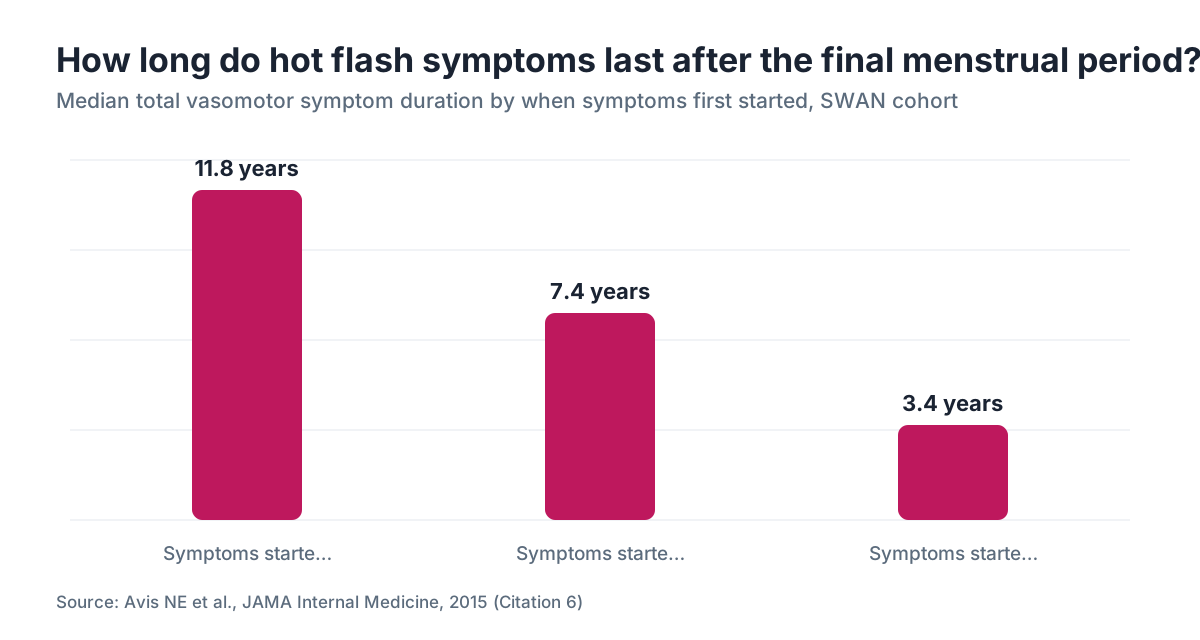
Hot flashes are the most studied. A 2015 analysis from SWAN found the median total duration of hot flash symptoms was 7.4 years, with symptoms often starting in perimenopause and running well into postmenopause [6]. Women who entered perimenopause with hot flashes earlier in the transition tended to have symptoms for longer, sometimes over a decade. About 9 percent of women in SWAN were still having frequent hot flashes at age 72 [6].
Genitourinary symptoms (vaginal dryness, urinary urgency, discomfort during sex) come from local estrogen loss and tend to worsen over time without treatment rather than fading on their own. This is called the genitourinary syndrome of menopause (GSM) [3].
So the honest answer: the transition ends. The new hormonal baseline is permanent unless you are on hormone therapy. Many symptoms ease with time. Some do not. Assuming postmenopause means symptom-free sets up false expectations.
Bone loss speeds up in the first 5 to 10 years after the menopause date from estrogen withdrawal, even in women who feel completely well [7]. That makes a bone density test a real postmenopause screening, not an optional extra.
What is postmenopause and how is it different from menopause?
Postmenopause is every day after your 12-month mark. There is no upper age limit; once you are postmenopausal, you stay postmenopausal for life. The key physiological difference from perimenopause is stability. In perimenopause, estrogen levels are chaotic, rising and falling without warning. In postmenopause, estrogen sits consistently low. That shift from chaotic to stably low is, oddly, why some symptoms ease while others dig in.
Cardiovascular risk changes meaningfully after the menopause date. Estrogen has modest protective effects on lipid profiles and vascular function, and its sustained loss contributes to rising LDL cholesterol and blood pressure in postmenopausal women [7]. This shift warrants attention to metabolic health, blood pressure, and lipids in postmenopause even in women who were metabolically healthy during their reproductive years.
Cognitive changes are a common worry. The research here is complicated and sometimes contradictory. Some of the fogginess during the transition appears to improve in early postmenopause for many women. Long-term cognitive risk, and the question of whether hormone therapy changes it, remains an active research area without settled answers [1].
Weight distribution also shifts in postmenopause, with more abdominal fat driven by estrogen loss and aging. This is partly why GLP-1 receptor agonists have drawn interest in postmenopausal women. There is early and growing evidence from trials like SURMOUNT-1 that tirzepatide produces meaningful weight loss in this population, though the trials were not designed specifically around menopausal status [8].
For women considering hormone therapy in postmenopause, timing matters more than most people realize. Evidence from the Women's Health Initiative and later analyses suggests the benefit-to-risk profile of hormone replacement therapy is most favorable when started within 10 years of the menopause date or before age 60 [1][7].
Can anything make menopause end sooner or later?
You cannot meaningfully speed up the endpoint with lifestyle changes, supplements, or medication, and you should be skeptical of any product claiming otherwise.
What you can influence is your symptom burden and long-term health trajectory. Hormone therapy (estrogen alone for women without a uterus, estrogen plus a progestogen for women with one) is the most effective treatment for perimenopausal and postmenopausal symptoms and is FDA-approved for that use [1]. Hormone therapy does not delay the final menstrual period. It can mask whether you have reached it, which is why some providers suggest a periodic hormone holiday to check.
Menopause at a later age is not automatically better. Later natural menopause links to higher bone density and possibly lower cardiovascular risk in some analyses, but also to slightly higher risk of estrogen-sensitive breast and endometrial cancers, though the absolute increases are small [7].
Early menopause and POI clearly warrant attention because of the longer stretch at low estrogen without treatment. NAMS and the Endocrine Society both recommend hormone therapy until at least the average age of menopause (around 51) for women with POI, barring specific contraindications [1][2].
Surgical menopause, from bilateral oophorectomy, ends the transition immediately. The abruptness matters clinically. Women who go through surgical menopause before the natural age have higher rates of cardiovascular disease, osteoporosis, and cognitive decline if they do not use hormone therapy, compared to women who reach natural menopause at the same age [7].
How do you confirm menopause has ended if you are on birth control or hormone therapy?
This is where the 12-month rule gets messy in practice.
If you are on hormonal contraception (the pill, hormonal IUD, implant, or injectable), you may not be having natural periods at all, so you cannot run the 12-month clock the usual way. NAMS guidance suggests women on hormonal contraception who want to know whether they have reached menopause can consider a trial period off contraception to watch their natural cycle pattern, or measure FSH during a hormone-free interval [1]. The FSH approach is imperfect for the reasons above.
If you are on systemic hormone therapy (estrogen with or without a progestogen), you may be having withdrawal bleeds on a cyclic regimen, or no bleeding at all on a continuous one. Hormone therapy does not stop ovarian aging. It just supplements what the ovaries no longer make. To confirm the natural menopause date, some providers suggest a temporary stop and monitoring, but that is not always practical or comfortable given symptom rebound.
A practical alternative many providers use: if you started HRT during perimenopause and you are now in your mid-50s, you are almost certainly postmenopausal, and the exact date matters less than continuing appropriate care.
For women using an estrogen patch or other local-only estrogen therapy for GSM, systemic hormone levels are low enough that the ovarian picture is less obscured, and cycle tracking is still workable if breakthrough bleeding shows up.
What health screenings matter most after menopause ends?
The postmenopause years carry specific risks that go underscreened in many primary care settings. Here is what the evidence supports.
Bone density: The U.S. Preventive Services Task Force (USPSTF) recommends osteoporosis screening for all women 65 and older, and for younger postmenopausal women with risk factors [9]. Because bone loss speeds up for as long as 10 years after the menopause date, waiting until 65 can miss a window for early intervention. NAMS recommends earlier testing in women with risk factors including early menopause, family history of osteoporosis, low body weight, or long-term corticosteroid use [1]. A bone density test is a simple, low-radiation DEXA scan.
Cardiovascular: Annual blood pressure checks, lipid panels every 4 to 6 years at minimum (more often if abnormal), and blood glucose are standard. The ACC/AHA guidelines make no special postmenopause-specific recommendations beyond standard cardiovascular screening, but clinicians experienced in women's health often track these more closely in the first 5 years postmenopause.
Breast cancer screening: Mammography recommendations vary by organization and by individual risk. NAMS recommends annual mammography beginning at 40 for average-risk women, and the USPSTF updated its 2024 guidance to recommend screening starting at 40 as well [10].
Genitourinary health: GSM affects an estimated 50 percent or more of postmenopausal women and is undertreated. Ask your provider directly; many women do not volunteer symptoms and many providers do not ask [3].
Mental health: Depression risk rises in the menopause transition and stays elevated in early postmenopause. Screening for depression at annual visits is appropriate.
For women who want telehealth access to postmenopause hormone care without the wait for a specialist appointment, platforms like WomenRx connect patients with licensed prescribers who can read lab work and prescribe hormone replacement therapy or other evidence-based treatments.
Is weight gain after menopause inevitable, and what actually helps?
Weight gain is common but not inevitable. The average postmenopausal woman gains about 1.5 pounds per year in the first few postmenopause years, a pattern driven partly by estrogen loss and partly by age-related decline in muscle mass and metabolic rate [7]. The distribution also shifts toward central fat even in women whose total weight barely changes, which carries its own cardiovascular risk.
Estrogen therapy modestly softens this fat redistribution, though it is not a weight-loss drug and the effect is small.
Strength training is among the most evidence-backed things you can do for postmenopause body composition. It preserves muscle mass, improves insulin sensitivity, and cuts fracture risk independently of bone density by improving balance and strength.
For women with significant weight to lose, GLP-1 receptor agonists have moved from theoretical interest to real clinical use in postmenopause. Tirzepatide (Zepbound) produced a mean 20.9 percent body weight reduction over 72 weeks in the SURMOUNT-1 trial, which enrolled a broad adult population [8]. Semaglutide (Wegovy) produced about 14.9 percent reduction over 68 weeks in the STEP 1 trial [11]. Neither trial was built to isolate menopausal women, but subgroup analyses suggest the drugs work in this population.
See our articles on semaglutide for weight loss and semaglutide vs tirzepatide for detailed comparisons.
The honest answer: weight gain in postmenopause is biologically primed by hormonal change, but it is not biologically fixed. Nutrition, resistance training, adequate sleep, and (when appropriate) medical weight management all have real data behind them.
What if you had premature menopause or early menopause?
Premature ovarian insufficiency (POI) is defined as menopause before age 40 and affects roughly 1 percent of women [2]. Early menopause, between ages 40 and 45, affects another 5 percent or so. Both carry risks that natural menopause at 51 does not, simply because of the longer stretch of estrogen deficiency.
The Endocrine Society's clinical practice guideline on POI states that "estrogen therapy is recommended for women with POI until at least the average age of natural menopause" [2]. This recommendation exists because the cumulative consequences of decades without estrogen, including bone loss, cardiovascular risk, and cognitive effects, outweigh the risks of hormone therapy in this group. The WHI risks, so often cited to discourage HRT, were based on women who started HRT at an average age of 63, well past menopause, not women using it to replace what their ovaries should still be making.
If you had POI or early menopause and you are not using hormone therapy because of fear of the WHI findings, this is worth revisiting with a menopause-informed provider. The evidence base for your situation is different.
With POI, the endpoint of menopause is not a gradual fade. It arrives abruptly or over a compressed timeline. Ovarian function can flicker back sporadically in POI (roughly 5 to 10 percent of women with POI will have a spontaneous pregnancy), which means contraception may still matter until age 50 to 51 for women who are not trying to conceive [2].
POI calls for evaluation of the underlying cause (autoimmune, chromosomal, iatrogenic, or idiopathic) and usually involves endocrinology or reproductive endocrinology alongside primary care.
Our article on menopause age covers the full range of when menopause can occur and what drives individual variation.
How do you know if your symptoms in postmenopause still need treatment?
The default assumption in many healthcare settings is that once menopause is over, the active treatment phase is over too. That assumption is wrong for a meaningful share of women.
Hot flashes do not follow a predictable off switch. As noted above, a real minority of women have frequent hot flashes at 70 and beyond [6]. If your symptoms are wrecking sleep, hurting work, or dragging down quality of life, they are worth treating regardless of how many years you are past your menopause date.
Hormone therapy started later in postmenopause (past age 60 or more than 10 years from the menopause date) carries a different risk profile than therapy started early. The WHI data showed higher risks for older starters; the "timing hypothesis" or "critical window" concept holds that earlier initiation is safer and more beneficial [1][7]. That does not make late initiation always wrong, but it does mean the conversation with your provider should be specific to your timeline.
Non-hormonal options exist and have real evidence. Low-dose paroxetine 7.5 mg (Brisdelle) is FDA-approved for hot flashes in postmenopause and does not carry the breast cancer concerns tied to hormone therapy [1]. Fezolinetant (Veozah), a neurokinin B antagonist, received FDA approval in 2023 specifically for moderate to severe vasomotor symptoms and offers a non-hormonal mechanism [12]. These are not placebo-level treatments.
For GSM specifically, vaginal estrogen (cream, ring, or tablet) delivers estrogen locally with minimal systemic absorption and is considered safe even for women who cannot use systemic hormone therapy, including many breast cancer survivors [3].
If you are managing postmenopause symptoms and not getting adequate guidance from your current care, WomenRx offers telehealth evaluation by providers with specific expertise in postmenopause hormonal management. Whether you want to weigh HRT, local estrogen, non-hormonal prescription options, or simply want your labs read in context, that kind of specialist access matters when symptoms drag on.
Read more about your options in our articles on progesterone and menopause.
Frequently asked questions
Does menopause end after 12 months of no period, or does it continue?
The clinical endpoint of menopause is exactly 12 consecutive months without any menstrual bleeding. After that point you are in postmenopause, which is a permanent state. The word "menopause" technically refers to that single transition point, not an ongoing process. What continues is postmenopause, along with whatever symptoms the low-estrogen environment produces, which varies widely from woman to woman.
Can menopause symptoms get worse after menopause officially ends?
Yes. Some women find hot flashes and broken sleep peak in the 2 years around the final menstrual period and then ease. Others see symptoms persist or even worsen well into postmenopause. Genitourinary symptoms like vaginal dryness tend to worsen over time without treatment because they come from sustained low estrogen rather than fluctuating estrogen. About 9 percent of women in the SWAN study still had frequent hot flashes at age 72.
How do I know I have reached menopause if I am on hormonal birth control?
Hormonal contraception suppresses or eliminates natural periods, so you cannot run the 12-month clock the usual way. Options include a supervised trial off hormonal contraception to see whether natural periods return, or FSH testing during a hormone-free interval. Neither is perfectly reliable. Many providers use age and clinical context as a practical guide: if you are in your mid-50s with no other explanation for amenorrhea, you are almost certainly postmenopausal regardless of exact lab values.
Is there a blood test that confirms menopause is over?
No single blood test confirms menopause definitively. A high FSH (often above 30 mIU/mL) and low estradiol fit postmenopause, but both values fluctuate during the transition and can look "postmenopausal" even in women who still have cycles. NAMS explicitly cautions against relying on FSH alone to confirm menopause in women still having any bleeding. The 12-month rule remains the standard diagnostic criterion.
What is the average age women reach the end of menopause in the US?
The median age of the final menstrual period in the United States is 51.4 years, based on the SWAN study, one of the largest longitudinal menopause studies available. The normal range is about 45 to 55. Reaching the endpoint before 45 is called early menopause; before 40 is premature ovarian insufficiency, which needs specific medical management including consideration of hormone therapy.
Can you still get pregnant near the end of menopause?
Yes. Ovulation can still happen sporadically during perimenopause, even when cycles are very irregular and gaps between periods run long. You are considered potentially fertile until you have completed 12 consecutive months without a period. NAMS recommends continuing contraception until that 12-month mark. After that, natural pregnancy is not possible, though menopause does not affect eligibility for IVF using donor eggs.
Why do hot flashes continue after menopause officially ends?
Hot flashes are triggered by changes in the brain's thermoregulation, specifically in the hypothalamus, driven by estrogen withdrawal. In postmenopause, estrogen is stably low rather than chaotically fluctuating, but the thermoregulatory set point stays disrupted. The SWAN study found a median total duration of hot flash symptoms of 7.4 years, often extending well past the final menstrual period. The brain's adaptation to the new low-estrogen baseline takes time, and for some women it is incomplete.
Does surgical menopause end differently than natural menopause?
Yes, significantly. Surgical menopause from bilateral oophorectomy is abrupt: estrogen drops to postmenopausal levels within days rather than years. There is no perimenopause transition and no gradual 12-month countdown. Women who go through surgical menopause before the natural age face longer low-estrogen exposure and generally have more intense symptoms. Hormone therapy is particularly important in this group, and the evidence for using it is strong when it begins promptly after surgery.
What happens to bone health after menopause ends?
Bone loss speeds up in the years right after the menopause date from estrogen withdrawal. Women can lose 1 to 2 percent of bone density per year in the first 5 to 10 years of postmenopause. The USPSTF recommends bone density screening for all women at 65 and for younger postmenopausal women with risk factors. NAMS recommends earlier testing for women with early menopause, family history, low body weight, or steroid use. Estrogen therapy reduces postmenopausal bone loss.
How long does postmenopause last?
Postmenopause begins the day after your 12-month no-period anniversary and lasts the rest of your life. There is no endpoint. The early postmenopause phase, roughly the first 5 to 10 years, is the time of most rapid hormonal adjustment and the highest rate of bone loss. Cardiovascular risk keeps rising with age throughout postmenopause, making long-term preventive care an ongoing priority rather than a finite treatment course.
When will the menopause end for women who started perimenopause very early?
Starting perimenopause early does not necessarily mean finishing early by the same interval. Women who begin the transition before 45 are more likely to reach their final menstrual period before 51, but the correlation between onset and endpoint is imperfect. The SWAN data shows a longer perimenopause transition is associated with earlier symptom onset, and women who develop hot flashes earlier in the transition tend to have longer total symptom duration, though individual variation is substantial.
What non-hormonal treatments help after menopause ends?
Several non-hormonal options have real clinical evidence. FDA-approved choices include low-dose paroxetine 7.5 mg (Brisdelle) for hot flashes and fezolinetant (Veozah), approved in 2023, which works on the neurokinin B pathway in the hypothalamus. Cognitive behavioral therapy for insomnia has good evidence for sleep disruption. Vaginal moisturizers and lubricants address dryness without hormones, though vaginal estrogen is more effective for GSM. Ospemifene, an oral SERM, is FDA-approved for painful intercourse in postmenopause.
Does menopause ever come back once it has ended?
No. Once you have completed 12 consecutive months without a period, menopause does not restart. Any vaginal bleeding after that point is not menopause resuming. It requires prompt medical evaluation because postmenopausal bleeding can be caused by endometrial atrophy, polyps, fibroids, or in some cases endometrial cancer. The workup typically involves pelvic ultrasound and possibly endometrial biopsy. Do not wait on this; same-week contact with your provider is appropriate.
Are mood changes and brain fog part of the end of menopause or postmenopause?
Both. Cognitive fog and mood instability are common in perimenopause and often peak near the final menstrual period. For many women they improve in early postmenopause as hormones settle at a new low level. But depression risk stays elevated in early postmenopause and sleep disruption from ongoing hot flashes compounds cognitive symptoms. If brain fog or depression is significant, it warrants direct clinical evaluation rather than assuming it will pass on its own.
Sources
- North American Menopause Society (NAMS), Menopause Practice: A Clinician's Guide
- Endocrine Society, Clinical Practice Guideline: Premature Ovarian Insufficiency
- NAMS, The 2020 Genitourinary Syndrome of Menopause Position Statement
- Study of Women's Health Across the Nation (SWAN), National Institute on Aging
- Harlow SD et al., Executive summary of the Stages of Reproductive Aging Workshop + 10, Menopause 2012
- Avis NE et al., Duration of menopausal vasomotor symptoms over the menopause transition, JAMA Internal Medicine 2015
- Manson JE et al., Menopausal hormone therapy and long-term all-cause and cause-specific mortality: Women's Health Initiative randomized trials, JAMA 2017
- Jastreboff AM et al., Tirzepatide once weekly for the treatment of obesity (SURMOUNT-1), NEJM 2022
- U.S. Preventive Services Task Force, Osteoporosis to Prevent Fractures: Screening, 2018
- U.S. Preventive Services Task Force, Breast Cancer: Screening, 2024
- Wilding JPH et al., Once-weekly semaglutide in adults with overweight or obesity (STEP 1), NEJM 2021
- FDA, Veozah (fezolinetant) Prescribing Information, approved May 2023