What is the most common reason for bleeding after menopause?
TL;DR: Endometrial atrophy, the thinning of the uterine lining after estrogen drops, is the most common reason for bleeding after menopause. It accounts for roughly 50 to 60% of cases. Endometrial cancer is the second most common cause and is found in about 10% of women who get worked up. Any bleeding after menopause needs a look within days, not weeks.
What is the most common reason for bleeding after menopause?
Endometrial atrophy is the answer. After menopause, estrogen drops sharply, and the tissue lining the uterus thins and turns fragile. That thin lining can break down and bleed on its own, with no tumor or polyp involved. Studies put endometrial atrophy at somewhere between 50% and 60% of all postmenopausal bleeding, more common than every other cause combined [1].
The cause that makes every clinician sit up straight is endometrial cancer. About 10% of women with postmenopausal bleeding turn out to have it on biopsy [2]. That number sounds small until you remember endometrial cancer is the most common gynecologic cancer in the United States, and bleeding after menopause is its loudest warning sign.
The remaining 30 to 40% comes from endometrial polyps, submucosal fibroids, cervical polyps, vaginitis from estrogen loss, cervical cancer, and, in women on hormone replacement therapy, bleeding from the regimen itself.
Here is the honest version. Most postmenopausal bleeding turns out to be harmless. You cannot know that without an evaluation. Every episode gets checked.
How does endometrial atrophy actually cause bleeding?
Estrogen keeps the endometrium plump the way it keeps skin supple. When estrogen disappears after menopause, the lining loses its thickness and the blood vessels underneath sit closer to the surface, where they tear easily. A thin endometrium on ultrasound usually measures under 4 to 5 mm in a postmenopausal woman who is not on hormones [3].
Those surface vessels can rupture with nothing more dramatic than an ordinary day. The bleeding is usually scant, spotting or light flow, though it can run heavier if a larger patch of tissue breaks down at once.
Atrophic vaginitis muddies the water. Vaginal and cervical tissue thin by the same estrogen-loss mechanism, so light bleeding sometimes comes from the vaginal walls, not the uterus. The two conditions travel together often, and telling them apart takes imaging and sometimes biopsy.
One thing to hold onto: atrophy is a diagnosis of exclusion. Nobody labels bleeding atrophic until cancer and other structural causes are off the table.
What are the other causes of postmenopausal bleeding, and how common is each?
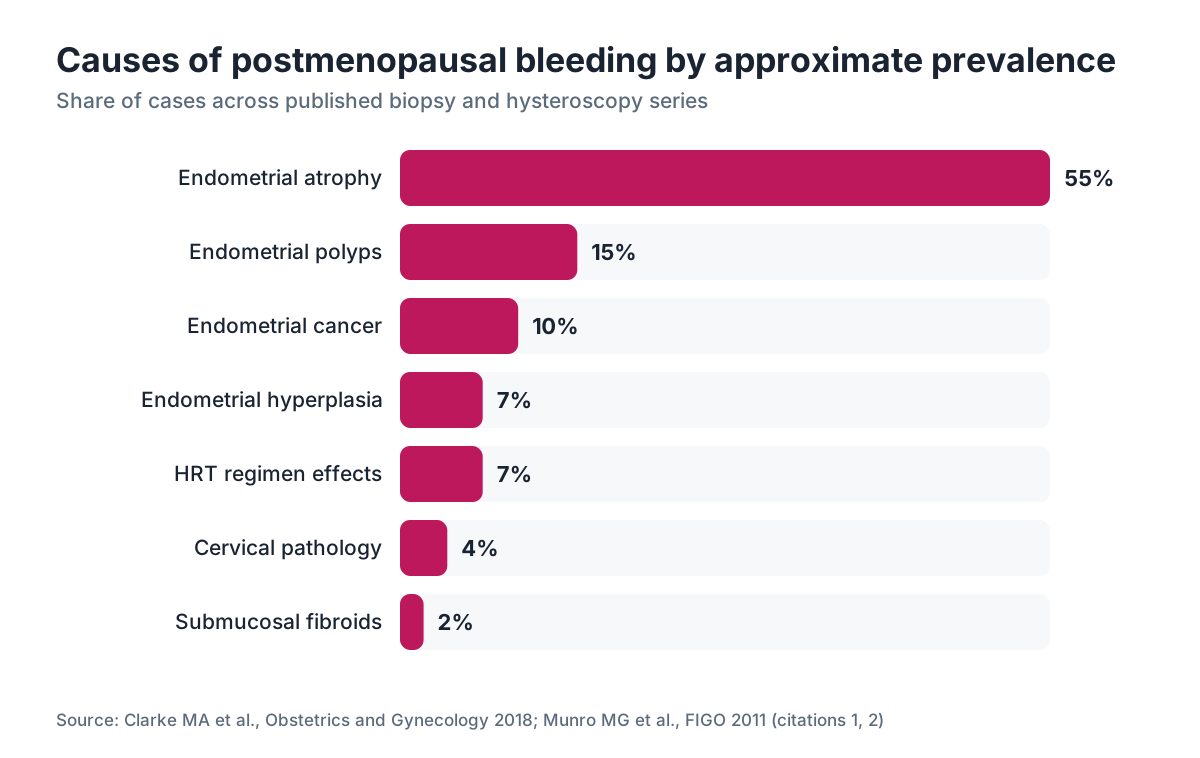
Here is how the causes stack up across published biopsy and hysteroscopy series [1][2][4]:
| Cause | Approximate share of cases | |---|---| | Endometrial atrophy | 50-60% | | Endometrial polyps | 10-20% | | Endometrial hyperplasia | 5-10% | | Endometrial cancer | ~10% | | Hormone therapy regimen | 5-10% | | Cervical pathology (polyps, cancer) | 3-5% | | Submucosal fibroids | 2-5% | | Vaginal or vulvar atrophy | overlaps with atrophy figure | | Other (coagulopathy, trauma) | <2% |
Endometrial polyps earn a closer look. They are overgrowths of endometrial glands and stroma, usually benign, and they bleed because they carry a rich blood supply and can outgrow it. Polyps often show up by chance on ultrasound and get confirmed by hysteroscopy. Most are removed, because a small share hide hyperplasia or cancer, especially after menopause.
Endometrial hyperplasia is an overgrowth of the lining driven by estrogen without opposing progesterone. It runs on a spectrum from simple hyperplasia, with low cancer risk, to atypical hyperplasia, which carries up to a 25 to 30% risk of progressing to cancer if left untreated [5]. Women who are overweight or obese sit higher on that risk curve because fat tissue converts androgens into estrogen, effectively dosing the uterus around the clock.
For women already on hormone therapy, breakthrough or irregular bleeding is common in the first 3 to 6 months of a new regimen. Bleeding that persists past that window, or turns heavy, still gets evaluated.
Is postmenopausal bleeding ever an emergency?
Rarely a same-day emergency. Always an urgent priority. ACOG's position is that any woman with postmenopausal bleeding should be evaluated promptly [4]. In practice that means a transvaginal ultrasound and, depending on what it shows, an endometrial biopsy within one to two weeks.
Go to an emergency room the same day if you are soaking a pad every hour, feel lightheaded or faint, or have severe pelvic pain with the bleed. Those signs can point to a large polyp prolapsing through the cervix, a pyometra (a uterine infection), or, rarely, an advanced cancer that has eroded into a vessel.
For most women the bleeding stays light. Light does not mean it can wait. Stage I endometrial cancer has a five-year survival above 95% [6]. Waiting can turn a stage I finding into a stage III one. Speed is the treatment here.
What tests will a doctor order for postmenopausal bleeding?
The standard workup runs on two tools: transvaginal ultrasound (TVUS) and endometrial biopsy.
TVUS usually goes first. It measures endometrial thickness. In a postmenopausal woman not on hormones, a stripe of 4 mm or less carries a very low cancer risk, roughly 1 in 917 in one large analysis [3]. A stripe thicker than 4 mm, or any irregularity in the cavity, sends you to biopsy.
Endometrial biopsy (EMB) is an in-office procedure. A thin catheter passes through the cervix and suctions a small tissue sample from the lining. It takes a few minutes, feels like a strong menstrual cramp, and gives a tissue diagnosis. Sensitivity for detecting endometrial cancer runs around 99% when the sample is adequate [4].
If the biopsy comes back with too little tissue, or the ultrasound is inconclusive, the next step is a saline-infusion sonogram (SIS) or hysteroscopy. SIS floods the cavity with saline during ultrasound so polyps and fibroids show up. Hysteroscopy lets the doctor look directly and take aimed biopsies.
Blood work is a sidekick, not the star. A CBC catches anemia from chronic bleeding, and clotting studies matter if you or your family have a bleeding disorder, but neither replaces uterine imaging.
Does hormone replacement therapy cause postmenopausal bleeding?
Yes, and it is common enough to expect in the early months. Combined continuous estrogen-progestogen therapy, the usual regimen for women with a uterus, often causes irregular spotting in the first three to six months while the endometrium settles. After that, most women on continuous combined therapy have no bleeding at all [7].
Sequential HRT, where progestogen runs for only part of the cycle, is built to produce a regular withdrawal bleed like a light period. That is expected and not a red flag.
What does deserve a workup: bleeding that starts or restarts after six months with no bleeding on a stable regimen, or any change in your pattern once the adjustment period ends. The estrogen in HRT stimulates the lining, which is exactly why women with a uterus need progestogen alongside it. Without progestogen, unopposed estrogen pushes the risk of hyperplasia and cancer up sharply [5].
If you manage menopause with a telehealth provider like WomenRx, report any new or surprising bleeding at your next check-in. Your provider may tweak the progestogen dose or timing before ordering imaging, but imaging is still often the right call.
For how the estrogen patch and other delivery methods shape bleeding patterns, see our piece on delivery options.
Who is at highest risk for endometrial cancer as a cause of postmenopausal bleeding?
Age is the biggest driver. Endometrial cancer is largely a postmenopausal disease, with a median diagnosis age around 63 [6]. Several specific factors push individual risk well past the background 10%.
Obesity is the strongest risk factor you can change. Fat tissue turns androgens into estrogen, dripping a low but steady estrogen dose onto the uterus with no progesterone to balance it. Women with a BMI above 40 carry roughly four times the endometrial cancer risk of women in the normal range [6].
Other factors: late menopause (after 55), early menarche (before 12), never having been pregnant, PCOS, diabetes or insulin resistance, tamoxifen use for breast cancer, Lynch syndrome or a family history of colorectal or endometrial cancer, and long-term unopposed estrogen.
Protective factors include combined oral contraceptive use in younger years and, oddly, cigarette smoking, which lowers estrogen (the harms of smoking swamp any endometrial upside, so this is trivia, not advice). Pregnancy and breastfeeding also look protective.
Lynch syndrome gets its own note. Lifetime endometrial cancer risk there runs from 25% to 60%, which is why many gynecologic oncologists raise surveillance biopsies or a prophylactic hysterectomy discussion for this group [6].
Can medications or supplements cause bleeding after menopause?
Several prescription drugs and a few supplements can cause or add to postmenopausal bleeding.
Tamoxifen, used to treat and prevent hormone-receptor-positive breast cancer, acts like estrogen in the uterus even while it blocks estrogen in the breast. It raises the risk of endometrial polyps, hyperplasia, and cancer. Any postmenopausal bleeding in a woman on tamoxifen is treated as cancer until proven otherwise and usually goes straight to hysteroscopy rather than waiting on ultrasound thresholds [8].
Anticoagulants (warfarin, apixaban, rivaroxaban) do not create structural uterine problems, but they can turn a trickle of atrophic bleeding into a clinically real bleed by blocking clotting. Always tell your gynecologist about blood thinners.
Supplements and herbs need a mention too. Phytoestrogens in high-dose soy isoflavone products, red clover, and some traditional herbal preparations have weak estrogen-like activity. Standard dietary soy looks safe in most evidence. Concentrated supplement forms are studied less, and their endometrial effects at high doses are uncertain.
Long-term corticosteroids can nudge the endometrium indirectly through effects on sex hormone-binding globulin. The link is modest, but it belongs in a careful medication history.
What happens if postmenopausal bleeding is ignored?
Most of the time, nothing acute happens, because most bleeding is atrophy. But ignoring it means betting on a probability without knowing where you land on the curve.
The cost of missing early-stage endometrial cancer is steep. Stage I disease treated surgically has a five-year survival above 95%. Stage III, where the cancer has reached lymph nodes or nearby structures, drops to around 57%. Stage IV falls below 20% [6]. Those gaps are enormous.
Endometrial hyperplasia can progress if missed. Atypical hyperplasia turns into endometrial cancer in roughly 8 to 29% of untreated cases across studies, over five or more years [5]. Simple hyperplasia without atypia carries a much lower risk, about 1%, but still earns follow-up.
Polyps rarely hurt by sitting there, but they can grow, bleed more, and occasionally carry a focal cancer. Removing them is low-risk and stops the bleeding in most cases.
The practical read: a transvaginal ultrasound and possible biopsy cost you a few hours. Waiting for bleeding to stop on its own is not a safe plan.
How is postmenopausal bleeding treated once the cause is known?
Treatment follows the diagnosis.
For endometrial atrophy, vaginal estrogen is usually the most effective fix. Low-dose local estrogen (cream, ring, or tablet) rebuilds the epithelium, strengthens the fragile vessels, and stops the bleeding in most women with little systemic absorption at standard doses [9]. The Menopause Society statement on genitourinary syndrome of menopause backs vaginal estrogen as first-line for local symptoms [9]. Women who cannot use estrogen (certain breast cancer histories) have non-hormonal options, including vaginal moisturizers and, on emerging evidence, ospemifene, an oral SERM.
For endometrial polyps, hysteroscopic polypectomy is standard. It is usually outpatient, takes 20 to 45 minutes, and resolves the bleeding in most cases.
For endometrial hyperplasia without atypia, progestogen therapy (oral medroxyprogesterone acetate, micronized progesterone, or a levonorgestrel IUD) reverses the overgrowth in most women. A follow-up biopsy at six months confirms it cleared [5].
For atypical hyperplasia, hysterectomy is the preferred treatment for women done with childbearing, because the concurrent or later cancer risk is high. Women who decline surgery or cannot have it can be managed with high-dose progestogens plus close surveillance.
For endometrial cancer, the main treatment is hysterectomy with bilateral salpingo-oophorectomy, often with sentinel lymph node biopsy. Radiation and chemotherapy get added based on stage and grade. Early-stage disease does well when it is caught by promptly investigating the bleeding.
For HRT-related bleeding, adjusting the progestogen type, dose, or timing often solves it. Switching from a sequential to a continuous combined regimen ends the planned bleed for many women.
What questions should you ask your doctor at your appointment?
Walking in prepared changes the visit. These questions get you the most useful answers fast.
Ask what your endometrial thickness is and what it means for your specific risk. The 4 mm threshold is a population rule; your clinician should put it in the context of your history.
Ask whether you need a biopsy at this visit or whether ultrasound is enough for now. If the stripe is under 4 mm and your bleeding was a single light episode, many guidelines support watching rather than immediate biopsy [3]. Ask what would change that plan.
Ask about your personal risk factors. With obesity, diabetes, a family history of Lynch syndrome, or prior PCOS, your threshold for biopsy should probably be lower.
Ask what a normal result rules out and what it does not. A normal office biopsy is very reassuring for cancer but does not rule out a small polyp that hysteroscopy might be needed to find.
Ask whether your current medications, including HRT, tamoxifen, or supplements, need a review.
Managing menopause remotely? Use the same questions. A good telehealth visit ends with a referral for in-person imaging, because the ultrasound cannot happen over video.
Can weight loss affect postmenopausal bleeding?
Yes, and the mechanism is real. Fat tissue makes estrogen by converting androgens, so extra body fat delivers a chronic low-level estrogen dose to the endometrium with no progesterone to oppose it. Losing weight cuts that peripheral estrogen and lowers the risk of hyperplasia and cancer.
For a woman with new postmenopausal bleeding who also carries significant excess weight, addressing weight belongs to the long-term prevention plan, not the acute diagnosis.
GLP-1 receptor agonists have become useful tools for weight loss in women across the menopause transition. The SURMOUNT-1 trial showed tirzepatide produced mean weight loss of 20.9% over 72 weeks in adults with obesity [10]. Whether that scale of weight loss lowers endometrial cancer incidence has not been tested head-on in a randomized trial, but the biology lines up.
If weight is part of your menopause picture, a conversation about semaglutide for weight loss or semaglutide vs tirzepatide options is worth having with a provider who understands the hormonal side. Losing weight does not cancel the need for a workup if you are already bleeding. It is downstream prevention, not acute care.
Women in perimenopause with irregular bleeding from still-cycling ovaries are a different category. That is hormonal fluctuation, not postmenopausal bleeding. The postmenopausal label requires 12 straight months without a period.
What does the research actually say about postmenopausal bleeding outcomes?
A handful of numbers worth carrying with you.
The most-cited figure: in a large systematic review in Obstetrics and Gynecology, the risk of endometrial cancer in a postmenopausal woman presenting with bleeding was 9.0% (95% CI 7.7 to 10.4%) [2]. Roughly 1 in 11 women. Not a reason to panic, not a reason to shrug.
Endometrial cancer incidence in the U.S. runs about 67,880 new cases a year in recent NCI data, making it the fourth most common cancer in women [6]. Lifetime risk is around 3%.
For atrophy specifically: when endometrial thickness is 3 mm or less on TVUS, the negative predictive value for cancer tops 99% in most studies [3]. That is why ultrasound works as a triage tool.
For tamoxifen users: the relative risk of endometrial cancer runs about two to three times baseline, which is why surveillance thresholds drop in this group [8].
The Menopause Society 2022 hormone therapy statement notes that combined estrogen-progestogen therapy in women with a uterus does not raise endometrial cancer risk when progestogen is used appropriately, and may even lower it compared with no therapy [7]. That is a strong argument against avoiding HRT out of endometrial cancer fear, as long as the regimen includes enough progestogen.
Curious whether your menopause age or when menopause starts shifts your risk? Earlier menopause generally means less lifetime estrogen exposure and a slightly lower endometrial risk. Later menopause tilts the other way.
Frequently asked questions
What is the most common reason for bleeding after menopause?
Endometrial atrophy, the thinning of the uterine lining caused by low estrogen after menopause, accounts for about 50 to 60% of cases. Endometrial cancer is the second most common cause, found in roughly 10% of women investigated for postmenopausal bleeding. Other causes include polyps, hyperplasia, and hormone therapy effects. Every episode needs evaluation no matter how light the bleeding is.
Is a small amount of spotting after menopause normal?
No. Any vaginal bleeding after 12 straight months without a period is abnormal and needs medical evaluation. Even a single episode of light spotting carries a roughly 10% chance of underlying endometrial cancer when investigated. Atrophy or a benign polyp is more likely, but you cannot know that without imaging and possibly a biopsy.
How soon should I see a doctor after noticing postmenopausal bleeding?
Within one to two weeks for light spotting. Same-day care if bleeding is heavy (soaking a pad an hour), comes with severe pelvic pain, or leaves you lightheaded. ACOG recommends prompt evaluation for all postmenopausal bleeding. Early-stage endometrial cancer has a five-year survival above 95%; delay worsens the odds.
Does postmenopausal bleeding always mean cancer?
No. Endometrial cancer is found in about 10% of cases. Atrophy is the cause in 50 to 60%. Polyps, hormone therapy effects, and cervical problems account for most of the rest. The catch is you cannot know your category without a workup, and cancer is serious enough that assuming benign without checking is not appropriate.
What is the first test a doctor will do for postmenopausal bleeding?
Transvaginal ultrasound (TVUS) is usually first. It measures the thickness of the uterine lining. A measurement of 4 mm or less carries a very low cancer risk (negative predictive value above 99% in most studies). If the lining is thicker or irregular, an endometrial biopsy comes next. Some clinicians go straight to biopsy in higher-risk women.
Can hormone replacement therapy cause bleeding after menopause?
Yes. Irregular spotting in the first three to six months of combined estrogen-progestogen HRT is common and expected. Sequential regimens are built to produce a regular withdrawal bleed. Bleeding that starts or resumes after six months of no bleeding on a stable regimen, or any change in pattern after the adjustment period, needs investigation even in women on HRT.
What is endometrial atrophy and why does it cause bleeding?
Endometrial atrophy is the thinning of the uterine lining that happens when estrogen falls after menopause. The lining loses thickness and its surface blood vessels sit closer to the top and turn fragile. Those vessels can break down with no structural lesion, producing light bleeding or spotting. It is diagnosed by ultrasound (thin stripe, usually under 4 mm) after other causes are excluded.
Can weight gain or obesity cause postmenopausal bleeding?
Indirectly, yes. Fat tissue converts androgens to estrogen through aromatization, creating continuous low-level estrogen stimulation of the uterus with no progesterone to oppose it. That raises the risk of endometrial hyperplasia and cancer, both of which can bleed. Women with a BMI above 40 carry roughly four times the endometrial cancer risk of women with a normal BMI.
What does it mean if my endometrial biopsy comes back normal?
A normal biopsy, meaning no cancer, atypia, or hyperplasia, is very reassuring. It does not fully rule out a small polyp or a focal lesion the sampling catheter missed. If bleeding continues after a normal biopsy, the next step is usually hysteroscopy or a saline-infusion sonogram to see the cavity directly.
Does tamoxifen increase the risk of postmenopausal bleeding?
Yes. Tamoxifen blocks estrogen in breast tissue but acts like estrogen in the uterus, raising the risk of endometrial polyps, hyperplasia, and cancer by about two to three times baseline. Any postmenopausal bleeding in a woman on tamoxifen is usually evaluated with hysteroscopy rather than waiting on ultrasound findings alone.
Can vaginal atrophy cause postmenopausal bleeding?
Yes. The vaginal walls thin after menopause for the same reason the uterine lining does, loss of estrogen. Thin, friable vaginal tissue can bleed with minimal friction, including from a pelvic exam, intercourse, or on its own. Vaginal atrophy often coexists with endometrial atrophy, and pinning down the source takes a pelvic exam and usually imaging.
Is postmenopausal bleeding treated differently in older women?
The workup is the same at any age. Treatment gets tailored: vaginal estrogen stays appropriate for atrophy even in women in their 70s and 80s who cannot tolerate systemic HRT. For cancer, surgical decisions weigh overall health and frailty. Age alone is never a reason to skip evaluation, because outcomes from early endometrial cancer are good at any age.
What is endometrial hyperplasia and is it serious?
Endometrial hyperplasia is an overgrowth of the uterine lining, usually from estrogen stimulation without opposing progesterone. Simple hyperplasia without atypia carries about a 1% risk of progressing to cancer. Atypical hyperplasia carries a 25 to 30% risk of concurrent or eventual cancer and is treated with hysterectomy in most women, or high-dose progestogens with close surveillance for those who decline surgery.
Can supplements or herbal remedies cause postmenopausal bleeding?
High-dose phytoestrogen supplements, including concentrated soy isoflavones and red clover extracts, have weak estrogen-like activity that could in theory stimulate the endometrium. Standard dietary soy appears safe. Evidence on high-dose herbal supplements and endometrial effects is thin, but any supplement with estrogenic activity should be disclosed to your gynecologist during a bleeding workup.
Sources
- Munro MG et al., FIGO classification of causes of abnormal uterine bleeding, International Journal of Gynaecology and Obstetrics, 2011
- Clarke MA et al., Prevalence of endometrial cancer among women with postmenopausal bleeding, Obstetrics and Gynecology, 2018
- Smith-Bindman R et al., How thick is too thick? When endometrial thickness should prompt biopsy in postmenopausal women without vaginal bleeding, Ultrasound in Obstetrics and Gynecology, 2004
- ACOG Practice Bulletin No. 149: Endometrial Cancer, Obstetrics and Gynecology, 2015 (reaffirmed 2021)
- ACOG Practice Bulletin No. 147: Lynch Syndrome and Endometrial Hyperplasia, 2014 (reaffirmed 2020)
- National Cancer Institute SEER Cancer Statistics, Endometrial (Uterine) Cancer, 2023
- The Menopause Society (NAMS) 2022 Hormone Therapy Position Statement
- Fisher B et al., Tamoxifen for prevention of breast cancer: report of the National Surgical Adjuvant Breast and Bowel Project P-1 Study, Journal of the National Cancer Institute, 1998
- The Menopause Society (NAMS) 2020 Genitourinary Syndrome of Menopause Position Statement
- Jastreboff AM et al., Tirzepatide once weekly for the treatment of obesity, SURMOUNT-1, New England Journal of Medicine, 2022