What does HRT stand for? A plain-language guide
TL;DR: HRT stands for hormone replacement therapy. It replaces the estrogen (and usually progesterone) your ovaries stop making during perimenopause and menopause. It's the most effective treatment for hot flashes, night sweats, and vaginal symptoms, and it protects bone. For most healthy women under 60 who start within 10 years of menopause, benefits outweigh risks.
What does HRT stand for?
HRT stands for hormone replacement therapy. You'll also see MHT, which stands for menopausal hormone therapy. The two mean the same thing. Doctors now lean toward MHT because it's more precise, but HRT is what most women type into a search bar, so both names stay in circulation.
HRT is the practice of giving back hormones, mainly estrogen, that the ovaries make less of during perimenopause and stop making after menopause. A prescription might be estrogen alone (if you've had a hysterectomy) or estrogen plus a progestogen (if you still have a uterus, because unopposed estrogen raises the risk of uterine cancer).
The North American Menopause Society, the leading professional body on this topic, calls menopausal hormone therapy "the most effective treatment for vasomotor symptoms and genitourinary syndrome of menopause" [1]. Translated: nothing works better for hot flashes, night sweats, and vaginal dryness.
Why is it called hormone replacement therapy?
The word "replacement" describes what happens physiologically. Before menopause, your ovaries make estrogen, progesterone, and small amounts of testosterone on a monthly cycle. In your late 40s and early 50s, ovarian function winds down and those levels drop sharply. HRT replaces what's missing.
Some clinicians dislike "replacement" because it implies you get back exactly what you lost, which isn't quite right. HRT doses are typically lower than the peak levels of your reproductive years, and the delivery methods (a patch, gel, pill, or ring) don't mimic the natural cycle. That's part of why the field has drifted toward MHT. It's a description of the therapy, not a promise to restore you to age 30.
The rename carries a messaging difference too. "Replacement" can sound alarming, like you're taking something artificial. "Menopausal hormone therapy" frames it as treatment for a life stage, which is what it is.
What hormones does HRT actually contain?
The common forms contain estrogen, progestogen, or both. Here's how each one works.
Estrogen is the primary active ingredient. It relieves hot flashes, improves sleep wrecked by night sweats, treats vaginal dryness, and protects bone density. Without it, the other ingredients don't accomplish much.
Progestogen is added to protect the uterine lining. Estrogen on its own thickens the endometrium (the lining of the uterus), and over time that raises the risk of endometrial cancer. Adding a progestogen, either a synthetic progestin or bioidentical micronized progesterone, keeps the lining stable. Women who've had a hysterectomy don't need it. Here's more on how progesterone fits into the picture.
Testosterone is sometimes added off-label for women reporting low libido or persistent fatigue. The FDA has not approved a testosterone product specifically for women in the US, though prescribers can use compounded or male-label products at lower doses. The evidence is moderately good for sexual function and less clear for energy.
| Hormone | Who gets it | Main purpose | |---|---|---| | Estrogen | Almost all HRT users | Hot flash relief, bone protection, vaginal health | | Progestogen | Women with intact uterus | Protect uterine lining from estrogen's thickening effect | | Testosterone | Some women, off-label | Low libido, sometimes fatigue |
The estrogen in most FDA-approved products comes in two chemical forms: estradiol (bioidentical, meaning chemically identical to human estrogen) and conjugated equine estrogens (CEE, derived from horse urine, used in older products like Premarin). Most new US prescriptions use estradiol [2].
What are the different types and delivery methods of HRT?
"HRT" is not one drug. It's a category covering dozens of FDA-approved products that deliver hormones in different ways. Delivery matters, because it changes how hormones enter your bloodstream and what risks they carry.
Transdermal estrogen (patches, gels, sprays, creams on the skin) bypasses the liver. That's a real clinical advantage. Oral estrogen goes through the liver and raises certain clotting proteins, which slightly increases stroke and clot risk. Transdermal forms largely skip that. British Menopause Society guidance notes that transdermal estradiol carries a lower risk of venous thromboembolism than oral forms [3]. The estrogen patch is one of the most commonly prescribed transdermal options.
Oral estrogen (pills) is convenient and heavily studied. The main US products are oral estradiol and conjugated equine estrogens. They work well. The liver-first metabolism is the downside for women with a clotting history or high triglycerides.
Vaginal estrogen (rings, tablets, creams) treats genitourinary symptoms locally with very little systemic absorption. That matters. Vaginal estrogen is so low in systemic exposure that it's generally considered safe even for women who can't use systemic HRT, including many breast cancer survivors, though that call always belongs to an oncologist.
Progesterone and progestin delivery can be oral (micronized progesterone is the bioidentical option, brand name Prometrium), transdermal, or via a hormonal IUD. The Mirena IUD delivers levonorgestrel directly to the uterus, so systemic progestin exposure stays very low while the endometrium is still protected.
Some women do best on combination pills. Others do better on separate estrogen and progesterone prescriptions that can be dosed more precisely. There's no universal right answer. It depends on your symptoms, history, and preferences.
What conditions does HRT treat?
The clearest reasons to use HRT tie back to menopause and perimenopause.
Hot flashes and night sweats (vasomotor symptoms) affect roughly 75 percent of menopausal women in the US, and HRT cuts their frequency by about 75 percent on average [1]. Nothing else in the evidence base comes close to that effect size.
Vaginal dryness, painful sex, and recurrent urinary tract infections fall under genitourinary syndrome of menopause (GSM). Estrogen, delivered vaginally or systemically, reverses the thinning and dryness of vaginal tissue that follows the drop in estrogen.
Bone protection keeps many women on HRT long-term. Estrogen is the primary regulator of bone resorption in women. After menopause, bone loss speeds up and lifetime fracture risk is real. HRT slows that loss. If you want to see where you stand before deciding, a bone density test is the starting point.
Mood and sleep disruption during perimenopause often improve with HRT, though the evidence is more mixed. Sleep problems driven by night sweats clearly improve. Depression tied to hormonal swings has a reasonable evidence base, especially in the perimenopause window. Clinical depression in postmenopause is a different question and shouldn't be managed with HRT alone.
HRT is not a weight loss drug, and it won't reverse most age-related changes unrelated to estrogen loss. It does seem to modestly reduce the abdominal fat redistribution that happens after menopause, but the effect is small.
What are the real risks of HRT, and how serious are they?
A lot of women still carry outdated fear here, thanks largely to the 2002 Women's Health Initiative (WHI) study, whose first press release set off enormous alarm about breast cancer and heart disease. Reanalysis of that data and two decades of research since have refined the picture substantially [4].
The WHI studied women who were, on average, 63 when they started HRT, well past the typical menopause window. The combination arm (estrogen plus synthetic progestin) showed a small increase in breast cancer risk. The estrogen-only arm (women without a uterus) actually showed a reduced breast cancer risk in the initial data [11]. Neither result applies cleanly to a 50-year-old starting HRT a few years into menopause.
Endocrine Society guidance holds that for healthy women under 60 or within 10 years of menopause onset, benefits generally outweigh risks for moderate to severe symptoms [5]. That's not a blanket clearance. Women with a personal history of hormone-receptor-positive breast cancer, active clotting disorders, or unexplained vaginal bleeding need individual assessment.
The breast cancer figure most cited for combination HRT is roughly 8 additional cases per 10,000 women per year of use, from the 2019 reanalysis in The Lancet [6]. That's real and shouldn't be waved away. It's also smaller than the risk from drinking two alcoholic drinks a day, or from a BMI over 30. Context matters.
Venous thromboembolism risk (blood clots) rises with oral estrogen but looks neutral or very low with transdermal estrogen, which is why many prescribers now default to a patch or gel for women with any clotting history or who smoke.
Heart disease risk is neutral or possibly favorable when HRT starts early in menopause. The "timing hypothesis" has strong observational support: estrogen appears protective in healthy arteries but potentially harmful in arteries already scarred by atherosclerosis. That's why starting at 65 carries a different risk profile than starting at 50.
Who qualifies for HRT? What does a doctor look for?
Most healthy women in perimenopause or early postmenopause with bothersome symptoms qualify. The conversation with a prescriber covers a few areas.
Symptom severity matters. HRT is clearly supported for moderate to severe hot flashes, significant GSM symptoms, and premature ovarian insufficiency. When the ovaries stop working before age 40, the case for HRT is even stronger, because the long-term risks of untreated estrogen deficiency at a young age are substantial.
Medical history gets screened carefully. Active or recent breast cancer, uterine cancer, blood clots, stroke, or liver disease are contraindications or need specialist input before prescribing.
Your menopause status and timing matter. Perimenopausal women (still having some periods but with symptoms) can use HRT. There's no requirement to be fully postmenopausal. The timing hypothesis means earlier is generally better for long-term cardiovascular benefit.
Blood tests aren't required to diagnose menopause in most women over 45 with typical symptoms, but a prescriber may check FSH, estradiol, thyroid function, and sometimes testosterone depending on the symptom picture.
Telehealth has widened access. Platforms like WomenRx let you consult a clinician experienced in hormone therapy without waiting months for a specialist, which matters because many primary care physicians have minimal training in menopause care. A survey published in Menopause reported that OB-GYN residents received a median of 4 hours of menopause education during training [7].
You can read more about when menopause begins and the hormone changes involved at when does menopause start.
How is HRT different from bioidentical hormones?
"Bioidentical" means the hormone is chemically identical to what the body makes. Here's the catch: many FDA-approved HRT products are already bioidentical. Estradiol patches (like Vivelle-Dot or Climara) use bioidentical estradiol. Prometrium is bioidentical micronized progesterone. So the FDA-approved and bioidentical categories overlap a lot.
When people treat "bioidentical hormones" as a separate category, they usually mean custom-compounded preparations mixed by a compounding pharmacy on a prescriber's order. These are not FDA-approved for safety and efficacy. Compounded bioidentical hormone therapy (cBHT) isn't inherently dangerous, but it isn't held to the same standardization as manufactured drugs. Potency can vary batch to batch.
The Endocrine Society's 2020 guideline on compounded hormone preparations says they "should not be recommended" over FDA-approved therapies, while acknowledging that compounding has a legitimate role when a woman genuinely can't tolerate commercial formulations [8].
The practical takeaway: if a prescriber recommends a patch, gel, or pill and calls it bioidentical, they may just mean it contains bioidentical hormones in an FDA-approved product. If they're pushing a custom compounded cream with a DHEA-estrogen-testosterone blend and a saliva test to guide dosing, that's a different conversation, and it deserves careful scrutiny.
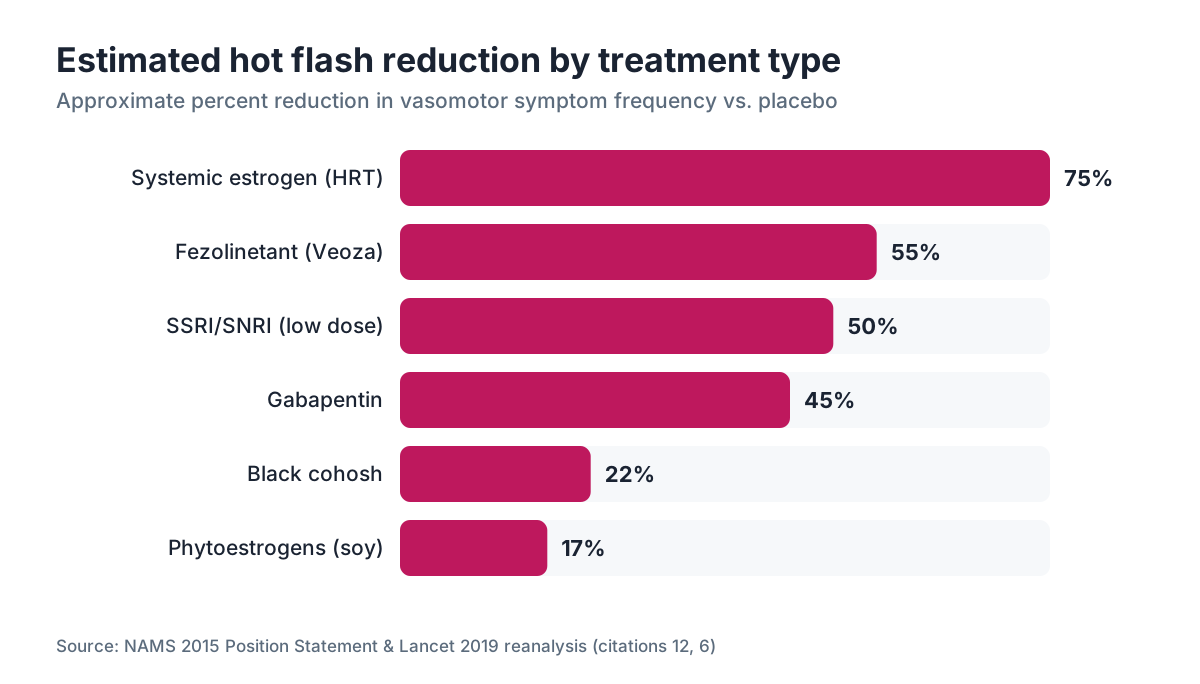
How does HRT compare to other menopause treatments?
For hot flashes, nothing beats systemic estrogen in head-to-head evidence. That's not an opinion. It's the consistent finding across decades of randomized controlled trials.
For women who can't or won't use estrogen, there are real alternatives, just less effective ones.
| Treatment | Hot flash reduction | Evidence quality | |---|---|---| | Systemic estrogen (HRT) | ~75% reduction | Highest (multiple large RCTs) | | Fezolinetant (Veoza) | ~50-60% reduction | Good (FDA approved 2023) | | SSRI/SNRI (low dose) | ~50% reduction | Moderate | | Gabapentin | ~45% reduction | Moderate | | Megestrol acetate | ~80% reduction | Moderate, but it's a progestin with its own risks | | Black cohosh | ~20-25% reduction | Weak, inconsistent | | Phytoestrogens (soy) | ~10-25% reduction | Weak |
Fezolinetant (brand name Veoza) is a genuinely new option, FDA-approved in May 2023. It's a neurokinin 3 receptor antagonist that works centrally to reduce hot flashes without hormones, so it's a real choice for women who can't use estrogen. It's also expensive (around $550 a month without insurance as of 2024) and it doesn't treat GSM symptoms or protect bone [9].
For women also managing weight in midlife, GLP-1 medications like semaglutide come up more and more, though they address a different problem than HRT and the two can be used together. Read semaglutide for weight loss if that's also on your radar.
How long should you take HRT?
There's no universal answer, and the old "five-year maximum" rule is not current guidance.
NAMS guidance says duration should be individualized based on your goals, risk factors, and quality of life [1]. Many women who started HRT for symptoms keep going as long as symptoms return when they stop. Some try to taper off at 50, 55, or 60 and find their hot flashes come back hard, so they go back on. That's a legitimate medical decision, not a failure.
For women with premature ovarian insufficiency, HRT is generally recommended at least until the average age of natural menopause (around 51 in the US), because early estrogen loss carries cardiovascular and bone risks that outweigh the HRT risks for this group [10].
Annual review is the standard of care. A prescriber should revisit your risk factors, symptoms, and the current evidence each year. The risk-benefit math shifts with age, new diagnoses, or family history updates.
Women on long-term HRT past 60 aren't being reckless if they've had that conversation and their risk profile is favorable. The evidence says the biggest absolute risk increase builds with longer duration, but "longer duration" in the trials often meant 10-plus years in older women. A 54-year-old on transdermal estrogen and oral progesterone is a different picture.
What's the difference between HRT and MHT, and does the name matter?
MHT (menopausal hormone therapy) and HRT (hormone replacement therapy) are the same treatment under two names. The shift toward MHT is deliberate. NAMS, the International Menopause Society, and the British Menopause Society have broadly adopted MHT in their official communications.
The reasoning is partly clinical accuracy (you're not restoring a pre-existing level, you're treating a symptomatic deficiency) and partly a move away from the fear associations HRT picked up after 2002. Whether the rename actually changed how women or doctors see the therapy is unclear.
For practical purposes: search "HRT" or "MHT" in a medical database, or ask your doctor about either, and you're discussing the same class of treatments. Don't let the terminology trip you up or make you think you're looking at two different things.
The hormone replacement therapy guide on this site goes deeper into specific products, dosing, and how to talk to a prescriber about starting.
Frequently asked questions
What does HRT stand for in medical terms?
HRT stands for hormone replacement therapy. In medical literature you'll increasingly see the equivalent term MHT, menopausal hormone therapy. Both refer to prescriptions that supplement estrogen (and usually progesterone) in women whose ovaries have slowed or stopped producing these hormones during perimenopause and menopause. The two terms are interchangeable in clinical practice.
Is HRT the same as menopausal hormone therapy (MHT)?
Yes, completely. MHT is the name preferred by NAMS, the International Menopause Society, and the British Menopause Society. HRT is the older, more widely recognized public term. The treatments described by both names are identical: estrogen-based prescriptions, often combined with a progestogen, for managing menopause symptoms and related health outcomes.
Who should take HRT?
Women with moderate to severe hot flashes and night sweats, genitourinary symptoms (vaginal dryness, painful sex), or premature ovarian insufficiency are the clearest candidates. The Endocrine Society says benefits generally outweigh risks for healthy women under 60 or within 10 years of menopause onset. Women with certain cancers, clotting disorders, or active liver disease need individual assessment before starting.
What are the main side effects of HRT?
Common early side effects include breast tenderness, bloating, headaches, and mood changes, most of which ease after a few months or with a dose adjustment. The bigger risks are a small rise in breast cancer risk with long-term combination HRT (roughly 8 extra cases per 10,000 women per year per The Lancet 2019 reanalysis) and a clot risk with oral but not transdermal estrogen. Annual review with a prescriber is standard.
Does HRT cause weight gain?
HRT does not cause weight gain in the evidence base. Some women get early bloating or fluid retention that can feel like weight gain, but controlled trials show no net weight increase from HRT. Menopause itself brings more abdominal fat redistribution, and HRT may modestly reduce that shift, though the effect is small and shouldn't be the reason you start it.
Can you take HRT in perimenopause, or do you have to wait until after menopause?
You can take HRT in perimenopause. There's no requirement to be fully postmenopausal. Many women get significant hot flashes, sleep disruption, and mood swings during perimenopause, often starting in the mid-40s. HRT treats those symptoms effectively at any stage of the transition. Perimenopause is also when estrogen fluctuations are most dramatic, which is why symptoms can be so unpredictable.
What's the difference between estrogen-only HRT and combination HRT?
Estrogen-only HRT is for women who've had a hysterectomy and no longer have a uterus. Combination HRT (estrogen plus a progestogen) is for women with a uterus, because estrogen alone thickens the uterine lining and raises the risk of endometrial cancer. Adding progesterone or a synthetic progestin neutralizes that risk. If you still have your uterus and a prescriber suggests estrogen alone, ask why.
Is HRT the same as birth control pills?
No. Birth control pills contain synthetic estrogen and progestin at doses high enough to suppress ovulation. HRT uses lower doses, often bioidentical estradiol and progesterone, to replace what the ovaries stop making. HRT is not contraceptive. Perimenopausal women who need contraception and HRT may need both, or a combined approach worked out with their prescriber.
Can HRT protect against osteoporosis?
Yes. Estrogen is the primary regulator of bone resorption in women, and HRT reduces postmenopausal bone loss significantly. Randomized data from the Women's Health Initiative showed a reduction in hip fracture risk with HRT use. It's not a first-line osteoporosis drug if you have no symptoms, but for symptomatic women already on HRT, bone protection is a real secondary benefit.
What happens when you stop HRT?
Hot flashes and other symptoms often return after stopping, sometimes hard. That can happen whether you quit abruptly or taper. For most women, vasomotor symptoms eventually fade on their own, but the timeline varies from months to years. Bone loss also resumes at the accelerated postmenopausal rate after stopping. There's no evidence tapering is medically necessary; it mainly makes the symptom return more gradual.
Is there an HRT option that doesn't raise breast cancer risk?
The breast cancer signal is tied mainly to combination estrogen plus synthetic progestin, and specifically to long-term use. Estrogen-only HRT (for women without a uterus) showed no increased risk and possibly a reduced risk in the WHI. Some research suggests bioidentical micronized progesterone may carry less breast cancer risk than synthetic progestins, though the evidence isn't definitive. Transdermal estrogen is lower risk than oral for clots, but breast risk looks similar by route.
What's the difference between FDA-approved HRT and compounded bioidentical hormones?
FDA-approved HRT includes many products using bioidentical estradiol and micronized progesterone, standardized for potency and purity. Compounded bioidentical hormones are custom-mixed by a pharmacy and are not FDA-approved for efficacy or safety. The Endocrine Society recommends preferring FDA-approved options when available. Compounding has a role when someone can't tolerate commercial formulations, but saliva-based dosing and proprietary custom blends have weak evidence behind them.
How do I know if my symptoms are from menopause and whether HRT is right for me?
Common signs of perimenopause and menopause include irregular periods, hot flashes, night sweats, vaginal dryness, sleep disruption, brain fog, and mood changes. In women over 45 with typical symptoms, blood tests aren't needed to confirm the diagnosis. A clinician experienced in menopause care, in-person or through a telehealth platform, can assess your symptoms and risk profile and recommend whether HRT fits your situation.
Can HRT help with anxiety and brain fog from menopause?
There's reasonable evidence that estrogen improves mood symptoms tied to hormonal fluctuation in perimenopause, which is different from a clinical anxiety disorder. Brain fog, often described as word-finding trouble and memory lapses, is reported by many menopausal women and may improve with HRT, though the evidence is less consistent than for hot flash relief. Both are worth raising with a prescriber, especially if they started around the time your periods became irregular.
Sources
- North American Menopause Society (NAMS), Menopause Practice: A Clinician's Guide
- FDA, Menopause: Medicines to Help You
- British Menopause Society, HRT and venous thromboembolism guidance
- Women's Health Initiative, JAMA 2002 (Rossouw JE et al., JAMA 288:321-333)
- Endocrine Society, Clinical Practice Guideline: Hormone Therapy in Postmenopausal Women (2015)
- Collaborative Group on Hormonal Factors in Breast Cancer, The Lancet 2019 (394:1273-1298)
- Kaunitz AM & Manson JE, Menopause 2015 (22:674-685), OB-GYN menopause education survey
- Endocrine Society, Clinical Practice Guideline: Compounded Bioidentical Hormone Preparations (2020)
- FDA, Drug Approval Package: Veoza (fezolinetant), approved May 2023
- European Society of Human Reproduction and Embryology, Guideline: Management of Premature Ovarian Insufficiency (2016)
- Women's Health Initiative, JAMA 2004, Estrogen-alone trial (Anderson GL et al., JAMA 291:1701-1712)
- NAMS, Nonhormonal Management of Menopause-Associated Vasomotor Symptoms: 2015 Position Statement