What causes bleeding on continuous HRT (and when to worry)
TL;DR: Bleeding on continuous combined HRT usually happens in the first 3 to 6 months as the uterine lining adjusts to steady progestogen. After that window, any bleeding needs evaluation. It can point to endometrial hyperplasia, fibroids, polyps, an unbalanced hormone dose, or, rarely, endometrial cancer. Timing and pattern tell you almost everything.
What is continuous HRT and why does bleeding happen at all?
Continuous combined HRT means estrogen and progestogen every single day, no break. The goal is a thin, inactive uterine lining that produces no monthly bleed, which is what most postmenopausal women want.
The endometrium does not always cooperate right away. When you start continuous therapy, the lining often still has some estrogen stimulation left over from perimenopause or early menopause, and it takes weeks to months for daily progestogen to fully quiet it down. During that adjustment, irregular spotting or light bleeding is genuinely expected [1].
This is different from sequential HRT, where you take progestogen for only part of the cycle and a scheduled withdrawal bleed is the intended outcome. On sequential therapy, bleeding is by design. On continuous therapy, any bleeding after the initial settling-in phase is a signal that needs a clinical explanation.
The hormone replacement therapy basics matter here because not every regimen carries the same bleeding risk. The type of progestogen, the dose of estrogen, the delivery route, and how far past menopause you are all shape what you should expect.
How long does breakthrough bleeding on continuous HRT normally last?
The honest answer is up to 6 months, and sometimes a little longer for women who were recently postmenopausal or who had irregular cycles right before starting.
The NICE menopause guideline (NG23, updated 2024) says irregular bleeding in the first 3 months of continuous combined HRT is expected and does not by itself need investigation [2]. Most guidelines stretch that clinical tolerance to 6 months if bleeding stays light and comes less often over time.
After 6 months, the math changes. Persistent or heavy bleeding past that window, or any bleeding that starts after a stretch of no bleeding, should trigger a transvaginal ultrasound (to measure endometrial thickness) and possibly an endometrial biopsy. The same is true if bleeding starts or comes back after you have been on continuous HRT for a year or more with none before [2].
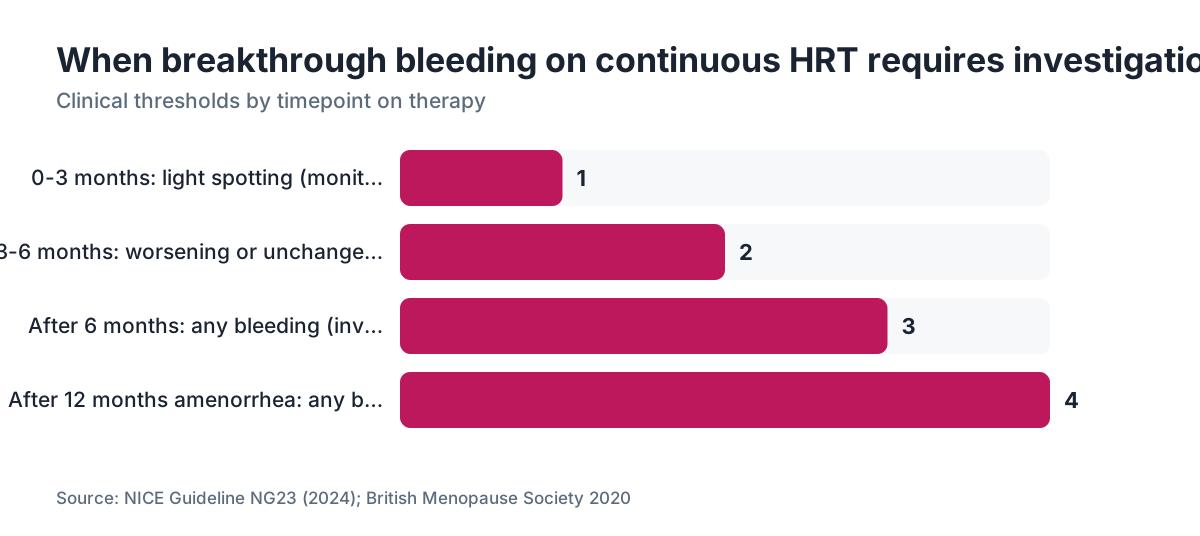
A rough timeline most clinicians use:
| Timepoint | What is expected | What warrants investigation | |---|---|---| | 0 to 3 months | Light, irregular spotting | Heavy or painful bleeding | | 3 to 6 months | Decreasing spotting | Spotting that stays the same or worsens | | After 6 months | No bleeding | Any bleeding at all | | After 12 months of amenorrhea | No bleeding | Any bleed, however light |
Unsure where you fall on this timeline? That is a conversation for your prescriber, not a wait-and-see moment.
What are the specific causes of bleeding on continuous HRT?
There is rarely one answer. Bleeding on continuous HRT usually comes from one of several overlapping sources, and the clinical job is figuring out which one is yours.
Endometrial adjustment (the benign cause) The most common explanation in the first 6 months. The lining sheds residual tissue before settling into atrophy. No treatment beyond watchful waiting and maybe a dose tweak.
Insufficient progestogen dose When estrogen stimulates the endometrium faster than progestogen can suppress it, the lining builds up and sheds. This is called unopposed or under-opposed estrogen stimulation, and it is the exact scenario continuous combined HRT is built to prevent. It happens when estrogen doses go up without adjusting progestogen, or when a woman absorbs more transdermal estrogen than expected [3].
Endometrial polyps Polyps are benign growths of uterine lining tissue. They are common, affecting roughly 10 to 35 percent of women on HRT in some series, and they bleed erratically regardless of what your hormones are doing [4]. A transvaginal ultrasound or saline-infusion sonogram usually spots them.
Uterine fibroids Fibroids are estrogen-sensitive benign tumors of the uterine muscle. HRT, especially higher-dose estrogen, can make small pre-existing fibroids grow or become more vascular and bleed. Submucosal fibroids (the ones that push into the uterine cavity) are the most likely to cause bleeding [4].
Endometrial hyperplasia This is the serious one. Hyperplasia means the lining has overgrown, usually because of relative estrogen excess over progestogen. Simple hyperplasia without atypia is treated and usually resolves. Atypical hyperplasia carries a real cancer risk and needs more aggressive management [5]. An endometrial biopsy is the only way to diagnose it.
Endometrial cancer Rare but real. The overall risk of endometrial cancer with continuous combined HRT is actually lower than in women using no HRT, because the daily progestogen protects the lining [6]. Cancer can still happen, which is why unexplained bleeding after the settling period is never something to shrug off.
Poor adherence or absorption issues Skipping progestogen doses or inconsistent absorption of a patch or gel opens gaps in endometrial protection. Transdermal estrogen skips liver first-pass metabolism and delivers more predictably than oral, but skin absorption varies a lot between people. If your serum estradiol is very high relative to your dose, that is worth investigating [3].
Cervical causes Cervical polyps, cervicitis, or, less often, cervical cancer can bleed in ways that look like uterine bleeding. A speculum exam separates these from an endometrial source and belongs in any workup for unexplained HRT-related bleeding.
Does the type of progestogen affect bleeding risk?
Yes, and this is one of the more underrated variables in HRT management.
Synthetic progestogens (progestins) like medroxyprogesterone acetate (MPA), norethisterone, and levonorgestrel have strong progestogenic activity on the endometrium. They suppress the lining efficiently, which is why bleeding rates run lower with some synthetic regimens. The trade-off is that some synthetic progestins carry androgenic or glucocorticoid activity that drives side effects like mood changes and bloating.
Micronized progesterone (body-identical progesterone, sold as Prometrium and Utrogestan) is more popular now because its side-effect profile is gentler [8]. Oral micronized progesterone has lower bioavailability and a shorter half-life than synthetic progestins, and some studies link it to slightly higher rates of irregular bleeding, especially with higher estrogen doses [7]. That does not make it unsafe. It means the dose may need to run higher or the regimen needs closer tailoring.
The levonorgestrel-releasing intrauterine system (Mirena or a generic equivalent) delivers progestogen straight to the endometrium at very low doses, produces a thin atrophic lining, and comes with low bleeding rates when used as the progestogen part of HRT. Some women using the Mirena IUD this way have irregular spotting in the first few months, similar to the general continuous HRT pattern.
The practical point: if you are bleeding on continuous HRT and your regimen has been stable for more than 6 months, the specific progestogen and its dose belong in the conversation with your prescriber.
Can the estrogen dose or delivery method cause bleeding?
Estrogen drives endometrial growth, so yes, both dose and delivery matter.
Higher estrogen doses stimulate the endometrium harder. If the progestogen dose is not raised to match, the lining can outpace suppression and bleed. This shows up often when women push their estrogen up for hot flashes or libido without revisiting their progestogen.
Delivery route matters indirectly. Oral estradiol is absorbed from the gut, processed by the liver (which makes binding proteins and other compounds that shift hormone levels), and circulates at much lower levels than the pill dose suggests. Transdermal estradiol, whether patch, gel, or spray, skips the liver and produces steadier, more predictable serum estradiol [3]. The estrogen patch generally gives more consistent levels than oral estrogen, which can reduce unpredictable endometrial stimulation.
Skin absorption still varies. Two women on the same patch dose can end up with very different serum estradiol levels. A woman who absorbs transdermal estrogen efficiently can effectively run higher-than-intended levels, creating a relative progestogen shortfall. Checking serum estradiol (not urine, not saliva) is the most reliable way to sort this out.
What tests should you expect when bleeding is investigated?
Any bleeding on continuous HRT that falls outside the early settling-in window should be evaluated. Here is what a thorough workup looks like.
Transvaginal ultrasound (TVUS): The first-line imaging test. It measures endometrial thickness and can spot polyps, fibroids, and abnormal tissue patterns. An endometrial thickness of 4 mm or less in a postmenopausal woman on HRT is generally reassuring. Thicker measurements prompt biopsy. Some guidelines use a 5 mm threshold; the exact cutoff varies by institution [5].
Endometrial biopsy (Pipelle or similar): An in-office procedure that samples the lining. It runs about 90 percent sensitive for detecting endometrial cancer when the cancer is diffuse, though sensitivity drops for focal lesions [5]. It is mildly uncomfortable, takes about 2 minutes, and gives histology that ultrasound alone cannot.
Saline infusion sonohysterography (SIS): A TVUS done while saline fills the uterine cavity. It outlines polyps and submucosal fibroids more clearly than standard TVUS and is often the next step when a standard scan is indeterminate [10].
Hysteroscopy: Direct look inside the uterine cavity with a thin camera. Used when other tests are inconclusive or when a suspicious lesion needs to be seen and biopsied directly.
Hormonal blood levels: Serum estradiol and sometimes progesterone, to see whether levels match the dose prescribed. This helps most when irregular absorption is suspected.
Expect a pelvic exam and a cervical smear review to rule out cervical causes too.
When is bleeding on continuous HRT an emergency?
Most unexpected bleeding on HRT is not an emergency, but a few patterns should prompt same-day or urgent-care contact.
Call your provider the same day if you have heavy bleeding (soaking more than a pad an hour for two or more hours), severe pelvic pain with the bleeding, or bleeding with fever. These can signal infection, a fibroid crisis, or, rarely, acute pathology that needs prompt assessment.
See your provider within two to four weeks (do not wait for your annual visit) if you have any new bleeding after 6 or more months of no bleeding on continuous HRT, bleeding that is worsening rather than improving after 3 months, or post-coital bleeding (bleeding after sex), which can point to a cervical source.
The NAMS position statement on hormone therapy (2022) states that "postmenopausal bleeding, however light, requires evaluation to exclude endometrial cancer" [6]. That is not meant to cause panic. It is a real clinical standard.
Does continuous HRT increase the risk of endometrial cancer?
No, and this is one of the more reassuring facts in HRT research.
Endometrial cancer risk is driven mainly by unopposed estrogen. Estrogen-alone therapy in women with a uterus raises endometrial cancer risk significantly. Continuous combined therapy, with daily progestogen, pushes that risk below baseline for never-users in most large studies.
The Women's Health Initiative (WHI) estrogen-plus-progestin arm found women on continuous combined conjugated equine estrogen plus MPA had a lower incidence of endometrial cancer than placebo [6]. The Million Women Study found similar protection for continuous combined regimens [9].
The caveat matters: protection depends on adequate progestogen. Irregular adherence, under-dosing, or a progestogen with weak endometrial activity effectively recreates partial estrogen exposure, and the risk climbs back up. That is exactly why any bleeding on continuous HRT deserves a workup rather than reassurance alone.
Women who have had a hysterectomy and take estrogen alone carry no endometrial cancer risk because they have no uterus. Everything above applies only to women with an intact uterus.
What can your doctor adjust if bleeding does not resolve?
If you have been evaluated, hyperplasia and cancer are ruled out, and you are still bleeding after 6 months, your options go well beyond tolerating it.
Common adjustments:
Switching progestogen type. If you are on micronized progesterone and bleeding sticks around, switching to a synthetic progestin with stronger endometrial suppression (like norethisterone or MPA) often fixes it. The reverse is tried too: some women do better switching from a synthetic to micronized progesterone, particularly with adjusted dose timing.
Increasing progestogen dose. A higher daily dose suppresses the endometrium more. This has to be weighed against side effects.
Switching to the levonorgestrel IUD. The Mirena IUD as the progestogen part of systemic HRT is highly effective at suppressing the lining and is especially useful for women with ongoing bleeding on oral or transdermal progestogens [11].
Reducing estrogen dose. If estrogen is running high relative to progestogen, lowering the estrogen rebalances things. Some women find this hits their symptom control and have to weigh the trade-off.
Temporary return to a sequential regimen. For women within a few years of their last period, switching temporarily to a sequential regimen (progestogen for 12 to 14 days per cycle) with a scheduled bleed can stabilize a bleeding pattern before trying continuous therapy again.
If you work with a telehealth provider, a practice like WomenRx can review your hormone levels alongside your bleeding pattern and adjust your regimen without a months-long wait for a specialist. Get serum hormone levels checked first, so any change rests on actual data rather than guesswork.
How does perimenopause status affect bleeding on HRT?
The timing of when you started HRT matters a lot here.
Women who start continuous combined HRT while still in perimenopause or very recently postmenopausal bleed more than women 3 or more years past their last natural period. The endometrium in recently perimenopausal women may still be primed by the erratic, sometimes high estrogen surges of late perimenopause. Add continuous progestogen, and the lining takes longer to quiet down.
For that reason, some clinicians prefer to start recently postmenopausal women (within 12 months of their last period) on sequential HRT and switch to continuous therapy after 12 to 24 months. Others start continuous therapy and counsel patients that irregular bleeding for 6 months or longer is possible. Neither approach wins across the board. It depends on the patient's preference, her bleeding history, and her fibroid or polyp status.
If you are unsure when menopause starts for you or where you sit in the transition, FSH and estradiol levels give useful (if imperfect) information, and a detailed menstrual history helps even more.
Can lifestyle or other medications cause bleeding on HRT?
Several non-HRT factors can cause or worsen uterine bleeding that looks like an HRT problem.
Anticoagulants and blood thinners. Warfarin, apixaban, and similar drugs increase bleeding from any uterine source, including small polyps or a slightly thickened lining that would otherwise bleed minimally.
Tamoxifen. Used for breast cancer prevention or treatment, tamoxifen has estrogen-agonist effects on the uterus and is strongly linked to endometrial polyps, hyperplasia, and cancer. Women on tamoxifen should not usually be on estrogen-containing HRT, but if they are, a bleeding workup is urgent.
SSRIs and SNRIs. These drugs impair platelet function slightly and can increase uterine bleeding, especially in women already prone to it.
Herbal supplements. Phytoestrogens from soy or red clover, black cohosh, and dong quai have variable estrogenic activity. They will not stimulate the endometrium the way pharmaceutical estrogen does, but in someone on continuous HRT, adding heavy phytoestrogen exposure can, in theory, shift the balance.
Weight gain. Fat tissue converts androgens to estrone, a weak estrogen. Significant weight gain raises background estrogen levels, which can partly counteract the endometrial suppression from progestogen. This cuts the other way for women on GLP-1 medications for weight loss: rapid fat loss can lower background estrogen, which sometimes changes how the endometrium responds to HRT.
Tell your prescriber about every medication, supplement, and any significant weight change when you report bleeding.
What should you track before your appointment?
Walk into any appointment about HRT-related bleeding with a clear picture of what is happening. Vague descriptions like "some spotting" are hard for a clinician to act on.
Track and bring:
- The date bleeding started and how it has changed over time.
- Flow: spotting (no pad or liner needed), light (liner is enough), moderate (pad needed), heavy (soaking a pad).
- Color: brown (old blood, often less urgent) versus red (fresh blood, more concerning).
- Pain: none, mild cramping, or significant pelvic pain.
- Relationship to sex, exertion, or time of day.
- Your exact HRT regimen, including brand, dose, and delivery route, plus any doses you missed in the past month.
- Any other medications or supplements you take.
A simple notes-app log for 2 to 4 weeks before your appointment gives your provider something to act on and often saves a repeat visit.
Frequently asked questions
Is spotting on continuous HRT normal in the first few months?
Yes. Light, irregular spotting in the first 3 to 6 months of continuous combined HRT is expected while the uterine lining adjusts to daily progestogen. It should gradually decrease and stop. If it is heavy, painful, or persists past 6 months, that warrants a clinical evaluation, not more waiting.
How long should I wait before seeing a doctor about HRT bleeding?
If you are within the first 6 months and bleeding is light and decreasing, you can monitor it. If bleeding starts or returns after more than 6 months of none, is heavy, is worsening, or occurs after sex, see your provider within a few weeks. Do not wait for your annual visit. Any new bleed after a year of amenorrhea on HRT needs prompt evaluation.
Can the wrong dose of progesterone cause breakthrough bleeding?
Yes. An insufficient progestogen dose relative to the estrogen dose lets the endometrium build up and eventually bleed. This can happen if your estrogen dose went up without adjusting progesterone, or if your skin absorbs the estrogen patch more efficiently than average. Checking serum estradiol and adjusting the progestogen dose usually resolves it.
Does continuous HRT cause endometrial cancer?
No. Continuous combined HRT with daily progestogen actually reduces endometrial cancer risk below baseline compared to women taking no HRT. The Women's Health Initiative data confirmed lower endometrial cancer incidence in the continuous combined group versus placebo. The risk only rises when estrogen is used without adequate progestogen protection.
Can fibroids cause bleeding on HRT?
Yes, particularly submucosal fibroids that protrude into the uterine cavity. Estrogen in HRT can cause pre-existing fibroids to grow or become more vascular. Transvaginal ultrasound will usually identify fibroids as a source of bleeding, and management depends on fibroid size, location, and symptom severity.
What is a normal endometrial thickness on HRT?
Most guidelines consider an endometrial thickness of 4 to 5 mm or less reassuring in a postmenopausal woman on HRT. Measurements above that threshold, particularly with bleeding, usually prompt endometrial biopsy. The exact cutoff varies slightly by guideline. Thickness alone is not diagnostic; it is read alongside symptoms and the specific HRT regimen.
Is micronized progesterone more likely to cause bleeding than synthetic progestins?
Some evidence suggests oral micronized progesterone is associated with slightly higher rates of irregular bleeding compared to synthetic progestins, particularly at standard doses. It has lower endometrial potency per milligram than agents like norethisterone. Switching to a synthetic progestin or increasing the progesterone dose often resolves persistent bleeding without sacrificing the tolerability advantages.
Can a Mirena IUD be used as the progestogen component of HRT?
Yes, and it is a well-established option. The levonorgestrel IUD delivers progestogen directly to the endometrium, suppresses the lining effectively, and produces low systemic progestogen levels. It is particularly useful for women with ongoing breakthrough bleeding on oral progestogens. Initial spotting in the first few months after insertion is common but usually resolves.
Does the estrogen patch cause less bleeding than oral estrogen?
Transdermal estrogen generally delivers more consistent serum levels than oral estrogen, which can reduce unpredictable endometrial stimulation. However, individual variation in skin absorption means some women run higher-than-expected estradiol levels on a patch, which can still cause breakthrough bleeding if progestogen is not adjusted accordingly.
What is endometrial hyperplasia and how is it related to HRT bleeding?
Endometrial hyperplasia is an overgrowth of the uterine lining, usually from estrogen stimulation that is not adequately opposed by progestogen. It causes irregular uterine bleeding and, in its atypical form, carries a meaningful risk of progressing to endometrial cancer. Diagnosis requires biopsy. Treatment depends on severity and ranges from higher-dose progestogen to surgical intervention.
Can post-coital bleeding on HRT be caused by HRT itself?
Post-coital bleeding (bleeding after sex) on HRT is more often cervical than endometrial in origin. Common causes include cervical ectropion, cervical polyps, or, less commonly, cervical cancer. A speculum exam and up-to-date cervical smear are the first steps. Any post-coital bleeding on HRT should be investigated promptly rather than blamed on HRT without an examination.
Can I stay on continuous HRT if I have a uterine polyp?
A polyp does not automatically mean stopping HRT. Most polyps are removed hysteroscopically, and you can typically continue HRT after removal. The pathology of the removed polyp matters: benign polyps with no atypical changes are reassuring, while atypical or malignant changes require more significant management decisions made with your gynecologist.
Does weight affect bleeding on HRT?
Yes. Fat tissue produces estrone, a weak estrogen. Women with higher body weight have higher background estrogen levels, which can partially counteract progestogen suppression of the endometrium. Significant weight gain after starting HRT may contribute to breakthrough bleeding. Adjusting progestogen dose in the context of weight changes is a reasonable clinical response.
Should I stop HRT immediately if I start bleeding unexpectedly?
Generally, no. Stopping HRT abruptly without evaluation does not protect your uterus and takes away your symptom control. The right step is to report the bleeding to your provider promptly, continue your regimen unless told otherwise, and get a transvaginal ultrasound and possibly a biopsy. Your provider adjusts treatment based on what the workup shows.
Sources
- NAMS (North American Menopause Society), Hormone Therapy Position Statement 2022
- NICE, Menopause: Diagnosis and Management, Guideline NG23 (updated 2024)
- Endocrine Society, Clinical Practice Guideline: Treatment of Symptoms of the Menopause
- American College of Obstetricians and Gynecologists (ACOG), Practice Bulletin on Abnormal Uterine Bleeding
- ACOG, Practice Bulletin on Endometrial Cancer (Bulletin 149)
- Rossouw JE et al., Women's Health Initiative, JAMA 2002; NAMS 2022 position statement on HRT and endometrial cancer
- Stute P et al., review of micronized progesterone versus synthetic progestins, Climacteric
- U.S. Food and Drug Administration, Prescribing Information for Prometrium (micronized progesterone capsules)
- Beral V et al., Million Women Study, The Lancet 2003
- ACOG, Committee Opinion on the Role of Transvaginal Ultrasonography in Evaluating the Endometrium
- British Menopause Society, Consensus Statement on HRT and Unscheduled Bleeding, 2020