What age can you go through menopause? A complete guide
TL;DR: Most women reach menopause, defined as 12 consecutive months without a period, between ages 45 and 55. The U.S. average is 51. Menopause before 40 is premature ovarian insufficiency. Perimenopause, the transition leading up to it, usually starts in the mid-to-late 40s but can begin sooner. Genetics, smoking, and cancer treatment all shift the timing.
What age can you go through menopause?
Menopause can happen anywhere from your late 30s to your late 50s. Most women in the United States reach it between 45 and 55, and the median age is 51 [1]. That number has barely moved across decades or across most racial and ethnic groups studied, though the differences that do exist are worth knowing.
Menopause itself is a single day, not a season. It's the day you look back and count 12 straight months without a period. Everything before that marker is perimenopause. Everything after is postmenopause. So when a woman says she's "going through menopause," she almost always means perimenopause, and that stretch can run anywhere from two to eight years [2].
Age at final period is one of the most studied and least predictable events in women's health. Your mother's age at menopause is the single strongest clue to your own [3]. After that, the list of things that shift the timing is long, and we'll work through each one below.
What is the normal age range for menopause?
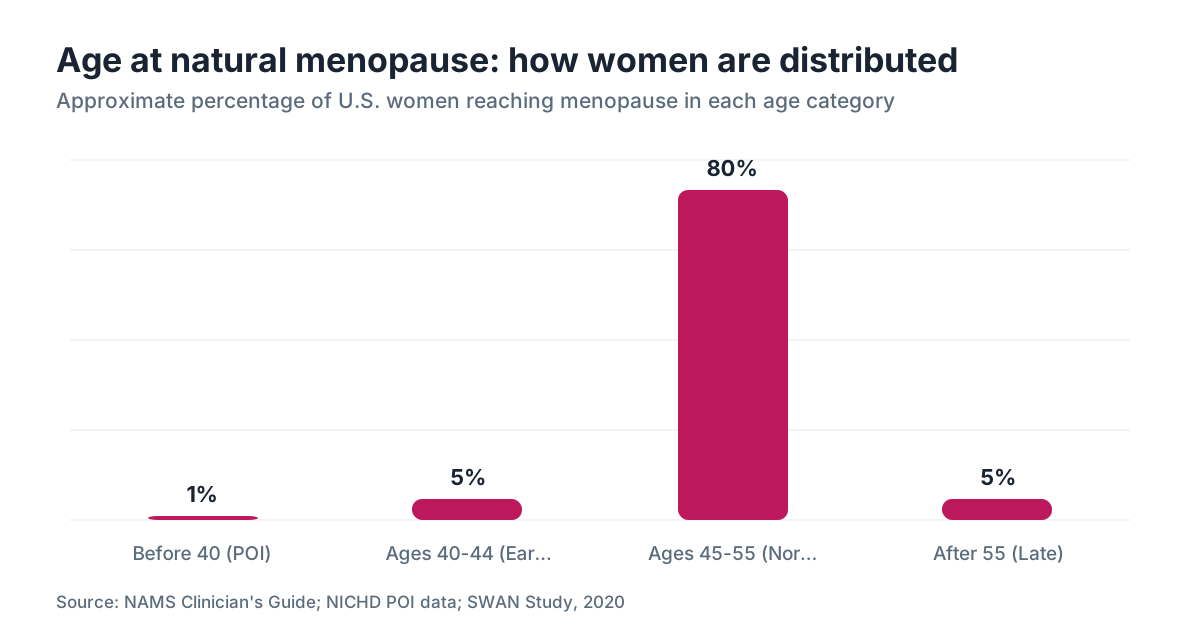
The North American Menopause Society treats natural menopause between ages 40 and 58 as broadly normal, with most women landing between 45 and 55 [1]. Menopause before 40 is premature ovarian insufficiency (POI). Menopause between 40 and 45 is early menopause. Both carry different health implications than menopause at the average age.
Late menopause, after age 55, affects roughly 5 percent of women [4]. It comes with more lifetime estrogen exposure, which slightly raises breast and endometrial cancer risk but appears to protect bone and heart longer.
Here's how the clinical world sorts the timing:
| Category | Age range | Approximate prevalence | |---|---|---| | Premature ovarian insufficiency | Before 40 | ~1% of women [4] | | Early menopause | 40 to 44 | ~5% of women [4] | | Normal range | 45 to 55 | ~80% of women [1] | | Late menopause | After 55 | ~5% of women [4] |
These numbers come mostly from population studies of North American and European women. Data on other populations has historically been thinner, though that's slowly improving.
What is the average age of menopause in the U.S.?
The average age of natural menopause in the United States is 51 [1]. That figure comes from the Study of Women's Health Across the Nation (SWAN), a multi-site, multi-ethnic study that followed more than 3,300 women through the transition [3].
SWAN also caught real ethnic variation. Black women reached menopause on average about 8.5 months earlier than white women. Japanese and Chinese women reached it slightly later. Hispanic women landed close to white women [3]. These gaps held even after the investigators accounted for education, body mass index, and smoking, which points to real biology rather than just socioeconomic noise.
None of these group differences are big enough to change how a doctor manages your care. But if you're a Black woman wondering whether your slightly earlier symptoms are abnormal, the data says they often aren't.
What age does perimenopause start?
Perimenopause usually begins in the mid-to-late 40s, but it can start in the late 30s [2]. The average length is about four years, though it ranges from a few months to a full decade [2]. Because it starts when cycles turn irregular rather than when they stop, a lot of women don't spot it at first.
The earliest sign is usually a shift in cycle length: periods that arrive a week early or late, cycles that suddenly get heavier, or a skipped month followed by a return. Declining ovarian reserve and swinging estradiol drive these changes long before estrogen and progesterone bottom out at their postmenopausal lows. That's why you can have real symptoms, including hot flashes, wrecked sleep, and mood swings, while you're still getting periods.
For a closer look at the timeline, the perimenopause age guide walks through the staging criteria clinicians use (the STRAW+10 framework) and what each stage actually feels like. The when does menopause start article covers the earliest warning signs in more detail.
What factors make menopause happen earlier or later?
Genetics is the biggest single driver. If your mother, sisters, or maternal grandmother reached menopause early, your odds of doing the same are much higher [3]. Genes aren't destiny, though. Several factors, some in your control and some not, can move your timing by months to years.
Smoking pulls menopause earlier, on average by one to two years [5]. Heavier smokers reach it sooner than light smokers, so the dose matters. The mechanism looks like direct toxic damage to ovarian follicles plus altered estrogen metabolism.
Body weight is messier. Very low body fat is tied to earlier menopause. Higher body weight, because fat tissue makes estrone (a weaker estrogen), may push menopause slightly later. Neither extreme is worth chasing for this reason.
Other factors that tend to move menopause earlier:
- Never having been pregnant (nulliparity)
- Certain autoimmune conditions, including lupus and thyroid disease
- Living at high altitude (the data here is modest)
- Some chemotherapy drugs and pelvic radiation [6]
- Surgical removal of both ovaries (bilateral oophorectomy), which causes immediate surgical menopause at whatever age the surgery happens [6]
Factors tied to later menopause:
- More full-term pregnancies
- Long-term oral contraceptive use (evidence is mixed)
- Higher socioeconomic status in some studies (likely through nutrition and healthcare access)
SWAN found that women who reached menopause later tended to have used oral contraceptives longer and had more births, but those links were modest once other variables were controlled [3].
What is premature menopause and who gets it?
Premature ovarian insufficiency (POI) is the current term for ovaries that stop working normally before age 40 [4]. About 1 in 100 women is affected. The older phrase "premature menopause" is still widely used, but POI is more accurate because, unlike ordinary menopause, it isn't always permanent. Some women with POI still ovulate occasionally and even conceive after diagnosis.
The National Institutes of Health lists the causes: chromosomal conditions like Turner syndrome or Fragile X premutation, autoimmune destruction of ovarian tissue, certain infections, and cancer treatments including chemotherapy and radiation [4]. Often no cause turns up at all. Those cases are called idiopathic POI.
Before FSH testing became routine, POI got missed for years. Women in their early-to-mid 30s with irregular periods were told they were "too young" for menopause, which delayed treatment. NAMS now recommends measuring follicle-stimulating hormone (FSH) twice, at least a month apart. An FSH consistently above 40 mIU/mL alongside irregular or absent periods strongly points to POI [1].
Women with POI face higher long-term risk of osteoporosis and heart disease because they spend more years without estrogen's protection. For this group, hormone therapy is generally recommended until at least the average age of menopause, around 51, unless something specific rules it out [1].
Can cancer treatment or surgery cause menopause at any age?
Yes, and it's one of the most abrupt ways menopause happens. Surgical menopause hits when both ovaries come out, and estrogen crashes within hours instead of over years. This can happen at any age, from teenagers with severe endometriosis to women in their 40s having surgery for ovarian cancer or other conditions [6].
Chemotherapy, especially alkylating agents like cyclophosphamide, and radiation to the pelvis or whole body can damage the ovaries enough to trigger menopause, temporarily or permanently. Whether it sticks depends heavily on the woman's age at treatment and the specific drugs. Younger women have a bigger ovarian reserve and more often recover some function afterward [6].
Surgical menopause tends to bring worse hot flashes than the natural kind, because the hormone drop is sudden rather than gradual. Women who go through it in their 30s or 40s should talk hormone therapy through with their oncologist and a menopause specialist, weighing cancer history and recurrence risk carefully.
Facing treatment that could hit your fertility or ovarian function? See a reproductive endocrinologist before you start, while egg or embryo freezing is still on the table. It's worth the appointment.
How do you know if you're in perimenopause or already postmenopausal?
The only way to confirm menopause is to look backward. After 12 consecutive months without a period, you can say menopause happened at the date of that last period [1]. No single blood test diagnoses it on its own.
During perimenopause, FSH rises and estradiol swings, but both move erratically. A single FSH reading can sit in the menopausal range one month and drop back to premenopausal the next. That's why NAMS won't hang a menopause diagnosis on one FSH test, especially in women who still get periods [1].
Women who've had a hysterectomy (uterus out, ovaries in) have no periods to track, which makes timing harder. Symptoms and hormone levels together get used to estimate where someone sits in the transition, and even that is rough.
If you're in your mid-to-late 40s with hot flashes, broken sleep, irregular cycles, vaginal dryness, or mood changes, perimenopause is the most likely answer. If you're under 40 with those symptoms plus absent periods, POI needs to be ruled out with lab work. A clinician who knows menopause care, or a telehealth service like WomenRx that focuses on this transition, can order the right tests and read them in context instead of in isolation.
Does race or ethnicity affect the age at menopause?
It does, modestly. SWAN, which enrolled white, Black, Chinese, Japanese, and Hispanic women, found Black women reached natural menopause about 8.5 months earlier than white women after adjusting for confounders [3]. Japanese and Chinese women reached it slightly later. Hispanic women landed close to white women.
Black women in SWAN also reported more frequent and more severe hot flashes and night sweats, and stayed symptomatic longer than white women. That matters clinically. If you're a Black woman in your early-to-mid 40s with real symptoms, your clinician should take them seriously instead of waving them off as too early.
Why these differences exist isn't fully understood. Socioeconomic factors, stress, diet, smoking rates, and body composition all differ across groups and all affect the ovaries. Real biological differences in ovarian reserve and steroid metabolism are plausible too. SWAN investigators keep publishing on this, and the study remains one of the best sources we have on ethnic variation in U.S. menopause timing [3].
What symptoms tell you menopause is happening?
The hot flash is the signature symptom: a sudden wave of heat, often starting in the chest or face, lasting two to four minutes, sometimes with sweating and then chills. About 75 percent of women get hot flashes during the transition [2]. For roughly a quarter, they're bad enough to interfere with daily life.
Other common symptoms:
- Night sweats and broken sleep
- Vaginal dryness and pain with sex
- Irregular periods in perimenopause
- Mood changes, including anxiety and low mood
- Trouble concentrating or memory gaps ("brain fog")
- Lower sex drive
- Joint aches
- Weight gain, especially around the middle
Not every woman gets every symptom. Some sail through with barely a ripple. Others are genuinely knocked flat. The median duration of moderate-to-severe hot flashes is about 7.4 years in the SWAN data, and some women deal with them for more than a decade [3].
Vaginal dryness and urinary changes go underreported because women assume they're permanent and untreatable. They're neither. Genitourinary syndrome of menopause (GSM), the clinical name for these changes, responds well to local estrogen and other treatments. Start with the menopause overview and the estrogen patch guide if you're weighing topical or transdermal therapy.
What health risks change after menopause, and how does age at menopause affect them?
Estrogen does far more than run your cycle. It works in the heart and blood vessels, the bones, the brain, and the bladder. When it drops, those systems feel it.
Bone loss speeds up sharply in the first few years after menopause, averaging 1 to 2 percent a year early on versus about 0.5 percent a year before [7]. Women who reach menopause earlier, naturally or surgically, log more years of fast bone loss and carry higher lifetime fracture risk. The U.S. Preventive Services Task Force recommends a bone density test at age 65 for all women, and earlier for those with POI, early menopause, or other risk factors [7].
Heart risk climbs after menopause too. Before menopause, women have lower heart disease rates than men their age. That gap closes fast in the decade after. Women who reach menopause before 45 carry roughly twice the cardiovascular risk of women who reach it at 50 or later [8].
When you start hormone therapy relative to menopause matters. The "timing hypothesis" (also called the critical window) holds that hormone therapy started within a few years of menopause may protect the heart, while starting it more than a decade out may not [1]. It's still an active research question, but it's one reason clinicians push women not to sit on symptoms for years before discussing hormone therapy.
If you're considering it, the hormone replacement therapy and progesterone guides cover what's available, who's a good candidate, and what the evidence actually says about risks and benefits.
Does menopause affect weight, and are GLP-1 medications relevant?
Weight gain around menopause is real, and it's part aging, part hormones. The hormonal piece matters: falling estrogen shifts fat toward the abdomen even when the scale barely moves, and shifting insulin sensitivity makes the whole thing harder to manage [9].
For women fighting significant weight gain during or after menopause, GLP-1 receptor agonists like semaglutide (Ozempic/Wegovy) and tirzepatide (Mounjaro/Zepbound) have become real options. The SURMOUNT-1 trial of tirzepatide showed mean weight loss of 15 to 20.9 percent in adults with obesity over 72 weeks [10]. The STEP 1 trial of semaglutide showed 14.9 percent versus 2.4 percent on placebo over 68 weeks [10].
GLP-1s don't treat menopause symptoms, and they're no substitute for hormone therapy in women with significant hot flashes or genitourinary symptoms. But for women whose transition is complicated by weight gain that's hurting their health, they're a legitimate tool worth raising with a clinician. WomenRx providers work with women sitting right at this overlap: hormonal change, metabolic change, and the question of whether a GLP-1 fits. Read more in the semaglutide for weight loss guide, or compare options in the semaglutide vs tirzepatide overview.
Can you predict when your menopause will happen?
Imperfectly, yes. Your mother's age at menopause is the best single predictor, followed by your sisters' ages [3]. If several first-degree relatives had early menopause, your risk is meaningfully higher.
AMH (anti-Mullerian hormone) testing estimates ovarian reserve, and lower AMH tracks with earlier menopause, but the prediction is a probability, not a date. A low AMH at 38 suggests a shorter reproductive window and possibly an earlier transition, but it can't tell you whether menopause lands at 43 or 48.
No FDA-approved test reliably predicts the exact age of menopause for an individual woman. Research into genetic markers continues, but nothing on the market has enough precision to act on in most cases.
Here's the practical move: watch your cycles starting in your late 30s. Cycles shortening from 28 days to 24 or 25 is often the first quiet sign that ovarian reserve is dropping. Track it. If your cycles turn irregular before 45, especially alongside symptoms, see a clinician rather than blaming stress.
Frequently asked questions
What is the earliest age you can go through menopause?
In rare cases menopause can occur in the early 20s, usually from chromosomal conditions like Turner syndrome or autoimmune destruction of the ovaries. Menopause before 40 is classified as premature ovarian insufficiency (POI) and affects about 1 in 100 women. When it happens before 40 without a surgical or medical cause, testing is recommended to find the reason.
Can you go through menopause at 40?
Yes. Menopause between ages 40 and 44 is called early menopause and affects roughly 5 percent of women. Menopause before 40 is premature ovarian insufficiency. Both are confirmed with two FSH readings above 40 mIU/mL at least one month apart, alongside irregular or absent periods. Women with menopause before 45 face higher long-term bone and heart risk and should discuss hormone therapy with a clinician.
What is the average age to start menopause in the U.S.?
The average age of final menstrual period in U.S. women is 51, based on data from the Study of Women's Health Across the Nation (SWAN). The normal range runs 45 to 55. Perimenopause, the transition before menopause, usually begins in the mid-to-late 40s, so most women start noticing symptoms several years before their final period.
Can you go through menopause at 35?
It's uncommon but possible. Menopause at 35 would be classified as premature ovarian insufficiency. Causes include chromosomal abnormalities, autoimmune conditions, and cancer treatment. Many cases are idiopathic, meaning no cause is found. If you're 35 with absent or very irregular periods and symptoms like hot flashes or vaginal dryness, ask your doctor to check FSH and estradiol rather than chalking it up to stress.
Can you go through menopause at 50?
Yes. Menopause at 50 is close to the U.S. average of 51 and well within the normal range of 45 to 55. Most women reaching menopause at 50 have been in perimenopause for two to eight years before that. There's nothing unusual about a 50-year-old having her final period. Statistically, it's the most common age to do so.
How long does menopause last?
Menopause itself is a single point in time, not a phase. What most people mean is how long symptoms last. Perimenopause, the transition before the final period, averages four years. Hot flashes often continue into postmenopause. The SWAN study found the median duration of moderate-to-severe hot flashes is about 7.4 years from onset, and some women have them for more than a decade after their final period.
Does smoking affect menopause age?
Yes. Smoking is one of the best-documented modifiable factors that moves menopause earlier, on average by one to two years compared with non-smokers. Heavier smokers reach menopause sooner than light smokers, which suggests a dose-response effect. The mechanism likely involves direct toxic damage to ovarian follicles plus altered estrogen metabolism. Quitting is one of the few lifestyle changes known to affect timing.
What is the difference between perimenopause and menopause?
Perimenopause is the transition phase when hormone levels start swinging and periods turn irregular. It can last two to eight years. Menopause is a single confirmed point: 12 consecutive months without a period. Everything after that is postmenopause. Many symptoms people pin on menopause, including hot flashes and mood changes, actually start during perimenopause, sometimes years before the final period.
Can you still get pregnant during perimenopause?
Yes. Ovulation can still happen during perimenopause even when cycles are irregular. Pregnancy is possible until menopause is confirmed (12 months without a period). Fertility drops sharply, but unintended pregnancies in perimenopause do happen. Contraception is still recommended for women who want to avoid pregnancy until they've been period-free for 12 months, or until age 55 if that comes first, depending on clinical guidance.
Does late menopause increase cancer risk?
Menopause after 55 comes with more lifetime estrogen exposure, which slightly raises breast and endometrial cancer risk. The absolute increase is small. Late menopause also appears protective for bone density and may carry cardiovascular benefits from the longer estrogen exposure. Routine screening mammography and gynecological care matter regardless of when menopause happens.
How does surgical menopause differ from natural menopause?
Surgical menopause, from removal of both ovaries, is immediate. Hormone levels crash within hours instead of over years. That usually means more abrupt and more severe hot flashes than natural menopause. Women who have surgical menopause in their 30s or 40s face a longer stretch without estrogen and carry higher bone and heart risk. Hormone therapy is generally recommended for this group until at least age 51 unless contraindicated.
What blood tests confirm menopause?
No single test confirms menopause on its own. Clinicians look at FSH (follicle-stimulating hormone), which rises as the ovaries make less estrogen, and estradiol, which falls. NAMS recommends two FSH readings above 40 mIU/mL taken at least one month apart, combined with absent periods, to support a diagnosis of menopause or POI. In women with a hysterectomy, symptoms and hormone levels together guide judgment since there are no periods to track.
Does body weight affect when menopause happens?
Body weight has a modest link with menopause timing. Very low body fat is tied to earlier menopause, since fat tissue helps produce some estrogen. Higher body weight may push menopause slightly later for the same reason. The effects are small and not a reason to manage weight for timing. Smoking and genetics have far larger, better-documented effects on the age at menopause.
What is the youngest age menopause can occur naturally?
Spontaneous menopause before age 30 is extremely rare and almost always has a specific cause such as a chromosomal condition, severe autoimmune disease, or galactosemia. The clinical threshold for premature ovarian insufficiency is before age 40. Women diagnosed that young need evaluation for chromosomal abnormalities, autoimmune markers, and fertility counseling, plus strong consideration of hormone therapy to protect bone and heart health.
Sources
- North American Menopause Society (NAMS), Menopause Practice: A Clinician's Guide
- Office on Women's Health, U.S. Department of Health and Human Services, Menopause page
- SWAN (Study of Women's Health Across the Nation), University of Michigan, SWAN publications overview
- National Institutes of Health, National Institute of Child Health and Human Development, Premature Ovarian Insufficiency page
- BMJ Open, Mishra GD et al., study of age at natural menopause and reproductive life span in relation to cardiovascular disease, cancer, and mortality, 2017
- American Cancer Society, Fertility and Women With Cancer
- U.S. Preventive Services Task Force, Osteoporosis to Prevent Fractures: Screening
- Endocrine Society, Clinical Practice Guidelines
- National Institute on Aging, NIH, Menopause: What You Need To Know
- Wilding JPH et al., STEP 1 trial, New England Journal of Medicine, 2021; Jastreboff AM et al., SURMOUNT-1 trial, New England Journal of Medicine, 2022