Weight bearing exercise and bone density: what the evidence says
TL;DR: Weight-bearing exercise puts mechanical stress on bone that signals bone-forming cells (osteoblasts) to build more tissue. Studies show 1 to 3% annual gains in spine and hip bone mineral density with consistent training. Jumping and heavy resistance work beat walking alone. The benefit is real but modest, and it works best alongside enough calcium, vitamin D, and, for many women past 45, hormone therapy.
How does weight-bearing exercise actually build bone?
Load your skeleton and it builds. That's the short version. Bone is living tissue that remodels constantly through a cycle where osteoclasts resorb old tissue and osteoblasts lay down new matrix. At rest, those two processes roughly balance. Apply mechanical stress, and you tip the scales toward formation.
When you jump, lift, or walk briskly, force travels through your skeleton. Bone deforms slightly under that force, a phenomenon called strain. Osteocytes, the sensor cells buried in mineralized bone, detect the strain and release signals (suppressed sclerostin, released nitric oxide) that tell osteoblasts to build [1]. The result is a net gain in bone mineral density (BMD) at the loaded sites.
The key word is "loaded." Swimming and cycling are good for your heart and your endurance, but they don't push meaningful ground-reaction force through your skeleton, so they don't drive this adaptation. Weight-bearing exercise means your skeleton works against gravity or an external resistance.
This distinction matters a lot for women. Estrogen normally holds osteoclast activity in check. When estrogen drops at perimenopause and after, osteoclasts get busier and spine BMD can fall 1 to 2% per year during the first five years after the final period [2]. Exercise can't fully cancel that hormonal shift. It can slow the loss and, in some women, flip it to a gain.
What is the difference between weight-bearing, impact, and resistance exercise for bones?
Weight-bearing is the broad category, impact is the intense subset, and resistance training is a separate mechanism entirely. People blur these terms, and the confusion pushes women toward exercise choices that do little for bone. Here's what each one actually does to your skeleton.
Weight-bearing exercise is any activity done on your feet against gravity: walking, hiking, dancing, stair climbing. Your skeleton carries your body weight. The category is wide, and the skeletal stimulus inside it ranges enormously. A slow stroll produces far lower strain rates than a hill sprint.
High-impact exercise is a subset where ground-reaction forces run past your body weight, often 2 to 4 times bodyweight. Running, jumping rope, hopping drills, and court sports live here. How fast the force arrives (strain rate) matters as much as how big it is. Bone responds better to brief, novel, high-rate loads than to long, repetitive, low-rate ones [3].
Resistance (strength) training applies compression and tension through muscle pulling on bone, with no ground reaction needed. A heavy squat loads the spine and hip. A weighted lunge stresses the femoral neck. The stimulus differs from impact but produces real BMD gains, especially at the sites nearest the working muscles [4].
The strongest evidence now favors combining all three: prioritize resistance training and moderate-to-high impact for BMD, and use walking or cycling as extra cardiovascular work rather than your main bone tool.
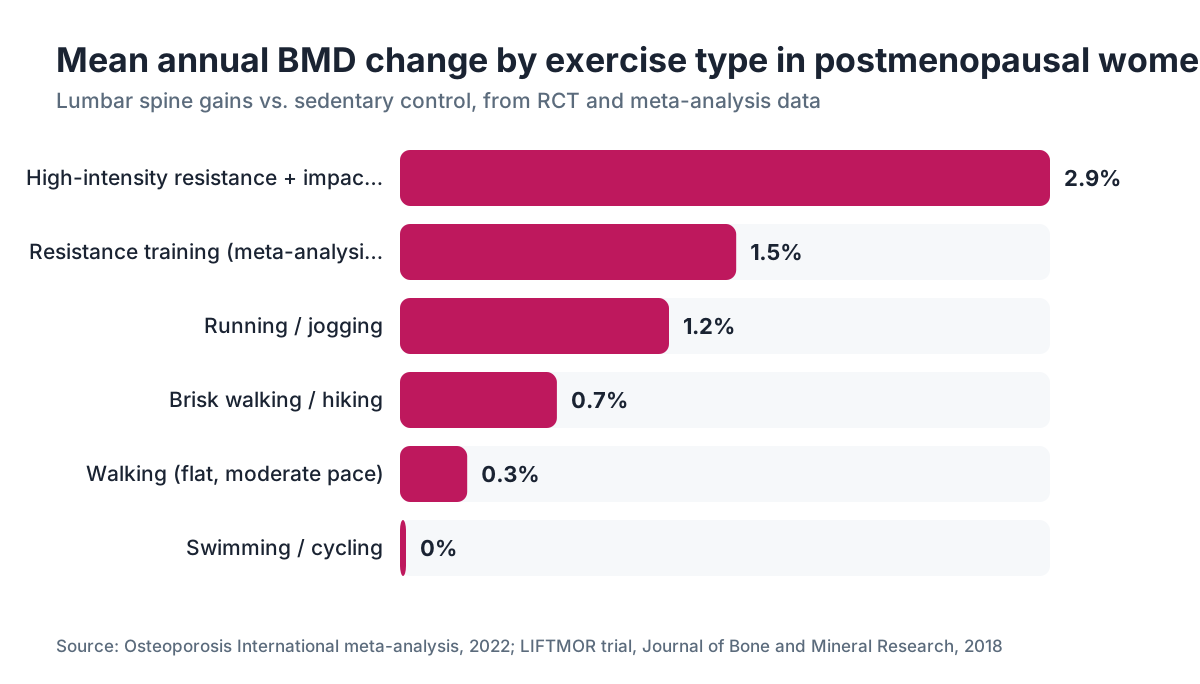
| Exercise type | Typical BMD benefit | Best skeletal sites | Notes | |---|---|---|---| | Walking (flat, moderate pace) | 0 to 0.5% per year | Hip, spine | Better than nothing; not the primary driver | | Brisk walking / hiking | 0.5 to 1% per year | Hip, lumbar spine | Grade and a loaded pack improve the effect | | Running / jogging | 1 to 2% per year | Hip, spine, tibia | Benefit may plateau after years of training | | Jumping / plyometrics | 1 to 3% per year | Hip, spine | Most potent impact stimulus in many RCTs | | Resistance training | 1 to 2% per year | Spine, hip, wrist | Site-specific; load must be progressive | | Swimming / cycling | ~0% | None measurable | Great for other outcomes; not bone-building |
How much bone density can exercise realistically add?
Modest but meaningful. That's the honest answer. A 2022 meta-analysis of 43 randomized controlled trials in postmenopausal women found that resistance training and impact exercise produced mean BMD gains of roughly 1 to 2% at the lumbar spine and 0.5 to 1% at the femoral neck versus controls, over 12 to 24 months [4]. Some jumping-focused trials beat those numbers.
The LIFTMOR trial out of Australia tested high-intensity resistance training and impact loading in postmenopausal women with low to very low bone mass. After eight months, the exercise group gained 2.9% lumbar spine BMD and 0.3% femoral neck BMD compared to a low-intensity control. The program used supervised deadlifts, overhead presses, and drop jumps at 80 to 85% of one-rep max [5].
Context matters here. Losing 10% of BMD roughly doubles fracture risk. Gaining 1 to 3% a year across several years can shift your T-score, the standard metric on a bone density test. A T-score of -1.0 to -2.5 is osteopenia; below -2.5 is osteoporosis by WHO criteria. Every fraction of improvement counts when the alternative is another year of loss.
One caveat worth stating plainly: most trials run 12 to 24 months, and very few follow women for a decade. The mechanism gives us good reason to believe the benefit holds with continued training, but long-term fracture data from exercise alone is thinner than anyone would like. The closest proxy comes from prospective cohorts showing physically active older women have 20 to 40% lower hip fracture risk than sedentary peers [6].
What are the best exercises for bone density in women?
If you have time for one thing, make it progressive resistance training. Two to three sessions a week, loading the spine and hips with squats, deadlifts, hip thrusts, and rows, drives the most reliable BMD gains in the literature. "Progressive" is the word that carries the weight: you have to keep adding load, because bone adapts to the stimulus it gets and stops responding once the challenge stops climbing [3].
Add jumping if your joints allow it. Fifty to a hundred jumps per session, two to three days a week, has improved hip BMD in premenopausal and postmenopausal women across multiple trials. You don't need elite plyometrics. Stepping up and jumping down from a 4 to 6 inch step, or jumping in place with rising intensity, counts. The BEST trial (Bone Estrogen Strength Training) and its follow-ups found that women who paired jumping with resistance training beat those doing resistance training alone [7].
Walking still earns a place, not for dramatic BMD numbers but because it's low-injury, sustainable, and stacks cumulative loading over thousands of steps. Hiking with a light backpack raises the stimulus. Dancing with some impact, like folk or ballroom, shows BMD benefit in observational data.
Yoga and Pilates improve balance, coordination, and back extensor strength, which cut fall risk and the fractures that follow. The direct BMD data is limited and mixed. They're useful additions, not substitutes.
The practical hierarchy:
- Heavy resistance training 2 to 3x/week (non-negotiable for bone)
- Jumping or impact activity 2 to 3x/week
- Walking or hiking on other days
- Balance and flexibility work (fall prevention, not BMD)
Women with existing osteoporosis or a fracture history need medical clearance before adding the jumping component. High-intensity resistance training is usually still indicated, but get supervision at the start.
Does exercise for bone density differ before and after menopause?
Yes, and the difference is big enough to change how you train. Before menopause, estrogen keeps bone responsive to exercise. Premenopausal women who do high-impact sport (gymnastics, running, jumping) build meaningfully higher peak bone mass than sedentary peers. Peak bone mass, reached in the late 20s to early 30s, is your skeletal savings account. Every unit of BMD you bank before 35 buffers the losses that come later.
Perimenopause (typically 45 to 55, though some women start earlier, see our explainer on perimenopause age) is when estrogen begins its erratic drop and bone loss speeds up. Exercise still works, but it's now fighting a stronger hormonal headwind. This is also when hormone replacement therapy becomes most relevant as a complement. The North American Menopause Society states in its 2023 hormone therapy position statement that hormone therapy "prevents bone loss, reduces fracture, and is an appropriate first-line therapy" for women at elevated fracture risk under age 60 or within 10 years of menopause onset [2].
After menopause, the rate of loss slows from that rapid early phase, but it doesn't stop. Exercise keeps producing BMD gains at any age, including in women in their 70s and 80s. LIFTMOR enrolled women with a mean age of 65 and still documented significant gains [5]. Frailty and falls loom larger now, so balance training earns equal footing with resistance and impact work.
If you're wondering exactly when menopause starts, or what the typical menopause age range looks like, read those before you set your bone-health plan.
How does exercise interact with hormone therapy for bone density?
Exercise and estrogen work through separate pathways that add up. Estrogen suppresses osteoclast activity. Exercise stimulates osteoblast activity. Together they build more bone than either does alone.
The BEST trial (Bone Estrogen Strength Training), published in the Journal of Bone and Mineral Research, compared four groups: exercise plus estrogen, exercise alone, estrogen alone, and neither. After one year, the combined group gained the most BMD at the lumbar spine and hip. Exercise alone beat the sedentary control. Estrogen alone beat control too. Neither single approach matched the combination [7].
For women who are good candidates for hormone therapy, adding steady resistance and impact training is the highest-yield double move in bone protection. An estrogen patch or oral estrogen addresses the hormonal driver of accelerated resorption; weight-bearing exercise adds the anabolic loading signal. Progesterone has some evidence for direct osteoblast stimulation too, though it's weaker than the estrogen data.
For women who can't or won't use hormone therapy, exercise matters even more. It won't fully replace estrogen's brake on bone resorption, but it's the best evidence-backed non-drug tool you have. Calcium and vitamin D (1200 mg calcium and 800 to 1000 IU vitamin D daily for postmenopausal women per NIH guidance) are required cofactors, not optional add-ons [8].
At WomenRx, clinicians usually discuss bone health inside hormone prescribing decisions, because for women in menopause the two conversations don't separate cleanly. Exercise is part of the clinical picture, not a side note in the wellness column.
What about GLP-1 medications and bone density?
Rapid weight loss unloads your skeleton, and your skeleton responds by remodeling down. This is real and it gets almost no airtime in weight-loss conversations. GLP-1 receptor agonists like semaglutide and tirzepatide can drive total weight loss of 15 to 22% of body weight in trials [9]. Fast weight loss of any kind, including bariatric surgery, speeds bone loss through reduced mechanical loading, hormonal shifts, and sometimes thin nutritional intake.
The STEP trials of semaglutide did not report fractures as a primary endpoint, but secondary and longer-term observational data are raising caution flags. The SURMOUNT-1 trial of tirzepatide showed lean mass losses alongside fat mass losses, and muscle mass ties directly to how much load your bones can take [10].
What that means in practice: women on GLP-1 medications for weight loss should be deliberate about resistance training. The weight you drop should come mostly from fat, not muscle or bone. Heavy lifting counters the mechanical unloading of weighing less. Adequate protein (at least 1.2 to 1.6 g per kg of body weight daily) protects lean mass during a calorie deficit. And bone density testing every 1 to 2 years is worth raising with your clinician if you're on these drugs long-term.
If you're comparing options, our coverage of semaglutide vs tirzepatide covers the efficacy differences. If you're already using these medications, resistance training isn't a bonus. It's close to mandatory.
How much exercise do you actually need to see results in bone density?
Two hard resistance sessions a week is the floor. Based on current trials, the minimum effective dose for bone from resistance training is two sessions per week at moderate-to-high intensity (roughly 70 to 85% of 1-rep max for the main lifts). Three sessions a week reliably beats two in trials running past 12 months.
For impact, the stimulus has to be novel enough that your skeleton hasn't fully adapted to it. Bone responds to strain rate and strain magnitude, and it habituates fast. Studies point to 50 to 100 jumps per session across at least two days a week for meaningful stimulus. Cramming 500 jumps into one day gives diminishing returns; spreading them across the week beats piling them into one session [3].
How long you keep it up matters too. BMD adaptations are slow. Most studies showing real gains run at least 12 months. Don't expect your next DXA to look different after 8 weeks of lifting. The payoff is real. It just takes the time that biological remodeling needs (each cycle runs 3 to 6 months).
Session length matters less than intensity and consistency. A focused 30-minute session at high effort beats an hour of light machines. Many women get better results training under supervision at first, because load selection ends up more aggressive than what they'd pick on their own. LIFTMOR used supervised sessions for exactly this reason, and its results ran stronger than most unsupervised studies [5].
Rest days count. Bone needs the recovery window between loading sessions to deposit new matrix. Two to three resistance sessions a week with full recovery between them beats daily light work.
Can exercise reverse osteoporosis, or only prevent it?
Exercise is better at slowing loss and adding modest gains than at reversing established osteoporosis, but "reversal" is the wrong frame anyway. A T-score of -2.6 is not a cliff. Every improvement in BMD, even moving from -2.6 to -2.3, lowers fracture risk. And exercise delivers bone benefits that a BMD number doesn't capture: better bone microarchitecture (trabecular connectivity), more muscle strength, sharper balance, faster reaction time, all of which cut the odds of a fall and the damage if one happens.
For women with established osteoporosis, exercise stays indicated and beneficial. The question is which kind. High-impact jumping with real fall risk gets approached cautiously. Loaded spinal flexion (crunches, some yoga poses) is usually avoided because of vertebral fracture risk. But progressive resistance training aimed at the hip and spine, with good form, stays appropriate and evidence-based in this group [6].
For most women with osteoporosis, exercise works alongside drug treatment (bisphosphonates, denosumab, teriparatide, romosozumab), not in place of it. A clinician who knows your BMD scores, fracture history, and fall risk should guide the combination. Exercise isn't the whole answer in severe osteoporosis. It's always part of it.
What are common mistakes women make with exercise for bone density?
The biggest mistake is treating walking as the main bone-building activity and calling it done. Walking is good. On its own it isn't enough for meaningful BMD gains, especially in postmenopausal women already losing bone fast.
The second mistake is lifting too light. Many women pick weights that feel safe and comfortable. For bone stimulus you need loads that push you near maximum effort on the last few reps. LIFTMOR used 80 to 85% of 1-rep max. That's heavy. Most women in an unsupervised gym never get close.
Third: inconsistency. Cardiovascular fitness rebuilds fast after a break. BMD gains from exercise come slowly and hold reasonably well, but months of illness, injury, or disengagement do reverse them. Consistency over years beats intensity over weeks.
Fourth: ignoring nutrition. Bone-building exercise without enough calcium, vitamin D, and protein is like building a wall with no cement. The exercise gives the blueprint; the nutrients supply the materials. NIH recommends 1200 mg of calcium daily for women over 50, food first [8].
Fifth, specific to GLP-1 users: letting weight-loss momentum crowd out the resistance sessions. Calorie restriction plus rapid weight loss plus low activity is genuinely bad for bone. If you're on a GLP-1 for weight loss, your training program isn't a bonus feature.
How do you know if your exercise is actually working for your bones?
The main tool is a DXA scan (dual-energy X-ray absorptiometry), which measures BMD at the lumbar spine, femoral neck, and total hip. Results come as a T-score (versus young-adult peak bone mass) and a Z-score (versus age-matched peers).
For women over 65, the U.S. Preventive Services Task Force recommends routine DXA screening. For women 50 to 64 with risk factors (early menopause, family history of osteoporosis, low body weight, smoking, long-term glucocorticoid use), earlier screening is indicated [11]. If you're actively trying to build bone, a baseline DXA and a repeat at 12 to 24 months gives you the clearest read on whether your program works.
Know that DXA has measurement variability of roughly 1 to 1.5% at the lumbar spine, so a change smaller than that may not mean anything on a single machine. Use the same DXA machine and, ideally, the same technician for repeat scans.
Bone turnover markers (serum CTX for resorption, P1NP for formation) give faster feedback, within weeks instead of years, on whether your skeleton is in net formation mode. These are blood tests, not standard for everyone, but some clinicians use them to track treatment response. P1NP rises with high formation activity, which is what you want to see after months of steady, progressive resistance training.
Our overview of bone density testing walks through what a DXA scan involves, how to read your T-score, and what triggers clinical treatment.
Frequently asked questions
Is walking enough to improve bone density?
Walking alone produces minimal BMD gains, roughly 0 to 0.5% per year, and mostly prevents further loss rather than driving improvement. Brisk walking with hills or a loaded pack beats flat, slow walking, but the evidence consistently shows resistance training and jumping produce far larger gains. Walking is a useful complement, not the primary bone-building tool.
How long does it take for exercise to improve bone density?
Bone remodeling cycles run 3 to 6 months, and most well-designed trials run 12 to 24 months before showing significant BMD change. Expect to train consistently for at least a year before a follow-up DXA shows meaningful improvement. Bone turnover markers in blood can show early signs of increased formation within 8 to 12 weeks, giving faster but indirect feedback that your skeleton is responding.
What exercises should I avoid if I have osteoporosis?
With established osteoporosis, avoid loaded spinal flexion (crunches, toe touches under load, some yoga forward folds) because they raise vertebral fracture risk. High-risk jumping where falls are likely should be cleared with your clinician first. Progressive resistance training aimed at the hip and spine stays appropriate and beneficial for most women. A physical therapist who knows bone health can build a safe program around your T-scores and fracture history.
Does resistance training build bone better than cardio?
Yes, by a meaningful margin. Resistance training consistently produces 1 to 2% annual BMD gains at the lumbar spine and hip in postmenopausal women. Walking and cycling produce little to no measurable BMD change. Running and jumping fall in between. The most effective programs combine progressive resistance training with moderate-to-high impact, giving both compressive force through muscle pull and ground-reaction force through impact.
How many times a week should I do weight-bearing exercise for bone density?
Current evidence supports two to three resistance sessions per week at 70 to 85% of 1-rep max, with at least one rest day between sessions for bone recovery. Impact exercise (jumping) works best at 50 to 100 jumps spread across two to three sessions weekly. Daily low-intensity walking fills the gaps. Consistency over months and years matters more than any single session's intensity or length.
Can yoga improve bone density?
The evidence for yoga's direct BMD effect is limited and mixed. A small 2016 study suggested certain poses could improve spine and hip BMD, but the methodology drew criticism. Yoga does improve balance, core strength, and fall prevention, which cut fracture risk independent of BMD. It's a good addition to a bone-health program, but it shouldn't replace resistance training and impact as the main bone stimulus.
Does jumping help bone density more than lifting weights?
Both work, and combining them beats either alone. Jumping produces high strain rates (how fast force arrives at the bone), a particularly potent signal for osteoblasts. Resistance training produces high peak compressive forces through muscle pull on bone. The BEST and LIFTMOR trials both showed the combination of impact plus resistance training produced the largest spine and hip BMD gains versus single-approach programs.
Does semaglutide or tirzepatide affect bone density?
Rapid weight loss from GLP-1 medications reduces the mechanical load your skeleton carries, which can slow bone formation. Secondary analyses from the STEP and SURMOUNT trials showed lean mass losses alongside fat mass, a concern for bone. Women on these medications should prioritize resistance training and adequate protein (1.2 to 1.6 g/kg/day) to offset the unloading. Baseline DXA and periodic monitoring are reasonable for long-term users.
How much calcium and vitamin D do I need alongside exercise for bone health?
NIH recommends 1200 mg of calcium daily for women over 50 (food first, supplemented if needed) and 800 to 1000 IU of vitamin D. Vitamin D deficiency blunts the bone response to exercise. Without enough calcium, the body resorbs bone to keep serum levels steady regardless of your training. Nutrition and exercise are both required; neither works well alone for building bone.
At what age should women start weight-bearing exercise for bone health?
Now. Premenopausal women who build higher peak bone mass (maxed by the late 20s) carry a larger buffer against later loss. Women in perimenopause and postmenopause benefit at every age. Published trials show significant BMD gains from resistance and impact training in women in their 60s, 70s, and 80s. There is no age at which the skeleton stops responding to mechanical loading.
Does hormone therapy replace the need for weight-bearing exercise?
No. Hormone therapy and exercise work through different pathways and add up. The BEST trial showed estrogen plus resistance training produced greater BMD gains than either alone. Hormone therapy suppresses osteoclast activity; exercise stimulates osteoblast formation. Women on hormone therapy still need consistent resistance and impact training. Women who can't use hormone therapy need exercise even more, as their primary bone-protective step.
Can you rebuild bone density after menopause?
You can improve BMD after menopause, though 'rebuild' overstates what exercise alone does. The LIFTMOR trial documented 2.9% lumbar spine BMD gains in postmenopausal women with low bone mass after eight months of supervised heavy resistance training. Those are real improvements, though rarely enough to move from osteoporosis back to normal without drug support. Consistent training stops net loss and adds modest gains; medication is often needed in more severe cases.
What is the best exercise for hip bone density specifically?
Exercises that load the femoral neck and greater trochanter directly give the best hip results. These include jumping with hip loading, weighted squats, deadlifts, hip thrusts, and lateral step exercises. Side-to-side impact (lateral jumps, side steps with resistance) targets the greater trochanter specifically. The femoral neck, the most common hip fracture site, responds best to compressive loading along the femoral neck axis, which squats and deadlifts provide.
Sources
- NIH National Institute of Arthritis and Musculoskeletal and Skin Diseases: Bone Health
- North American Menopause Society (NAMS): 2023 Menopause Hormone Therapy Position Statement
- Frontiers in Endocrinology (journal, Bone Research section)
- Osteoporosis International: meta-analysis of resistance training and BMD in postmenopausal women (2022)
- Journal of Bone and Mineral Research: LIFTMOR trial (Watson et al., 2018)
- NIH National Institute on Aging: Osteoporosis and Bone Health
- Journal of Bone and Mineral Research: BEST Trial (Bone Estrogen Strength Training)
- NIH Office of Dietary Supplements: Calcium Fact Sheet for Health Professionals
- New England Journal of Medicine: STEP 1 trial (Wilding et al., 2021)
- New England Journal of Medicine: SURMOUNT-1 trial (Jastreboff et al., 2022)
- U.S. Preventive Services Task Force: Osteoporosis Screening Recommendation (2018)
- CDC: Physical Activity