Testosterone for women and weight loss: what the evidence actually shows
TL;DR: Low testosterone in women is linked to less muscle, more fat, and a slower metabolism, but testosterone is not a proven stand-alone weight loss drug. It works best inside a fuller hormonal picture. Women with confirmed low levels, especially in perimenopause or menopause, may see real body composition changes. Fat loss is modest. The evidence is stronger for building lean mass than for pounds on the scale.
What does testosterone actually do in a woman's body?
Testosterone is not a male hormone that women happen to carry a little of. Women make it in the ovaries and adrenal glands across their whole reproductive life, and it does real work: holding onto muscle, shaping where fat lands, driving libido and mood, and slowing the loss of bone. [1]
Normal testosterone in women runs roughly 15 to 70 ng/dL, against 300 to 1,000 ng/dL in men. [11] Tiny numbers. The tissues are sensitive anyway. Even a 30 percent drop can show up as fatigue, brain fog, weaker lifts, and a slow drift toward more fat and less muscle. [2]
Testosterone also touches insulin sensitivity. In lean women, higher androgen levels usually track with better glucose handling, which is part of why researchers started asking whether restoring low levels could move body composition. The relationship bends, though. In women with polycystic ovary syndrome, high testosterone runs the other way and goes with insulin resistance. The number alone tells you less than the context around it. [3]
Does low testosterone cause weight gain in women?
Low testosterone does not add weight in the plain calorie sense. It shifts your body composition in ways that make weight harder to manage as the years pass.
Muscle is expensive tissue to run. A pound of muscle burns roughly 6 calories a day at rest, against about 2 calories for a pound of fat. [4] As testosterone falls, women lose muscle faster and gain fat in its place, especially the visceral fat that packs around the abdomen. The scale may barely move at first. The metabolic rate drops quietly underneath it.
A 2019 study in the Journal of Clinical Endocrinology and Metabolism followed women through the early menopause transition and found that falling androgens were independently tied to more fat mass, even after accounting for estrogen changes. [3] That matters because menopause research points almost everything at estrogen, and testosterone's part gets skipped.
Women who have both ovaries removed (bilateral oophorectomy) drop testosterone abruptly and often report faster body composition changes than women who reach menopause naturally. Their experience is one of the cleaner natural experiments we have for what losing testosterone does. [1]
What does the clinical evidence say about testosterone and body composition?
The honest answer: the evidence is promising and imperfect, and most trials were never built to study weight loss.
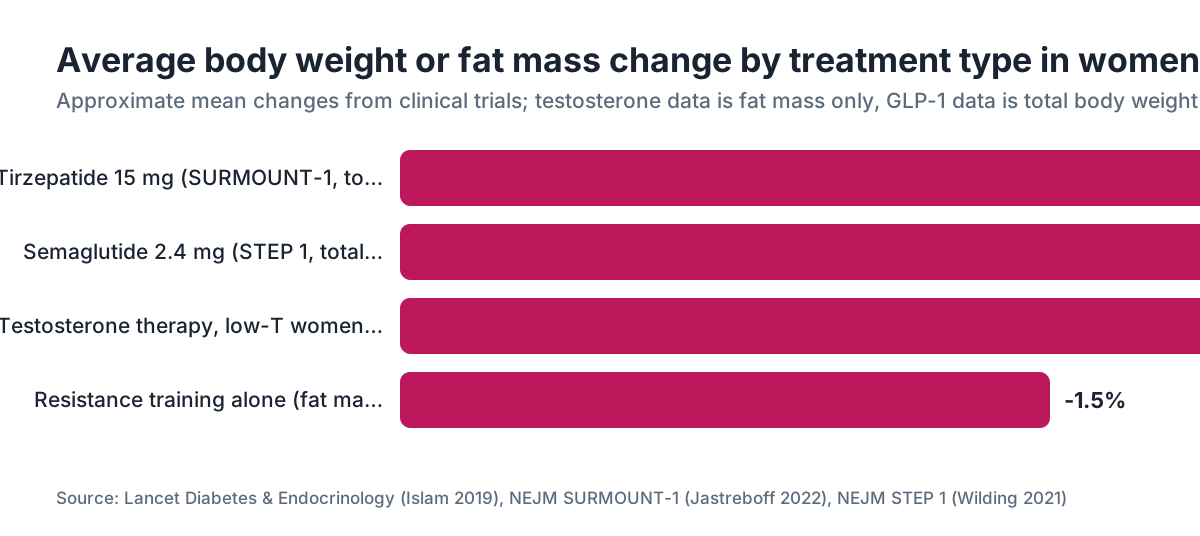
A 2019 systematic review and meta-analysis in the Lancet Diabetes and Endocrinology pooled 46 randomized controlled trials of testosterone therapy in women. Testosterone improved sexual function across the board. Lean body mass went up, fat mass went down, but the fat loss was small. The average drop in fat mass landed around 1 to 2 kg, nowhere near the numbers that get thrown around online. [5]
The Endocrine Society's 2023 clinical practice guideline concluded that current evidence supports testosterone in women mainly for hypoactive sexual desire disorder, and that off-label use for body composition or mood stays investigational. [2] That is not the same as saying it fails for those uses. It means nobody has run large randomized trials designed to measure those outcomes over enough time.
Here is what the data does say cleanly: women who pair testosterone restoration with resistance training get better lean mass results than women who do one or the other. Testosterone without lifting is a weak tool. Lifting without adequate testosterone in a deficient woman leaves gains on the table. [4]
Most of the body composition data comes from women already on hormone replacement therapy for menopause symptoms, with testosterone added on top. Testosterone alone, without estrogen, has been studied far less.
How does testosterone compare to other weight loss approaches for women?
This is where you set your expectations honestly.
GLP-1 receptor agonists like semaglutide and tirzepatide produce far larger fat loss than testosterone ever will. In the SURMOUNT-1 trial, tirzepatide cut mean body weight by 15 to 21 percent over 72 weeks in adults with obesity. [6] No testosterone trial gets within shouting distance. If plain fat reduction is your goal, read up on semaglutide for weight loss or the semaglutide vs tirzepatide comparison as their own topic.
Testosterone does one thing GLP-1s do poorly on their own: it protects and builds lean muscle while you lose weight. That matters a lot for women past 40. Fast weight loss without enough muscle drops your resting metabolic rate, so your body burns fewer calories at the new lower weight and regains more easily. A woman on a GLP-1 who also has low testosterone may do better treating both than picking one. [4]
The table shows what each approach is best documented to do for women's body composition.
| Approach | Primary effect | Average fat loss | Muscle preservation | Evidence quality | |---|---|---|---|---| | Testosterone therapy (low T women) | Body composition shift | 1-2 kg fat mass | Yes, increases lean mass | Moderate (mostly <12-month trials) | | Semaglutide (2.4 mg/week) | Caloric intake reduction | ~15% body weight | Partial loss without resistance training | High (STEP trials, n>4,000) | | Tirzepatide (15 mg/week) | Dual GIP/GLP-1 agonism | ~21% body weight | Partial loss without resistance training | High (SURMOUNT trials) | | Resistance training alone | Muscle gain | Modest | Yes | High | | Testosterone + resistance training | Muscle and composition | 1-3 kg fat mass | Strongest effect | Moderate |
Who is most likely to benefit from testosterone for weight management?
Testosterone for body composition is not the right tool for every woman. The ones who see real benefit fit a specific profile.
Start with confirmed low testosterone. That means a morning serum total testosterone below roughly 15 to 20 ng/dL, ideally measured twice because levels swing. Prescribing testosterone to a woman with normal levels has no good evidence behind it for extra fat loss, and it adds risk for nothing. [2]
Next, women in perimenopause or post-menopause who are already living the muscle-for-fat trade that hormonal change brings. This is where the gap between what the ovaries make and what the tissues need is widest, and where restoration makes the most sense.
Then, women with surgical menopause or premature ovarian insufficiency, who lose androgens faster and more completely than women who reach menopause naturally.
And women already committed to resistance training. Almost all the evidence for testosterone-driven lean mass sits inside some physical activity. Without it, the signal fades.
Women with active or past hormone-sensitive cancers, uncontrolled polycythemia, or untreated sleep apnea are generally not candidates. [2] A real workup, with labs and history, is not optional.
What forms of testosterone are available for women and what do they cost?
No FDA-approved testosterone product exists specifically for women in the United States. That is a genuine gap. Every approved testosterone product is dosed for men, so women end up using off-label, compounded, or low-dose versions of male products. [7]
The options that show up most in clinical practice:
Transdermal creams or gels, usually 0.5 to 2 mg a day rubbed into the inner arm or thigh. These are typically compounded at a pharmacy. Monthly cost runs about $30 to $100 depending on pharmacy and concentration.
Testosterone pellets, implanted under the skin every 3 to 6 months. Dosing varies widely, which is a real problem. Cost runs $300 to $600 per insertion, and once it is placed it cannot be removed or dialed back, so any side effect has to be waited out. This is not the form I would start with.
Low-dose patches, which are not sold in the US but exist elsewhere (Intrinsa was approved in Europe, never here).
Injections rarely fit women, because getting a stable low dose out of the available concentrations is hard.
For women working with a telehealth provider like WomenRx, compounded transdermal testosterone is the usual choice because it lets you titrate precisely at doses that suit female physiology.
Insurance coverage is spotty because the use is off-label. Most women pay out of pocket. [7]
What are the real risks and side effects of testosterone for women?
Dosed for women, meaning kept inside the normal female range instead of pushed toward male levels, testosterone is generally well tolerated. The scary side effects come from overdosing. [2]
At normal female doses, the common complaints are acne and more facial or body hair. Both track with dose and usually reverse when you lower it. Clitoral enlargement and voice deepening are rare at therapeutic doses, but they can be permanent if they happen, which is exactly why you start low and monitor. [2]
The Endocrine Society's 2023 guideline puts the boundary plainly: "We recommend against pharmacological doses of testosterone for women and suggest that if testosterone is used, it should maintain serum testosterone concentrations in the normal female range." [2] That sentence is the whole safety rule.
Cardiovascular effects are murkier. High-dose testosterone in men raises hematocrit and can worsen lipids, but data in women at physiologic doses do not show the same signal. [5] Women with existing heart disease should still talk this through carefully with their physician.
For women with a history of hormone-sensitive breast cancer, the safety data is genuinely unsettled. Some researchers think androgens may protect; others say we lack the long-term numbers to know. The Endocrine Society recommends against use in this group until better evidence lands. [2]
Regular monitoring (testosterone, hematocrit, lipids) every 6 months in the first year is standard. [1]
How is testosterone tested and what levels matter for women?
Testing testosterone in women is messier than most clinicians admit. The standard immunoassays that most commercial labs run are calibrated for male ranges and lose accuracy at the low concentrations women actually have. Mass spectrometry is more accurate and less widely available. [8]
A morning total testosterone is the starting point. Free testosterone, the biologically active fraction, adds real information, especially in women with high sex hormone-binding globulin (SHBG), which soaks up testosterone and leaves less available than the total suggests. Some women with a normal-looking total actually have low free testosterone because SHBG is elevated, which is common on oral estrogen. [1]
Reference ranges vary by lab, but a total testosterone below about 15 ng/dL in a symptomatic woman is generally read as low. Treatment usually caps out at 70 ng/dL to stay inside normal female physiology. Push past that and the virilization risks show up. [2]
DHEA-S is another androgen worth checking. The adrenals make it, and it converts to testosterone in the tissues. Low DHEA-S can drag down the whole androgen picture and is sometimes treated alongside testosterone. [1]
If you are working with any hormone replacement therapy provider, ask for a mass spec test when an immunoassay result does not match how you feel.
Does testosterone affect menopause belly fat specifically?
The "menopause belly" question is one of the most searched by women over 45, so here is the direct answer.
Visceral fat piling up around the abdomen after menopause is driven mainly by estrogen decline, not testosterone decline. Estrogen sets where fat gets stored, and when it drops, subcutaneous fat from the hips and thighs shifts into the visceral compartment. [10] Testosterone loss piles on by shrinking the muscle that would otherwise pull in glucose and cap fat storage. [4]
So testosterone alone, without estrogen, does not fully fix menopause-related abdominal fat. It can nudge the muscle-to-fat ratio and trim total fat a little, but it is not hitting the main mechanism. Women who address both estrogen and testosterone as part of a menopause plan see better body composition than women who chase either one alone. [10]
An estrogen patch or another estrogen route, paired with progesterone for women with a uterus, plus testosterone, is the full hormonal picture for post-menopausal women. Knowing when menopause starts matters here, because the earlier you address the shift, the less visceral fat has already settled in.
The practical read: testosterone helps body composition, but if visceral belly fat is your main concern, estrogen management is the more direct lever.
How long does testosterone therapy take to change body composition?
This takes patience. Body composition effects in women are slow.
Most trials that tracked lean and fat mass ran 6 to 24 months. The earliest lean mass changes tend to appear around 3 to 6 months. Fat mass lags further behind. [5] A woman expecting to feel remade in 4 to 6 weeks will be disappointed, and that gap between hope and reality is where a lot of pointless dose escalation happens.
What arrives sooner, within weeks to a couple of months, is the symptom relief: steadier energy, stronger libido, easier recovery between workouts. Those are real quality-of-life wins, and they also prop up the habits (more training, better sleep) that drive the slower body composition changes.
Track with a DEXA scan, not the bathroom scale. A woman can add 2 pounds of muscle, drop 2 pounds of fat, see zero movement on the scale, and be meaningfully leaner. The scale never catches that. If bone health is also on your mind, a baseline bone density test is worth doing, since low testosterone and low estrogen both eat away at bone in perimenopausal and menopausal women.
Can testosterone and GLP-1 medications be combined for women?
This pairing shows up more and more in practice, even though head-to-head trial data on the combination specifically in women does not yet exist at scale.
The theory is clean. GLP-1 agonists like semaglutide cut caloric intake and produce large fat loss, but they also strip some lean muscle. Roughly 25 to 39 percent of total weight lost in the STEP trials came from lean mass rather than fat. [9] In women past 45 who already carry reduced testosterone and weaker muscle maintenance, that lean loss is a real concern.
Testosterone plus resistance training could, in theory, offset some of that lean loss during GLP-1-driven weight reduction. Whether it does so in practice, at a size that matters, has not been answered with long-term randomized data. The mechanism is sound, and several academic centers are studying it now.
In plain terms: women on GLP-1s who also have symptomatic low testosterone should not assume the GLP-1 covers everything. Getting labs run and treating the hormonal deficiency alongside the GLP-1 is reasonable when the clinical picture supports it. semaglutide and testosterone are not contraindicated together. [6]
WomenRx providers look at the full hormonal picture, testosterone included, alongside GLP-1 eligibility, because treating them as separate silos misses how they interact.
What should women ask their doctor before starting testosterone?
A few pointed questions will tell you fast whether a provider is actually thinking this through.
Ask for free testosterone measured by mass spectrometry, more than total testosterone by immunoassay. If they look puzzled, that is a signal. Ask what SHBG level they expect alongside your result. Ask what serum level they are aiming for and what their stopping point is if you climb above the normal female range.
Ask about the form they plan to prescribe and why. If they lead with pellets, ask why not start with a titratable transdermal instead. Pellets are not inherently wrong, but starting a first-time user on a depot you cannot remove is less cautious than it should be.
Ask how often you will be retested and how they monitor hematocrit and lipids. Ask about their experience treating women specifically, not men.
If the provider cannot answer these concretely, keep looking. The off-label reality of testosterone for women means the quality of care swings wildly between practitioners. A provider inside a telehealth hormone platform has often seen a wider range of hormone cases than a generalist OB-GYN who prescribes testosterone once in a while.
Frequently asked questions
Can testosterone help a woman lose belly fat?
Testosterone can modestly reduce total fat mass and improve the muscle-to-fat ratio in women with confirmed low levels, but it does not specifically target belly fat. Visceral abdominal fat after menopause is driven primarily by estrogen decline. Addressing both estrogen and testosterone together, alongside resistance training, gives better abdominal results than testosterone alone.
What is the best form of testosterone for women trying to lose weight?
Compounded transdermal testosterone cream or gel, applied daily at 0.5 to 2 mg, is the most used and most titratable option. It keeps levels stable, allows dose adjustments, and can be stopped if problems arise. Pellets offer convenience but cannot be removed or adjusted. No FDA-approved female-specific testosterone product exists in the US, so all forms are off-label.
How do I know if my testosterone is low enough to be causing weight gain?
A morning serum total testosterone below roughly 15 ng/dL, paired with symptoms like fatigue, muscle loss, more abdominal fat, and low libido, points to clinical deficiency. Free testosterone and SHBG add context. Mass spectrometry is more accurate than standard immunoassay at female concentration ranges. Confirm one low result with a repeat test before treating.
Is testosterone FDA-approved for weight loss in women?
No. The FDA has not approved any testosterone product for weight loss in women, or for women at all in the United States. Use is off-label, usually with compounded formulations. The Endocrine Society's 2023 guideline supports testosterone for hypoactive sexual desire disorder but classifies body composition as investigational pending more long-term trial data.
What testosterone level should women aim for when treating deficiency?
Most guidelines target the normal female range, roughly 15 to 70 ng/dL total testosterone. The Endocrine Society recommends against dosing that pushes levels above that range. Free testosterone should also stay within normal female parameters. Check levels 3 to 6 months after starting therapy and every 6 to 12 months after that.
Will testosterone make women look more masculine?
At doses that keep levels in the normal female range, virilization (voice deepening, clitoral enlargement, big body hair changes) is uncommon. Mild acne and some increased body hair can happen and track with dose. They usually resolve when the dose drops. Virilization risk climbs sharply with overdosing, which is why clinical guidelines warn specifically against supraphysiologic dosing.
Does testosterone replacement help with menopause weight gain?
It can improve body composition modestly, mainly lean muscle, which helps hold up metabolic rate. But menopause weight gain involves several hormonal changes, primarily estrogen loss, and testosterone alone does not cover the full picture. Women who combine estrogen, testosterone (if deficient), resistance training, and enough protein see the best body composition outcomes in menopause.
Can I take testosterone and a GLP-1 medication at the same time?
There is no known contraindication to combining testosterone with GLP-1 medications like semaglutide or tirzepatide. The combination may help in theory: GLP-1s produce large fat loss but also some lean loss, while testosterone supports muscle maintenance. Clinical trial data on the specific combination in women is limited, but the biological rationale is sound.
How long before testosterone affects body composition in women?
Lean mass changes usually become measurable after 3 to 6 months. Fat mass reductions lag further behind, with most trials measuring at 6 to 24 months. Improvements in energy and exercise tolerance may come sooner, within weeks to 2 months, and those changes support the habits that drive longer-term body composition shifts.
Does testosterone therapy affect bone density in women?
Yes, positively. Testosterone supports bone mineral density directly and through conversion to estrogen in bone tissue. Women with low testosterone and low estrogen, common after surgical menopause or premature ovarian insufficiency, face higher osteoporosis risk. Restoring testosterone alongside estrogen can help preserve bone, and a baseline bone density test is reasonable before starting.
What labs should be checked before starting testosterone for women?
At minimum: morning serum total testosterone (mass spectrometry preferred), free testosterone, SHBG, DHEA-S, estradiol, a complete blood count with hematocrit, and a lipid panel. In women over 40, a thyroid panel and fasting glucose help too, since hypothyroidism and insulin resistance produce overlapping symptoms and change how well testosterone therapy works.
Is testosterone safe for women with a history of breast cancer?
The evidence is genuinely uncertain. Some researchers argue androgens may protect against estrogen-sensitive breast cancer; others cite thin long-term safety data. The Endocrine Society's 2023 guideline recommends against testosterone in women with active or past hormone-sensitive breast cancer until better evidence exists. Women in this group should have the specific conversation with their oncologist before any hormonal therapy.
Can young women with low testosterone benefit from therapy for weight management?
Women under 40 with confirmed low testosterone, from causes like premature ovarian insufficiency, hypothalamic amenorrhea, or adrenal insufficiency, can benefit from restoration for overall health including body composition. The evidence base is thinner here than in menopausal women, but the physiologic rationale holds. Identifying the cause of low testosterone in a young woman comes before starting therapy.
Sources
- Endocrine Society, "Androgen Therapy in Women" overview
- Endocrine Society Clinical Practice Guideline: Testosterone Therapy in Women, 2023
- Journal of Clinical Endocrinology and Metabolism, Davis et al. 2019, androgens and fat mass in menopause transition
- American College of Sports Medicine, position stand on resistance training and muscle metabolism
- Islam RM et al., Lancet Diabetes and Endocrinology, 2019, systematic review and meta-analysis of testosterone therapy in women (46 RCTs)
- Jastreboff AM et al., NEJM, SURMOUNT-1 trial, tirzepatide for obesity, 2022
- FDA, Drugs@FDA approved products database
- CDC/National Center for Health Statistics, laboratory reference ranges and assay accuracy note
- Wilding JPH et al., NEJM, STEP 1 trial, semaglutide 2.4 mg for weight management, 2021
- North American Menopause Society (NAMS), position statement on hormone therapy and menopause, 2022
- NIH Office on Women's Health, menopause and testosterone overview